WF Q56 .V45 1927
The Veiled Prophetess
First published in Weird Tales, May 1927 (vol. 9, no. 5). Novelette. Jules de Grandin. Text from the May 1927 Weird Tales appearance.
United States public domain. Held in the Reading Room of The Weird Library. Published by Weird Tales.
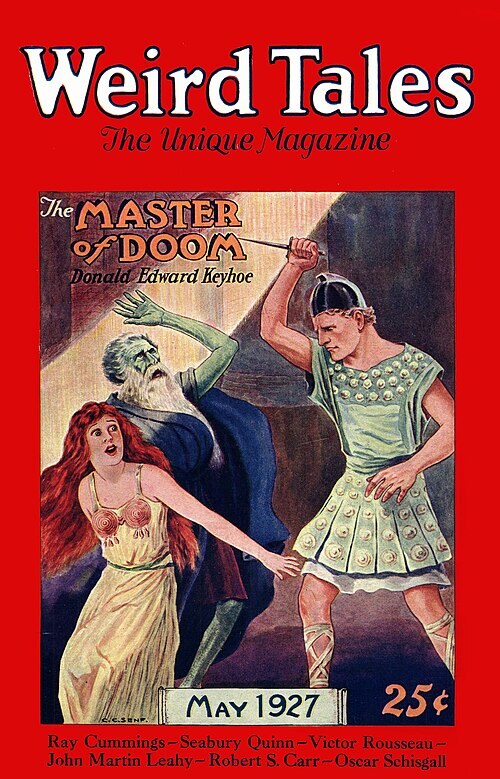
Issue cover by C. C. Senf.
"BUT, Madame, what you say is incredible," Jules de Grandin was saying to a fashionably dressed young woman as I returned to the consulting room from my morning round of calls.
"It may be incredible," the visitor admitted, "but it's so, just the same. I tell you she was there."
“Ah, Trowbridge, mon cher,” de Grandin leaped up as he beheld me in the doorway, “this is Madame Penneman. She has a remarkable story to tell."
“Madame,” he bowed ceremoniously to our caller, “will you have the goodness to relate your case to Dr. Trowbridge? He will be interested.” The young lady crossed her slender, gray-silk-clad legs, adjusted her abbreviated black-satin dress in a manner to cover at least a portion of her patellae, and regarded me with
the fixed, dreamy stare of a pupil reciting a lesson learned by rote.
“My name is Naomi Penneman,” she began; “my husband is Benjamin Penneman, of the chocolate importing firm of Penneman & Brixton. We have been married six months, and came to live in Harrisonville when we returned from our honeymoon trip, three months ago. We have the Barton place in Tunlaw Street.”
“Yes?” I murmured. ‘ ‘ I heard of Dr. de Grandin through Mrs. Norman—she said he did a wonderful piece of work in res cuing her daughter Esther from some horrible old man—so I brought my case to you. I wouldn’t dare go to the police with it.”
“U’m?” I murmured. “Just what-”
“It’s about my husband,” she
went on, without giving me time to form my query. “There’s a woman —or something—trying to take him away from me!”
“Well—er—my dear young lady, don’t you think you would better have consulted a lawyer?” I objected. “Physicians sometimes under take to patch up leaky hearts, but they are scarcely in the business of repairing outraged affections, you know. ’ ’ “Mais non, Friend Trowbridge," de Grandin denied with a delighted chuckle, “you do misapprehend Madame’s statement. Me, I think per haps she speaks advisedly when she does say ‘a woman or something’ de signs to alienate her husband.
“Proceed, Madame, if you please.”
“I graduated from Barnard in ’24,” Mrs. Penneman took up her statement, “and married Ben last year. We went on a ninety-day cruise for our wedding tour, and moved here as soon as we came back.
“Our class had a reunion at the Allenton Thursday of Christmas week, and some of the girls were crazy about Madame Naira, the Veiled Prophetess, a fortune-teller up in East Eighty-second Street. They talked about her so much the rest of us decided to pay her a call.
“I was afraid to go by myself, so I teased Ben, my husband, into going with me, and—and he’s been acting queer ever since.”
“Queer?” I echoed. “How?”
“Well”—she made a vague sort of gesture with one of her small, wellmanicured hands and flushed slightly—“you know, Doctor, when two people have been married only six months the star-dust oughtn’t to be rubbed off the wings of romance, ought it? Yet Ben’s been cooler and cooler to me, commencing almost im mediately after we went to see that horrid woman.”
“You mean-”
“Oh, it’s hard to put into words.
Just little things, you know; none of them important in themselves, but pretty big in the aggregate. He for gets to kiss me good-bye in the morning, stays over in New York late at night—sometimes without calling me up to let me know he won’t be home —and breaks engagements to take me places without warning. Then, when I expostulate, he pleads business.”
“But my dear madame,” I pro tested, “this is certainly no case for us.' Not every man has the capacity for retaining romance after marriage. Mighty few of them have, I imagine. And it may easily be exactly as your husband says: his business may require his presence in New York at nights. Be reasonable, my dear; when you were first married, he might have strained a point to be home while dinner was still hot, and let his partners handle matters, but you’re really old married folks now, you know, and he has to make a living for you both. You’d best let me give you a bromide—this thing may have gotten on your nerves—and go home and forget your silly sus picions.”
“And will the bromide keep her— or it—out of my house—out of my bedroom—at night?” Mrs. Penneman asked.
“Eh, what’s that?” I demanded.
“That’s what made me call on Dr. de Grandin,” she replied. “It was bad enough when Ben took to neglecting me, but on the second of last month, while we were in bed, I saw a woman in our room.”
“A woman—in your bedroom?” I asked. The story seemed more sordid than I had at first supposed.
“Well, if it wasn’t a woman it was something in the shape of one,” she replied. “I’d been pretty much upset by Ben’s actions, and had reproached him pretty severely the Sunday before when he didn’t show up to take me from the Ambersons’
reception, and he’d promised to reform.
“He did, too. For four nights, from Monday to Thursday, he’d been home to dinner on time, and Thurs day night—the second—we’d been to the theater over in New York. We went to a night club after the play and came back on the owl train. It must have been 1 o’clock before we got home. I was awfully tired and went to bed just as soon as I could get my clothes off; but Ben was in bed first, and was sound asleep when I got into mine.
“I was just dropping off when I happened to remember he hadn’t kissed me good night—we’d rather gotten out of the habit during the last few weeks.
“I turned my covers back and was in the act of getting out of bed to lean over Ben and kiss him, when I noticed he was moaning, or talking in his sleep. Just as I put my feet to the floor, I heard him say, ‘ Second, Second!’ twice, just like that, and put his hands out, as if he were pushing something away from him.
“Then I saw her. All at once she was standing by the door of our room, smiling at him like—like a cat smiling at a bird, if you can imagine such a thing—and walking toward him with her arms outstretched.
“I thought I was dreaming, but I wasn’t. I tell you, I saw her. She walked across the rug and stood be side him, looking down with that queer, catty smile of hers, and took both his hands in hers. He sat up in bed, and looked at her like—as he used to look at me when were were first married!
“I was spellbound for a moment, then I said, ‘ Dream or no dream, she shan’t have him!’ and leaped to my feet. The woman loosed one of her hands from Ben’s and pointed her finger at me, smiling that same awful, calm smile all the time.
“ How do you mean, * went away I asked. “Did she vanish?”
“I don’t know,” Mrs. Penneman answered. “I couldn’t say whether she actually vanished or faded out like a motion picture or went through the door. She just wasn’t there when I looked again.”
“And your husband?”
“He fell right back on the pillows and went to sleep. I had to shake him in order to wake him up.”
“Shamming?”
“No-o, I don’t think so. He really seemed asleep, and he didn’t seem to know anything about the woman when I asked him.”
“U’m?” I gave de Grandin a quick look, but there was no gleam of agreement in his round blue eyes as they encountered mine.
“Proceed, Madame, if you please,” he urged with a nod at our caller.
“She’s been back three times since then,” Mrs. Penneman said, “and each time she has warned me to leave. The last time—night before last— she threatened me. Said she would wither me if I did not go. ’ ’ “Tell me, Madame de Grandin broke in, “is there any condition precedent to this strange visitant’s appearance?”
“I—I don’t believe I understand,” the girl replied.
“Any particular conduct on your husband’s part which would seem to herald her approach? Does he show any signs? Or, perhaps, do you have any feelings of apprehension or pre sentiment before she comes?”
“No-o,” Mrs. Penneman answered thoughtfully, “no, I can’t say that— wait a moment!—yes! Every time she’s come it’s been after a period of
reformation on Ben’s part, after he’s been attentive to me for several days. As long as he’s indifferent to me she stays away, but each time he begins to be his old, dear self, she makes hexappearance, always very late at night or early in the morning, and always with the same command for me to leave.
“One thing more, Doctor. The last time she told me to 'go—the time she threatened me—I noticed Ben’s seal ring on her finger.”
“Eh, what is that?” de Grandin snapped. “His ring? How?” ‘ ‘ He lost his ring when we went to visit Madame Naira. I’m sure he did, though he declares he didn’t. It was a class ring with the seal of the uni versity on it and his class numei'als imposed on the seal.”
“And how came he to lose it, if you please?”
“He was clowning,” the girl answered. “Ben was always acting like a comedian in the old days, and he was showing off when we went to the Veiled Prophetess’ that day. Really, I think the place rather impressed him and he was like a little boy whistling his way past the graveyard when he acted like a buffoon. The place was awfully weird, with a lot of Eastern bric-a-brac in the reception room where we waited for the Prophetess to see us. Ben went all around, examining everything, and seemed especially taken with the statue of a woman with a cat’s head. The thing was almost life-size, and shaped something like a mummy—it gave me the creeps, really. Ben put his hat—he was wearing a derby that day—on its head, and then slipped his seal ring on its finger. Just then the door to the Prophetess’ consulting room opened, and Ben snatched his hat off the thing’s head in a hurry, but I’m sure he didn’t get his ring back. We were ushered into the fortune-teller’s place immediately, and went out by another door, and
we were so full of the stuff she’d told us that neither of us missed the ring till we were on the train coming home.
“Ben ’phoned her place next day, but they said no such ring had been found. He didn’t like to confess he’d put it on the statue’s finger, so he told them he must have dropped it on the floor.”
“Ah?” de Grandin drew a pad of paper and a pencil toward him and scribbled a note. “And what did she tell you, this Madame Veiled Prophetess Naira, if you please, Madame?”
“Oh”—the girl spread her hands —“the usual patter the fortune-tell ers have. Recited my history fairly accurately, told me I’d been to Egypt —nothing wonderful in that; I was wearing a scarab Ben bought me in Cairo—and ended up with some non sense about my having to make a big sacrifice in the near future that others might have happiness and destiny be fulfilled.” She paused, a rosy flush suffusing her face. “That frightened us a lit tle,” she confessed, “because, when she said that, we both thought maybe she meant I was going to die when— well, you see-”
“Perfectly, Madame,” de Grandin nodded with quick understanding.
“Mankind is perpetuated by wom an’s going into the Valley of the Shadow of Death to fetch up new lives. Fear not, dear lady, I do as sure you the Prophetess meant something quite otherwise.”
“And you will help me?” she begged. “Dr. de Grandin, I—I am going to do what you said about the Valley of the Shadow this spring, and I want my husband. He is my man, my mate, and no one —no thing —shall take him from me. Can you make her go away? Please?”
“I shall try, Madame,” the little Frenchman answered gently. ‘ ‘ I cannot say I quite understand everything—yet—but I shall make your ease my study. Parbleu, but I shall sleep not until I have reached a working hypothesis!”
“Oh, thank you; thank you!” the young matron exclaimed. “I feel ever so much easier already.”
“But of course,” de Grandin ac quiesced, bending a smile of singular sweetness on her, “that is as it should be, ma chere.” He raised her fingers to his lips before escorting her from the room.
“And now, Friend Trowbridge, what do you think of our case?” he demanded when the front door had closed behind our caller.
“Since you ask me,” I answered with brutal frankness, “I don’t know who’s the crazier, Mrs. Penneman or you; but I think you are, for you should know better. You know as well as I that illusions and hallu cinations are apt to occur at any time during the puerperal period. This is a clear case of mild manic-de pressive insanity. Because of her condition this poor child has con strued her husband’s absorption in his business as neglect. She’s a psychic type, reacting readily to ex ternal stimuli, and in her state of de pression she thinks his love has failed. That’s preyed on her mind till she’s on the borderline of insan ity, and you were very unkind to humor her in her delusions.” He rested his elbows on the desk, cupping his little pointed chin in his hands, aiid puffed furiously on his cigarette till its acrid, unpleasant smoke surrounded his sleek blond head in a gray nimbus. “O, la, la, hear him!” he chuckled. “Suppose, Trowbridge, mon vieux, I were to say I do not consider la belle Penneman mad at all. Not even one little bit. What then?”
“Humph!” I returned. “I dare say you’d have agreed with her if she’d said that statue her husband put his ring on had come to life?”
“Perhaps,” he returned with an irritating grin. “Before we are through with this case, my friend, we may see stranger things than that.”
T wo days later he announced matter-of-factly, “Today, Friend Trowbridge, we go to interview this Madame Naira, the Prophetess of the Veil.”
“We?” I responded. “Perhaps you do, but I’ll have nothing to do with the matter.”
“Parddeu, but you will!” he re plied with a laugh. “This case, my friend, promises as much adventure as any you and I have had together. Come, a spice of the unusual will be a tonic for you after an uneventful season of house-to-house calls.”
“Oh, all right,” I agreed grudg ingly. “I’ll go along, but I want you to know I don’t countenance any of this foolishness. What Mrs. Pen neman needs is a nerve specialist, not this clowning we’re going through.” Madame Naira’s atelier in East Eighty-second Street spoke volumes for the public’s credulity. It was one of the old-fashioned brownstono front residences of two generations ago, located within a pebble’s toss of Central Park, and worth its square footage in gold coin. Outside it was as like its neighbors in the block as one pea is like its fellows in the pod. Within it was a perfect example of good taste and expensive furnishings. A butler bearing all the hall-marks of having served in at least a duke’s household, staidly resplendent in cor rect cutaway coat and striped trou sers, admitted us and took the cards de Grandin handed him, inspecting them with minute care, accepted the Prophetess’ fee (payable strictly in advance) and ushered us into a large and luxuriously furnished parlor.
“See here,” I began as we seated ourselves in a pair of richly uphol stered chairs, “if you expect to-”
A violent grimace on the French man’s face warned me to silence. Next moment he rose, remarking, “What a beautiful room we have here, my friend,” and sauntered about, admiring the handsome pic tures on the walls. Passing my chair he seated himself on its arm and slapped me jovially on the back, then bent close and whispered fiercely in my ear: “No talk, Friend Trow bridge; already I have discovered dictographs concealed behind nearly every picture, and I know not if they have periscope peepholes to enable them to watch us as well. Caution! I had a friend at the French consu late make the appointment for us in his name, and I am Alphonse Charres, while you have assumed the role of William Tindell, an attorney. Re member. ’ ’ Humming a snatch of tune he be gan a second circuit of the room. Before he had completed his trip a slender, dark-skinned young man in flowing blue linen robes and a huge turban of red and yellow silk ap peared almost as if by magic in the drawing room doorway, beckoning us with a thin bamboo cane which he bore like a badge of office. Casting me the flicker of a wink de Grandin fell in step behind him and followed up the stairs. The ground floor drawing room where we had first cooled our heels was a perfect example of Occidental elegance in furniture and appoint ments. The room into which we were now shown was a riot of Oriental ex travagance. Rugs of hues and pat terns as gorgeous as the plumage of paradise birds were strewn over the floor, in some cases three deep, the plaster walls were painted in glaring reproductions of Egyptian temple scenes, and fitted here and there with niches in which stood statues of plas ter, stone or metal, many of them enameled in brilliant colors. The only article of furniture in the
apartment was a long crescent-shaped bench or settee of some dark wood thickly encrusted with mother-ofpearl inlays, which stood almost in the center of the room and faced what appeared to be the entrance to another chamber. This entrance was constructed in the form of a temple gateway, or, it seemed to me, the door to a mauso leum. Plaster blocks, made to imi tate stone, had been laid like a wall about it, and on each side of the opening there rose straight, thick columns topped with lotus capitals, while a slab of flat stone reached be tween them, forming the pediment of the doorway. On this was en graved the Egyptian symbol of the solar disk, vulture wings spreading from right and left of it. To the left of the door crouched a terra cot ta androsphinx, while on the right stood a queer-looking statue repre senting a woman swathed in mummy bands about her lower body, naked from the waist upward, and having the head of a lioness set upon her shoulders. One hand she held against her rather prominent bosom, grasping an instrument something like an undersized tennis racket, only, in stead of strings, the open oval of the racket was fitted with transverse horizontal bars on which rows of lit tle bells hung. The other hand was extended as though bestowing a blessing, the long, tapering fingers widely separated. I did not like the thing’s looks. In voluntarily, even though I knew it to be only a lifeless piece of plaster and papier-mache, I shuddered as I looked at it, and felt easier when my gaze rested elsewhere. Straight before us the entrance to the next room opened between the pillars of the temple door. The doorway was fitted with two gates of iron grillwork, heavily gilded; be hind the arabesqued iron hung cur tains of royal purple silk.
At a sign from the usher we seat ed ourselves on the inlaid bench and faced the closed iron lattice.
“Assez!” de Grandin exclaimed in an irritable voice, “When you have done inspecting us, Madame, kindly have the goodness to admit us. We have urgent business elsewhere. ’ ’ To me he whispered: “They do peer at us through the meshes of the cur tain! Mordieu, are we beasts at the menagerie to be stared at thus? ’ ’ As though in answer to his protest the lights in the room began to grow dimmer, a deep-toned gong sounded somewhere beyond the iron gates, and the grilled doors swung back, disclosing a darkened room beyond.
“Enter!” a deep, sepulchral voice bade us, and we stepped across the threshold of Madame Naira’s con sultation room. T he place was pitch-dark, for the purple curtain fell behind us, shutting out all light from the room we had left. I stood stock-still, at tempting vainly to pierce the en veloping darkness with my gaze, and it seemed as though an icy wind were blowing on my face, a chilling wind, like the draft from a long-dis used tunnel. Subtly, too, the odor of sandalwood and acrid tang of frankincense was wafted to my nos trils, and in the darkness before me the faint, phosphorescent glow of a cold green-blue light became visible. Slowly the luminosity spread, gradually taking form. Through the dark it shone, cold and hard as a fardistant star viewed on a frosty night, assuming the shape of an ancient coffin. Now the effulgence gained in strength till we could make out an upright figure in the mummy case; the figure of a woman, garbed in a straight-hanging robe of silk tissue thickly sewn with silver sequins. Her hands were crossed above her breast and her face was bowed upon them so that all we could observe at first
“Morbleu,” I heard de Grandin murmur, “are we at the circus, per haps? ’ ’ Seemingly unaware of our pres ence, the veiled woman glided noise lessly across the room till she stood a scant two yards from us, extended one of her white, jewel-decked arms and motioned us to be seated. Si multaneously a crystal sphere sud denly appeared in the dark before her, glowing with cold inward fire like a monster opal, and she sank to rest in a carved chair, her long, sinu ous hands hovering and darting in fantastic gestures about and above the crystal. On each fore- and little finger there gleamed a green-jeweled ring, so that her writhing hands looked for all the world like a pair of green-eyed serpents weaving a sara band in the purple dark.
“I see,” she intoned in a rich con tralto voice, ‘ ‘ I see a man who vaunts his learning; a man who dares pit his
puny strength against the powers which were old when Kronos himself was young. I warn that man to meddle not with what does not con cern him. I warn him not to inter fere in behalf of the wife who has been put away, or cross the path of one who draws her strength from the ancient goddess of Bubastis.
“Away with you, rash upstart”— one of her long, jeweled hands sud denly rose and pointed through the shadows at de Grandin—“back to your test-tubes and yo.ur retorts, your puny science and punier learn ing. Go give your aid to the sick and the ailing, but espouse not the cause of the woman who has been cursed by Bast, or your life shall pay the for feit!” Like the closing of an eyelid the light in the crystal and the paler light about the mummy ease went out, leaving the room in total black ness. There came a greater gust of air than any we had yet felt, and with it an overpowering, cloying sweetness which stifled our breath and made our eyes smart like fumes from burning pepper.
“Seize her, Friend Trowbridge!” I heard de Grandin cry, then fall to coughing and gasping as the sharp, penetrating fumes attacked his mu cous membranes. Something more po tent than the darkness blotted out my sight, bringing hot tears to my eyes and smothering the answering hail I would have given. About me the gloom seemed filled with tiny shim mering star-points of wicked, danc ing light. I reached blindly for the spot where the veiled woman had sat, encountered only empty space, and fell forward on my face, wrenched and racked w T ith a fit of uncontrol lable coughing. Somewhere, far, far away, a light was shining, and in the greater dis tance a voice was calling my name, thinly, ineffectually, like a voice heard dimly in a dream. I sat up,
rubbing my stinging eyes, and stared about me. The light which danced and flickered overhead was a city street lamp, and the voice ringing faintly in my ears was the voice of Jules de Grandin. We were sitting, the pair of us, on the curb of East Eighty-second Street, the arc-light laughing down at us through the cold, frosty air of the winter evening. Neither of us had hat or overcoat, and de Grandin’s thin, white face was already pinched with cold..
“Nom d’un colimagon; nom d’un coq; nom de Dieu de nom de Dicu!’* he chattered through rattling teeth.
“They have made of us one pair of fools, Friend Trowbridge. They have taken us as the fisherman takes the fish of April. Jules de Grandin, you are no more worthy to regard yourself in the mirror! ’ ’ “Whew!” I breathed, clearing my lungs of the fumes which still hung in them. “That was as sharp a trick as I ever saw, de Grandin. There must have been enough chloroform mixed with that incense to have put a dozen men away! ” I got unstead ily to my feet and looked about me. We were a good two blocks from the house where Madame Naira had hoodwinked us so neatly, though how we came there was more than I knew.
“Parbleu, yes,” he agreed, rising and buttoning his jacket over his breast. “We were unconscious be fore we could so much as call the name of that Monsieur Jacques Rob inson! Meantime, I famish with the cold. Can we not obtain suitable clothing?”
“H’m,” I answered, “it’s too late for any of the regular shops to be open, but we might get something to tide us over at one of the second hand places in Third Avenue.”
“Ha, is it so?” he replied. “By all means, then, let us do so at once, right away, immediately. M or dieu, me, I am likely to become a snow man at any minute. Allons!”
A Hebrew gentleman who dealt in cast-off garments eyed us suspiciously when we entered his musty emporium of relics, but the sight of our money quickly quieted any misgivings he might have entertained, and within half an hour, togged out in garments which almost sent their vendor into fits at their beauty and general excel lence, we were seated in a taxicab proceeding toward the railway sta tion.
“VXT'ell,” I teased as we conclud- * * ed our dinner that night, “you saw your Veiled Prophetess. Are you satisfied?”
“Satisfied!” He gave me a glare beside which the fabled basilisk’s worst would have been a melting love-glance. “Pardieu, we shall see who shall make un sacre singe out of whom before we are through! That woman—that adventuress! She did warn me not to meddle in what was not my affair. Nom d’un veau noir, and is not a five-hundred-franc overcoat, to say nothing whatever of a hundred-franc hat, which she stole from me—are they, perhaps, not my affair? Morbleu, I shall say they are, my friend! Metis oui, I shall make that fortune-teller of the veil eat her words. Cordieu, but she shall eat them to the last crumb, nor will they prove a palatable meal for her, either!”
“You’ve got to admit she drew first blood, anyhow,” I replied with a laugh.
“That is true,” he agreed, nod ding gravely, “but attend me, my friend, he bleeds best who bleeds last, I do assure you.” He was moody as a bear with a sore head all evening, and morose to the point of surliness the next day. Toward noon he took his hat and coat and left the house abruptly. “I shall return when I come back,” he told me as he hastened down the steps.
“Ah ha, my friend,” he replied when I urged him to explain our er rand, “you shall see what you shall see, and it shall be worth seeing.” Presently, as we proceeded toward Cleopatra’s Needle, he gave me a sharp nudge in the ribs. “Observe that moteur yonder, my friend,” he commanded, “that one of the color of pea soup. Regard the driver and his companion, if you please.” Our taxi leaped ahead at his sud den command to the driver, and we passed a long, low sport-model road ster driven by a young man in a heavy raccoon ulster. There was nothing remarkable about the fellow, except that he seemed more than commonly pleased with himself, but I was forced to admit that it was worth our trip to the city to view his companion. She was dark, dark with that mysterious, compelling beauty not possessed by one woman in a thousand. Despite the chill of the winter wind her cheeks showed not a touch of color, but were pale with the rich, creamy tint of old parchment, which made her vivid red lips seem all the more brilliant. Her head was small and finely poised, and fitted with a cap of some tawny-hued fur which nestled snugly to her blueblack hair with the tightness of a tur ban. Her eyes were long and narrow and of that peculiar shade of hazel which defies exact classification, be ing sometimes topaz-brown, sometimes sea-green. Her lips were full, passionate and brightly rouged, and her long, oval face and prominent cheekbones gave her a decidedly Ori ental appearance. Patrician she looked, even royal, and mysterious as night-veiled Isis herself. A collar of tawny fur frothed about her slender bare throat, and her shoulders were covered by a coat of some smooth, mustard-colored pelage which glistened in the morning sunlight like the back of a seal just emerged from the water.
“By George, she’s a beauty,” I admitted, “but-”
“Yes?” de Grandin elevated his brows interrogatively. “You did say ‘but,’ my friend?”
“I was thinking I wouldn’t care to have her enmity,” I replied. “Her claws seem a bit too near the surface, and I’ll warrant they’re sharp, too.”
“Eh bien, you should know, mon vieux,” he replied with a chuckle.
“You have felt them.”
“What—you mean-?”
“Nothing less. The lady is none other than our friend, Madame Naira, the Veiled Prophetess.”
“And the man-?”
“Is Benjamin Penneman, the hus band of our client, Madame Penneman. ’ ’ “Oh, so he is running about with Madame Naira?” I replied. “His poor little wife-”
“Will have him back, and on his knees, to boot, or Jules de Grandin is a greater fool than Madame Naira made of him the other night,” he cut in. “Attend me, Friend Trowbridge. After our so humiliating fiasco at the house of the Prophetess that night, I was like a caged beast who sees her young slain before her eyes. Only desire for revenge actuated me, and
I could not think clearly for my mad ness. Then I calmed myself. ‘Jules de Grandin, you great zany,’ I said to me, ‘if you are to overcome the enemy, you must think, and to think you must have the clear brain. Con trol yourself.’ “And so I did. I went to New York and proceeded to play detective on the trail of this unfaithful hus band. Where he went I went. When he stopped I stopped. Parbleu, but he led me a merry chase! He is ac tive, that one.
“At last, however, my patience reaped its deserved reward. I did see him go to that accursed house in Eighty-second Street and come out with that woman. Again and again I did follow him, and always my trail led to the same burrow. ‘ Triomphe!’ I told me. ‘We have at last estab lished this lady’s identity.’ Today I did but bring you to see her that you might recognize her face without its veil. Tonight we begin our work of turning her temporary victory into crushing defeat.”
“How are you going to pay her off?” I asked. “Name her as core spondent in a divorce suit?”
“Non, non, non!” he grinned at me. “All in good time, my friend. I have first planned my work; you shall now observe me as I work my plan. This very night I do begin.” Nor could I get any further informa tion from him. F or three consecutive nights de Grandin watched our telephone as a cat mounts vigil over a rat-hole. On the fourth night, as we were pre paring to go upstairs to bed, the bell rang, and he snatched the receiver from the hook before the little clap per had ceased to vibrate against the gongs.
“Alio, alio!” he called excitedly through the mouthpiece. “But yes; most certainly. Immediately, at once, right away!
“Trowbridge, my friend, come with me. Come and see the game we have caught in our trap. Death of my life, but that Madame Penneman is one clever woman!” Waving away my questions, he hustled me into hat and coat and fairly dragged me to the automobile, urging more and more speed as we bowled along the road to the Penneman house. Disdaining to knock, he burst the front door open and hurried up the stairs, turning unerringly down the upper hall and pushing open the first door to the right. An amazing scene greeted us. The room was a tastefully furnished bedchamber, pieces of mahogany, well chosen rugs and shaded lamps giving it the air of intimacy such apartments have at their best. Against the farther wall, opposite the dressing table, stood a pair of twin beds, and on the nearer one lay the pajama-clad form of the young man we had seen driving in the park a few days before. Obviously, he was asleep, and quite as obviously his sleep was troubled, for he tossed and moaned restlessly, turning his head from side to side on the pillow, and once or twice attempting to rise to a sitting posture. In the niche beside the windows, beside the telephone table, crouched Mrs. Penneman, clad in a negligee of orchid silk, her frightened eyes turning now on her sleeping husband, now on something which occupied the center of the room. I followed her gaze as it swerved from the man on the bed and gasped in astonishment, then rubbed my eyes in wonder and gasped again. A circle of holly leaves, some six feet in diameter, lay upon the rug, and within it, half nebulous, like a ghost, but plainly visible, cowered the form of Madame Naira, the Veiled Prophetess. She was clad as we had first seen her, in a diaphanous one-piece garment of midnight blue silk encrusted with tiny bright metal plates, and on her head was the crown of Egypt’s royalty. But the veil was gone from her face, and if ever I beheld loathsome, inhuman hatred on human countenance, it sat upon the beautiful features of the fortune-teller. Her green eyes were no longer narrow, but opened to their greatest compass, round and flashing with fury, and her red mouth was squared like the grimacing of an old Greek tragic mask or those hideous carved heads made by the natives of Fiji. Now she extended her hands, long, slender and red-nailed, and now she beat her breasts with clenched fists. Again she opened her vivid lips and emitted gurgling sounds like the moanings of an enraged cat, or hissed with a sibilant, spitting noise, as though she were in very truth a cat and no woman at all.
“Tres lien, Madame,” de Grandin bowed to Mrs. Penneman, “I see you have caught the marauder.” He turned nonchalantly to the hiss ing fury inside the circle of holly leaves. “I believe you did warn me not to pit my strength—my puny strength — against one who drew her power from the goddess of Bubastis? ” he asked mockingly.
“You have some further warnings to give, n’est-ce-pas, Madame?”
“Let me go; let me go!” she begged, stretching her hands out to him supplicatingly.
“Eh, what is this? You do beg deliverance of me?” he replied in mock misunderstanding. “Were you not about to forfeit my so worthless life if I continued to espouse the cause of the wife who had been put away? Eh lien, Madame Cat, you purr a different tune tonight, it would seem.”
“Benjamin, Benjamin,” the pris oned woman screamed. “Help me, my husband, my lover! See, by the
ring I hold you with, I implore your aid!” The man on the bed stirred un easily and moaned in his sleep, but did not wake or rise.
“I fear my puny science has best ed you, Madame Cat,” de Grandin put in. ‘‘Your husband-lover is bound in a spell which I did conjure up from a bottle, and not all your magic can overcome it. Seek no help from him. I, Jules de Grandin, rule here!” With that his cloak of sarcasm fell from him, and he faced her with a visage as savage and implacable as her own. “You—you would come into honest women’s houses and take their men!” he fairly spat at her.
“You would thrust your unclean magic between a man and the motherto-be of his child! You— mordieu — you would steal the hat and coat of Jules de Grandin! Look not for mercy from me. Till cock-crow I shall hold you here, and then-” He elevated his shoulders in an ex pressive shrug.
“No, no; not that!” she begged, and her voice sank from a wail to a whimper. “See, I will give back his ring. I will release him from my charm—only let me go; let me go!”
“I make no promises to such as you,” he responded, but the selfsatisfied twinkle in his little blue eyes, and the half-checked gesture of his right hand as it rose to caress his trimly waxed blond mustache betrayed him. The woman redoubled her entreat ies. She sank to her knees and low ered her forehead to the floor. “Mas ter!” she exclaimed. “I am your slave, your conquest. You have won. Show me mercy, and I will swear by the head of Bast, my mother, never to trouble this man or this woman again!”
“Tiens,” this time his hand would not be denied. It rose automatically to his mustache and tweaked the
waxed end viciously. ‘ ‘ Give back the ring, then, and go in peace. And make sure that you send us those hats and those overcoats which you did so unwisely steal from us.” She tossed a heavy gold seal ring across the intervening hedge of holly, and de Grandin bent forward, re trieving the trinket, before he dis placed one of the green twigs with the toe of his boot. There was a noise like steam escap ing from an overheated teakettle, and the woman on the floor seemed sud denly to elongate, to draw out into a vapory nothingness, and vanish like a puff of smoke before a freshening breeze.
“ Here, Madame de Grandin bowed gallantly, French fashion, from the hips, as he extended the seal to Mrs. Penneman. “Do you place this upon your husband’s finger and bid him be more careful in future. He will wake anon, and have no mem ory of the thralldom in which he has been held. Blame him not. He signed himself into slavery to a thing which was old—and very wicked— when time was still a youth.” Mrs. Penneman bent above her hus band and slipped the golden circlet on the little finger of his left hand, then leaned forward and kissed him on the mouth. “My boy, my poor, sweet boy,” she murmured, as gently as a mother might croon above her babe.
“Isn’t he wonderful?” she asked de Grandin.
“Undoubtlessly, Madame,” the Frenchman agreed with a quick bow.
“Did he not have the rare judgment to pick you for a helpmeet? But me, I think I am a little wonderful, too.” He twisted first one, then the other end of his mustache till the waxed points stood out from his lips like the whiskers of a belligerent tom-cat.
“Of course you are—you’re a dar ling!” she agreed enthusiastically, and before he was aware of her intention, she put her hands upon his shoulders and kissed him soundly first on one cheek, then the other, finally upon the lips.
“Pardieu, Friend Trowbridge, I think it is high time we did leave these reunited lovers together!” he exclaimed, his little eyes dancing like ■sunlight reflected on running water.
“Come, my friend, let us go. Allezvous-en!
“Bonne nuit, Madame!” ‘‘ 'C'or the love of heaven, de Gran- * din,” I demanded as we drove home, “what have I been seeing, or have I dreamed it all? Was that really Madame Naira in the Pennemans’ bedroom, and if it were-?”
“Ha!” he gave a short, delighted laugh. “Did I not tell you you should see what you should see, and that it would be worth seeing?”
“Never mind the showmanship,” I cut in. “Just explain all this crazy business—if you can.”
“Eh bein, that can also be ar ranged,” he replied. “Listen, my friend. The average man will tell you there are no such things as witches, and he will, perhaps, be right in the main, but he will also be wrong. From the very birth of time there have been forces—evil forces, Parbleu! —which the generality of men wisely forbore to understand or to know, but which a few sought out and allied themselves with for their own wicked advantage.
“These gods of ancient times, now — what were they but such forces? Nothing. Zeus, Apollo, Osiris, Ptah, Isis, Bast—such things are but names; they describe certain vaguely understood, but nonetheless potent forces. Pardieu, there is no God but God, my friend; the rest are—who knows what?
“Now, when your countrymen hanged each other in Salem town in the winter of 1692, they undoubtlessly killed many innocent persons, but
“In some way, I know not how, she had become adept in using certain principles of evil for her ends, and set up in business as a fortune-teller in the world's richest city. Before our time there were thousands such in Thebes, Babylon, Ilium and Rome. Always these evil ones follow the course of the river of gold.”
“And you mean to tell me Penneman actually married her when he put his ring on that statue’s hand?” I asked, incredulously.
“Mais non, he did not wed her, for true marriage is a spiritual linking of the souls, my friend, but he did put himself in her power, for when he had gone she took the ring he left and kept it, and having such an intimate ly personal possession of his, she also acquired a powerful hold on its owner.
“The first clue I had to the true state of affairs was when Madame Penncman related the incident of the strange woman’s appearance in her chamber. Already she had told of the incident of the missing ring, and when she declared her husband ex claimed ‘Second, Second! ’ in his sleep as the sorceress bent above him, at once I knew that what he said was not ‘Second,’ but ‘Sechet,’ which is an other name for Bast, the cat-headed goddess.
“ ‘Very good,’ I tell me, ‘we have here a votary of that cruel half woman, half cat, which reigned in olden times along the banks of the Nile. We shall see how we can defeat her.’ ‘ ‘ I then undertook to ascertain what the young Penneman did while he neglected his wife. Parbleu, his
time and money were lavished like water on that veiled woman for whose smile he forsook her he had sworn to love and cherish!”
“Then there really was a liaison between him and Madame Naira?” I asked.
“Yes—yes, and no,” he replied ambiguously. “For the touch of her lower lip he would have walked bare foot over miles of broken glass, yet he knew not what he did while doing it. His state was something akin to that of one under hypnosis—con scious of his acts and deeds while do ing them, entirely unaware of them afterward. A sort of externally in duced amnesia, it was.
“These things puzzled me much, but still I was unwilling to concede the woman possessed more than ordi nary powers. ‘We shall see this Veiled Prophetess,’ I tell me.. ‘Friend Trowbridge and I shall interview her under assumed names, and prove to ourselves that she is but a charlatan. ’ “Eh bien, we did see much. We did see the loss of our hats and over coats!”
“But if Madame Naira knew at once who you were and that you were fighting her, how was it she could not avoid the trap—and, by the way, what was that trap?” I demanded.
“I cannot say,” he responded.
“Perhaps there are limitations on her powers of divination. It may well be that she could read my thoughts even to my name, when we were face to face, yet could not project herself through space to observe what I planned while away from her. Were not those other witches of olden times unable to say when the officers of the law were descending on them, and so were taken to perish at the stake?
“As for the trap we set, my friend, it was simple. That was not the Veiled Prophetess herself you did behold in Madame Penneman’s room, but her simulacrum—her projection. It is possible for those people, by taking thought, to project their likenesses at great distances, but always they must be where there is sympathetic atmosphere. This the witch-woman already had, because she had bound Benjamin Penneman in her spell. At will she could assume the likeness of herself in his room, or anywhere he happened to be, while her living body lay, as though locked in sleep, miles away. That explains how it is she vanished so mysteriously after warning Madame Penneman on her previous visits.
“But, grace a Dieu, for all ill there is a remedy, if we can but find it. I bethought me. ‘Is it not likely,’ I ask me, ‘that the things which charm away those other evil people, the werewolves and the vampires, will also prevent the free movement of the projection of a witch?’ “ ‘Morbleu, but it is most proba ble, ’ I reply to me, and so I set about my work.
“First I did give to Madame Pen neman a harmless drug—a hypnotic —to mix with the food and drink of her husband. That will induce a seemingly natural sleep, and hold him fast away from the wicked Madame Naira. Very good. The first night the plan did work well, the second and third, also.
“Heretofore this woman have come in her spiritual likeness to charm her lover back when he have returned to his wife. I make sure she will do so again, and I have prepared a barrier which I think she cannot pass. It is made of the wicks of blessed candles and on it are strung many leaves and twigs of holly—holly, the Christmas bloom, the touch of which is intolerable to evil spirits and over which they cannot pass.
“When the projection of Madame Naira comes to Penneman’s house tonight, Madame Penneman does surround it suddenly with the ring of holly. Then she calls me. Had it been the real Naira in the flesh, she could have stepped over the holly, but her projection, being spirit—and evil spirit, at that—was powerless to move. Also, my friend, I well knew that if I did but keep that spiritual seeming of the real Naira away from her body until the crowing of the cock it might have great difficulty in returning to its habitation, and would, perhaps, be forced to wander forever through space. The flesh of Madame Naira would, as we say, die, for there would be no spirit to animate it.
“Therefore, I was in position to bargain with her, to force her to give back the ring she stole by trick from the young Penneman and to quit the house and the lives of those young people forevermore.”
“But why didn’t you keep her in the holly circle, if what you say is true?” I asked. “Surely, she would be better dead.”
“What!” he demanded. “And leave her evil spirit, freed from the bonds of flesh, to walk the earth by night? Not I, my friend. In the flesh she had certain restrictions; dying a natural death she shall probably re turn to that unpleasant place from whence she came; but had I torn her from her body by force, she would have still held the young Penneman beneath her spell, and that would have meant death, or worse, for him. No, my friend, I did act for the best, I assure you.
“Br-r-r-r!” he shivered and pulled a comic face as I brought the car to a stop before my door. “I do still shake like a little wet dog from that experience when she stole my coat, Friend Trowbridge," he announced.
“Come, a long drink of your so excellent sherry before we go to bed! It will start the blood to flowing through my frozen veins once more.”
Shelved near: The Blood-Flower · The Man Who Cast No Shadow · The Curse of Everard Maundy