WF Q56 .B56 1927
The Blood-Flower
First published in Weird Tales, March 1927 (vol. 9, no. 3). Novelette. Jules de Grandin. Text from the March 1927 Weird Tales appearance.
United States public domain. Held in the Reading Room of The Weird Library. Published by Weird Tales.
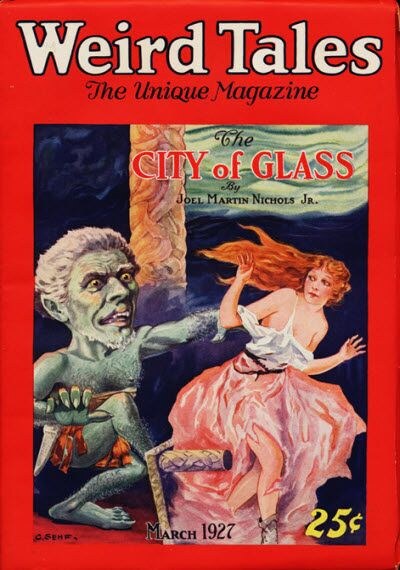
Issue cover by C. C. Senf.
"HELLO," Jules de Grandin seized the receiver from the office telephone before the echo of the tinkling bell had ceased, “who is it, please? But of course, Mademoiselle, you may speak with Dr. Trowbridge.” He passed the instrument to me and busied him self with a third unsuccessful attempt to ignite the evil-smelling French cigarette with which he insisted on fumigating the room.
“Yes?” I queried, placing the receiver to my ear.
“This is Miss Ostrander, Dr. Trow bridge,” a well-modulated voice in formed me. “Mrs. Evander’s nurse, you know.”
“Yes?” I repeated, a little sharp ly, annoyed at being called by an ordinary case after an onerous day.
“What is it?”
“I—I don’t quite know, sir.” She laughed the short, semi-hysterical laugh of an embarrassed woman.
“She’s acting very queerly. She— she’s—oh, my, there it goes again,
sir! Please come over right away; I’m afraid she’s becoming delirious!” And with that she hung up, leaving me in a state of astounded impa tience.
“Confound the woman!” I scolded as I prepared to slip into my overcoat. “Why couldn’t she have hung on thirty seconds more and told me what the matter was?”
“Eh, what is it, my friend?” de Grandin gave up his attempt to make the cigarette burn and regarded me with one of his fixed, unwinking stares. “You are puzzled, you are in trouble; can I assist you?” “Perhaps,” I replied. * * There’s a patient of mine, a Mrs. Evander, who’s been suffering from a threat ened leukemia—I’ve administered Fowler’s solution and arsenic trioxid and given her bed-rest treatment for the past week. It looked as if we had the situation pretty well in hand, but-” I repeated Miss Ostran der’s message.
“Ah?” he murmured, musingly.
“ ‘There it goes again,’ she did say? What, I wonder, was ‘it’; a cough, a convulsion, or—who can say? Let us hasten, my friend. Parbleu, she does intrigue me, that Mademoiselle Ostrander with her so cryptic * There it goes again’!” ights were gleaming through the storm from the windows of the Evander house as we came to a stop before its wide veranda. A colored servant, half-clothed and badly frightened, let us in and ushered us on tiptoe to the upper story chamber where the mistress of the establish ment lay sick.
“What’s wrong?” I demanded as I entered the sickroom, de Grandin at my heels. A glance at the patient reassured me. She lay back on a little pile of infant pillows, her pretty blond hair trickling in stray rivulets of gold from the confines of her lace sleeping-cap, her hands, almost as white as the linen itself, spread restfully on the Madeira counterpane.
“Humph!” I exclaimed, turning angrily to Miss Ostrander. “Is this what you called me out in the rain to see?” The nurse raised a forefinger quickly to her lips and motioned to ward the hall with her eyes. “Doc tor,” she said in a whisper when we stood outside the sickroom door, “I know you’ll think me silly, but—but it was positively ghastly!”
“Tiens, Mademoiselle de Gran din cut in, “I pray you be more ex plicit: first you tell Friend Trow bridge that something—we know not what—goes again, now you do inform us that something is ghastly. Pardieu, you have my sheep—non, non, how do you say?—my goat!” In spite of herself the girl laughed at the tragic face he turned to her, but she recovered her gravity quickly.
TALES “Last night,” she went on, still in a whisper, “and the night before, just at 12, a dog howled somewhere in the neighborhood. I couldn’t place the sound, but it was one of those long, quavering howls, almost human. Positively, you might have mistaken it for the cry of a little child in pain, at first..” De Grandin tweaked first one, then the other end of his trimly waxed blond mustache. “And it was the sleepless dog’s lament which went again, and which was so ghastly, Mademoiselle?’* he inquired solicit ously.
“No!” the nurse exploded with suppressed vehemence and height ened color. “It was Mrs. Evander, sir. Night before last, when the beast began baying, she stirred in her sleep —turned restlessly for a moment, then went back to sleep. When it howled the second time, a little near er the house, she half sat up, and made a queer little growling noise in her throat. Then she slept. Last night the animal was howling louder and longer, and Mrs. Evander seemed more restless and made odd noises more distinctly. I thought the dog was annoying her, or that she might be having a nightmare, so I got her a drink of water; but when I tried to give it to her, she snarled at me!*’ “Eh bien, but this is of interest,” de Grandin commented. “She did snarl at you, you say?”
“Yes, sir. She didn’t wake up when I touched her on the shoulder; just turned her head toward me and showed her teeth and growled. Growled like a bad-tempered dog.”
“Yes? And then?” “Tonight the dog began howling a few minutes earlier, five or ten minutes before midnight, perhaps, and it seemed to me his voice was much stronger. Mrs. Evander had the same reaction she had the other two nights at first, but suddenly she sat bolt-upright in bed, rolled her head
from side to side, and drew back her lips and growled, then she began snapping at the air, like a dog an noyed by a fly. I did my best to quiet her, but I didn’t like to go too near—I was afraid, really—and all at once the dog began howling again, right in the next yard, it seemed, and Mrs. Evander threw back her bedclothes, knelt up in bed and answered him!”
“Answered him?” I echoed in stupefaction.
“Yes, doctor, she threw back her head and howled—long, quavering howls, just like his. At first they were low, but they grew louder and higher till the servants heard them, and James, the butler, came to the door to see what the matter was. Poor fellow, he was nearly scared out of his wits when he saw her.”
“And then-?” I began.
“Then I called you. Right while I was talking to you, the dog began baying again, and Mrs. Evander answered him. That was what I meant” — she turned to de Grandin—“when I said, ‘There it goes again.’ I had to hang up before I could explain to you, Dr. Trowbridge, for she had started to crawl out of bed toward the window, and I had to run and stop her.”
“But why didn’t you tell me this yesterday, or this afternoon when I was here? ” I demanded.
“I didn’t like to, sir,” she defended. “It all seemed so crazy, so utterly impossible, especially in the day time, that I was afraid you’d think I’d been asleep on duty and dreamed it all; but now that James has seen seen him.”
Outside in the rain-drenched night there suddenly rose a wail, long-drawn, pulsating, doleful as the cry of an abandoned soul. “O-o-o—o-o-o-o — o-o-o — o-o-o-o!” it rose and fell, quavered and almost died away, then resurged with increased force. “O-o-o—o-o-o-o — o-o-o — o-o-o-o! ’ *
“Hear it?” the nurse cried, her voice thin-edged with excitement and fear. Again, “O-o-o—o-o-o-o — o-o-o — o-o-o-o!” like the echo of the howls outside came an answering cry from the sickroom beyond the door. Miss Ostrander dashed into the room, de Grandin and I close behind her. The dainty white counterpane had been thrown back, Mrs. Evander, clad only in her Georgette nightrobe and bed-cap, had crossed the floor to the window and flung up the sash. Already the wind-whipped rain was beating in upon her as she leaned across the sill, one pink sole toward us, one little white foot on the win dow-ledge, preparatory to jumping.
“Mon Dieu, seize her!” de Gran din shrieked, and, matching command with performance, leaped across the room, grasped her shoulders in his small, strong hands, and bore her backward as she flexed the muscles of her legs to hurl herself into the yaTd below. For a moment she fought like a tigress, snarling, scratching, even snapping at us with her teeth, but Miss Ostrander and I overbore her and thrust her into bed, drawing the covers over her and holding them down like a strait-jacket against her furious struggles. De Grandin leaned across the win dow-sill, peering out into the stormy darkness. “Aroint thee, accursed of God!” I heard him shout into the wind as he drew the sash down, snapped the catch fast and turned again to the room.
“Ah?” he approached the strug gling patient and bent over her, star ing intently. “A grain and a half of morphine in her arm, if you please, Friend Trowbridge. The dose is heavy for a non-addict, but”—he shrugged his shoulders—“it is necessaire that she sleep, this poor one. So! That is better.
“Mademoiselle,” he regarded Miss Ostrander with his wide-eyed stare, “ I do not think she will be thus dis turbed in the day, but I most strong ly urge that hereafter you administer a dose of one-half grain of codein dis solved in eighty parts of water each night not later than half-past 10. Dr. Trowbridge will write the pre scription.
“Friend Trowbridge,” he inter rupted himself, “where, if at all, is Madame’s husband, Monsieur Evan der?”
“He’s gone to Atlanta on a busi ness trip,” Miss Ostrander supplied.
“We expect him back tomorrow.” “Tomorrow? Zut, that is too bad!” de Orandin exclaimed. “Eh bien, with you Americans it is always the business. Business before pleasure, business before happiness.; cordi&u, business before the safety of those you love!
“Mademoiselle, you will please keep in touch with Dr. Trowbridge and me at all times, and when that Monsieur Evander does return from his business trip, please tell him that we desire to see him soon—at once, right away, immediately. * ‘ Come, Friend Trowbridge— bonne nuit, Mademoiselle.”
“T say. Dr. Trowbridge,” Niles A Evander flung angrily into my consulting room, “what’s the idea of keeping my wife doped like this? Here I just got back from a trip to the South last night and rushed out to the house to see her before she went to sleep, and that dam’ nurse said she’d given her a sleepin’ pow der and couldn’t waken her. I don’t like it, I tell you, and I won’t have it! I told the nurse that if she gave her any dope tonight she was through, and that goes for you, too!” He glared defiantly at me. De Grandin, sunk in the depths of a great chair with a copy of de Gobineau’s melancholy Lovers of Kanda
TALES har, glanced up sharply, then con sulted the watch strapped to his wrist. “It is a quarter of 11,” he announced apropos of nothing, laying down the elegant blue-and-gold volume and rising from his seat. Evander turned on him, eyes ablaze. “You’re Dr. de Grandin,” he accused. “I’ve heard of you from the nurse. It was you per suaded Trowbridge to dope my wife —buttin’ in on a case that didn’t concern you. I know all about you, ” he went on furiously as the French man gave him a cold stare. “You’re some sort of charlatan from Paris, a dabbler in criminology and spiritual ism and that sort of rot. Well, sir, I want to warn you to keep your hands off my wife. American doctors and American methods are good enough forme!”
“Your patriotism is most admir able, Monsieur,” de Grandin mur mured with a suspicious mildness.
“If you-” The jangle of the telephone bell cut through his words. “Yes?” he asked sharply, raising the receiver, but keeping his cold eyes fixed on Evander’s face. “Yes, Mademoiselle Ostrander, this is— grand Dieu! What? how long? Eh, do you say so? Dix million diables! But of j course, we come, we hasten,— morbleu, but we shall fly.
“Gentlemen,” he hung up the receiver, then turned to us, inclining his shoulders ceremoniously to each of us in turn, his gaze as expressionless as the eyes of a graven image, “that was Mademoiselle Ostrander on the ’phone. Madame Evander is gone— disappeared.” “Gone? Disappeared?” Evander echoed stupidly, looking helplessly from de Grandin to me and back again. He slumped down in the nearest chair, gazing straight before him unseeingly. “Great God!” he murmured.
“Precisely, Monsieur,” de Grandin agreed in an even, emotionless voice. “That is exactly what I said. Mean time”—he gave me a significant glance—“let us go, cher Trowbridge. I doubt not that Mademoiselle Os trander will have much of interest to relate.
“Monsieur ”—his eyes and voice again became cold, hard, stonily ex pressionless—“if you can so far dis commode yourself as to travel in the company of one whose nationality and methods you disapprove, I sug gest you accompany us.” Niles Evander rose like a sleep walker and followed us to my wait ing car. npHE previous day’s rain had turned to snow with a shifting of the wind to the northeast, and we made slow progress through the sub urban roads. It was nearly midnight when we trooped up the steps to the Evander porch and pushed vigorous ly at the bell-button.
“Yes, sir,” Miss Ostrander re plied to my question, “Mr. Evander came home last night and positively forbade my giving Mrs. Evander any more codein. I told him you wanted to see him right away, and that Dr. de Grandin had ordered the narcotic, but he said- ”
“Forbear, if you please, Mademoi selle,” de Grandin interrupted.
“Monsieur Evander has already been at pains to say as much—and more— to us in person. Now, when did Madame disappear, if you please?”
“I’d already given her her medicine last night,” the nurse took up her story at the point of interruption, “so there was no need of calling you to tell you of Mr. Evander’s orders. I thought perhaps I could avoid any unpleasantness by pretend ing to obey him and giving her the codein on the sly this evening, but about 9 o’clock he came into the sick room and snatched up the box of
powders and put them in his pocket. Then he said he was going to drive over to have it out with you. I tried to telephone you about it, but the storm had put the wires out of commission, and I’ve been trying to get a message through ever since.”
“And the dog, Mademoiselle, the animal who did howl outside the win dow, has he been active?”
“ Yes! Last night he screamed and howled so I was frightened. Positively, it seemed as though he were trying to jump up from the ground to the window. Mrs. Evander slept through it all, though, thanks to the drug.”
“And tonight?” de Grandin prompted.
“Tonight!” The nurse shud dered. “The howling began about half-past 9, just a few minutes after Mr. Evander left for the city. Mrs. Evander was terrible. She seemed like a woman possessed. I fought and struggled with her, but nothing I could do had the slightest effect. She was savage as a maniac. I called James to help me hold her in bed once, and then, for a while, she lay quietly, for the thing outside seemed to have left.
“Some time later the howling be gan again, louder and more furious, and Mrs. Evander was twice as hard to manage. She fought and bit so that I was beginning to lose control of her, and I screamed for James again. He must have been somewere downstairs, though, for he didn’t hear my call. I ran out into the hall and leaned over the balus trade to call again, and when I ran back—I wasn’t out there more than a minute—the window was up and Mrs. Evander was gone.”
“And didn’t you do anything?— didn’t you look for her?” Evander cut in passionately.
“Yes, sir. James and I ran outside and called and searched all through the grounds, but we couldn’t find a
trace of her. The wind is blowing so and the snow falling so rapidly, any tracks she might have made would have been wiped out almost immediately.” De Grandin took his little pointed chin between the thumb and forefinger of his right hand and bowed his head in silent meditation. “Homs of the devil!” I heard him mutter to himself. “This is queer—those cries, that delirium, that attempted flight, now this disappearance. Pardieu, the trail seems clear. But why? Mille cochons, why?”
“See here,” Evander broke in frantically, “cdn’t you do some thing? Call the police, call the neighbors, call-”
“Monsieur,” de Grandin inter rupted in a frigid voice, “may I in quire your vocation?”
“Eh?” Evander was taken aback.
“Why—er—I’m an engineer.”
“Precisely, exactly. Dr. Trow bridge and I are medical men. We do not attempt to build bridges or sink tunnels. We should make sorry work of it. You, Monsieur, have al ready once tried your hand at medicine by forbidding the administra tion of a drug we considered neces sary. Your results were most de plorable. Kindly permit us to fol low our profession in our own way. The thing we most of all do not de sire in this case is the police force. Later, perhaps. Now, it would be more than ruinous.”
“But-”
“There are no buts, Monsieur. It is my belief that your wife, Madame Evander, is in no immediate danger. However, Dr. Trowbridge and I shall institute such seareh as may be prac ticable, and do you meantime keep in such communication with us as the storm will permit.” He bowed formally. “A very good night to you, Monsieur.” Miss Ostrander looked at him ques
TALES tioningly. “Shall I go with you, doctor?” she asked.
“Mais non,” he replied. “ You will please remain here, ma nourrice, and attend the homecoming of Ma dame Evander.” “Then you think she will return?”
“Most doubtlessly. Unless I am more badly mistaken than I think I am, she will be back to you before another day.”
“Say,” Evander, almost beside himself, burst out, “what makes you so cock-sure she’ll be back? Good Lord, man, do you realize she’s out in this howling blizzard with only her night-clothes on?”
“Perfectly. But I do declare she will return.”
“But you’ve nothing to base your absurd-”
“Monsieur!” de Grandin’s sharp, whiplike reply cut in. “Me, I am Jules de Grandin. When I say she will return, I mean she will return. I do not make mistakes.”
“ VX7'here shall we begin the W search?” I asked as we en tered my car. He settled himself snugly in the cushions and lighted a cigarette. “We need not search, cher ami,” he re plied. “She will return of her own free will and accord.”
“But, man,” I argued, “Evander was right; she’s out in this storm with nothing but a Georgette night dress on.”
“I doubt it,” he answered easually.
“You doubt it? Why-?”
“Unless the almost unmistakable signs fail, my friend, this Madame Evander, thanks to her husband’s pig-ignorance, is this moment clothed in fur.”
“Fur?” I echoed.
“Perfectly. Come, my friend, tread upon the gas. Let us snatch what sleep we can tonight. Tomorrow— eh bien, tomorrow is another day.”
He was up and waiting for me as I entered the office next morning.
“Tell me, Friend Trowbridge,” he demanded, “this Madame Evander’s leukemia, upon what did you base your diagnosis?”
“Well,” I replied, referring to my clinical cards, “a physical examina tion showed the axillary glands slightly enlarged, the red corpuscles reduced to little more than a million to the count, the white cells stood at about four hundred thousand, and the patient complained of weakness, drowsiness and a general feeling of malaise.” “U’m?” he commented noncommittally. “That could easily be so. Yes; such signs would undoubtedly be shown. Now-” The telephone bell broke off his remarks half ut tered.
“Ah?” his little blue eyes snapped triumphantly as he listened to the voice on the wire. “I did think so. But yes; right away, at once, immediately.
“Trowbridge, my old one, she has returned. That was Mademoiselle Ostrander informing me of Madame Evander’s reappearance. Let us hasten. There is much I would do this day.”
“ A fter you went last night,” Miss Ostrander told us, “I lay down on the chaise longue in the bedroom and tried to sleep. I suppose I must have napped by fits and starts, but it seemed to me I could hear the faint howling of dogs, sometimes mingled with yelps and cries, all through the night. This morning, just after 6 o’clock, I got up to prepare myself a piece of toast and a cup of tea before the servants were stirring, and as I came downstairs I found Mrs. Evander lying on the rug in the front hall.” She paused a moment, and her color mounted slightly as she went on. “She was lying on that gray
wolfskin rug before the fireplace, sir, and was quite nude. Her sleep ing cap and nightgown were crum pled up on the floor beside her.”
“All?” de Grand in commented..
“And-?”
“I got her to her feet and helped her up-stairs, where I dressed her for bed and tucked her in. She didn’t seem to show any evil effects from be ing out in the storm. Indeed, she seems much better this morning, and is sleeping so soundly I could hardly wake her for breakfast, and when I did, she wouldn’t eat. Just went back to sleep.”
“Ah?” de Grandin repeated.
“And you bathed her, Mademoiselle, before she was put to bed?” The girl looked slightly startled.
“No sir, not entirely; but I did wash her hands. They were discolored, especially about the fingertips, with some red substance, almost as if she had been scratching something, and gotten blood under her nails.”
“Parblou!” the Frenchman ex ploded. “I did know it, Friend Trowbridge. Jules de Grandin, he is never mistaken.
“ Mademoiselle,” he turned fever ishly to the nurse, “did you, by any happy chance, save the water in which you laved Madame Evander’s hands?”
“Why, no, I didn’t, but—oh, I see —yes, I think perhaps some of the stain may be on the washcloth and the orange stick I cleaned her nails with. I really had quite a time clean ing them, too.”
“ Bien tres bien!” he ejaculated., “Let us have these cloths, these sticks, at once, please. Trowbridge, do you withdraw some blood from Madame’s arm for a test, then we must hasten to the laboratory. Cordieu, I burn with impatience!” An hour later we faced each other in the office. “I can’t understand it,” I confessed. “By all the canons of the profession, Mrs. Evander
ought to be dead after last night’s experience, but there’s no doubt she’s better. Her pulse was firmer, her temperature right, and her blood count practically normal today.”
“Me, I understand perfectly, up to a point,” he replied. “Beyond that, all is dark as the cave of Erebus. Behold, I have tested the stains from Madame’s fingers. They are—what do you think?”
“Blood?” I hazarded.
“Parbleu, yes; but not of human ity. Mais non, they are blood of a dog, my friend.”
“Of a dog?”
“Perfectly. I, myself, did greatly fear they might prove human, but grace a, Dieu, they are not. Now, if you will excuse, I go to make certain investigations, and will meet you at the maison Evander this evening. Come prepared to be surprized, my friend. Pardieu, I shall be surprized if I do not astonish myself!” rpouR of us, de Grandin, Miss Os- * trander, Niles Evander and I, sat in the dimly lighted room, looking alternately toward the bed where the mistress of the house lay in a drugged sleep, into the still-burning fire of coals in the fireplace grate, and at each other’s faces. Three of us were puzzled almost to the point of hys teria, and de Grandin seemed on pins and needles with excitement and expectation. Occasionally he would rise and walk to the bed with that quick, soundless tread of his which always made me think of a cat. Again he would dart into the hall, nervous ly light a cigarette, draw a few quick puffs from it, then glide noiselessly into the sickroom once more. None of us spoke above a whisper, and our conversation was limited to incon sequential things. Throughout our group there was the tense expectancy and solemn, taut-nerved air of medi cal witnesses in the prison death
TALES chamber awaiting the advent of the condemned. Subconsciously, I think, we all real ized what we waited for, but my nerves nearly snapped when it came. With the suddenness of a shot, un heralded by any preliminary, the wild, vibrating howl of a beast sound ed beneath the sickroom window, its sharp, poignant wail seeming to split the frigid, moonlit air of the night.
“O-o-o—o-o-o-o — o-o-o — o-o-o-o!” it rose against the winter stillness, diminished to a moan of heart-rend ing melancholy, then suddenly crescendoed upward, from a moan to a wail, from a wail to a howl, de spairing, passionate, longing as the lament of a damned spirit, wild and fierce as the rallying call of the fiends of hell.
“Oh!” Miss Ostrander exclaimed involuntarily.
“Let be!” Jules de Grandin or dered tensely, his whisper seeming to carry more because of its sharpness than from any actual sound it made. ‘ * O-o-o—o-o-o-o — o-o-o — o-o-o-o!” again the cry shuddered through the air, again it rose to a pitch of intol erable shrillness and evil, then died away, and, as we sat stone-still in the shadowy chamber, a new sound, a sinister, scraping sound, intensified by the ice-hard coldness of the night, came to us. Someone, some thing, was swarming up the rose-trellis out side the house! Scrape, scratch, scrape, the alter nate hand- and foot-holds sounded on the cross-bars of the lattice. A pair of hands, long, slender, corded hands, like the hands of a cadaver long dead, and armed with talons, blood-stained and hooked, grasped the windowledge, and a face—God of Mercy, such a face!—was silhouetted against the background of the night. Not human, nor yet wholly bestial it was, but partook grotesquely of both, so that it was at once a foul caricature of each. The forehead was
low and narrow, and sloped back to a thatch of short, nondescript-colored hair resembling an animal’s fur. The nose was elongated out of all semblance to a human feature and resembled the pointed snout of some animal of the canine tribe except that it curved sharply downward at the tip like the beak of some unclean bird of prey. Thin, cruel lips were drawn sneeringly back from a double row of tusklike teeth which gleamed horrid ly in the dim reflection of the open fire, and a pair of round, baleful eyes, green as the luminance from a rot ting carcass in a midnight swamp, glared at us across the window-sill. On each of us in turn the basilisk glance dwelt momentarily, then fastened itself on the sleeping sick woman like a falcon’s talons on a dove. Miss Ostrander gave a single chok ing sob and slid forward from her chair unconscious. Evander and I sat stupefied with horror, unable to do more than gaze in terror-stricken silence at the apparition, but Jules de Grandin was out of his seat and across the room with a single bound of feline grace and ferocity.
“Aroint thee, accursed of God!” he screamed, showering a barrage of blows from a slender wand on the creature’s face. “Back, spawn of Satan! To thy kennel, hound of hell! I, Jules de Grandin, command it!” The suddenness of his attack took the thing by surprize. For a mo ment it snarled and cowered under the hailstorm of blows from de Gran din’s stick, then, as suddenly as it had come into view, it loosed its hold on the window-sill and dropped from sight.
“Sang de Dieu, sang du ddable; sang des tons les saints de ciell” de Grandin roared, hurling himself out the window in the wake of the fleeing monster. “I have you, vile wretch.
Pardieu, Monsieur Loup-garou, but I shall surely crush you!” Rushing to the window, I saw the tall, skeleton-thin form of the enorm ity leaping across the moonlit snow with great, space-devouring bounds, and after it, brandishing his wand, ran Jules de Grandin, shouting tri umphant invectives in mingled French and English. By the shadow of a copse of ever greens the thing made a stand. Wheeling in its tracks, it bent nearly double, extending its cadaverous claws like a wrestler searching for a hold, and baring its glistening tusks in a snarl of fury. De Grandin never slackened pace. Charging full-tilt upon the waiting monstrosity, he reached his free hand into his jacket pocket. There was a gleam of blue metal in the moonlight. Then eight quick, pitiless spurts of flame stabbed through the shadow where the monster lurked, eight whip like, crackling reports echoed and re echoed in the midnight stillness,— and the voice of Jules de Grandin: “Trowbridge, mon vieux, ohe, Friend Trowbridge, bring a light quickly! I would that you see what I see!” Weltering in a patch of blood stained snow at de Grandin’s feet we found an elderly man, ruddy-faced, gray-haired, and, doubtless, in life, of a dignified, even benign aspect. Now, however, he lay in the snow as naked as the day his mother first saw him, and eight gaping gunshot wounds told where de Grandin’s mis siles had found their mark. The winter cold was already stiffening his limbs and setting his 'face in a mask of death.
“Good heavens,” Evander ejacu lated as he bent over the lifeless form, “it’s Uncle Friedrich—my wife’s uncle! He disappeared just before I went south.”
“Eh bien,” de Grandin regarded the body with no more emotion than
if it had been an effigy molded in snow, “we shall know where to find your uncle henceforth, Monsieur. Will some of you pick him up? Me— pardieu —I would no more touch him than I would handle a hyena!
“ Now, Monsieur,” de Grandin faced Evander across the liv ing room table, “your statement that the gentleman at whose happy dis patch I so fortunately officiated was your wife’s uncle, and that he dis appeared before your southern trip, does interest me. Say on, tell me all concerning this Uncle Friedrich of your wife’s. When did he disappear, and what led up to his disappear ance? Omit nothing, I pray you, for trifles which you may consider of no account may be of the greatest im portance. Proceed, Monsieur. I listen.” Evander squirmed uncomfortably in his chair like a small boy undergo ing catechism. “He wasn’t really her uncle,” he responded. “Her father and he were schoolmates in Germany — Heidelberg — years ago. Mr. Hoffmeister—Uncle Friedrich— immigrated to this country shortly after my father-in-law came back, and they were in business together for years. Mr. Hoffmeister lived with my wife’s people—all the chil dren called him Uncle Friedrich— and was just like one of the family.
“My mother-in-law died a few years ago, and her husband died shortly after, and Mr. Hoffmeister disposed of his share of the business and went to Germany on a long visit. He was caught there in the war and didn’t return to America until ’21. Since that time he lived with us.” Evander paused a moment, as though debating mentally whether he should proceed, then smiled in a half shamefaced manner. “To tell you the truth,” he continued, “I
TALES wasn’t very keen on having him here. There were times when I didn’t like the way he looked at my wife a dam’ bit.”
“Eh,” de Grandin asked, “how was that, Monsieur?”
“Well, I can’t quite put a handle to it in words, but more than once I’d glance up and see him with his eyes fastened on Edith in a most peculiar way. It would have an gered me in a young man, but in an old man it both angered and dis gusted me. I was on the point of asking him to leave, when he disap peared and saved me the trouble.”
“Yes?” de Grandin encouraged.
“And his disappearance, what of that?”
“The old fellow was always an enthusiastic amateur botanist,” Evander replied, “and he brought a great many specimens for his herba rium back from Europe with him. Off and on he’s been messing around with plants since his return, and about a month ago he received a tin of dried flowers from Kerovitch, Ru mania, and they seemed to set him almost wild.”
“Kerovitch? Mordieu!” de Gran din exclaimed. “Say on, Monsieur; I burn with curiosity. Describe these flowers in detail, if you please.”
“H’m,” Evander took his chin in his hand and studied in silence a moment. “There wasn’t anything especially remarkable about them that I could see. There were a doz en of them, all told, perhaps, and they resembled our ox-eyed daisies a good deal, except that their petals were red instead of yellow. Had a queer sort of odor, too. Even though they were dried, they exuded a sort of sickly-sweet smell, yet not quite sweet either. It was a sort of mix ture of perfume and stench, if that means anything to you.”
“ Pardieu, it means much!” de Grandin assured him. “And their
sap, where it had dried, did it not resemble that of the milkweed plant?”
“Yes! How did you know?”
“No matter. Proceed, if you please. Your Uncle Friedrich did take these so accursed flowers out and-”
“And tried an experiment with them, ” Evander supplied. “He put them in a bowl of water, and they freshened up as though they had not been plucked an hour.”
“Yes—and his disappearance— name of a little green man!—his dis appearance?”
“That happened just before I went south. All three of us went to the theater one evening, and Uncle Friedrich wore one of the red flowers in his buttonhole. My wife wore a spray of them in her eorsage. He tried to get me to put one of the things in my coat, too, but I hated their smell so much I wouldn’t do it.”
“Lucky you!” de Grandin mur mured so low the narrator failed to hear him.
“Uncle Friedrich was very rest less and queer all evening,” Evander proceeded, “but the old fellow had been getting rather childish lately, so we didn’t pay any particular at tention to his actions. Next morn ing he was gone.”
“And did you make inquiry?”
“No, he often went away on little trips without warning us before hand, and, besides, I was glad enough to see him get out. I didn’t try to find him. It was just after this that my wife’s health became bad, but I had to make this trip for our firm, so I called in Dr. Trow bridge, and there you are.”
“Yes, parbleu, here we are, in deed!” de Grandin nodded em phatically. “Listen, listen careful ly, my friends; what I am about to say is the truth: “When first I came to visit Ma
dame Evander with Friend Trow bridge, and heard the strange story Mademoiselle Ostrander told, I was amazed. ‘Why,’I ask me,‘does this lady answer the howling of a dog beneath her window?’ Parbleu, it was most curious!
“Then while we three—Friend Trowbridge, Mademoiselle Ostran der and I—did talk of Madame’s so strange malady, I did hear the call of that dog beneath the window with my own two ears, and did ob serve Madame Evander’s reaction to it.
“Out the window I did put my head, and in the storm I saw no dog at all, but what I thought might be a human man—a tall, thin man. Yet a dog had howled beneath that win dow and had been answered by Ma dame but a moment before. Me, I do not like that.
“I call upon that man, if such he be, to begone. Also I do request Mademoiselle Ostrander to place her patient under an opiate each night, that the howls beneath her window may not awaken Madame Evander.
“Eh bien, thus far, thus good. But you do come along, Monsieur, and countermand my order. While Ma dame is not under the drug that un holy thing beneath her window does howl once more, and Madame dis appears. Yes.
“Now, there was no ordinary medical diagnosis for such a case as this, so I search my memory and my knowledge for an extraordinary one. What do I find in that store house of my mind?
“In parts of Europe, my friends —believe me, I know whereof I speak!—there are known such things as werewolves, or wolf-men.
In France we know them as les loupsgaroux, in Wales they call them the bug-wolves, or bogie-wolves; in the days of old the Greeks did know them under the style of lukanthropos. Yes.
“What he is no one knows well. Sometimes he is said to be a wolf—a magical wolf—who can become a man. Sometimes, more often, he is said to be a man who can, or must, become a wolf. No one knows accu rately. But this we know: The man who is also a wolf is ten times more terrible than the wolf who is only a wolf. At night he quests and kills his prey, which is most often his fel low man, but sometimes his ancient enemy, the dog. By day he hides his villainy under the guise of a man’s form. Sometimes he changes entire ly to a wolf’s shape, sometimes he be comes a fearful mixture of man and beast, but always he is a devil incar nate. If he be killed while in the wolf shape, he at once reverts to hu man form, so by that sign we know we have slain a werewolf and not a true wolf. Certainly.
“Now, some werewolves become such by the aid of Satan; some be come so as the result of a curse; a few are so through accident. In Transyl vania, that devil-ridden land, the very soil does seem to favor the trans formation of man into beast. There are springs from which the water, once drunk, will make its drinker in to a savage beast, and there are flow ers— cordieu, have I not seen them? —which, if worn by a man at night during the full of the moon, will do the same. Among the most potent of these blooms of hell is la fleur de sang, or blood-flower, which is exact ly the accursed weed you have de scribed to us, Monsieur Evander— the flower your Uncle Friedrich and your lady did wear to the theater that night of the full moon. When you mentioned the village of Kerovitch, I did see it all at once, immediately, for that place is on the Rumanian side of the Transylvanian Alps, and there the blood-flowers are found in greater numbers than anywhere else in the world. The very mountain
TALES soil does seem cursed with lycanthropy.
“Very well. I did not know of the flower when first I came into this case, but I did suspect something evil had cast a spell on Madame. She did exhibit all the symptoms of a lycanthrope about to be transformed, and' beneath her window there did howl what was undoubtedly a wolf-thing.
“ ‘He has put his cursed sign upon her and does even now seek her for his mate, ’ I tell me after I order him away in the name of the good God.
“When Madame disappeared I was not surprized. When she returned after a night in the snow, I was less surprized. But the blood on her hands did perturb me. Was it hu man? Was she an all-unconscious murderess, or was it, happily, the blood of animals? I did not know. I analyzed it and discovered it were dog’s blood. ‘Very well,’ I tell me. ‘Let us see where a dog has been mauled in that vicinity.’ “This afternoon I made guarded inquiries. I find many dogs have been strangely killed in this neighbor hood of late. No dog, no matter how big, was safe out of doors after night fall.
“Also I meet a man, an ivrogne — what you call a drunkard—one who patronizes the leggers-of-the-boot not with wisdom, but with too great frequency. He is no more so. He have made the oath to remain sober. Pourquoif Because three nights ago, as he passed through the park he were set upon by a horror so terrible that he thought he was in alcoholic delirium. It were like a man, yet not like a man. It had a long nose, and terrible eyes, and great, flashing teeth, and it did seek to kill and de vour him. My friends, in his way, that former drunkard did describe the thing which tried to enter this house tonight. It were the same.
“Fortunately for the poor drunk en man, he were carrying a walking
cane of ash wood, and when he raised it to defend himself, the terror did shrink from him. ‘Ah ha,’ I tell me when I hear that, ‘now we know it were truly le loup-garou,’ for it is notorious that the wood of the ash tree is as intolerable to the werewolf as the bloom of the garlic is unpleas ant to the vampire. “What do I do? I go to the woods and cut a bundle of ash switches.
Then I come here. Tonight the wolfthing come crying for the mate who ranged the snows with him last night. He is lonely, he is mad for another of his kind. Tonight, perhaps, they will attack nobler game than dogs. Very well, I am ready.
“When Madame Evander, being drugged, did not answer his call, he was emboldened to enter the house.. Pardieu, he did not know Jules de Grandin awaited him! Had I not been here it might well have gone hard with Mademoiselle Ostrander. As it was”—he spread his slender hands—“there is one less man-mon ster in the world this night.” Evander stared at him in round eyed wonder. “I can’t believe it,” he muttered, “but you’ve proved your case. Poor Uncle Friedrich! The curse of the blood-flower-” He broke off, an expression of min gled horror and despair on his face.
“My wife!” he gasped. “Will she become a thing like that? Will-?”
“Monsieur,” de Grandin inter rupted gently, “she has become one. Only the drug holds her bound in human form at this minute.”
“Oh,” Evander cried, tears of grief streaming down his face, “save her! For the love of heaven, save her! Can’t you do anything to bring her back to me?”
“You do not approve my meth ods,” de Grandin reminded him. Evander was like a pleading child.
“I apologize,” he whimpered. “I’ll give you anything you ask if you’ll
only save her. I’m not rich, but I think I can raise fifty thousand dol lars. I’ll give it to you if you’ll cure her!” The Frenchman twisted his little blond mustache furiously. “The fee you name is attractive, Monsieur,” he remarked.
“I’ll pay it; I’ll pay it!” Evander burst out hysterically. Then, unable to control himself, he put his folded arms on the table, sank his head up on them, and shook with sobs.
“Very well,” de Grandin agreed, casting me the flicker of a wink. “To morrow night I shall undertake your lady’s case. Tomorrow night we at tempt the cure. Au revoir, Monsieur. Come away, Friend Trowbridge, we must rest well before tomorrow night.” D e grandin was silent to the point of moodiness all next morning. Toward noon he put on his outdoor clothing and left without luncheon, saying he would meet me at Evan der’s that night.
“Meantime, Trowbridge, mon vieux, I beg you will assist me in the kitchen. There is much to do and little time in which to do it.” Opening a large valise he produced a bundle of slender sticks which he began splitting into strips like basketwithes, explaining that they were from a mountain ash tree. When some twenty-five of these had been prepared, he selected a number of bottles from the bottom of the satchel, and, taking a large aluminum kettle, began scouring it with a clean cloth.
“Attend me carefully, Friend Trow bridge,” he commanded; “do you keep close tally as I compound the draft, for much depends on the formula being correct. To begin.” Arranging a pair of apothecary’s scales and a graduate glass before him on the table, he handed me this memorandum.
3 pints pure spring water 2 drachms sulfur ½ oz. castorium 6 drachms opium 3 drachms asafoetida ½ oz. hypericum ½ oz. aromatic ammonia ½ oz. gum camphor As he busied himself with scales and graduate I checked the amounts he poured into the kettle. “Voila,” he announced, “we are prepared!” Quickly he thrust the ash withes into a pailful of boiling water and proceeded to bind together a threestranded hyssop of ash, poplar and birch twigs.
“And now, my friend, if you will assist me, we shall proceed,” he as serted, thrusting a large washpan in to my hands and preparing to follow me into the dining room with the ket tle of liquor he had prepared, his lit tle brush-broom thrust under his arm. We moved the dining room furni ture against the walls, and de Grandin put the kettle of liquid in the dish pan I had brought in, piling a number of light wood chips about it, and starting a small fire. As the liquid in the kettle began bubbling and seething over the flame, he knelt and began tracing a circle about sev en feet in diameter with a bit of white chalk. Inside the first circle he drew a second ring some three feet in diameter, and within this traced a star composed of two interlaced tri angles. At the very center he marked down an odd-looking figure composed of a circle surmounted by a crescent and supported by a cross. “This is the Druid’s foot, or pentagram,” he explained, indicating the star. “The powers of evil are powerless to pass it, either from without or within. This,” he pointed to the central fig ure, “is the sign of Mercury. It is also the sign of the Holy Angels, my friend, and the bon Dieu knows we shall need their kind offices this night. Compare, Friend Trowbridge,
TALES if you please, the chart I have drawn with the exemplar which I did most carefully prepare from the occult books today. I would have the testi mony of both of us that I have left nothing undone.” Into my hand he thrust the follow ing chart: - o Quickly, working like one pos sessed, he arranged seven small silver lamps about the outer circle where the seven little rings on the chart in dicated, ignited their wicks, snapped off the electric light and, rushing in to the kitchen, returned with the boiled ash withes dangling from his hand. Fast as he had worked, there was not a moment to spare, for Miss Os trander’s hysterical call, “Dr. de Grandin, oh, Dr. de Grandin!” came down the stairs as he returned from the kitchen. On the bed Mrs. Evander lay writhing like a person in convulsions. As we approached, she turned her face toward us, and I stopped in my tracks, speechless with the spectacle before me. It was as if the young woman’s pretty face were twisted into a grim ace, only the muscles, instead of re suming their wonted positions again, seemed to stretch steadily out of place. Her mouth widened gradually
till it was nearly twice its normal size, her nose seemed lengthening, becoming more pointed, and crooking sharply at the end. Her eyes, of sweet cornflower blue, were widening, be coming at once round and prominent, and changing to a wicked, phosphor escent green. I stared and stared, unable to believe the evidence of my eyes, and as I looked she raised her hands from beneath the covers, and I went sick with the horror of it. The dainty, flowerlike pink-and-white hands with their well-manicured nails were transformed into a pair of withered, corded talons armed with long, hornlike, curved claws, sabersharp and hooked like the nails of some predatory bird. Before my eyes a sweet, gently bred woman was be ing transfigured into a foul hell-hag, a loathsome, hideous parody of her self.
“Quickly, Friend Trowbridge, seize her, bind her!” de Grandin called, thrusting a handful of the limber withes into my grasp and hurling himself upon the monstrous thing which lay in Edith Evander’s place. The hag fought like a true mem ber of the wolf pack. Howling, claw ing, growling and snarling, she op posed tooth and nail to our efforts, but at last we lashed her wrists and ankles firmly with the wooden cords and bore her. struggling frantically, down the stairs and placed her within the mystic circle de Grandin had drawn on the dining room floor.
“Inside, Friend Trowbridge, quick ly!” the Frenchman ordered as he dipped the hyssop into the boiling liquid in the kettle and leaped over the chalk marks. “Mademoiselle Os trander, Monsieur Evander, for your lives, leave the house!”
from page 330) Reluctantly the husband and nurse left us and de Grandin began show ering the contorting, howling thing on the floor with liquid from the boil ing kettle. Swinging his hyssop in the form of a cross above the hideous change ling’s head, he uttered some invoca tion so rapidly that I failed to catch the words, then, striking the wolfwoman’s feet, hands, heart and head in turn with his bundle of twigs, he drew forth a small black book and began reading in a firm, clear voice: “Out of the deep have I called un to Thee, 0 Lord; Lord hear my voice..”.. And at the end he finished with a great shout: “I know that my re deemer liveth I am the resurrec.... tion and the life, saitli the Lord: he that believeth in me, though he were dead, yet shall he live! >> As the words sounded through the room it seemed to me that a great cloud of shadow, like a billow of black vapor, rose from the dark cor ners of the apartment, eddied toward the circle of lamps, swaying their flames lambently, then suddenly gave back, evaporated and disappeared with a noise like steam escaping from a boiling kettle.
“Behold, Trowbridge, my friend,” de Grandin ordered, pointing to the still figure which lay over the sign of Mercury at his feet, I bent forward, stifling my repupiance, then sighed with mingled relief and surprize. Calm as a sleep ing child, Edith Evander, freed from all the hideous stigmata of the wolfpeople, lay before us, her slender hands, still bound in the wooden ropes, crossed on her breast, her sweet, delicate features as though
they had never been disfigured by the curse of the blood-flower. Loosing the bonds from her wrists and feet the Frenchman picked the sleeping woman up in his arms and bore her to her bedroom above stairs.
“Do you summon her husband and the nurse, my friend,” he called from the turn in the stairway. “She will have need of both anon.”
“mn— why, she’s herself again!” » ' Evander exclaimed joyfully as he leaned solicitously above his wife’s bed.
“But of course!” de Grandin agreed. “The spell of evil was strong upon her, Monsieur, but the charm of good was mightier. She is released from her bondage for all time.” “I’ll have your fee ready tomor row,” Evander promised diffidently.
“I could not arrange the mortgages today—it was rather short notice, you know.” Laughter twinkled in de Grandin’s little blue eyes like the reflection of moonlight on flowing water. “My friend,” he replied, “I did make the good joke on you last night. Parbleu, to hear you agree to anything, and to announce that you did trust to my methods, as well, was payment enough for me. I want not your money.. If you would repay Jules de Grandin for his services, continue to love and cherish your wife as you did last night when you feared you were about to lose her. Me, morbleu! but I shall make the eyes of my con freres pop with jealousy when I tell them what I have accomplished this night. Sang d’u.i poisson, I am one very clever man, Monsieur!”
“Tt’s all a mystery to me, de Gran- *- din,” I confessed as we drove home, “but I’m hauged if I can un derstand how it was that the man was transformed into a monster al most as soon as lie wore those flowers,
TALES and the woman resisted the influence of the things for a week or more.” “Yes,” he agreed, “that is strange.
Myself, I think it was because werewolfism is an outward and visible sign of the power of evil, and the man was already steeped in sin, while the woman was pure in heart. She had what we might call a higher im munity from the virus of that sinful blood-flower.”
“And wasn’t there some old legend to the effect that a werewolf could only be killed with a silver bullet?”
“Ah bah,” he replied with a laugh.
“What did those old legend-mongers know of the power of modem fire arms? Parbleu, had the good St. George possessed a military rifle of today, he might have slain the dragon without approaching nearer than a mile! When I did shoot that wolfman, my friend, I had something more powerful than superstition in my hand. Morbleu, but I did shoot a hole in him large enough for him to have walked through!”
“That reminds me,” I added, “how are we going to explain his body to the police?”
“Explain?” he echoed with a chuckle. “Nom d’un bouc, we shall not explain: I, myself, did dispose of him this very afternoon. He lies buried beneath the roots of an ash tree, with a stake of ash through his heart to hold him to the earth. His sinful body will rise again no more to plague us, I do assure you. He was known to have a habit of disap pearing. Very good.. This time there will be no reappearance. We are through, finished, done with him for good.” We drove another mile or so in silence, then my companion nudged me sharply in the ribs. “This curing of werewolf ladies, my friend,” he confided, “it is dry work. Are you sure there is a full bottle of brandy in the cellar?”
Shelved near: The Man Who Cast No Shadow · Ancient Fires · The Curse of Everard Maundy