WF Q56 .C87 1927
The Curse of Everard Maundy
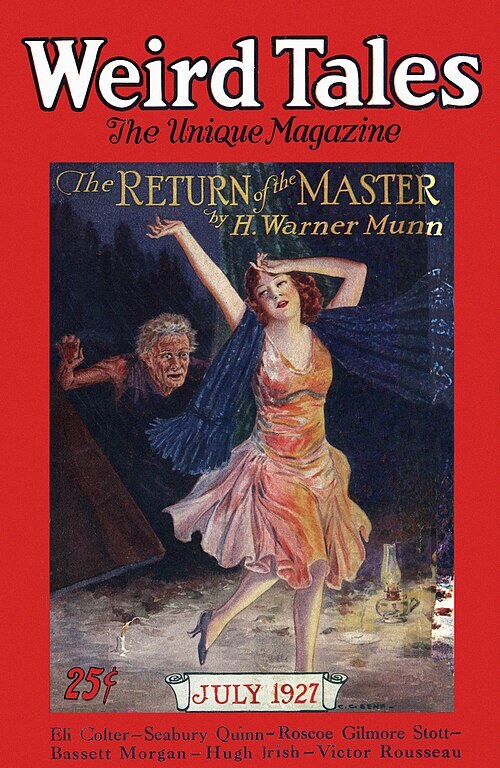
First published in Weird Tales, July 1927 (vol. 10, no. 1). Novelette. Jules de Grandin.
United States public domain. Held in the Reading Room of The Weird Library. Published by Weird Tales.
This text is printed as first published. It uses racial language from the period, including slurs.
Mort d'un chat! I do not like this! ” Jules de Grandin slammed the evening paper down upon the table and glared ferociously at me through the library lamplight.
“What’s up now?” I asked, wondering vaguely what the cause of his latest grievance was. “Some reporter say something personal about you?”
“Parbleu, non, he would better not!” the little Frenchman replied, his round blue eyes flashing ominously. “Me, I would pull his nose and tweak his ears. But it is not of the reporter’s insolence I speak, my friend; I do not like these suicides; there are too many of them.”
“Of course there arc,” I conceded soothingly, ‘ ‘ one suicide is that much too many; people have no right to ”
“Ah bah!” he cut in. “You do misapprehend me, vieux. Excuse me one moment, if you please.” He rose hurriedly from his chair and left the room. A moment later I heard him rummaging about in the cellar.
In a few minutes he returned, the week’s supply of discarded newspapers salvaged from the dust bin in his arms.
“Now, attend me,” he ordered as he spread the sheets out before him and began scanning the columns
hastily. “Here is an item from Monday’s Journal:
Two Motorists Die While Driving Cars
The impulse to end their lives apparently attacked two automobile drivers on the Albemarle turnpike near Lonesome Swamp, two miles out of llarrisonville, last night.
Carl Planz, thirty-one years old, of Mai-tins Falls, took his own life by shooting him.self in the head with a shotgun while seated in his automobile, which he had parked at the roadside where the pike passes nearest the swamp. His remains n ere identified by two letters, one addressed to his wife, the other to his father, Joseph Planz, with whom he was associated in the real estate business at Martins Falls. A check for three himdred dollars and several other papers found in his pockets completed identification.
The letters, which mei-ely declared his intention to kill himself, failed to establish any motive for the act.
Almost at the same time, and within a hundred yards of the spot where Planz’s body was found by State Trooper Henry Ander.son this morning, the body of Henry William Nixon, of New Rochelle, N. Y., was discovered partly sitting, partly lying on the rear seat of his automobile, an empty bottle of windshield cleaner lying on the floor beside him. It is thought this liquid, which contained a small amount of cyanide of potassium, was used to inflict death. Police Surgeon, Stevens, who examined both bodies, declared that the men had been dead approximately the same length of time when brought to the station house.
“What think you of that, my friend, hein” de Grandin demanded, looking tip from the ])aper with one of his direct, challenging stares.
“Why — er ’’ I began, but he
interrupted.
“Hear this,’’ he commanded, taking up a second paper, “this is from the News of Tuesday:
Mother and Daughters Die in Death Pact
Police.and heai'tbroken relatives are today trying to trace a motive for the triple suicide of Mrs. Ruby Westerfelt and her daughters, Joan and Elizabeth, who perished by leaping from the eighth floor of the Hotel Dolores, Newark, late yesterday afternoon. The women registered at the hotel under assumed names, went immediately to the room assigned them, and ten minutes Liter Miss Gladys Walsh, who occupied a room on the fourth floor, was
startled to see a dark form hurtle past her window. A moment later a second body flashed past on its downward flight, and as Miss Walsh, horrified, rushed toward the window, a loud crash sounded outside.
Looking out. Miss Walsh saw the body of a third woman partly impaled on the spikes of a balcony rail.
Miss Walsh sought to aid the woman. As slie leaned from her window and reached out with a trembling arm she was greeted by a scream: “Don’t try! I won’t be saved; I must go with Mother and Sister!” A moment later the woman had managed to free herself from the restraining iron spikes and fell to the cement areaway four floors below.
“And here is still another account, this one from tonight’s paper,” he continued, unfolding the sheet which had caused his original protest:
High School Co-ed Takes Life in Attic
The family and friends of Edna May McCarty, fifteen-year-old co-ed of Harrisonville High School, are at a loss to assign a cause for her suicide early this morning.
The girl had no love affairs, as far as is known, and had not failed in her examinations. On the contrary, she had passed the school’s latest test with flying colors.
Her mother told investigating police officials that overstudy might have temporarily unbalanced the child’s mind. Miss McCarty’s body was found suspended from the rafters of her father’s attic by her mother this morning when the young woman did not respond to a call for breakfast and could not be found in her room on the second floor of the house. A clothesline, used to hang clothes which were dried inside the house in rainy weather, was used to form the fatal noose.
“XJow then, my friend,” de Grandin reseated himself and lighted a vile-smelling French cigarette, puffing furiously, till the smoke surrounded his sleek, blond head like a mephitic nimbus, “what have you to say to those reports? Am I not right? Are there not too many — mordie\i, entirelv too manv! — ^suicides in our city?”
“All of them weren’t committed here,” I objected practically, “and besides, there couldn’t very well be any connection between them. Mrs. Westerfelt and her daughters carried
THE CURSE OP EVERARD MAUNDY
out a suicide pact, it appears, but they certainly could have had no understanding with the two men and
the young girl ”
“Perhaps, maybe, possibly,” he agreed, nodding his head so vigorously that a little column of ash detached itself from his cigarette and dropped unnoticed on the bosom of his stiffly starched evening shirt. “You may be right. Friend Trowbridge, but then, as is so often the case, you may be entirely wrong. One thing I know: I, Jules de Grandin, shall investigate these eases myself personally. Cordieu, they do interest me! I shall ascertain what is the what here.”
“Go ahead,” I encouraged. “The investigation will keep you out of mischief,” and I returned to the second chapter of Haggard’s The Wanderer’s Necklace, a book which I have read at least half a dozen times, yet find as fascinating at each rereading as when I first perused its pages.
T he matter of the six suicides still bothered him next morning. “Trowbridge, my friend,” he asked abruptly as he disposed of his second helping of coffee and passed his cup for replenishment, “why is it that people destroy themselves?”
“Oh,” I answered evasively, “different reasons, I suppose. Some are crossed in love, some meet financial reverses and some do it while temporarily deranged.”
“Yes,” he agreed thoughtfully, “yet every self-murderer has a real or fancied reason for quitting the world, and there is apparently no reason why any of these six poor ones who hurled themselves into outer darkness during the past week should have done so. All, apparently, were well provided for, none of them, as far as is known, had any reason to regret the past or fear the future; yet” — he shrugged his narrow shoulders significantly — “voild, they are gone!
“Another thing: At the FaculU de Medicine Legal and the Surete in Paris we keep most careful statistics, not only on the number, but on the manner of suicides. I do not think your Frenchman differs radically from your American when it comes to taking his life, so the figures for one nation may well be a signpost for the other. These self-inflicted deaths, they are not right. They do not follow the rules. Men prefer to hang, slash or shoot themselves; women favor drowning, poison or gas; yet here we have one of the men taking poison, one of the women hanging herself, and three of them jumping to death. Yom d’lm canard, I am not satisfied with it!”
“H’m, neither are the unfortunate parties who killed themselves, if the theologians are to be believed,” I returned.
“You speak right,” he returned, then muttered dreamily to himself: “Destruction — destruction of body and imperilment of soul — mordieu, it is strange, it is not righteous!” He disposed of his coffee at a gulp and leaped from his chair. “I go!” he declared dramatically, turning toward the door.
“Where?”
“Where? Where should I go, if not to secure the history of these so puzzling cases? I shall not rest nor sleep nor eat until I have the string of the mysteiy’s skein in my hands.” He paused at the door, a quick, elfin smile playing across his usually stem features. “And should I return before my work is complete,” he suggested, “I pray you, have the excellent Nora prepare another of her so magnificent apple pies for dinner. ’ ’
Forty seconds later the front door clicked shut, and from the dining room’s oriel window I saw his neat little figure, trimly encased in blue chinchilla and gray worsted, pass quickly down the sidewalk, his ebony cane hammering a rapid tattoo on the
stMies as it kept time to the thoughts racing through his active brain.
“T AM desolated tliat my capacity is exhausted, ” he announced that evening as he finished his third portion of deep-dish apple pie smothered in pungent rum sauce and regarded his empty plate sadly. “Eh Men, perhaps it is as well. Did I eat more I might not be able to think clearly, and clear thought is what I shall need this night, my friend. Come; we must be going.”
“Going where?” I demanded.
“To hear the reverend and estimable Monsieur Maundy deliver his sermon. ’ ’
“Who? Everard Maundy?”
“But of course, who else?”
“But — but,” I stammered, looking at him incredulously, “why should we go to the tabernacle to hear this man? I can’t say I’m particularly impressed with his sj’^tem, and — aren’t you a Catholic, de Grandin?”
“Who can say?” he replied as he lighted a cigarette and stared thoughtfully at his coffee cup. “My father was a Huguenot of the Huguenots; a several times great-grandsire of his cut his way to freedom through the Paris streets on the fateful night of Axigust 24, 1572. My mother was convent-bred, and as pious as anyone with a sense of humor and the gift of thinking for herself could well be. One of my uncles — ^he for whom I am named — was like a blood brother to Darwin the magnificent, and Huxley the scarcely less magnificent, also.
Me, I am” — ^lie elevated his eyebrows and shoulders at once and pur-sed his lips comically — “what should a man with such a heritage he, my friend? But come, we delay, we tarry, we lose time. Let us hasten.
I have a fancy to hear what this Monsieur Maixndy has to say, and to observe him. See, I have here tickets for the fourth row of the hall.”
Very much puzzled, but never
doubting that something more than the idle wish to hear a sensational evangelist urged the little Frenchman toward the tabernacle, I rose and accompanied him.
“Parbleu, w'hat a day!” he sighed as I turned my ear toward the dowmtown section. “Prom coroner’s office to undertakers’ I have run; and from undertakers’ to hospitals. I have interviewed everyone who could shed the smallest light on these strange deaths, yet I seem no further advanced than when I began. What I have foiuid out serves only to whet my curiosity; what I have not discovered ” He spread his hands
in a world-embracing gesture and lapsed into silence.
The Jaehin Tabernacle, where the Kev. Everard Maundy was holding his series of non-sectarian revival meetings, was crow'ded to overflowing when we arrived, but our tickets passed us through the jostling crowd of half-skeptical, half-believing people who thronged the lobby, and we were soon ensconced in seats where every word the preacher uttered could be heard with ease.
Before the introductory hymn had been finished, de Grandin mumbled a wholly unintelligible excuse in my ear and disappeared up the aisle, and I ^ttled myself in my seat to enjoy the service as best I might.
The Rev. Mr. Maundy was a tall, hatchet-faced man in early middle life, a little inclined to rant and make use of worked-over platitudes, but obviously sincere in the message he had for his congregation. From the half-cynical attitude of a regularlyenrolled church member who looks on revivals with a certain disdain, I found myself taking keener and keener interest in the story of regeneration the preacher had to tell, my attention compelled not so much by his words as by the earnestness of his manner and the wonderful stage presence the man possessed. When
THE CURSE OF EVERARO MAUNDY
the ushers had taken up the collection and the final hymn was sung, I was surprized to find we had been two hours in the tabernacle. If anyone had asked me, I should have said half an hour would have been nearer the time consumed by the service.
“Eh, my friend, did you find it interesting? ” de Grandin asked as he joined me in the lobby and linked his arm in mine.
“Yes, very,” I admitted, then, somewhat sulkily: “I thought you wanted to hear him, too — it was your idea that w’e came here — what made you run away?”
“I am sorry,” he replied w'ith a chuckle which belied his words, “but it was necessaire that I fry other fish while you listened to the reverend gentleman’s discourse. Will you drive me home?”
The March wind cut shrewdly through my overcoat after the superheated atmosphere of the tabernacle, and I felt myself shivering involuntarily more than once as we drove through the quiet streets. Strangely, too, I felt rather sleepy and ill at ease. By the time w'e reached the wide, tree-bordered avenue before my house I was conscious of a distinctly unpleasant sensation, a constantly-growing feeling of malaise, a sort of baseless, irritating uneasiness. Thoughts of years long forgotten seemed summoned to my memory without rime or reason. An incident of an unfair advantage I had taken of a younger boy while at public school, recollections of petty, useless lies and bits of naughtiness committed when I could not have been more than three came flooding back on my consciousness, finally an episode of my early youth which I had forgotten some forty years.
My father had brought a little stray kitten into the house, and I, with the tiny lad’s unconscious cruelty, had fallen to teasing the wretched bundle of bedraggled fur.
finally tossing it nearly to the ceiling to test the tale I had so often heard that a cat always lands on its feet. My experiment was the exception which demonstrated the rule, it seemed, for the pool’, half-starved feline hit the hardwood floor squarely on its back, struggled feebly a moment, then yielded up its' entire ninefold expectancy of life. '
Long after the smart of the whipping I received in consequence had been forgotten, the memory of that unintentional murder had plagued my boyish conscience, and many were the times I had awakened at dead of night, -weeping bitter repentance out upon my pillow.
Now, some forty yeare later, the thought of that kitten’s death came back as clearly as the night the unkempt little thing thrashed out its life upon our kitchen floor. Strive as I would, I could not drive the memory from me, and it seemed as though the unwitting crime of my childliood was assuming an enormity out of all proportion to its true importance.
I shook my head and passed my hand across my brow, as a sleeper suddenly wakened does to drive away ' the lingering memory of an unpleasant dream, but the kitten’s ghost, like Banquo’s, would not down.
“What is it. Friend Trowbridge?” de Grandin asked as he eyed me shrewdly.
“Oh, nothing,” 1 replied as I parked the car before our door and leaped to the ciirb, “I was just thinking.”
“Ah?” he responded on a rising accent. “And of what do you think, my friend? Something unpleasant?”
“Oh, no; nothing important enough to dignify by that term,” I answered shortly, and led the way to the house, keeping w’ell ahead of him, lest he push his inquiries farther.
In this, however, I did him wrong. Tactful women and Jules de Grandin have the talent of feeling without be54
ing told when conversation is unwelcome, and besides wishing me a pleasant good-night, he spoke not a word until we had gone upstairs to bed. As I was opening my door, he called down the hall, ‘ ‘ Should you want me, remember, you have but to call.”
‘ ‘ Humph! ” I muttered ungraciously as I shut the door. “Want him? What the devil should I want him for? ’ ^ And so I pulled off my clothes and climbed into bed, the thought of the murdered kitten still with me and annoying me more by its persistence than by the faint sting of remorse it evoked.
H ow long I had slept I do not know, but I do know I was wideawake in a single second, sitting up in bed and staring through the darkened chamber with eyes which strove desperately to pierce the gloom.
Somewhere — ^whether far or near I could not tell — a cat had raised its voice in a long-drawn, wailing cry, kept silence a moment, tlien given tongue again with increased volume.
There are few sounds more eery to hear in the dead of night than the cry of a prowling feline, and this one was of a particularly sad, almost reproachful tone.
“Confound the beast!” I exclaimed angrily, and lay back on my pillow, striving vainly to recapture my broken sleep.
Again the wail sounded, indefinite as to location, but louder, more prolonged, even, it seemed, fiercer in its timbre than when I first heard it in my sleep.
I glanced toward the window with the vague thought of hurling a book or boot or other handy missile at the disturber, then held my breath in sudden affright. Staring through the aperture between the scrim curtains was the biggest, most ferocious-looking tom-cat I had ever seen. Its eyes, seemingly as large as butter dishes, glared at me with the green phosphorescence of its tribe, and with an added demoniacal glow the like of which I had never seen. Its red mouth, opened to full compass in a venomous, soundless “spit,” seemed almost as large as that of a lion, and the wicked, pointed ears above its rounded face were laid back against its head, as though it were crouching for combat.
“Get out! Seat!” I called feebly, but making no move toward the thing.
“S-s-s-sssh!” a hiss of incomparable fury answered me, and the creature put one heavy, padded paw tentatively over the window-sill, still regarding me with its unchanging, hateful stare.
“Get!” I repeated, and stopped abruptly. Before my eyes the great beast was growing, increasing in size till its chest and shoulders completely blocked the window. Should it attack me I would be as helpless in its claws as a Hindoo under the paws of a Bengal tiger.
Slowly, stealthily, its cushioned feet making no sound as it set them down daintily, the monstrous creature advanced into the room, crouched on its haunches and regarded me steadily, wdckedly, malevolently.
I rose a little higher on my elbow. The great brute twitched the tip of its sable tail warningly, half lifted one of its forepaws from the fioor, and set it down again, never shifting its sulfurous eyes from my face.
Inch by inch I moved my farther foot from the bed, felt the fioor beneath it, and pivoted slowly in a sitting position until my other foot was free of the bedclothes. Apparently the cat did not notice my strategy, for it made no menacing move till I flexed my muscles for a leap, suddenly flung myself from the bedstead, and leaped toward the door.
With a snarl, white teeth flashing, green eyes glaring, ears laid back, the
THE CUESE OF EVEEARD MAUNDY
beast moved between me and the exit, and began slowly advancing on me, hate and menace in every line of its giant body.
I gave ground before it, retreating step by step and striving desperately to hold its eyes with mine, as I had heard hunters sometimes do when suddenly confronted by wild animals.
Back, back I crept, the ogreish visitant keeping pace with my retreat, never suffering me to increase the distance between us.
I felt the cold draft of the window on my back; the pressure of the sill against me; behind me, from the waist up, was the open night, before me the slowly advancing monster.
It was a thirty-foot drop to a cemented roadway, but death on the pavement was preferable to the slashing claws and grinding teeth of the terrible thing creeping toward me.
I threw one leg over the sill, watching constantly, lest the cat-thing leap on me before I could cheat it by dashing myself to the ground
“Trowbridge, mon Dicu, Trowbridge, my friend! What is it you would do?” The frenzied hail of Jules de Grandin cut through the dark, and a flood of light from the hallway swept into the room as he flung the door violently open and raced across the room, seizing my arm in both hands and dragging me from the window.
“Look out, de Grandin!” I screamed. “The cat! It’ll get you!”
“Cat?” he echoed, looking about him uncomprehendingly. “Do you say ‘eat’, my friend? A cat will get mef Mort (run cJiou, the eat which can make a mouse of Jules de Grandin is not yet whelped! Where is it, this cat of yours?”
“There! Th ” I began, then
stopped, rubbing my eyes. The room was empty. Save for de Grandin and me there was nothing animate in the place.
“But it was here,” I insisted. “I
tell you, I saw it; a great, black cat, as big as a lion. It came in the window and crouched right over there, and was driving me to jump to the ground when you came ”
“Nom d’un pore! Do you say so?” he exclaimed, seizing my arm again and shaking me. “Tell me of this eat, my friend. I would learn more of this puss-puss who comes into Friend Trowbridge’s house, grows great as a lion and drives him to his death on the stones below. Ha, I think maybe the trail of these mysterious deaths is not altogether lost! Tell me more, mon ami; I would know all — all!”
“Of course, it was just a bad dream,” I concluded as I finished the recital of my midnight visitation, “but it seemed terribly real to me while it lasted.”
“I doubt it not,” he agreed with a quick, nervous nod. “And on our way from the tabernacle tonight, my friend, I noticed you were much distrait. Were you, perhaps, feeling ill at the time?”
“Not at all,” I replied. “The truth is, I was remembering something which occurred when I was a lad four or five years old; sometliing which had to do with a kitten I killed,” and I told him the whole wretched business.
“U’m?” he commented when I had done. “You arc a good man, Trowbridge, my friend. In all your life, since you attained to years of discretion, I do not believe you have done a wicked or ignoble act.”
“Oh, I wouldn’t say that,” I returned, “we all ”
“Parbleu, I have said it. That kitten incident, now, is probably the single tiny skeleton in the entire closet of your existence, yet sustained thought upon it will magnify it even as the eat of your dream grew from cat’s to lion’s size. Pardieu, my friend, I am not so sure you did dream' of that abomination in the
WEIRD TALB»
shape of a eat which visited you. Suppose ” he brolre off, staring intently before him, twisting first one, then the other end of his trimly waxed mustache.
“Suppose what?" I prompted.
“Non, we will suppose nothing tonight," he replied. “You will please go to sleep once more, my friend, and I shall remain in the room to frighten aw'ay any more dream-demons which may come to plague you. Come, let us sleep. Here I do remain." He leaped into the wide bed beside me and pulled the down comforter snugly up about his pointed chin.
“.... and I ’d like very much to have you come right over to see her. if you w’ill," Mrs. Weaver finished. “I can’t imagine whatever made her attempt such a thing — she’s never shonm any signs of it before."
I hung up the telephone receiver and tuiTied to de Grandin. “Here’s another suicide, or almost-suicide, for you," I told him half teasingly. “The daughter of one of my patients attempted her life by hanging in the bathroom this morning.”
“Par la fete hleu, do you tell me so?" he exclaimed eagerly. “I go with you, chcr ami. I see this young woman; I examine her. Perhaps I shall find some key to the riddle there. Parbleu, me, I itch, I burn, I am all on fire wdth this mystery! Certainly, there must be an answer to it; but it remains hidden like a peasant’s pig when the tax collector arrives."
^'Vl^ELL, young lady, what’s this I
’ ^ hear about you?" I demanded severely as we entered Grace Weaver’s bedroom a few minutes later. “What on earth have you to die for?"
“I — I don’t know what made me want to do it. Doctor,’’ the girl replied with a wan smile. “T hadn’t thought of it before — ever. But T just got to — oh, you know, sort of
brooding over things last night, and when I went into the bathroom this morning, something — something inside my head, like those ringing noises you hear w'hen you have a head-cold, you know — seemed to be whispering, ‘ Go on, kill yourself; you’ve nothing to live for. Go on, do it!’ So I just stood on the scales and took the cord from my bathrobe and tied it over the transom, then knotted the other end about my neck. Then I kicked the scales away and" — she gave another faint smile — “I’m glad I hadn’t locked the door before I did it," she admitted.
De Grandin had been staring unwinkingly at her with his curiously level glance throughout her recital. As she concluded he bent forward and asked; “This voice w'hieh you heard bidding you commit an unpardonable sin. Mademoiselle, did you, perhaps, recognize it?"
The girl.shuddered. “No!" she replied, but a sudden paling of her face about the lips gave the lie to her word.
‘ ‘ Pardonn ez-moi, Madem oiselle, ’ ’ the Frenchman retiirned.. “I think you do not tell the truth. Now, whose voice was it, if you please?"
A sullen, stubborn look spread over the girl’s featxn*es, to be replaced a moment later by the muscular spasm which ixrelndes weeping. “It — it sounded like Fanny’s," she cried, and turning her face to the pillow, fell to sobbing biti^erly.
“And Fanny, who is she?” de Grandin began, but Mrs. Weaver motioned him to silence with an imploring ge.sture.
I proscribed a mild bromide and left the patient, w'ondering what mad impulse could liave led a girl in the first flush of young womanhood, happily situated in the home of parents who idolized her, engaged to a fine young man, and without bodily or spiritxial ill of any sort, to attempt her life. Outside, de Grandin seized
the mother’s arm and whispered fiercely: “Who is this Fanny, Madame Weaver? Believe me, I ask not from idle curiosity, but because I seek vital information!”
“Fanny Briggs was Grace’s chum two years ago,” Mrs. Weaver answered. “My husband and I never quite approved of her, for she was several years older than Grace, and had such pronounced modern ideas that we didn’t think her a suitable companion for our daughter, but you know how girls are with their ‘crushes’. The more we objected to her going with Fanny, the more she used to seek her company, and we were both at our wits’ ends when the Briggs girl was drowned while swimming at Asbury Park. I hate to say it, but it was almost a positive relief to us when the news came. Grace was almost broken-hearted about it at first, but she met Charley this summer, and I haven’t heard her mention Fanny’s name since her engagement until just now.”
“Ah?” de Grandin tweaked the tip of his mustache meditatively. “And perhaps Mademoiselle Grace was somewhere to be reminded of Mademoiselle Fanny last night?”
“No,” Mrs. Weaver replied, “she went with a crowd of young folks to hear Maundy preach. There was a big party of them at the tabeffiacle — I’m afraid they went more to make fun than in a religious frame of mind, but he made quite an impression on Grace, she told us. ’ ’
“Few de Dieu!” de Grandin exploded, twisting his mustache furiously. “Do you tell me so, Madame f This is of the interest. Madame, I salute you,” he bowed formally to Mrs. Weaver, then seized me by the arm and fairly dragged me away.
“Trowbridge, my friend,” he informed me as we descended the steps of the Weaver portico, “this business, it has Vodeur du poisson — how is it you say? — the fishy smell.”
•‘What do you mean?” I asked.
"‘Parblcu, what should I mean except tliat we go to interview this Monsieur Everard Maundy immediately, right away, at once? Mordicii, I damn think I have the tail of this mystery in my hand, and may the blight of prohibition fall upon Fi’ance if I do not twist it!”
T he Rev. Everard Maundy’s rooms in the Tremont Hotel were not hard to locate, for a constant stream of visitors went to and from them.
“Have you an appointment with Mr. Maundy?” the secretary asked as we were ushered into the anteroom.
“Not we,” de Grandin denied, “but if you will be so kind as to tell him that Dr. Jules de Grandin, of the Paris Surete, desires to speak with him for five small minutes, I shall be in your debt.”
The young man looked doubtful, but de Grandin ’s steady, catlike stare never wavered, and he finally rose and took our message to his employer.
In a few minutes he returned and admitted las to the big I’oom where the evangelist received his callei’s behind a wide, flat-topped desk.
“Ah, Mr. de Grandin,” the exhorter began with a professionally bland smile as we entered, “you are from Fi-anee, are you not, sir? What can I do to help you toward the light?”
“Cordieu, Monsieur,” de Grandin barked, for once forgetting his courtesy and ignoring the preacher’s outstretched hand, “you can do much.
You can explain these so unexplainable suicides which have taken place during the past week — the time you have preached here. That is the light we do desire to see.”
Maundy’s face went masklike and expressionless. “Suicides? Suicides?” he echoed. “What should I know of ”
The Frenchmau shrugged his narrow shoulders impatiently. “We do fence with words, Monsieur,” he interrupted testily. ‘ ‘ Behold the facts: Messieurs Planz and Nixon, young men with no reason for such desperate deeds, did kill themselves by violence; Madame Westerfelt and her two daughters, who were happy in their home, as everyone thought, did hurl themselves from an hotel window; a little schoolgirl hanged herself; last night my good friend Trowbridge, who never understandingly harmed man or beast, and whose life is dedicated to the healing of the sick, did almost take his life; and this very morning a young girl, wealthy, beloved, wdth every reason to be happy, did almost succeed in dispatcliing herself.
“Now, Monsietir le predicateur, the only thing this miscellaneous assortment of persons had in common is the fact that each of them did hear you preach the night before, or the same night, he attempted self-destruction. That is the light we seek. Explain us the mystery, if you please.”
Maundy’s lean, rugged face had undergone a strange transformation while the little Frenchman spoke. Gone was his smug, professional smirk, gone the forced and meaningless expression of benignity, and in their place a look of such anguish and horror as might rest on the face of one who Ileal’s his sentence of damnation read.
“Don’t — don’t!” he besought, covering his writhing face with his hands and bowing his head upon his desk while his shoulders shook with deep, soul-racking sobs. “Oh, miserable me! My sin has found me out! ’ ’
For a moment he wrestled in spiritual anguish, then raised his sti’ieken countenanee and regarded us with tear-dimmed eyes. “I am the greatest sinner in the world,” he announced sorrowfully. “Tlierc is no
hope for me on earth or yet in heaven!”
De Grandin tweaked the ends of his mustache alternately as he gazed curiously at the man before us.
Monsieur,” he replied at length, “I think you do exaggerate. There are surely greater sinners than you. But if you would shrive you of the sin which gnaws your heart, I pray you shed what light you can upon these deaths, for there may be more to follow, and who knows that I shall not be able to stop them if you will but tell me all? ”
“Mea culpa!” Maundy exclaimed, and struck his chest with his clenched fists like a Hebrew prophet of old.
“ In my younger days, gentlemen, before I dedicated myself to the salvaging of souls, I was a scoffer. What I could not feel or weigh or measure, I disbelieved. I mocked at all religion and sneered at all the things which others held sacred.
“One night I went to a Spiritualistic seance, intent on scoffing, and forced my young wife to accompany me. The medium was an old colored woman, wrinkled, half-blind and unbelievably ignorant, but she had something — some secret power — which was denied the rest of us. Even I, atheist and derider of the truth that I was, could see that.
“As the old woman called on the spirits of the departed, I laughed out loud, and told her it was all a fake. The negress came out of her trance and turned her deep-set, burning old eyes on me. ‘White man,’ she said, ‘yuli is gwine ter feel mighty sorry fo’ dem words. Ah tells yuh de speerits can heah whut yuh says, an’ dey will take deir revenge on yuh an’ yours — yas, an’ on dem as f oilers yuh — till yuh wishes yo’ tongue had been cut out befo’ yuh said dem words dis yere night.’
“I tried to laugh' at her — to curse her for a sniveling old faker — but there was something so terrible in
THE CURSE OF EVERARD ]\IAUNDY
her wrinkled old face that the words froze on my lips, and I hurried away.
“The next night my wife — my young, lovely bride — drowned herself in the river, and I have been a marked man ever since. Wherever I go it is the same. God has seen fit to open my eyes to the light of Truth and give me words to place His message before His people, and many who come to sneer at me go away believers; but wherever throngs gather to hear me bear my testimony there are always these tragedies. Tell me, gentlemen” — he threw out his hands in a gesture of surrender — “must I forever cease to preach the message of the Lord to His people? I have told myself that these self-murders w’ould have occurred whether I came to town or not, but — is this a judgment which pursues me forever?”
Jules de Grandin regarded him thoughtfully. Monsieur,” he murmured, “I fear you make the mistakes we are all too prone to make. You do saddle le bon Dieu with all the sins with which the face of man is blackened. What if this were no judgment of heaven, but a curse of a very different sort, hein”
“You mean the devil might be striving to overthrow the effects of my work?” the other asked, a light of hope breaking over his haggard face.
“U’m, perhaps; let us take that for our working hypothesis, ’ ’ de Grandin replied. “At present we may not say whether it be devil or devilkin which dogs your footsteps; but at the least w^e are greatly indebted to you for what you have told. Go, my friend; continue to preach the Truth as you conceive the Truth to be, and may the God of all peoples uphold your hands. Me, I have other word to do, but it may be scarcely less important.” He bowed formally and, turning on his heel, strode quickly from the room.
T h.\t’s the most fantastic story I ever heard!” I declared as we entered the hotel elevator. “The idea! As if a)i ignorant old negress
could put a curse on ”
“Zut!” de Grandin shut me off. “You are a most excellent physician in the State of New Jersey, Friend Trowbridge, but have you ever been in Martinique, or Haiti, or in the jungles of the Congo Belgique?”
“Of course not,” I admitted, “but ”
“I have. I have seen things so strange among the Voudois people that you would wish to have me committed to a madhouse did I but relate them to you. However, as that Monsieur Kipling says, ‘that is another story. ’ At the present we are pledged to the solving of another mystery. Let us go to your house. I would think, I would consider all this business-of-the-monkey. Pardieu, it has as many angles as a diamond cut in Amsterdam!”
“'^ELL me. Friend Trowbridge,” he demanded as we concluded our evening meal, “have you perhaps among your patients some young man who has met with a great sorrow recently; someone who has sustained a loss of wife or child or parents?”
I looked at him in amazement, but the serious expression on his little heart-shaped face told me he was in earnest, not making some ill-timed jest at my expense.
“Why, yes,” I responded. “There is young Alvin Spence. His wife died in childbirth last June, and the poor chap has been half beside himself ever since. Thank God I was out of town at the time and didn’t liave the responsibility of the ease. ’ ’ “Thank God, indeed,” de Grandin nodded gravely. “It is not easy for us, though we do ply our trade among the dying, to tell those who remain behind of their bereavement. But this Monsieur Spence; will you call
on him this evening? Will you give him a ticket to the lecture of Monsieur Maundy?”
“No!” I blazed, half rising from my chair. “I’ve known that boy since he was a little toddler — knew his dead -wife from childhood, too; and if you’re figuring on making him the subject of some experiment ”
“Softly, my friend,” he besought. “There is a terrible Thing loose among us. Remember the noble martyrs of science, those so magnificent men who risked their lives that yellow fever and malaria should be no more. Was not their work a holy one? Certainly. I do but wish that this young man may attend the lecture tonight, and on my honor, I shall guard him until all danger of attempted self-murder is passed. You will do w'hat I say?”
He was so earnest in his plea that, though I felt like an accessory before the fact in a murder, I agreed.
Meantime, his little blue eyes snapping and sparkling with the zest of the chase, de Grandin had busied himself with the telephone directorj', looking up a number of addresses, culling through them, discarding some, adding others, until he had obtained a list of some five or six. “Now, mon vieux,” he begged as I made ready to visit Alvin Spence on my treacherous errand, “I would that you convey me to the rectory of St. Benedict’s Church. The priest in charge there is Irish, and the Irish have the gift of seeing things which you colder-blooded Saxons may not. I must have a confab with this good Father O’Brien before I can permit that you interview the young Monsieur Spence. Mordieu, me, I am a scientist; no murderer! ’ ’
I drove him past the rectory and parked my motor at the curb, waiting impatiently while he thundered at the door with the handle of his ebony walking stick. His knock was answered by a little old man in clerical garb and a face as round and ruddy as a winter apple.
De Grandin spoke hurriedly to him in a low' voice, waving his hands, shaking his head, shrugging his shoulders, as was his wont when the earnestness of his argument bore him before it. The priest’s round face showed first incredulity, then mild skepticism, finally absorbed interest. In a moment the pair of them had vanished inside the house, leaving me to cool my heels in the bitter March air.
“'\7'ou were long enough,” I * grumbled as he emerged from the rectory.
“Pardieu, yes, just long enough,” he agreed. “I did accomplish my purpose, and no visit is either too long or too short when you can say that. Now to the house of the good Monsieur Spence, if you will. Mordieu, but we shall see what we shall see this night!”
S IX hours later de Grandin and I crouched shivering at the roadside where the winding, serpentine Albemarle Pike dips into the hollow beside the Lonesome Swamp. The wind which had been trenchant as a shrew’s tongue earlier in the'evening had died away, and a hard, dull bitterness of cold hung over the hills and hollows of the rolling countryside. From the wide salt marshes where the bay’s tide crept up to mingle with the swamp’s brackish waters twice a day there came great sheets of brumous, impenetrable vapor which shrouded the landscape and distorted commonplace objects into hideous, gigantic monstrosities.
“Mort d’un petit honhomme, my friend,” de Grandin commented between chattering teeth, “I do not like this place; it has an evil air. There are spots where the very earth does breathe of unholy deeds, and by the sacred name of a rooster, this is one
such. Look you at this accursed fog. Is it not as if the specters of those drowned at sea were marching up the shore this night?”
^“Umph!” I replied, sinking my neck lower in the collar of my ulster and silently cursing myself for a fool.
A moment’s silence, then: “You are sure Monsieur Spence must come this way? There is no other road by which he can reach his home?”
‘ ‘ Of course not, ’ ’ I answered shortly. “He lives out in the new Weiss development with his mother and sister — ^you were there this evening — and this is the only direct motor route to the subdivision from the city.”
“Ah, that is well,” he replied, hitching the 'collar of his greatcoat higher about his ears. “You will recognize his car — surely?”
“I’ll try to,” I promised, “but you can’t be sure of anything on a night like this. I’d not guarantee to pick out my own — ^there’s somebody pulling lip beside the road now,” I interrupted myself as a roadster came to an abrupt halt and stood panting, its headlights forming vague, luminous spots in the haze.
“Mais Old,” he agreed, “and no one stops at this spot for any good until It has been conquered. Come, let us investigate.” He started forward, body bent, head advanced, like a motion picture conception of an Indian on the warpath.
Half a hundred stealthy steps brought us abreast of the parked car. Its occupant was sitting back on the driving seat, his hands resting listlessly on the steering wheel, his eyes upturned, as though he saw a vision in the trailing wisps of fog before him. I needed no second glance to recognize Alvin Spenee, though the rapt look upon his white, set face transfigured it almost beyond recognition. He was like a poet beholding the beatific ^n6ion of his mistress or a medieval eremite
gazing through the opened imrtals of Paradise.
“A-a-ah!” de Grandin’s whisper cut like a wire-edged knife through the silence of the fog-bound air, “do you behold it. Friend Trowbridge?”
“Wha ” I whispered back, but
broke the syllable half uttered. 'Thin, tenuous, scarcely to be distinguished from the lazily drifting festoons of the fog itself, there was a something in midair before the ear where Alvin Si)enee sat with his yearning soul looking from his eyes. I seemed to see clear through the thing, yet its outlines were plainly perceptible, and as I looked and looked again, I recognized the unmistakable features of Dorothy Spence, the young man’s dead wife.. Her body — if the tenuous, ethereal mass of static vapor could be called such — ^was bare of clothing, and seemed endued with a voluptxaous grace and allure the living woman had never possessed, but her face was that of the young woman who had lain in Rosedale Cemetery for three-quarters of a year. If ever living man beheld the simulacrum of the dead, we three gazed on the wraith of Dorothy Spenee that moment.
“Dorothy — my beloved, my dear, my dear!” the man half whispered, half sobbed, stretching forth his hands to the spirit-woman, then falling back on the seat as the vision seemed to elude his grasj) when a sudden puff of breeze stirred the fog.
We could not catch the answer he received, close as we stood, but we could see the pale, curving lips frame the single word, “Come!” and saw the transparent arms stretched out to beckon him forward.
The man half rose from his seat, then sank back, set his face in sudden resolution and plunged his hand into the pocket of his overcoat.
Beside me de Gran din had been fumbling with something in his inside imcket. As Alvin Spenee drew
forth his hand and the dull gleam of a polished revolver shone in the light from his dashboard lamp, the Frenchman leaped forward like a panther. “Stop him, Friend Trowbridge!” he called shrilly, and to the hovering vision;
“Avaunt, accursed one! Begone, thou exile from heaven! Away, snake-spawn!”
As he shouted he drew a tiny pellet from his inner pocket and hurled it point-blank through the vaporous body of the specter.
Even as I seized Spence’s hand and fought with him for possession of the pistol, I saw the transformation from the tail of my eye. As de Grandin’s missile tore through its unsxxbstantial substance, the vision-woman seemed to shrink in upon herself, to become suddenly more compact, thinner, scrawny. Her rounded bosom flattened to mere folds of leatherlike skin stretched drum-tight above staring ribs, her slender graceful hands were horrid, claw-tipped talons, and the yearning, enticing face of Dorothy Spence became a mask of hideous, implacable hate, great-eyed, thinlipped, beak-nosed — sxich a face as the demons of hell might show after a million million years of burning in the infernal fires. A screech like the keening of all the owls in the world together split the fog-wrapped stillness of the night, and the monstrous thing before us seemed suddenly to shrivel, shrink to a mere spot of baleful, phosphorescent fire, and disappear like a snuffed-out candle’s flame.
Spence saw it, too. The pistol dropped from his nerveless fingers to the car’s floor with a soft thud, and his arm went limp in my grasp as he fell forward in a dead faint.
‘‘ Parbleu,” de Grandin swore softly as he climbed into the unconscious lad’s car. “Let us drive forward, Friend Trowbridge. We will take him b.ome and administer a
soporific. He must sleep, this poor one, or the memory of what we have shown him will rob him of his reason. ’ ’
So we carried Alvin Spence to his home, administered a hypnotic and left him in the care of his wondering mother with instructions to repeat the dose if he should wake.
It was a mile or more to the nearest bus station, and we set out at a brisk walk, our heels hitting sharply against the frosty concrete of the road.
“What in the world was it, de Grandin?” I asked as we marched in step down the darkened highway.
“It was the most horrible ”
“Parbleu,” he interrupted, “someone comes this way in a monstrous hurry!”
His remark was no exaggeration. Driven as though pursued by all the furies from pandemonium, came a light motor car with plain black sides and a curving top. “Look out!” the driver warned as he recognized me and came to a bumping halt. “Look out. Dr. Trowbridge, it’s walking! It got out and walked!”
De Grandin regarded him with an expression of comic bewilderment. “Now what is it that walks, mon hravef” he demanded. “MordJieu, you chatter like a monkey with a handful of hot chestnuts! What is it that walks, and why must we look out for it, hein?”
“Sile Gregory,” the young man answered. “He died this momin’, an’ Mr. Johnson took him to th’ parlors to fix ’im up, an’ sent me an’ Joe Williams out with him this evenin’. I was just drivin’ up to th’ house, an’ Joe hopped out to give me a lift with th’ casket, an’ old Silas got up an’ tvalJced away! An’ Mr. Johnson embalmed ’im this mornin’, I tell you! ’ ’
**Nom d’un chou-fletir!” de Grandin shot back. “Aiid where did this
THE CURSE OP EVERARD MAUNDY
so remarkable demonstration take place, mo7i vieuxf Also, what of the excellent Williams, your partner?”
“I don’t know, an’ I don’t care,” the other replied. “When a dead corpse I saw embalmed this mornin’ gets outa its casket an’ walks, I ain’t gonna wait for nobody. Jump up here, if you want to go with me; I ain’t gonna stay here no longer!”
“Bien,” de Grandin acquiesced. ‘ ‘ Go your way, my excellent one. Should we encounter your truant corpse, we will direct him to his waiting Mere.”
The young man waited no second invitation, but started his car down the road at a.speed which would bring him into certain troiible if observed by a state trooper.
“Now, what the devil do you make of that?” I asked. “I know Johnson, the funeral director, well, and I always thought he had a pretty levelheaded crowd of boys about his place, but if that lad hasn’t been drinking some powerful liquoi% I’ll be ”
“Not necessarily, my friend,” de Grandin interrupted. “I think it not at all impossible that he tells but the sober truth. It may M^ell be that the dead do walk this road tonight.”
I shivered with something other than the night’s chill as he made the matter-of-fact assertion, but forbore pressing him for an explanation. There are times when ignorance is a happier portion than knowledge.
We had marched perhaps another quarter-mile in silence when de Grandin suddenly plucked my sleeve. “Have you noticed nothing, my friend?” he asked.
“What d’ye mean?” I demanded sharply, for my nerves were worn tender by the night’s events.
“I am not certain, but it seems to me we are followed.”
‘ ‘ Followed? Nonsense? W/iO would be following us?” I returned, unconsciously stressing the personal pronoun, for I had almost said, “What
would follow us,” and the implication raised by the impei-sonal form sent tiny shivers racing along my back and neck.
De Grandin cast me a quick, appraising glance, and I saw the ends of his spiked mustache lift suddenly as his lips framed a sardonic smile, but instead of answering he swung round on his heel and faced the shadows behind us.
“Ilola, Monsieur le Cadavre!” he called.sharply. ‘ ‘ Here we are, and — sang dv, diahle! — ^hei’e we shall stand.”
I looked at him in open-mouthed amazement, bxat his gaze xvas turned stedfastly on something half seen in the mist which lay along the road.
Next instant my heart seemed pounding through my ribs and my breath came hot and choking in my throat, for a tall, gangling man suddenly emerged from the fog and made for us at a shambling gait.
He was clothed in a long, oldfashioned double-breasted frock coat and stiffly starched shirt topped by a standing collar and white, ministerial tie. His hair was neatly, though somewhat unnaturally, arranged in a central part above a face the color and smoothness of wax, and little flecks of talcum powder still clung here and there to his eyebrows. No mistaking it! Johnson, artist that he was, had arrayed the dead farmer in the manner of all his kind for then* last public appearance before relatives and friends. One look told me the horrible, incredible truth. It xvas the body of old Silas Gregory which stumbled toward us through the fog. Dressed, greased and powdered for its last, long rest, the thing came tow’ard xis with faltering, xxnceii:ain strides, and I noticed, witli the sudden ability for minxxte inventory fear sometimes lends our.senses, that his old, sunbxxrned skin showed more than one brand where the formaldehyde embalming fluid had burned it.
In one long, thin hand the horrible thing grasped the helve of a farmyard ax, the other hand lay stiffly folded across the midriff as the embalmer had placed it when his professional ministrations were finished that morning.
“My God!” I cried, shrinking back toward the roadside. But de Grandin ran forward to meet the charging horror with a cry which was almost like a welcome.
“Stand clear. Friend Trowbridge,” he warned, “we will fight this to a finish, I and It!” His little, round eyes were fiashing with the zest of combat, his mouth was set in a straight, uncompromising line beneath the sharply waxed ends of his diminutive mustache, and his shoulders hunched forward like those of a practised wrestler before he comes to grips with his op])onent.
With a quick, whij)ping motion, he ripped the razor-sharp blade of his sword-cane from its ebony sheath and swung the fiashing steel in a whirring circle about his head, then sank to a defensive posture, one foot advanced, one retracted, the leg bent at the knee, the triple-edged sword dancing before him like the darting tongue of an angry serpent.
The dead thing never faltered in its stride. Three feet or so from Jules de Grandin it swung the heavy, rust-encrusted ax above its shoulder and brought it downward, its dull, lack-luster eyes staring straight before it with an im])assivity more terrible than any glare of hate.
“Sa ha!” de Grandin ’s blade fiickei’ed forward like a streak of storm lightning, and fleslied itself to the hilt in the corpse’s shoulder.
He might as well have struck his steel into a bag of meal.
The ax descended with a crushing, devastating blow.
De Grandin leaped nimbly aside, disengaging his blade and swinging it again before him, but an expression
of surprize — almost of consternation — was on his face.
I felt my mouth go dry with excitement, and a queer, weak feeling hit me at the pit of the stomach. The Frenchman had driven his sword home with the skill of a practised fencer and the precision of a skilled anatomist. His blade had pierced the dead man’s body at the junction of the short head of the biceps and the great pectoral muscle, at the coracoid process, inflicting a wound which should have paralyzed the arm — ^yet the terrible ax rose for a second blow as though de Grandin ’s steel had struck wide of the mark.
“Ah?” de Grandin nodded understandingly as he leaped backward, avoiding the ax-blade by the breadth of a hair. “Bien. A la fin!”
His defensive tactics changed instantly. Flickeringly his sword lashed forward, then came down and back with a sharp, whipping motion. The keen edge of the angular blade bit deeply into the corpse’s wrist, laying bare the bone. Still the ax rose and fell and rose again.
Slash after slash de Grandin gave, his slicing cuts falling with almost mathematical precision in the same spot, shearing deeper and deeper into his dreadful opponent’s w'rist.
At last, with a short, clucking exclamation, he drew his blade sharpl.y back for the last time, severing the ax-hand from the arm.
The dead thing collapsed like a deflated balloon at his feet as hand and ax fell together to the cement roadway.
Quick as a mink, de Grandin thrust his left hand within his coat, drew forth a pellet similar to that with which he had transfoi’med the counterfeit of Dorothy Spence, and hurled it straight into the upturned, ghastly-calm face of the mutilated body before him.
The dead lips did not part, for the embalmer’s sutures had closed them
forever that morning, but the body writhed upward from the road, and a groan which was a muted scream came from its flat chest. It twisted back and forth a moment, like a mortally stricken serpent in its death agony, then lay still.
Seizing the corpse by its graveelotlies, de Grandin dragged it through the line of roadside hazel bushes to the rim of the swamp, and busied himself cutting long, straight withes from the brushwood, then disappeared again behind the tangled branches. At last:
“It is finished,” he remarked, stepping back to the road. “Let us go.”
“Wha — what did you do?” I faltered.
“I did the needful, my friend. Morhleu, we had an evil, a very evil thing imprisoned in that dead man, and I took such precautions as were necessary to fix it in its prison. A stake through the heart, a severed head, and the whole firmly thrust into the ooze of the swamp — voila. It will be long before oilier innocent ones are induced to destroy themselves by that.”
“But ” I began.
‘‘Non, non,” he replied, half laughing. “En avant, mon ami! I would that we return home as quickly as possible. Much work creates much appetite, and I make small doubt that I shall consume the remainder of that so delicious apple pie which I could not eat at dinner.”
J ULES DE GRANDIN regarded the empty plate before him with a look of comic tragedy. “May endless benisons rest upon your amiable cook. Friend Trowbridge,” he pronounced, “but may the curse of heaven forever pursue the villain who manufactures the wofully inadequate pans in which she bakes her pies.”
“Hang the pies, and the platemakers, too!” I bufst out. “You promised to explain all this hocuspocus, and I've been patient long enough. Stop sitting there like a glutton, wailing for more pie, and tell me about it.”
“Oh, the mystery?” he replied, stifling a yawn and lighting a cigarette. “That is simple, my friend, but these so delicious pies — ^however, I do digress:
“Wlien first I saw the accounts of so many strange suicides within one little week I was interested, but not greatly puzzled. People have slain themselves since the beginning of time, and yet” — he shrugged his shoulders depreeatingly — “what is it that makes the hound scent his quarry, the war-horse sniff the battle afar off? Who can tell?
“I said to me: ‘There is undoubtedly more to these deaths than the newspapers have said. I shall investigate. ’
“From the coroner’s to the undertakers’, and from the undertakers’ to the physicians’, yes, parbleu! and to the family residences, as well, I did go, gleaning here a bit and there a bit of information which seemed to mean nothing, but which might mean much did I but have other information to add to it.
“One thing I ascertained early: In each instance the suicides had been to hear this reverend Maundy the night before or the same night they did away with themselves. This was perhaps insignificant; perhaps it meant much. I deteimined to hear this Monsieur Jlaundy with my own two ears; but I would not hear him too close by.
“Forgive me, my friend, for I did make of you the guinea-pig for my laboratory experiment. You I left in a foi’ward seat while the reverend gentleman preached, me, I stayed in the rear of the hall and used my eyes as well as my ears.
“What happened that night?
Why, my good, kind Friend Trowbridge, who in all his life had done
no greater wrong than thoughtlessly to kill a little, so harmless kitten, did almost seemingly commit suicide. But I was not asleep by the switch, my friend. Not Jules de Grandin!
All the way home I saw you were distrait, and I did fear something would happen, and I did therefore watch beside your door with my eye and ear alternately glued to the keyhole. Parbleu, I entered the chamber not one little second too soon, either!
“ ‘This is truly strange,’ I tell me. ‘My friend hears this preacher and nearly destroys himself. Six others have heard him, and have quite killed themselves. If Friend Trowbridge were haunted by the ghost of a dead kitten, why should not those others, w’ho also undoubtedly possessed distressing memories, have been hounded to their graves by them?’
“ ‘There is no reason why they should not,’ I tell me.
“Next morning comes the summons to attend the young Mademoiselle Weaver. She, too, have heard the preacher; she, too, have attempted her life. And what does she tell us? That she fancied the voice of her dead friend urged her to kill herself.
“ ‘Ah, ha!’ I say to me. ‘This whatever-it-is which causes so much suicide may appeal by fear, or perhaps by love, or by whatever will most strongly affect the person who dies by his own hand. We must see this Monsieur Maundy. It is perhaps possible he can tell us much.’
“As yet I can see no light — I am still in darkness — but far ahead I already see the gleam of a promise of information. When we see Monsieur Everard Maundy and he tells us of his experience at that seance so many years ago — parhJeu, I see it all. or almost all.
“Now, what was it acted as agent for that aged sorceress’ curse?”
He elevated one shoulder and looked questioningly at me.
“How should I know?” I answered.
“Correct,” he nodded, “how, indeed? Beyond doubt it were a spirit of some sort; what sort we do not know'. Perhaps it were the spirit of some unfortunate who had destroyed himself and was earthbound as a consequence. There are such. And, as misery loves company in the proverb, so do these wretched ones seek to lure others to join them in their unhappy state. Or, maybe, it were an Elemental.”
“A what?’’ 1 demanded.
“An Elemental — a Neutrarian.”
“What the deuce is that?”
For answer he left the table and entered the library, returning with a small red-leather bound volume in his hand. “You have read the works of Monsieur Rossetti?” he asked.
“Yes.”
“You recall his poem, Eden Bowers, perhaps?”
“H’m; yes, I’ve read it, but I never could make anything of it.”
“Quite likely,” he agreed, “its meaning is most obscure, but I shall enlighten you. Attendez-moi!”
Thumbing through the thin pages he began reading at random:
It waa Lilith, the wdfe of Adam,
Not a drop of her blood waa human.
But she was made like a soft, sweet woman....
Lilith stood on the skirts of Eden,
She was the first that thence was driven.
With her waa hell and with Eve waa heaven....
What bright babes had Lilith and Adam,
Shapes that coiled in the woods and waters.
Glittering sons and radiant daughters....
“You see, my friend?”
“No, I’m hanged if I do.”
“Very well, then, according to the rabbinical lore, before Eve was created, Adam, our first father, had a demon wife named Lilith. And by
THE CURSE OP EVERARD MAUNDY
her he had many children, not human, nor yet wholly demon.
“For her sins Lilith Avas expelled from Eden’s bowers, and Adam was given Eve to wife. With Lilith was driven out all her progeny by Adam, and Lilith and her half-man, halfdemon brood declared war on Adam and Eve and their descendants for ever. These descendants of Lilith and Adam have ever since roamed the earth and air, incorporeal, having no bodies like men, yet having always a hatred for flesh and blood. Because they were the first, or elder race, they are sometimes called Elementals in the ancient lore; sometimes they are called Neutrarians, because they are neither w’holly men nor wholly devils. Me, I do not take sides in the controversy; I care not what they are called, but I know what I have seen. I think it is highly possible those ancient Hebrews, misinterpreting the manifestations they observed, accounted for them by their so fantastic legends. We are told these Neutrarians or Elementals are immaterial beings. Absurd? Not necessarily. What is matter — material? Electricity, perhaps — a great system of law' and order throughout the universe and all the millions of worlds extending throughout infinity.
“Very good, so far; but w'hen we have said matter is electricity, what have we to say if asked, ‘AVhat is electricity?’ Me, I think it a modification of the ether.
“ ‘Very good,’ you say; ‘but what is ether?’
‘‘Parbleu, I do not know. The matter — or material — of the universe is little, if anything, more than electrons flow'ing about in all directions. Now here, now' there, the electrons coalesce and form what we call solids — rocks and trees and men and women. But may they not coalesce at a different rate of speed, or vibration, to form beings w'hieh are real, w'ith emotions and loves and hates similar
to ours, yet for the most part invisible to us, as is the air? Why not? No man can truthfully say, ‘I have seen the air,’ yet no one is so great a fool as to doubt its existence for that reason.”
“Yes, but we can see the effects of air^” I objected. “Air in motion, for instance, becomes wind, and ”
“Mart dhin cmpaud!” he burst out. “And have w’e not observed the effects of these Elementals — these Neutrarians, or whatsoever their name may be? How of the six suicides; how of that which tempted the young Mademoiselle Weaver and the young Monsieur Spence to self-murder? How' of the cat which entered your room? Did we see no effects there, keinf”
“But the thing we saw with young Spence, and the cat, were visible,” I objected.
“But of course. When you fancied you saw' the cat, you w'ere influenced from within, even as Mademoiselle Weaver w'as w'hen she heard the voice of her dead friend. What we saw with the young Spence was the sliadow of his desire — the intensified love and longing for his dead wife, plus the evil entity w'hich urged him to unpardonable sin.”
“Oh, all right,” T conceded. “Oo on W'ith your theory.”
He stared thoughtfully at the glowing tip of his cigarette a moment, then: “It has been obseiwed, my friend, that he w'ho goes to a Spiritualistic seance may come away W'ith some evil spirit attached to him — ^whether it be a spirit which once inhabited hiiman form or an Elemental, it is no matter; the evil ones swarm about the lowered lights of the Spiritualistic meeting as flies congregate at the honey-pot in summer. It appeal’s such an one fastened to Everard IMaundy. His wife was its first victim, afterward those who heard him preach were attacked.
“Consider the.scene at the taber68
nacle when Monsieur Maundy preaches: Emotion, emotion — all is emotion; reason is lulled to sleep by the power of his words; and the minds of his hearers are not on their guard against the entrance of evil spirits; they are too intent on what he is saying. Their consciousness is absent. Pmif! The evil one fastens firmly on some unwary person, explores his innermost mind, finds out his weakest point of defense. With you it was the kitten; with young Mademoiselle Weaver, her dead friend; with Monsieur Spence, his lost wife. Even love can be turned to evil purposes by such an one.
“These things I did consider most carefully, and then I did enlist the services of young Monsieur Spence. You saw what you saw on the lonely road this night. Appearing to him in the form of his dead beloved, this wicked one had all but persuaded him to destroy himself when we intervened.
**Tres hien. We triumphed then; the night before I had prevented your death. The evil one was angry at me; also it was frightened. If I continued, I would rob it of much prey, so it sought to do me harm. Me, I am ever on guard, for knowledge is power. It could not lead me to my death, and, being spirit, it could not directly attack me. It had recourse to its last resort. While the young undertaker’s assistant was about to deliver the body of the old Monsieur Gregory, the spirit seized the corpse and animated it, then pursued me.
“Ha, almost, T thought, it had done for me at one time, for I forgot it was no living thing I fought, and attacked it as if it could be killed. But when T found my sword could not kill that which was already dead, T did cut off its so abominable hand. T am very clever, my friend. The- evil spirit reaped small profits from fighting with me.”
He made the boastful admission in
all seriousness, entirely unaware of its sound, for to him it was but a straightforward statement of undisputed fact. I grinned in spite of myself, then curiosity got the better of amusement. “What were those little pellets you threw at the spirit when it was luring young Spence to commit suicide, and later at the corpse of Silas Gregory?” I asked.
“x\h” — his elfish smile flickered across his lips, then disappeared as quickly as it came — “it is better you do not ask me that, mon cher. Let it suffice w'hen I tell you I convinced the good Pere O ’Brien that he should let me have what no lajunan is supposed to touch, that I might use the ammunition of heaven against the forces of hell.”
“But how do we know this Elemental, or whatever it is, won’t come back again?” I persisted.
‘ ‘ Little fear, ’ ’ he encouraged. ‘ ‘ The resort to the dead man’s body was its last desperate chance. Having elected to fight me physically, it must stand or fall by the result of the fight. Once inside the body, it could not quickly extricate itself. Half an hour, at least, must elapse before it could withdraw, and before that time had passed I had fixed it there for all time. The stake through the heart and the severed head makes that body as harmless as any other, and the wicked spirit which animated it must remain with the flesh it sought to pervert to its own evil ends henceforth and forever.”
“But ”
“Ah hah!” He dropped his cigarette end into his empty coffee cup and yawned frankly. “We do talk too much, my friend. This night’s work has made me heavy with sleep. Let us take a tiny sip of cognac, that the pie may not give us unhappy dreams, and then to bed. Tomorrow is another day, and who knows what new task lies before us?