WF Q56 .T46 1925
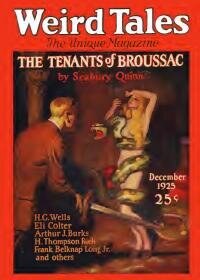
The Tenants of Broussac
First published in Weird Tales, December 1925 (vol. 6, no. 6). Novelette. Jules de Grandin.
United States public domain. Held in the Reading Room of The Weird Library. Published by Weird Tales.
The Rue des Batailles was justifying its name. From my table on the narrow sidewalk before the Café de Liberté I could view three distinct fights alternately, or simultaneously. Two cock-sparrows contended noisily for possession of a wisp of straw, a girl with unbelievably small feet and incredibly thick ankles addressed a flood of gamin abuse to an oily-haired youth who wore a dirty black-silk muffler in lieu of a collar. At the curb a spade-bearded patron, considerably the worse for vin ordinaire, haggled volubly with an unshaven taxi chauffeur of five francs.
I had dropped my cigar end into my empty coffee cup, motioned the waiter for my addition and shoved back my chair, when a light but commanding tap fell on my shoulder.
"Now for it," I muttered, feeling sure some passing bravo, aching for a fight, had chosen me for his attentions. Turning suddenly, I looked straight into a pair of light-blue eyes, round as a cat's, and just missing a humorous expression because of their challenging directness. Beneath the eyes was a straw-colored mustache, trimly waxed into a horizontal line and bristling so belligerently as to heighten its wearer's resemblance to a truculent tom-cat. Below the feline mustache was a grin wider and friendlier than any I'd seen in Paris.
"Par la barbe d'un bouc vert!" swore my accoster. "If it is not truly my friend, the good Dr. Trowbridge, then I am first cousin to the Emperor of China."
"Why, de Grandin," I exclaimed, grasping his small sinewy hand, "fancy meeting you this way! I called at the École de Médecine the day after I arrived, but they told me you were off on one of your wild goose chases and only heaven knew when you'd be back."
He tweaked the points of his mustache alternately as he answered with another grin. "But of course! Those dull-witted ones would term my researches in the domain of inexact science a wild goose hunt. Pardieu! They have no vision beyond their test tubes and retorts, those ones."
"What is it this time?" I asked as we caught step. "A criminal investigation or a ghost-breaking expedition?"
"Morbleu!" he answered with a chuckle; "I think, perhaps, it is a little of both. Listen, my friend, do you know the country about Rouen?"
"Not I," I replied. "This is my first trip to France, and I've been here only three days."
"Ah, yes," he returned, "your ignorance of our geography is truly deplorable; but it can be remedied. Have you an inflexible program mapped out?"
"No. This is my first vacation in ten years, and I've made no plans, except to get as far away from medicine as possible."
"Good!" he applauded. "I can promise you a complete change from your American practise, my friend, such a change as will banish all thoughts of patients, pills and prescriptions entirely from your head. Will you join me?"'
"Hm, that depends," I temporized. "What sort of case are you working on?" Discretion was the better part of acceptance when talking with Jules de Grandin, I knew. Educated for the profession of medicine, one of the foremost anatomists and physiologists of his generation, and a shining light in the University of Paris faculty, this restless, energetic little scientist had chosen criminology and occult investigation as a recreation from his vocational work, and had gained almost as much fame in these activities as he had in the medical world. During the war he had been a prominent, though necessarily anonymous, member of the Allied Intelligence Service, since the Armistice he had penetrated nearly every quarter of the globe on special missions for the French Ministry of Justice. It behooved me to move cautiously when he invited me to share an exploit with him; the trail might lead to India, Greenland or Tierra del Fuego before the case was closed.
"Eh bien," he laughed. "You are ever the old cautious one, Friend Trowbridge. Never will you commit yourself until you have seen blue-prints and specifications of the enterprize. Very well, then, listen:
"Near Rouen stands the very ancient château of the de Broussac family. Parts of it were built as early as the Eleventh Century, none of it is less than two hundred years old. The family has dwindled steadily in wealth and importance until the last two generations have been reduced to living on the income derived from renting the château to wealthy foreigners.
"A common story, n'est-ce-pas? Very well, wait, comes now the uncommon part: Within the past year the Château Broussac has had no less than six tenants; no renter has remained in possession for more than two months, and each tenancy has terminated in a tragedy of some sort.
"Stories of this kind get about; houses acquire unsavory reputations, even as people do, and tenants are becoming hard to find for the château. Monsieur Bergeret, the de Broussae family's avoué, has commissioned me to discover the reason for these interrupted tenancies; he desires me to build a dam against the flood of ill fortune which makes tenants scarce at the château and threatens to pauperize one of the oldest and most useless families of France."
"You say the tenancies were terminated by tragedies?" I asked, more to make conversation than from interest.
"But yes," he answered. "The cases, as I have their histories, are like this:
"Monsieur Alvarez, a wealthy Argentine cattle raiser, rented the château last April. He moved in with his family, his servants and entirely too many cases of champagne. He had lived there only about six weeks when, one night, such of the guests as retained enough soberness to walk to bed missed him at the good-night round of drinks. He was also missing the following morning, and the following night. Next day a search was instituted, and a servant found his body in the chapel of the oldest part of the château. Morbleu, all the doctors in France could not reassemble him! Literally, my friend, he was strewn about the sanctuary; his limbs tom off, his head severed most untidily at the neck, every bone in his trunk smashed like crockery in a china store struck by lightning. He was like a doll pulled to pieces by a peevish child. Voilà, the Alvarez family decamped the premises and the Van Brundt family moved in.
"That Monsieur Van Brundt had amassed a fortune selling supplies to the sale Boche during the war. Eh bien, I could not wish him the end he had. Too much food, too much wine, too little care of his body he took. One night he rose from his bed and wandered in the château grounds. In the place where the ancient moat formerly was they found him, his thick body thin at last, and almost twice its natural length—squeezed out like a tube of crème from a lady's dressing table trodden under foot by an awkward servant. He was not a pretty sight, my friend.
"The other tenants, too, all left when some member of their families or suites met a terrifying fate. There was Simpson, the Englishman, whose crippled son fell from the battlements to the old courtyard, and Biddle, the American, whose wife now shrieks and drools in a madhouse, and Muset, the banker from Montreal, who woke one night from a doze in his study chair to see Death staring him in the eye.
"Now Monsieur Luke Bixby, from Oklahoma, resides at Broussae with his wife and daughter, and—I wait to hear of a misfortune in their midst.
"You will come with me? You will help me avert peril from a fellow countryman?"
"Oh, I suppose so," I agreed. One part of France appealed to me as strongly as another, and de Grandin was never a dull companion.
"Ah, good," he exclaimed, offering his hand in token of our compact. "Together, mon vieux, we shall prove such a team as the curse of Broussac shall find hard to contend with."
2
The sun was well down toward the horizon when our funny little train puffed officiously into Rouen the following day. The long European twilight had dissolved into darkness, and oblique shadows slanted from the trees in the nascent moonlight as our hired moteur entered the château park.
"Good evening, Monsieur Bixby," de Grandin greeted as we followed the servant into the great hallway. "I have taken the liberty to bring a compatriot of yours. Dr. Trowbridge, with me to aid in my researches." He shot me a meaning glance as he hurried on. "Your kindness in permitting me the facilities of the château library is greatly appreciated, I do assure you."
Bixby, a big, full-fleshed man with ruddy face and drooping mustache, smiled amiably. "Oh, that's all right, Monsoor," he answered. "There must be a couple o' million books stacked up in there, and I can't read a one of 'em. But I've got to pay rent on 'em, just the same, so I'm mighty glad you, or someone who savvies the lingo, can put 'em to use."
"And Madame Bixby, she is well, and the so charming Mademoiselle, she, too, is in good health, I trust?"
Our host looked worried. "To tell you the truth, she ain't," he replied. "Mother and I had reckoned a stay in one of these old houses here in France would be just the thing for her, but it seems like she ain't doin' so well as we'd hoped. Maybe we'd better try Switzerland for a spell; they say the mountain air there—"
Dr. Grandin bent forward eagerly. "What is the nature of Mademoiselle's indisposition?" he asked. "Dr. Trowbridge is one of your America's most famous physicians, perhaps he—" He paused significantly.
"That so?" Bixby beamed on me. "I'd kind o' figured you was one of them doctors of philosophy we see so many of round here, 'stead of a regular doctor. Now, if you'd be so good as to look at Adrienne, Doc, I'd take it right kindly. Will you come this way? I'll see supper's ready by the time you get through with her."
He led us up a magnificent stairway of ancient carved oak, down a corridor paneled in priceless wainscot, and knocked gently at a high-arched door of age-blackened wood. "Adrienne, darlin'," he called in a huskily tender voiee, "here's a doctor to see you—an American doctor, honey. Can you see him?"
"Yes," came the reply from beyond the door, and we entered a bedroom as large as a barrack, furnished with articles of antique design worth their weight in gold to any museum rich enough to buy them.
Fair-haired and violet-eyed, slender to the borderline of emaciation, and with too high a flush on her cheeks, Bixby's daughter lay propped among a heap of real-lace pillows on the great carved bed, the white of her thin throat and arms only a shade warmer than the white of her silk nightdress.
Her father tiptoed from the room with clumsy care and I began my examination, observing her heart and lung action by auscultation and palpation, taking her pulse and estimating her temperature as accurately as possible without my clinical thermometer. Though she appeared suffering from fatigue there was no evidence of functional or organic weakness in any of her organs.
"Hm." I muttered, looking as professionally wise as possible, "just how long have you felt ill, Miss Bixby?"
The girl burst into a storm of tears. "I'm not ill,” she denied hotly. "I'm not—oh, why won't you all go away and leave me alone? I don't know what's the matter with me. I—I just want to be let alone!" She buried her face in a pillow and her narrow shoulders shook with sobs.
"Friend Trowbridge," de Grandin whispered, "a tonic—something simple, like a glass of sherry with meals—is indicated, I think. Meantime, let us repair to the so excellent supper which waits below."
We repaired. There was nothing else to do. His advice was sound, I knew, for all the physician's skill is powerless to cheer a young woman who craves the luxury of being miserable.
3
Find anything serious, Doc?" Bixby asked as de Grandin and I seated ourselves in the château's paneled dining hall.
"No," I reassured him. "She seems a little run down, but there's certainly nothing wrong which can't be corrected by a light tonic, some judicious exercise and plenty of rest."
"Uh-huh?" he nodded, brightening. "I've been right smart worried over her, lately.
"You know, we wasn't always rich. Up to a couple o' years ago we was poor as church mice—land poor, in the bargain. Then, when they begun findin' oil all round our place, Mother kept at me till I started some drillin,' too, and darned if we didn't bring in a gusher first crack outa the box.
"Adrienne used to teach school when we was ranchin' it—tryin' to, rather—an' she an' a young lawyer, name o' Ray Keefer, had it all fixed up to get married.
"Ray was a good, upstandin' boy, too. Had a considerable practise worked up over Bartleville way, took his own company overseas durin' the war, an' would a' been run for the legislature in a little while, like as not. But when we started takin' royalties on our leases at the rate of about three hundred dollars a week, Mother, she ups and says he warn't no fittin' match fittin' match for our daughter.
"Then she and Adrienne had it hot an' heavy, with me stayin' outa the fuss an' bein' neutral, as far as possible. Mother was all for breakin' the engagement off short, Adrienne was set on gettin' married right away, an' they finally compromised by agreein' to call a truce for a year while Ray stayed home an' looked after his practise an' Adrienne come over here to Europe with Mother an' me to see the world an' 'have her mind broadened by travel,' as Mother says.
"She's been gettin' a letter from Ray at every stop we made since we left home, an' sendin' back answers just as regular, till we come here. Lately she ain't seemed to care nothin' about Ray, one way or other. Don't answer his letters—half the time don't trouble to open 'em, even, an' goes around the place as if she was sleep-walkin'. Seems kind o' peaked an' run down, like, too. We've been right worried over her. You're sure it ain't consumption, or nothin' like that, Doc?" He looked anxiously at me again.
"Have no fear, Monsieur," de Grandin answered for me. "Dr. Trowbridge and I will give the young lady our greatest care; rest assured, we shall effect a complete cure. We—"
Two shots, following each other in quick succession, sounded from the grounds outside, cutting short his words. We rushed to the entrance, meeting a breathless gamekeeper in the corridor. "Le serpent, le serpent!" he exclaimed excitedly, rushing up to Bixby. "Ohé, Monsieur, un serpent monstrueux, dans le jardin!"
"What is it you say?" de Grandin demanded. "A serpent in the garden? Where, when; how big?"
The fellow spread his arms to their fullest reach, extending his fingers to increase the space compassed. "A great, a tremendous serpent, Monsieur," he panted. "Greater than the boa constrictor in the Paris menagerie—ten meters long, at the shortest!"
"Pardieu, a snake thirty feet long?" de Grandin breathed incredulously. "Come, mon enfant, take us to the spot where you saw this so great zoological wonder."
"Here, 'twas here I saw him, with my own two eyes," the man almost screamed in his excitement, pointing to a small copse of evergreens growing close beside the château wail. "See, it's here the shots I fired at him cut the bushes"—he pointed to several broken limbs where buckshot from his fowling piece had crashed through the shrubs.
"Here? Mon Dieu!" muttered de Graudin.
"Huh!" Bixby produced a plug of tobacco and bit off a generous mouthful. "If you don't lay off that brandy they sell down at the village you'll be seein' pink elephants roostin' in the trees pretty soon. A thirty-foot snake! In this country? Why, we don't grow 'em that big in Oklahoma! Come on, gentlemen, let's get to bed; this feller's snake didn't come out o' no hole in the wall, he came outa a bottle!"
4
Mrs. Bixby, a buxom woman with pale eyes and tinted hair, had small courtesy to waste on us next morning at breakfast. A physician from America who obviously did not enjoy an ultra fashionable practise at home, and an undersized foreigner with a passion for old books, bulked of small importance in her price-marked world. Bixby was taciturn with the embarrassed silence of a wife-ridden man before strangers, and de Grandin and I went into the library immediately following the meal without any attempt at making table talk.
My work consisted, for the most part, of lugging ancient volumes in scuffed bindings from the high shelves and piling them on the table before my colleague. After one or two attempts I gave over the effort to read them, since those not in archaic French were in monkish Latin, both of which were as unintelligible to me as Choctaw.
The little Frenchman, however, dived into the moldering tomes like a gourmet attacking a feast, making voluminous notes, nodding his head furiously as statement after statement in the books seemed to confirm some theory of his, or muttering an occasional approving "Morbleu!" or "Pardieu!"
"Friend Trowbridge," he looked up from the dusty book spread before him and fixed me with his unwinking stare, "is it not time you saw our fair patient? Go to her, my friend, and whether she approves or whether she objects, apply the stethoscope to her breast, and, while you do so, examine her torso for bruises."
"Bruises?" I echoed.
"Precisely, exactly, quite so!" he shot back. "Bruises, I have said it. They may be of the significance; they may not, but if they are present I desire to know it. I have an hypothesis."
"Oh, very well," I agreed, and went to find my stethoscope.
Though she had not been present at breakfast, I scarcely expected to find Adrienne Bixby in bed, for it was nearly noon when I rapped at her door.
"S-s-s-sh, Monsieur le Docteur," cautioned the maid who answered my summons, "Mademoiselle is still asleep. She is exhausted, the poor, pretty one."
"Who is it, Roxanne?" Adrienne demanded in a sleepy, querulous voice. "Tell them to go away."
I inserted my foot in the door and spoke softly to the maid. "Mademoiselle is more seriously ill than she realizes; it is necessary that I make an examination."
"Oh, good morning, doctor," the girl said as I brushed past the maid and approached the bed. Her eyes widened with concern as she saw the stethoscope dangling from my hand. "Is—is there anything the matter—seriously the matter with me?" she asked. "My heart? My lungs?"
"We don't know yet," I evaded. "Very often, you know, symptoms which seem of no importance prove of the greatest importance; then, again, we often find that signs which seem serious at first mean nothing at all. That's it, just lie back, it will be over in a moment."
I placed the instrument, against her thin chest, and, as I listened to the accelerated beating of her healthy young heart, glanced quickly down along the line of her ribs beneath the low neckband of her nightrobe.
"Oh, oh, doctor, what is it?" the girl cried in alarm, for I had started back so violently that one of the ear-phones was shaken from my head. Around the young girl's body, over the ribs, was an ascending livid spiral, definitely marked, as though a heavy rope had been wound about her, then drawn taut.
"How did you get that bruise?" I demanded, tucking my stethoscope into my pocket.
A quick flush mantled her neck and cheeks, but her eyes were honest, as she answered simply, "I don't know, doctor. It's something I can't explain. When we first came here to Broussac I was as well as could be; we'd only been here about three weeks when I began to feel all used up in the morning. I'd go to bed early and sleep late and spend most of the day lying around, but I never seemed to get enough rest. I began to notice these bruises about that time, too. First they were on my arm, about the wrist or above the elbow—several times all the way up. Lately they've been around my waist and body, sometimes on my shoulders, too, and every morning I feel tireder than the day before. Then—then"—she turned her face from me and tears welled in her eyes—"I don't, seem to be interested in th-things the way I used to be. Oh, doctor, I wish I were dead! I'm no earthly good, and—"
"Now, now," I soothed. "I know what you mean when you say you've lost interest in 'things'. There'll be plenty of interest when you get back to Oklahoma again, young lady."
"Oh, doctor, are we going back, really? I asked Mother if we mightn't yesterday and she said Dad had leased this place for a year and we'd have to stay until the lease expired. Do you mean she’s changed her mind?"
"M'm, well," I temporized, "perhaps you won't leave Broussac right away; but you remember that old saying about Mohammed and the mountain? Suppose we were to import a little bit of Oklahoma to France, what then?"
"No!" She shook her head vigorously and her eyes filled with tears again. "I don't want Ray to come here. This is an evil place, doctor. It makes people forget all they ever loved and cherished. If he came here he might forget me as—" the sentence dissolved in a fresh flood of tears.
"Well, well," I comforted, "we'll see if we can't get Mother to listen to medical advice."
"Mother never listened to anybody's advice," she sobbed as I closed the door softly and hurried downstairs to tell de Grandin my discovery.
5
"CORDIEU!" de Grandin swore excitedly as I concluded my recitation. "A bruise? A bruise about her so white body, and before that on her arms? Non d'un nom! My friend, this plot, it acquires the thickness. What do you think?"
"M'm." I searched my memory for long-forgotten articles in the Medical Times. "I've read of these stigmata appearing on patients' bodies. They were usually connected with the presence of some wasting disease and an abnormal state of mind, such as extreme religious fervor, or—"
"Ah, bah!" he cut in. "Friend Trowbridge, you can not measure the wind with a yardstick nor weigh a thought on the scales. We deal with something not referable to clinical experiments in this case, or I am much mistaken."
"Why, how do you mean—?" I began, but he turned away with an impatient shrug. "I mean nothing, now," he answered. "The wise judge is he who gives no decision until he has heard all the testimony." Again he commenced reading from the huge volume open before him, making notations on a slip of paper as his eyes traveled rapidly down the lines of faded type.
Mrs. Bixby did not join us at dinner that evening, and, as a consequence, the conversation was much less restrained. Coffee was served in the small corridor connecting the wide entrance hall with the library, and, under the influence of a hearty meal, three kinds of wine and several glasses of liqueur, our host expanded like a flower in the sun.
"They tell me Jo-an of Arch was burned to death in Ruin," he commented as he bit the end from a cigar and elevated one knee over the arm of his chair. "Queer way to treat a girl who'd done so much for 'em, seems to me. The guide told us she's been made a saint or somethin' since then, though."
"Yes," I assented idly, "having burned her body and anathematized her soul, the ecclesiastical authorities later decided the poor child's spirit was unjustly condemned. Too bad a little of their sense of justice wasn't felt by the court which tried her in Rouen."
De Grandin looked quizzically at me as he pulled his waxed mustaches alternately, for all the world like a tom-cat combing his whiskers. "Throw not too many stones, my friend," he cautioned. "Nearly five hundred years have passed since the Maid of Orleans was burned as a heretic. Today your American courts convict high school teachers for heresy far less grave than that charged against our Jeanne. We may yet see the bones of your so estimable Thomas Jefferson and Benjamin Franklin exhumed from their graves and publicly burned by your heretic-baiters of this today. No, no, my friend, it is not for us of today to sneer at the heretic-burners of yesterday. Torquemada's body lies in the tomb these many years, but his spirit still lives. Mon Dieu! What is it that I say? 'His spirit still lives'? Sacré nom d'une souris! That may be the answer!" And, as if propelled by a spring, he bounded from his seat and rushed madly down the corridor into the library.
"De Grandin, what's the matter?" I asked as I followed him into the book-lined room.
"Non, non, go away, take a walk, go to the devil!" he shot back, staring wildly around the room, his eager eyes searching feverishly for a particular volume. "You vex me, you annoy me, you harass me; I would be alone at this time. Get out!"
Puzzled and angered by his bruskness, I turned to leave, but he called over his shoulder as I reached the door: "Friend Trowbridge, please interview Monsieur Bixby's chef and obtain from him a sack of flour. Bring it here to me in not less than an hour, please."
6
Forgive my rudeness, Friend Trowbridge," he apologized when I re-entered the library an hour or so later, a parcel of flour from Bixby's pantry under my arm. "I had a thought which required all my concentration at the time, and any disturbing influence—even your own always welcome presence—would have distracted my attention. I am sorry and ashamed I spoke so."
"Oh, never mind that," I replied. "Did you find what you were looking for?"
He nodded emphatically. "Mais oui," he assured me. "All which I sought—and more. Now let us to work. First I would have you go with me into the garden where that gamekeeper saw the serpent last night."
"But he couldn't have seen such a snake," I protested as we left the library. "We all agreed the fellow was drunk."
"Surely, exactly; of course," he conceded, nodding vigorously. "Undoubtedly the man had drunk brandy. Do you recall, by any chance, the wise old Latin proverb, 'In vino veritas'?"
"'In wine is truth'?" I translated tentatively. "How could the fact that the man was drunk when he imagined he saw a thirty-foot snake in a French garden make the snake exist when we know perfectly well such a thing could not be?"
"Oh la, la," he chuckled. "What a sober-sided one you are, cher ami. It was here the fellow declared Monsieur le Serpent emerged, was it not? See, here are the shot-marks on the shrubs."
He bent, parting the bushes carefully, and crawled toward the château's stone foundation. "Observe," he commanded in a whisper, "between these stones the cement has weathered away, the opening is great enough to permit passage of a sixty-foot serpent, did one desire to come this way. No?"
"True enough," I agreed, "but the driveway out there would give room for the great Atlantic sea serpent himself to crawl about. You don't contend he's making use of it, though, do you?"
He tapped his teeth thoughtfully with his forefinger, paying no attention to my sarcasm. "Let us go within," he suggested, brushing the leaf-mold carefully from his knees as he rose.
We re-entered the house and he led the way through one winding passage after another, unlocking a succession of nail-studded doors with the bunch of jangling iron keys he obtained from Bixby's butler.
"And here is the chapel," he announced when half an hour's steady walk brought us to a final age-stained door. "It was here they found that so unfortunate Monsieur Alvarez. A gloomy place in which to die, truly."
It was, indeed. The little sanctuary lay dungeon-deep, without windows or, apparently, any means of external ventilation. Its vaulted roof was composed of a series of equilateral arches whose stringers rose a scant six feet above the floor and rested on great blocks of flint carved in hideous designs of dragons' and griffins' heads. The low altar stood against the farther wall, its silver crucifix blackened with age and all but eaten away with corrosion. Row on row, about the low upright walls, were lined the crypts containing the coffins of long dead de Broussacs, each closed with a marble slab engraved with the name and title of its occupant. A pall of cobwebs, almost as heavy as woven fabrics, festooned from vaulted ceiling to floor, intensifying the air of ghostly gloom which hung about the chamber like the acrid odor of ancient incense.
My companion set the flickering candle-lantern upon the floor beside the doorway and broke open the package of flour. "See, Friend Trowbridge, do as I do," he directed, dipping his hand into the flour and sprinkling the white powder lightly over the flagstone pavement of the chapel. "Back away toward the door," he commanded, "and on no account leave a footprint in the meal. We must have a fair, unsoiled page for our records."
Wonderingly, but willingly, I helped him spread a film of flour ever the chapel floor from altar-step to doorway, then turned upon him with a question: "What do you expect to find in this meal, de Grandin? Surely not footprints. No one who did not have to would come to this ghastly place."
He nodded seriously at me as he picked up his lantern and the remains of the package of flour. "Partly right and partly wrong you are, my friend. One may come who must, one may come who wants. Tomorrow, perhaps, we shall know more than we do today."
7
I was in the midst of my toilet, when he burst into my bedroom next morning, feline mustache bristling, his round eyes fairly snapping with excitement. "Come, mon vieux," he urged, tugging at my arm as a nervous terrier might have urged his master to go for a romp, "come and see; right away, quick, at once, immediately!"
We hastened through the château's modern wing, passed the doors blocking the corridors of the Fifteenth Century buildings and came at last to the Eleventh Century chapel. De Grandin paused before the oak-and-iron door like a showman about to raise the curtain from an exhibit as he lit the candle in his lantern, and I heard his small, even teeth clicking together in a chill of suppressed excitement. "Behold, mon ami," he commanded in a hoarse whisper more expressive of emotion than a shout, "behold what writings are on the page which we did prepare!"
I looked through the arched doorway, then turned to him, dumb with surprize.
Leading from the chapel entrance, and ending at the center of the floor, directly before the altar, was the unmistakable trail of little, naked feet. No woodcraft was needed to trace the walker's course. She had entered the sanctuary, marched straight and unswervingly to a spot about fifteen feet from the altar, but directly before it, then turned about slowly in a tiny circle, no more than two feet in diameter, for at that point the footprints were so superimposed on each other that all individual traces were lost.
But the other track which showed in the strewn flour was less easily explained. Beginning at a point directly opposite the place the footprints ceased, this other trail ran some three or four inches wide in a lazy zigzag, as though a single automobile wheel had been rolled in on uncertain course across the floor by someone staggeringly drunk. But no prints of feet followed the wheel-track. The thing had apparently traversed the floor of its own volition.
"See," de Grandin whispered, "flour-prints lead away from the door"—he pointed to a series of white prints, plainly describing bare heels and toes, leading up the passage from the chapel door, diminishing in clearness with each step until they faded out some ten paces toward the modern part of the château. "And see," he repeated, drawing me inside the chapel to the wall where the other, inexplicable, track began, "a trail leads outward here, too."
Following his pointing finger with my eye I saw what I had not noticed before, a cleft in the chapel wall some five inches wide, evidently the result of crumbling cement and gradually sinking foundation stones. At the entrance of the fissure a tiny pile of flour showed, as though some object previously dusted with the powder had been forced through the crevice.
I blinked stupidly at him. "Wh-what is this track?" I asked in bewilderment.
"Ah, bah!" he exclaimed disgustedly. "The blindest man is he who shuts his own eyes, my friend. Did you never, as a boy, come upon the trail of a serpent in the dusty road?"
"A snake track"—my mind refused the evidence of my eyes—"but how can that be—here?"
"The gamekeeper thought he saw a serpent in the garden exactly outside this chapel," de Grandin replied in a low voice, "and it was where that besotted gamekeeper imagined he beheld a serpent that the body of Mijnheer Van Brandt was found crushed out of semblance to a human man. Tell me. Friend Trowbridge,—you know something of zoology—what creature, besides the constrictor-snake, kills his prey by crushing each bone of his body till nothing but shapeless pulp remains? Hein?"
"Bu—but—" I began, when he cut me short:
"Go call on our patient," he commanded. "If she sleeps, do not awaken her, but observe the drugget on her floor!"
I hastened to Adrienne Bixby's room, pushed unceremoniously past Roxanne, the maid, and tiptoed to the girl's bedside. She lay on her side, one cheek pillowed on her arm, sleeping the sleep of utter exhaustion. I bent over her a moment, listening to her even breathing, then, nodding to the maid, turned and walked softly from the room, my eyes glued to the dark-red plush carpet which covered the chamber floor.
Five minutes later I met the little Frenchman in the library, my excitement now as high as his own. "De Grandin," I whispered, involuntarily lowering my voice, "I looked at her carpet. The thing's made of red velvet and shows a spot of dust ten feet away. A trail of faint white footprints leads right up to her bed!"
8
"Sacré nom d'un petit bonhomme!" He reached for his green felt hat and turned toward the door. "The trail becomes clear; even my good, skeptical friend Trowbridge can follow it, I think. Come cher ami, let us see what we can see."
He led me through the château park, between the rows of tall, trembling poplar trees, to a spot where black-boughed evergreens cast perpetual shade above a stone-fenced area of a scant half acre. Rose bushes, long deteriorated from their cultivated state, ran riot over the ground, the whole enclosure had the gloomy aspect of a deserted cemetery. "Why," I asked, "what place is this, de Grandin? It's as different from the rest of the park as—"
"As death is from life, n'est-ce-pas?" he interjected. "Yes, so it is, truly. Observe." He parted a mass of intertwined brambles and pointed to a slab of stone, once white, but now brown and roughened with centuries of exposure. "Can you read the inscription?" he asked.
The letters, once deeply cut in the stone, were almost obliterated, but I made out:
CI GÎT TOUJOURS RAIMOND SEIGNEUR DE BROUSSAC
"What does it say?" he demanded.
"'Here lies Raimond, Lord of Broussac,'" I replied, translating as well as I could.
"Non, non," he contradicted. "It does not say, 'Ci gît,' here lies; but 'Ci gît toujours,'—here lies always, or forever. Eh, my friend, what do you make of that if anything?"
"Dead men usually lie permanently," I countered.
"Ah, so? Have I not heard your countrymen sing:
"What of the poor Seigneur de Broussac, is he to lie buried here toujours, or shall he, too, not rise once again?"
"I'm not familiar with French idioms," I defended. "Perhaps the stonecutter merely intended to say the Seigneur de Broussac lies here for his last long sleep."
"Cher Trowbridge," de Grandin replied, speaking with slow impressiveness, "when a man's monument is carved the words are not chosen without due consideration. Who chose Raimond de Broussac's epitaph thought long upon its wording, and when he dictated those words his wish was father to his thought."
He stared thoughtfully at the crumbling stone a moment, repeating softly to himself, "And Madame l'abbesse said, 'Snake thou art, and—'" he shook his shoulders in an impatient shrug as though to throw off some oppressive train of thought. "Eh bien, but we waste time here, my friend; let us make an experiment." Turning on his heel he led the way to the stables.
"I would have some boards, a hammer and some sharp nails, if you please," he informed the hostler who greeted us at the barn door. "My friend, the very learned Docteur Trowbridge, from America, and I desire to test an idea."
When the servant brought the desired materials de Grandin sawed the boards into two lengths, one about eighteen inches, the other about three feet, and through these he drove the sharp-pointed horseshoe nails at intervals of about three-quarters of an inch, so that, when he finished, he had what resembled two large combs of which the boards were the backs and the needle-pointed nails the teeth. "Now," he announced, surveying his work critically, "I think we are prepared to give a little surprize party."
Taking up the hammer and two short pieces of boards in addition to his "combs" he led the way to the spot outside the château walls where the tipsy gamekeeper claimed to have seen the great snake. Here he attached the two strips of wood at right angles to the shorter of the pieces of board through which he had driven the nails, then, using the lateral lengths of wood as staked, attached the comblike contrivance he had made firmly to the earth, its back resting levelly on the ground, its sharp spikes pointing upward before the crevice in the château foundations. Any animal larger than an earthworm desiring to make use of the crack in the wall as a passageway would have to jump or crawl over the sharp, lancelike points of the nails. "Bien," he commented, viewing his work with approval, "now to put your wise American maxim of 'Safety First' into practise."
We found our way to the ancient, gloomy chapel, and he wedged the longer of the nail-filled boards firmly between the jambs at the inner side of the doorway. "And now," he announced, as we turned once more toward the inhabited part of the house, "I have the splendid appetite for dinner, and for sleep, too, when bedtime arrives.
"What on earth does all this child's play mean, de Grandin?" I demanded, my curiosity getting the better of me.
He winked roguishly by way of answer, whistled a snatch of tune. then remarked, irrelevantly, "If you have the desire to gamble, cher ami, I will lay you a wager of five francs that our fair patient will be improved tomorrow morning."
9
He won the bet. For the first time since we had been at Broussac, Adrienne Bixby was at the breakfast table the following day, and the healthy color in her cheeks and the clear sparkle of her lovely eyes told of a long, restful sleep.
Two more days passed, each seeing a marked improvement in her spirits and appearance. The purple semicircles beneath her eyes faded to a wholesome pink, her laughter rippled like the sound of a purling brook among the shadows of the château's gloomy halls.
"I gotta hand it to you, Doc," Bixby complimented me. "You've shore brought my little girl round in great shape. Name your figger an' I'll pay the bill, an' never paid one with a better heart, neither."
"Dr. Trowbridge," Adrienne accosted me one morning as I was about to join de Grandin in the library, "remember what you said about importing a little bit of Oklahoma to France the other day? Well, I've just received a letter—the dearest letter—from Ray. He's coming over—he'll be here day after tomorrow, I think, and no matter what Mother says or does, we're going to be married, right away. I've been Mrs. Bixby's daughter long enough; now I'm going to be Mr. Keefer's wife. If Mother makes Dad refuse to give us any money, it won't make the least little bit of difference. I taught school before Father got his money, and I know how to live as a poor man's wife. I'm going to have my man—my own man—and no one―no one at all—shall keep him away from me one day longer!"
"Good for you!" I applauded her rebellion. Without knowing young Keefer I was sure he must be a very desirable sort of person to have incurred the enmity of such a character as Bixby's wife.
But next morning Adrienne was not at breakfast, and the downcast expression of her father's face told his disappointment more eloquently than any words he could have summoned. "Reckon the girl's had a little set-back, Doc," he muttered, averting his eyes. His wife looked me fairly between the brows, and though she said never a word I felt she considered me a pretty poor specimen of medical practitioner.
"Mais non, Monsieur le Docteur," Roxanne demurred when I knocked at Adrienne's door, "you shall not waken her. The poor lamb is sleeping, she is exhaust this morning, and she shall have her sleep. I, Roxanne, say so."
Nevertheless, I shook Adrienne gently, rousing her from a sleep which seemed more stupor than slumber. "Come, come, my dear," I scolded, "this won't do, you know. You've got to brace up. You don't want Ray to find you in this condition, do you? Remember, he's due at Broussac tomorrow."
"Is he?" she answered indifferently. "I don't care. Oh, doctor, I'm—so—tired." She was asleep again, almost at the last word.
I turned back the covers and lifted the collar of her robe. About her body, purple as the marks of a whiplash, lay the wide, circular bruise, fresher and more extensive than it had been the day I first noticed it.
"Death of my life!" de Grandin swore when I found him in the library and told him what I had seen. "That sacré bruise again? Oh, it is too much! Come and see what else I have found this cursed day!" Seizing my hand he half led, half dragged me outdoors, halting at the clump of evergreens where he had fixed his nail-studded board beside the château wall.
Ripped from its place and lying some ten feet away was the board, its nails turned upward in the morning sunlight and reminding me, somehow, of the malicious grin from a fleshless skull.
"Why, how did this happen?" I asked.
He pointed mutely to the moist earth in which the dwarf cedars grew, his hand shaking with excitement and rage. In the soft loam beside the place where the board had been fixed were the prints of two tiny, bare feet.
"What's it mean?" I demanded, exasperated at the way he withheld information from me, but his answer was no more enlightening than any of his former cryptic utterances.
"The battle is joined, my friend," he replied through set teeth. "Amuse yourself as you will—or can—this day. I go to Rouen right away, immediately, at once. There are weapons I must have for this fight besides those we now have. Eh, but it will be a fight to the death! Yes, par la croix, and we shall help Death reclaim his own too. Pardieu! Am I not Jules de Grandin? Am I to be made a monkey of by one who preys on women? Morbleu, we shall see!"
And with that he left me, striding toward the stables in search of a motor car, his little yellow mustache bristling with fury, his blue eyes snapping, French oaths pouring from him like spray from a garden-sprinkler.
10
It was dark before he returned, his green hat set at a rakish angle over his right ear, a long, closely wrapped brown paper parcel under his arm. "Eh bien," he confided to me with an elfish grin, "it required much argument to secure this. That old priest, he is a stubborn one, and unbelieving, almost as skeptical as you, Friend Trowbridge."
"What on earth is it?" I demanded, looking curiously at the package. Except that it was too long, it might have been an umbrella, judging by its shape.
He winked mysteriously as he led the way to his room, where, having glanced about furtively, as though he apprehended some secret watcher, lie laid the bundle on the bed and began cutting the strings securing its brown paper swaddling clothes with his pocket knife. Laying back the final layer of paper he uncovered a long sword, such a weapon as I had never beheld outside a museum. The blade was about three and a half feet in length, tapering from almost four inches in width at the base to an inch and a half at the tip, where it terminated in a beveled point. Unlike modern weapons, this one was furnished with two sharpened edges, almost keen enough to do duty for a knife, and, instead of the usual groove found on the sides of sword blades, its center presented a distinct ridge where the steep bevels met at an obtuse angle as they sloped from the edges. The handle, made of ivory or some smoothly polished bone, was long enough to permit a two-handed grip, and the hilt which crossed the blade at a right angle turned downward toward the point, its ends terminating in rather clumsily carved cherubs' heads. Along the blade, apparently carved, rather than etched, marched a procession of miscellaneous angels, demons and men at arms with a mythological monster, such as a griffin or dragon, thrown in for occasional good measure. Between these crudely carved figures I made out the letters of the motto: Dei Gratia—by the grace of God.
"Well?" I asked wonderingly as I viewed the ancient weapon.
"Well?" he repeated mockingly, then: "Had you as many blessings on your head as this old bit of carved metal has received, you would be a very holy man, indeed, Friend Trowbridge. This sword, it was once strapped to the thigh of a saint—it matters not which one—who fought the battles of France when France needed all the champions, saintly or otherwise, she could summon. For centuries it has reposed in a very ancient church at Rouen, not, indeed, as a relic, but as a souvenir scarcely less venerated. When I told the curé I purposed borrowing it for a day or more I thought he would die of the apoplexy forthwith, but"—he gave his diminutive mustache a complacent tweak—"such was my power of persuasion that you see before you the very sword."
"But what under heaven will you do with the thing, now you've got it?" I demanded.
"Much—perhaps," he responded, picking up the weapon, which must have weighed at least twenty pounds, and balancing it in both hands as a wood-chopper holds his ax before attacking a log.
"Nom d'un bouc!" he glanced suddenly at his wrist-watch and replaced the sword on his bed. "I do forget myself. Run, my friend, fly, fly like the swallow to Mademoiselle Adrienne's room and caution her to remain within—at all hazards. Bid her close her windows, too, for we know not what may be abroad or what can climb a wall this night. See that stubborn, pig-foolish maid of hers has instructions to lock her mistress' door on the inside and, should Mademoiselle rise in the night and desire to leave, on no account permit her to pass. You understand?"
"No, I'll be hanged if I do." I replied. "What—?"
"Non, non!" he almost shrieked. "Waste not time nor words, my friend. I desire that you should do as I say. Hurry, I implore; it is of the importance, I do assure you."
I did as he requested, having less difficulty than I had expected concerning the windows, since Adrienne was already sunk in a heavy sleep and Roxanne possessed the French peasant's inborn hatred of fresh air.
"Good, very, very, very good," de Grandin commended when I rejoined him. "Now we shall wait until the second quarter of the night—then, ah, perhaps I show you something to think about in the after years, Friend Trowbridge."
He paced the floor like a caged animal for a quarter-hour, smoking one cigarette after another, then: "Let us go," he ordered curtly, picking up the giant sword and shouldering it as a soldier does his rifle. "Aller au feu!"
We tramped down the corridor toward the stairway, when he turned quickly, almost transfixing me with the sword blade, which projected two feet and more beyond his shoulder. "One more inspection, Friend Trowbridge," he urged. "Let us see how it goes with Mademoiselle Adrienne. Eh bien, do we not carry her colors into battle this night?"
"Never mind that monkey-business!" we heard a throaty feminine voice command as we approached Adrienne's room. "I've stood about all I intend to from you; tomorrow you pack your clothes, if you've any to pack, and get out of this house."
"Eh, what is this?" de Grandin demanded as we reached the chamber door and beheld Roxanne weeping bitterly, while Mrs. Bixby towered over her like a Cochin hen bullying a half-starved sparrow.
"I'll tell you what it is!" replied the irate mistress of the house. "I came to say good-night to my daughter a few minutes ago and this—this hussy!—refused to open the door for me. I soon settled her, I can tell you. I told her to open that door and get out. When I went into the room I found every window locked tight—in this weather, too.
"Now I catch her hanging around the door after I'd ordered her to her room. Insubordination; rank insubordination, it is. She leaves this house bright and early tomorrow morning, I can tell you!"
"Oh, Monsieur Trow-breege, Monsieur de Grandin," sobbed the trembling girl, "I did but attempt to obey your orders, and—and she drove me from my duty. Oh, I am so sorree!
De Grandin's small teeth shut with a snap like a miniature steel trap. "And you forced this girl to unbar the door?" he asked, almost incredulously, gazing sternly at Mrs. Bixby.
"I certainly did," she bridled, "and I'd like to know what business it is of yours. If—"
He brushed by her, leaping into the bedroom with a bound which carried him nearly two yards beyond the doorsill.
We looked past him toward the bed. It was empty. Adrienne Bixby was gone.
"Why—why, where can she be?" Mrs. Bixby asked, her domineering manner temporarily stripped from her by surprize.
"I'll tell you where she is!" de Grandin, white to the lips, shouted at her. "She is where you have sent her, you meddling old ignoramus, you, you—oh, mon Dieu, if you were a man how I should enjoy cutting your heart out!"
"Say, see here———" she began, her bewilderment sunk in anger, but he cut her short with a roar.
"Silence, you! To your room, foolish, criminally foolish one, and pray le bon Dieu on your bare knees that the pig-ignorance of her mother shall not have cost your daughter her life this night! Come, Trowbridge, my friend, come away; the breath of this woman is a contamination, and we must hurry if we are to undo her fool's work. Pray God we are not too late!"
We rushed downstairs, traversed the corridors leading to the older wing of the house, wound our way down and down beneath the level of the ancient moat till we stood before the entrance of the chapel.
"Ah," de Grandin breathed softly, lowering his sword point a moment as he dashed the sweat from his forehead with the back of his hand, "no sound, Friend Trowbridge. Whatever happens, whatever you may see, do not cry out; 'tis death to one we seek to save if you waken her!"
Raising his hand, be signed himself quickly with the cross, muttering an indistinct in nomine, while I gaped in amazement to see the cynical, scoffing little man of science shedding his agnosticism and reverting to a simple act of his childhood's faith.
Lifting the sword in both hands, he gave the chapel door a push with his foot, whispering to me, "Hold high the lantern, Friend Trowbridge, we need light for our work."
The rays from my lamp streamed across the dark, vaulted chapel and I nearly let the lantern crash to the door at what I beheld.
Standing before the ancient, tumbledown altar, her nude, white body gleaming in the semi-dark like a lovely, slender statue of sun-stained marble, was Adrienne Bixby. Her long, rippling hair, which had always reminded me of molten gold in the assayer's crucible, streamed over her shoulders to her waist, one arm was raised in a gesture of absolute abandon while her other hand caressed some object which swayed and undulated before her. Parted in a smile such as Circe, the enchantress, might have worn when she lured men to their ruin, her red lips were drawn back from her gleaming teeth, while she crooned a slow, sensuous melody the like of which I had never heard, nor wish to hear again.
My astounded eyes took this in at first glance, but it was my second look which sent the blood coursing through my arteries like river-water in zero weather. About her slender, virginal torso, ascending in a spiral from hips to shoulders, was the spotted body of a gigantic snake.
The monster's horrid, wedge-shaped head swung and swayed a scant half-inch before her face, and its darting, lambent tongue licked lightly at her parted lips.
But it was no ordinary serpent which held her, a laughing prisoner, in its coils. Its body shone with alternate spots of green and gold, almost as if the colors were laid on in luminous paint, its flickering tongue was red and glowing as a flame of fire, and in its head were eyes as large and blue as those of human kind, but set and terrible in their expression as only the eyes of a snake can be.
Scarcely audible, so low his whisper was, de Grandin hissed a challenge as he hurled himself into the chapel with one of his lithe, catlike leaps: "Snake thou art, Raimond de Broussac, and snake thou shalt become! Garde à vous!"
With a slow, sliding motion, the great serpent turned its head, gradually released its folds from the leering girl's body and slipped to the floor, coiled its length quickly, like a giant spring, and launched itself like a flash of green-and-gold lightning at de Grandin!
But quick as the monster's attack was, de Grandin was quicker. Like the shadow of a flying hawk, the little Frenchman slipped aside, and the reptile's darting head crashed against the chapel's granite wall with an impact like a wave slapping a ship's bow.
"One!" counted de Grandin in a mocking whisper, and swung his heavy sword, snipping a two-foot length from the serpent's tail as neatly as a sempstress snips a thread with her scissors. "En garde, fils du diable!"
Writhing, twisting, turning like a spring from which the tension has been loosed, the serpent gathered itself for another onslaught, its malign, human-seeming eyes glaring implacable hatred at de Grandin.
Not this time did the giant reptile launch a battering-ram blow at its adversary. Instead, it reared itself six feet and more in the air and drove its wicked, scale-armored bead downward with a succession of quick shifting jabs, seeking to take de Grandin off his guard and enfold him in its crushing coils.
But like a veritable chevaux-de-frise of points, de Grandin's sword was right, left, and in between. Each time the monster's head drove at the little man the blade engraved with the ancient battle cry stood in its path, menacing the hateful blue eyes and flashing, backward-curving fangs with its sharp, tapering end.
"Ha, ha!" de Grandin mocked; "to fight a man is a greater task than to bewitch a woman, n'est-ce-pas, M'sieur le Serpent?
"Ha! You have it!" Like a wheel of living flame the saintly sword circled through the air, there was a sharp, slapping impact, and the steel sheared clean and clear through the reptile's body six inches behind the head.
"Sa, ha; sa, ha!" de Grandin's face was set in a look of incomparable fury, his small mouth was squared beneath his bristling mus tache like that of a snarling wildcat, and the sword blade rose and fell in a quick succession of strokes, separating the writhing body of the serpent into a dozen, twenty, half a hundred sections.
"S-s-sh, no noise!" he cautioned as I opened my lips to speak. "First clothe the poor child's nakedness; her gown lies yonder on the floor."
I looked behind me and saw Adrienne's silk nightrobe lying in a crumpled ring against the altar's lowest step. Turning toward the girl, revulsion and curiosity fighting for mastery of my emotions, I saw she still retained the same fixed, carnal smile, her right hand still moved mechanically in the air as though caressing the head of the loathsome thing yet quivering in delayed death at her white feet.
"Why, de Grandin," I exclaimed in wonder, "why, she's asleep!"
"S-s-sh, no sound!" he cautioned again, laying his finger on his lips. "Slip the robe over her head, my friend, and pick her up gently. She will not know."
I draped the silken garment about the unconscious girl, noticing, as I did so, that a long, spiral bruise was already taking form on her tender flesh.
"Careful, Friend Trowbridge," de Grandin commanded, picking up the lantern and sword and leading the way from the chapel. "Carry her tenderly, the poor, sinned-against one. Do not waken her, I beseech you. Pardieu, if that scolding mother of hers does but open her shrewish lips within this poor lamb's hearing this night I shall serve her as I did the serpent. Mordieu, may Satan burn me if I do not so!"
11
"Trowbridge, Trowbridge, my friend, come and see!" de Grandin's voice sounded in my ear.
I sat up, sleepily staring about me. Daylight had just begun, the gray of early morning still mingled with the first faint rose of the new day, and outside my window the blackbirds were singing.
"Eh, what's up?" I demanded, swinging my feet to the floor.
"Plenty, a very plenty, I do assure you," he answered, tugging delightedly first at one end of his mustache, then the other. "Arise, my friend, arise and pack your bags; we must go, immediately, at once, right away."
He fairly pranced about the room while I shaved, washed and made ready for the journey, meeting my bewildered demands for information only with renewed entreaties for haste. At last, as I accompanied him down the great stairway, my kit bags banging against my knees:
"Behold!" he cried, pointing dramatically to the hall below. "Is it not superb?"
On a couch before the great, empty fireplace of the château hall sat Adrienne Bixby, dressed and ready for a trip, her slender white hands securely held in a pair of bronzed ones, her fluffy golden head pillowed on a broad, homespun-clad shoulder.
"Monsieur Trowbridge," de Grandin almost purred in his elation, "permit that I present to you Monsieur Ray Keefer, of Oklahoma, who is to make happy our so dear Mademoiselle Adrienne at once, right away, immediately. Come, mes enfants, we must away," he beamed on the pair of lovers. "The American consul at Rouen, he will unite you in the bonds of matrimony, then—away for that joyous wedding trip, and may your happiness never be less than it is this day. I have left a note of explanation for Monsieur your father, Mademoiselle; let us hope he gives you his blessing. However, be that as it may, you have already the blessing of happiness."
A large motor was waiting outside, Roxanne seated beside the chauffeur, mounting guard over Adrienne's baggage.
"I did meet Monsieur Keefer as he entered the park this morning," de Grandin confided to me as the car gathered speed, "and I did compel him to wait while I rushed within and roused his sweetheart and Roxanne from their sleep. Ha, ha, what was it Madame the Scolding One did say to Roxanne last night, that she should pack her clothes and leave the house bright and early this morning? Eh bien, she has gone, n'est-ce-pas?"
Sheperded by de Grandin and me, the lovers entered the consulate, emerging a few minutes later with a certificate bearing the great seal of the United States of America and the information that they were man and wife.
De Grandin hunted feverishly in the gutters, finally discovered a tattered old boot, and shied it after them as, with the giggling Roxanne, they set out for Switzerland, Oklahoma and happiness.
"Name of a little green man!" he swore, furtively flicking a drop of moisture from his eye. "I am so happy to see her safe in the care of the good young man who loves her that I could almost bring myself to kiss that so atrocious Madame Bixby!"
12
"Now, de Grandin," I threatened, as we seated ourselves in a compartment of the Paris express, "tell me all about it, or I'll choke the truth out of you!"
"La, la," he exclaimed in mock terror, "he is a ferocious one, this Americain! Very well, then, cher ami, from the beginning:
"You will recall how I told you houses gather evil reputations, even as people do? They do more than that, my friend, they acquire character.
"Broussac is an old place; in it generations of men have been born and have lived and met their deaths, and the record of their personalities—all they have dreamed and thought and loved and hated—is written fair upon the walls of the house for him who cares to read. These thoughts I had when first I went to Broussac to trace down the reason for these deaths which drove tenant after tenant from the château.
"But fortunately for me there was a more tangible record than the atmosphere of the house to read. There was the great library of the de Broussac family, with the records of those of it who were good, those who were not so good, and those who were not good at all written down. Among those records I did find this story:
"In the years before your America was discovered there dwelt at Broussac one Sieur Raimond, a man beside whom the wickedest of the Roman emperors was a mild-mannered gentleman. What he desired he took, this one, and as most of his desires leaned toward his neighbors' women folk, he was busy at robbery, murder and rapine most of the time.
"Eh bien, he was a mighty man, this Sieur Raimond, but the Bishop of Rouen and the Pope at Rome were mightier. At last, the wicked gentleman came face to face with the reckoning of his sins, for where the civil authorities were fearful to act the church stepped in and brought him to his trial.
"Listen to this which I found among the chronicles at the château, my friend. Listen and marvel." He drew a sheaf of papers from his portmanteau and began reading slowly, translating as he went along:
Now when the day for the wicked Sieur Raimond's execution was come, a great procession issued from the church where the company of faithful people were gone to give thanks that earth was to be ridded of a monster.
Francois and Henri, the de Broussac's wicked accomplices in crime, had become reconciled to Mother Church, and so were accorded the mercy of strangling before burning, but the Sieur Raimond would have none of repentance, but walked to his place of execution with the smile of a devil on his false, well-favored face.
And as he marched between the men at arms toward the stake set up for his burning, behold, the Lady Abbess of the convent of Our Lady of Mercy, together with the gentlewomen who were her nuns, came forth to weep and pray for the souls of the condemned, even the soul of the unrepentant sinner, Raimond de Broussac.
And when the Sieur Raimond was come over against the place where the abbess stood with all her company, he halted between his guards and taunted her, saying, "What now, old hen, dost seek the chicks of thy brood who are missing?" (For it was a fact that three novices of the convent of Our Lady had been ravished away from their vows by this vile man, and great was the scandal thereof everywhere.)
Then did the Lady Abbess pronounce these words to that wicked man, "Snake
thou art, Raimond de Broussac, snake thou shalt become and snake thou must remain until some good man and true shall cleave thy foul body into as many pieces as the year hath weeks."
And I, who beheld and heard all, do declare upon the rood that when the flames were kindled about that wicked man and his sinful body had been burned to ashes, a small snake, of the colors of green and gold, was seen by all to emerge from the fire and, maugre the efforts of the men at arms to slay it, did escape to the forest of the chateau of Broussac.
"Eh? What think you of that, Friend Trowbridge?" he asked as he laid the papers beside him on the car seat.
"Rather an interesting medieval legend," I answered, "but hardly convincing today."
"Truly," he conceded, "but as your English proverb has it, where there is much smoke there is apt to be a little flame. Other things I found in the records, my friend. For instance:
"The ashes of this Raimond de Broussac could not be buried in the château chapel among his ancestors and descendants, for the chapel is consecrated ground, and he died excommunicate. They buried him in what was then a pine forest hard by the house where he had lived his evil life, and on the stone which they set over him they did declare that there he lay forever.
"But one year from the day of his execution, as the de Broussac chaplain was reciting his office in the chapel, he did see a green-and-gold snake, something thicker than a monk's girdle but not so long as a man's forearm, enter that chapel, and the snake attacked the holy man fiercely that he was much put to it to defend himself.
"Another year went by, and a servant bearing oil to refill the sanctuary lamp in the chapel did behold a similar snake, but now grown to the length of a man's arm, coiled above one of the tombs, and the snake also attacked that servant, and nearly slew him.
"From year to year the records go on. Often about Broussac was seen a snake, but each succeeding time it appeared larger than before.
"Too, there were strange stories current—stories of women of the locality who wandered off into the woods of Broussac, who displayed strange bruises upon their bodies, and who died eventually in a manner unexplained by any natural cause. One and all, mon ami, they were crushed to death.
"One was a member of the de Broussac family, a distant kinswoman of Sieur Raimond himself, who had determined to take the veil. As she knelt at prayer in the chapel one day, a great sleep fell upon her, and after that, for many days, she seemed distrait—her interest in everything, even her religious vocation, seemed to wane to nothing. But it was thought she was very saintly, for those who watched her did observe that she went often to the chapel by night. One morning she was found, like the others, crushed to death, and on her face was the look not of the agony of dying, but the evil smile of an abandoned woman. Even in death she wore it.
"These things I had already read when that gamekeeper brought us news of the great snake he had seen in the garden, and what I had noted down as idle legend appeared possible to me as sober fact—if we could prove it.
"You recall how we spread flour on the chapel floor; you also recall the tracks we read in that flour next day.
"I remembered, too, how that poor Madame Biddle, who went mad in the château Broussac, did so when she wandered one day by chance into the chapel, and I remembered how she does continually cry out of a great snake which seems to kiss her. The doctor who first attended her, too, when her reason departed, told me of a bruise, not to be explained, a spiral bruise about the poor lady's arm.
"Pardieu! I think I will test these legends some more, and I search and search until I find this wicked Sieur Raimond's grave. It was even as the chronicler wrote, for, to prove it, I made you go with me and read the inscription on the tombstone. Morbleu! Against my reason I am convinced, so I make what you called my 'combs' and place them so that their sharp nails would scratch the belly of any snake—if he really were a snake—who tried to crawl over them. Voilà next day Mademoiselle Adrienne, she was better. Then I knew for a certainty that she was under the influence of this Sieur Raimond snake, even as that poor intending-nun lady who met so tragic a death in the days of long ago.
"Something else I learn, too. This demon snake, this relic of the accurst Raimond de Broussac, was like a natural snake. Material iron nails would keep him from the house his wickedness had so long held under a spell. If this was so, then a natural weapon could kill his body if one man was but brave enough to fight him. 'Cordieu, I am that man!' says Jules de Grandin to Jules de Grandin.
"But in the meantime what do I see! Hélas! That wicked one has now so great an influence over poor Mademoiselle Adrienne that he can compel her, by his wicked will, to rise from her bed at night and go barefoot to the garden to tear away the barrier I have erected for her protection.
"Nom d'un coq! I am angered, I am furious. I decide this snake-devil have already lived too long; I shall do even as the lady abbess prescribed and slash his so loathly body into as many parts as the year has weeks.
"Morbleu! I go to Rouen and obtain that holy sword, I come back, thinking I shall catch that snake waiting alone in the chapel for his assignation, since I shall bar Mademoiselle's way to him. And then her so stupid mother must needs upset all my plans, and I have to fight that snake in almost silence—I can not shout and curse at him as I would, for if I raise my voice I may waken that poor, unconscious child, and then, perhaps, she goes mad, even as did Madame Biddle.
"Eh bien, perhaps it is for the best. Had I said all the foul curses I had in mind as I slew that blue-eyed snake, all the priests, clergymen and rabbis in the world could scarce have shriven my soul of their weight.
"Voilà tout! We are in Paris once more, my friend. Come, let us have a drink."