WF Q56 .G74 1926
The Great God Pan by Seabury Quinn
First published in Weird Tales, October 1926 (vol. 8, no. 4). Short story. Jules de Grandin. Text from the October 1926 Weird Tales appearance.
United States public domain. Held in the Reading Room of The Weird Library. Published by Weird Tales.
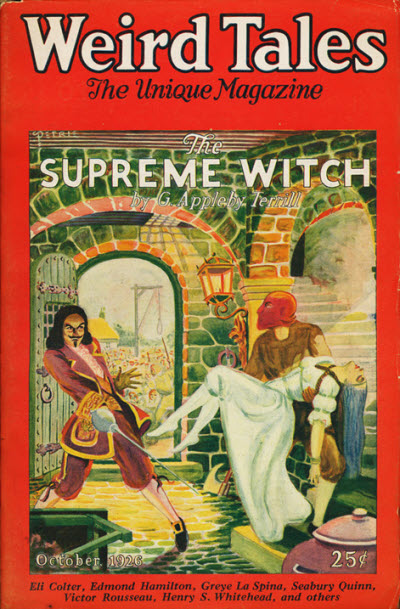
Issue cover by C. Barker Petrie Jr.
“But of course, my friend,” Jules de Grandin conceded as he hitched his pack higher on his shoulders and leaned forward against the grade of the wooded hill, “I grant you American roads are better than those of France; but look to what inconvenience these same good roads put us. Everything in America is arranged for the convenience of the motorist—the man who covers great distances swiftly. Your roads are the direct result of motorized transportation for the million, and, consequently, you and I must tramp half the night and very likely sleep under the stars, because there is no inn to offer shelter.
“Now in France, where roads were laid out for stage-coaches hundreds of years before your Monsieur Ford was dreamed of, there is an abundance of resting places for the pedestrian. Here—” He spread his hands in an eloquent gesture of deprecation.
“Oh, well,” I comforted, “we started out on a hiking trip, you know, and we’ve had mighty fine weather so far. A night in the open won’t do us any harm. That cleared place at the top of the hill looks like a good spot to make camp.”
“Eh, yes, I suppose so,” he acquiesced as he breasted the crown of the hill and paused for breath. “Parbleu,” he gazed about him, “I fear we trespass, Friend Trowbridge! This is no natural glade, it has been cleared for human habitation. Behold!” He waved his arm in a commanding gesture.
“By George, you’re right!” I agreed in disappointment as I surveyed the clearing.
“The trees—beech, birch and poplar—had been cut away for the space of an acre or more, and the stumps removed, the cleared land afterward being sown with grass as smooth and well cared for as a private estate’s lawn. Twenty yards ahead a path of flat, smooth stones was laid in the sod, running from a dense thicket of dwarf pine and rhododendron across the sward to a clump of tall, symmetrical cedars standing almost in the center of the clearing. Through the dark, bearded boughs of the evergreens we caught the fitful gleam of lights as the soft summer-evening breeze swayed the branches.
“Too bad,” I murmured; “guess we’ll have to push on a little farther for our bivouac.”
“Mille cochons, non!” de Grandin denied. “Not I. Parbleu, but my feet faint from exhaustion, and my knees cry out for the caress of Mother Earth with a piety they have not known these many years! Come, let us go to the proprietor of that mansion and say, ‘Monsieur, here are two worthy gentleman tramps who crave the boon of a night’s lodging and a meal, also a bath and a cup of wine, if that so entirely detestable Monsieur Volstead has allowed you to retain any.’ He will not refuse us, my friend. Morbleu, a man with the charity of a Senegalese idol would not turn us away in the circumstances! I shall ask him with tears in my voice—pardieu, I shall weep like a lady in the cinema; I shall wring my hands and entreat him! Never fear, my friend, we shall lodge in yonder house this night, or Jules de Grandin goes supperless to a bed of pine-needles.”
“Humph, I hope your optimism is justified,” I grunted as I followed him across the close-cropped lawn to the stone path and marched toward the lights in the cedars.
We had progressed a hundred feet or so along the path when a sudden squealing cry, followed by a crashing in the thicket at the clearing edge, stopped us in our tracks. Something fluttering and white, gleaming like a ghost in the faint starlight, broke through the bushes, and a soft slapping noise, as though someone were beating his hands lightly and quickly together, sounded as the figure approached us.
“Oh, sirs, run, run for your lives, it—it’s Pan!” the girl called in a frightened voice as she came abreast of us. “Run, run, if you want to live; he’s there, I tell you! I saw his face among the leaves!”
One of de Grandin’s small, slender hands rose with an involuntary gesture to stroke his little blond mustache as he surveyed our admonisher. She was tall and built with a stately, statuesque beauty which was doubly enhanced by the simple white linen garment which fell in straight lines from her lovely bare shoulders to her round, bare ankles. The robe was bound about the waist with a corded girdle which crossed above her breast, and was entirely sleeveless, though cut rather high at the neck, exposing only a few inches of white throat. Her feet, narrow and high-arched, and almost as white as the linen of her robe, were innocent of any covering, and I realized that the slapping sound I had heard was the impact of her bare soles on the stones of the path as she ran.
“Tiens, Mademoiselle,” de Grandin declared with a bow, “you are as lovely as Pallas Athene herself. Who is it has dared frighten you? Cordieu, I shall do myself the honor of twisting his unmannerly nose!”
“No, no!” the girl besought in a trembling voice. “Do not go back, sir, please! I tell you Pan—the Great God Pan, Himself—is in those bushes. I went to bathe in the fountain a few minutes ago, and as I came from the water I—I saw his face grinning at me between the rhododendron bushes! It was only for a second, and I was so frightened I did not look again, but—oh, let us go to the house! Hurry, hurry, or we may see him in good earnest, and—” She broke off with a shudder and turned from us, walking hurriedly, but with consummate grace, toward the knot of cedars before us.
“Sacré nom!” de Grandin murmured as he fell in behind her. “Is it that we have arrived at a home for the feeble-minded, Friend Trowbridge, or is this beautiful one a goddess from the days of old? Nom d’un coq, she speaks the English like an American, but her costume, her so divine beauty, they are things of the days when Pygmalion hewed living flesh from out the lifeless marble!”
The murmur of feminine voices, singing softly in unison, came to us as we made our way through the row of cedar trees and approached the house. The building was almost square, as well as we could determine in the uncertain light, constructed of some sort of white or light-colored stone, and fronted by a wide portico with tall pillars topped with Doric capitals. The girl ran lightly up the three wide steps leading to the porch, her bare feet making no sound on the stone treads, and we followed her, wondering what sort of folk dwelt in this bit of classic Greece seemingly dropped from some other star in the midst of the New Jersey woods.
“Morbleu!” de Grandin exclaimed softly in wonderment as we paused at the wide, doorless entrance. Inside the house, or temple, was a large apartment, almost fifty feet square, paved with alternate slabs of white and gray-green stone. In the center stood a square column of black stone, some three feet in height, topped by an urn of some semitransparent substance in which a light glowed dimly. The place was illuminated by a series of flaring torches hung in rings let into the walls, their uncertain, flickering light showing us a circle of ten young women, dressed in the same simple classic costume as that worn by the girl we had met outside, kneeling about the central urn, their faces bowed modestly toward the floor, white arms raised above their heads, hands bent inward toward the center of the room. As we stood at gaze the girl who had preceded us hurried soundlessly across the checkered pavement and sank to her knees, inclining her shapely head and raising her arms in the same position of mute adoration assumed by the others.
“Name of a sacred pig!” de Grandin whispered. “We have here the votaries, but the hierophant, where is he?”
“There, I think,” I answered, nodding toward the lighted urn in the pavement’s center.
“Parbleu, yes,” my companion assented, “and a worthy one for such a class, n’est-ce-pas?”
Standing beside the central altar, if such it could be called, was a short, pudgy little man, clothed in a short chiton of purple cloth bordered about neck, sleeves and bottom with a zigzag design of gold braid. His bald head, gleaming in the torchlight, was crowned with a wreath of wild laurel, and a garland of roses hung about his fat, creased neck like an overgrown Hawaiian lei. Clasped in the crook of his left elbow was a zither, or some similar musical instrument, while a little stick, ending in a series of curved teeth, something like the fingers of a Japanese back-scratcher, was clasped in his dimpled right hand.
“Come, my children,” the comic little man exclaimed in a soft, unctuous voice, “let us to our evening worship. Beauty is love, love beauty; that is all ye know and all ye need to know. Come, Chloe, Thisbe, Daphne, Clytie, let us see how well you know the devotion of beauty!”
He waved his stick like a monarch gesturing with his scepter, and drew its claw-tipped end across the strings of his zither, striking a chord, whereat the kneeling girls began singing, or, rather, humming, a lilting, swinging tune vagely reminiscent of Mendelssohn’s Spring Song, and four of their number leaped nimbly to their feet, ran lightly to the center of the room, joined hands in a circle and began a dance of light, lithe grace.
Faster and faster their white feet whirled in the convolutions of the dance, their graceful arms weaving patterns of living beauty as they swung in time to the measures of the song. They formed momentary tableaux of sculptural loveliness, only to break apart instantly into quadruple examples of individual posturing such as would have set an artist mad with delight.
The music ceased on a long-drawn, quavering note, the four dancers ran quickly back to their positions in the circle, and dropped again to their knees, extending their arms above their heads and bending their supple hands inward.
“It is well,” the fat little man pronounced oracularly. “The day is done; let us to our rest.”
The girls rose with a subdued rustling of white garments and separated into whispering, laughing groups, while the little man posed more pompously than ever beside the lighted urn.
“Tiens, Friend Trowbridge,” de Grandin whispered with a chuckle, “do you behold how this bantam would make a peacock of himself! He is vain, this one. Surely, we shall spend the night here!
“Monsieur,” he emerged from the shadow of the doorway and advanced toward the absurd figure posturing beside the urn, “we are two weary travelers, lost in the midst of these woods, without the faintest notion of the direction of the nearest inn. Will you not, of your so splendid generosity, permit that we spend the night beneath your roof?”
“Eh, what’s that?” the other exclaimed with a start as he beheld the little Frenchman for the first time. “What d’ye want? Spend the night here? No, no; I can’t have that. Get my school talked about. Couldn’t possibly have it. Never have any men in this place.”
“Ah, but Monsieur,” de Grandin replied smoothly, “you do forget that you are already here. If it were but a question of having male guests at this so wonderful school of the arts, is not the reputation of the establishment already ruined? Surely, a gentleman with so much of the appeal to beauty as Monsieur unquestionably possesses would cause much gossip if he were not so well known for his discretion. And, Monsieur’s discretion being already so firmly established, who would dare accuse him of anything save great-heartedness if he did permit two wanderers—and medical men in the bargain—to remain overnight in his house? Permit me, Monsieur; I am Dr. Jules de Grandin, of the Sorbonne, and this is Dr. Samuel Trowbridge, of Harrisonburg, New Jersey, both entirely at your good service, Monsieur.”
The little fellow’s fat face creased in a network of wrinkles as he regarded de Grandin with a self-satisfied smirk. “Ah, you appreciate the pure beauty of our school?” he remarked with almost pathetic eagerness. “I am Professor Judson—Professor Herman Judson, sir—of the School of the Worship of Beauty. These—ah—young ladies whom you have seen here tonight are a few of my pupils. We believe that the old ideals—the old thought—of ancient Greece is a living, motivating thing today, just as it was in centuries gone by. We assert sir, that the religion of beauty which actuated the Greeks is still a living, vital thing. We believe that the old gods are not dead; but come to those who woo them with the ancient rite of song and the dance. In fine, sir, we are pagans—apostles of the religion of neo-paganism!”
He drew himself up to his full height, which could not have exceeded five feet six inches, and glared defiantly at de Grandin, as though expecting a shocked protest at his announcement.
The Frenchman’s smile became wider and blander than ever. “Capital, Monsieur,” he congratulated. “Anyone with the eye of a blind man could see that you are the very personality to head such an incontestably sensible school of thought. The expertness with which your pupils perform their dances shows that they have a teacher worthy of all your claims. We do felicitate you most heartily, Monsieur. Meantime”—he slipped the pack from his shoulders and lowered it to the pavement—“you will undoubtlessly permit that we shall pass the night here? No?”
“We-ell,” the professor’s doubt gave way slowly; “you seem to be more appreciative than the average modern barbarian. Yes, you may remain here overnight; but you must be off in the morning—early in the morning, mind you. Never do to have the neighbors seeing strange men coming from this place. Understand?”
“Perfectly, Monsieur,” de Grandin answered with a bow. “And, if we might make so bold, may we trespass on your hospitality for a bite—the merest morsel of food?”
“U’m, pay for it?” the other demanded dubiously.
“But assuredly,” de Grandin replied, producing a roll of bills. “It would cause us the greatest anguish, I do assure you, if it were ever said that we accepted the hospitality of the great Professor ’Erman Judson without making adequate return.”
“Very well,” the professor assented, and hurried through a door at the farther end of the apartment, returning in a few minutes with a tray of cold roast veal, warm, ripe apples, a loaf of white bread and a jug of more than legally strong, sour wine.
“Ah,” de Grandin boasted as he washed down a sandwich with a draft of the acid liquor, “did I not tell you we should spend the night here, Friend Trowbridge?”
“You certainly made good your promise,” I agreed as I shoved the remains of my meal from me, undid my pack and prepared to pillow my head on my rolled-up jacket. “See you in the morning, old fellow.”
“Very good,” he agreed. “Meantime, I go out of doors to smoke a last cigarette before I join you in sleep.”
I might have slept an hour, perhaps a little more, when a sharp, insistent poke in my ribs woke me sufficiently to understand the words whispered fiercely in my ear. “Trowbridge, Trowbridge, my friend,” Jules de Grandin breathed so low I could scarcely make out the syllables. “This house, it is not all as it should be, I fear me.”
“Eh, what’s that?” I demanded sleepily, sitting up and blinking half comprehendingly at his dim outline in the semidarkness of the big room.
“S-s-sh, not so loud,” he cautioned, then leaned nearer, speaking rapidly: “Do you know from whence your English word ‘panic’ comes, my friend?”
“What?” I demanded in disgust. “Did you wake me up to discuss etymology—after a day’s hiking? Good Lord, man—”
“Be still!” he ordered sharply; then, inconsistently, “Answer me, if you please; whence comes that word?”
“Hanged if I know,” I replied, “and I’m hanged if I care a whoop, either. It can come from the Cannibal Islands, for all I—”
“Quiet!” he commanded, then hurried on: “In the old days when such things were, my friend, Pan, the god of Nature, was very real to the people. They believed, firmly, that whoso saw Pan after nightfall, that one died instantly. Therefore, when a person is seized with a blind, unreasoning fear, even to this day, we say he has a panic. Of what consequence is this? Remember, my friend, the young lady whom we did meet as we approached this house told us she had seen Pan’s face grinning at her from out the bushes as she bathed. Is it not so?”
“I guess so,” I answered, putting my head back on my improvised pillow and preparing to sleep while he talked.
But he shook my shoulder with a sharp, imperative gesture. “Listen, my friend,” he besought, “when I did go out of doors to smoke my cigarette, I met one of those beautiful young women who frequent this temple of the new heathenism, and engaged her in conversation. From her I learned much, and some of it sounds not good to my ears. For instance, I learn that this Professor Herman Judson is a much misunderstood man. Oh, but yes. The lawyers, they have misunderstood him many times. Once they misunderstood him so that he was placed in the state’s prison for deceiving gullible women with fortune-telling tricks. Again he was misunderstood so that he went to the bastille for attempting to secure some money which a certain deceased lady’s heirs believed should have gone to them—which did go to them eventually.”
“Well, what of it?” I growled. “That’s no affair of ours. We’re not a committee on the morals of dancing masters, are we?”
“Eh, are we not so?” he replied. “I am not entirely sure of that, my friend. I fear we, too, are about to misunderstand this Professor Judson. Some other things I find out from that young lady with the Irish nose and the Greek costume. This professor, he has founded this school of dancing and paganism, taking for his pupils only young women who have no parents or other near relations, but much money. He is not minded to be misunderstood by heirs-at-law again. What think you of that, hein?”
“I think he’s got more sense than we gave him credit for,” I replied.
“Undoubtlessly,” he agreed, “very much more; for also I discovered that Monsieur le Professeur has had his school regularly incorporated, and has secured from each of his pupils a last will and testament in which she does leave the bulk of her estate to the corporation.”
“Well,” I challenged, giving up hope of getting any sleep till he had talked himself out, “what of it? The man may be sincere in his attempt to found some sort of esthetic cult, and he’ll need money for the project.”
“True, quite true,” he conceded, nodding his head like a china mandarin, “but attend me, Friend Trowbridge; while we walked beneath the stars I did make an occasion to take that young lady’s hand in mine, and—”
“You old rake!” I cut in, grinning, but he shut me off with a snort of impatience.
“—and that was but a ruse to feel her pulse,” he continued. “Parbleu, my friend, her heart did race like the engine of a moteur! Not with emotion for me—never think it, for I did talk to her like a father or an uncle, well, perhaps more like a cousin—but because it is of an abnormal quickness. Had I a stethoscope with me I could have told more, but as it is I would wager a hundred dollars that she suffers a chronic myocarditis, and the prognosis of that ailment is always grave, my friend. Think you a moment—what would happen if that young girl with a defective heart should see what she took to be the face of the great god Pan peering at her from the leaves, as the lady we first saw declared she did? Remember, these children believe in the deities of old, my friend.”
“By George!” I sat bolt upright. “Do you mean—you don’t mean that—”
“No, my friend, as yet I mean nothing,” he replied evenly, “but it would be well if we emulated the cat, and slept with one eye and both ears open this night. Perhaps”—he shrugged his shoulders impatiently—“who knows what we may see in this house where the dead gods are worshiped with song and the dance?”
A marble pavement is a poor substitute for a bed, even when the sleeper is thoroughly fatigued from a long day’s tramp, and I slept fitfully, troubled by all manner of unpleasant dreams. The forms of lithe, classically draped young girls dancing about a fire-filled urn alternated with visions of goat-legged, grinning satyrs in my sleep as I rolled from side to side on my hard bed; but the sudden peal of devilish laughter, quavering sardonically, almost like the bleating of a goat, was the figment of no dream. I sat suddenly up, wide-awake, as a feminine scream, keen-edged with the terror of death, rent the tomblike stillness of the early morning, and ten white-draped forms came rushing in the disorder of abject fright into the room about us.
Torches were being lighted, one from another, and we beheld the girls, their tresses unloosed from the classic fillets which customarily bound them, their robes hastily adjusted, huddled fearfully in a circle about the glowing urn, while outside, in the moonless night, the echo of that fearful scream seemed wandering blindly among the evergreens.
“Professor, Professor!” one of the girls cried, wringing her hands in an agony of apprehension. “Professor, where are you? Chloe’s missing, Professor!”
“Eh, what is it that you say?” de Grandin demanded, springing up and gazing questioningly about him. “What is this? One of your number missing? And the professor, too? Parbleu; me, I shall investigate this! Do you attend the young ladies, Friend Trowbridge. I, Jules de Grandin, shall try conclusions with whatever god or devil accosts the missing one!”
“Wait a minute,” I cautioned. “The professor will be here in a moment. You can’t go out there now; you haven’t any gun.”
“Ha, have I not?” he replied sarcastically, drawing the heavy, blue-steel pistol from his jacket pocket. “Friend Trowbridge, there are entirely too many people of ill repute who desire nothing more than the death of Jules de Grandin to make it safe for me to be without a weapon at any time. Me, I go to investigate.”
“Never mind, sir,” the smooth, oily voice of Professor Judson sounded from the door at the rear of the room as he marched with short-legged dignity toward the altar. “Everything is all right, I assure you.
“My children,” he turned to the frightened girls, “Chloe has been frightened at the thought of Pan’s presence. It is true that the great god of all Nature hovers ever near his worshipers, especially at the dark of the moon, but there is nothing to fear. Chloe will soon be all right. Meantime, let us propitiate Pan by prayer and sacrifice. Thetis, bring hither a goat!” He turned his small, deep-set eyes on the young girl we had met as we entered the grounds, and waved a pudgy hand commandingly.
The girl went white to the lips, but with a submissive bow she hurried from the room, returning in a moment leading a half-grown black goat by a string, a long, sharp butcher-knife and a wide, shallow dish under her free arm.
She led the animal to the altar where the professor stood, gave the leading string into his hand and presented the sacrificial knife, then knelt before him, holding the dish beneath the terrified goat’s head, ready to catch the blood when the professor should have cut the creature’s throat.
It was as if some heady, madness-compelling fume had suddenly wafted into the room. For a single breathless moment the other girls looked at their preceptor and his kneeling acolyte with a gaze of fear and disgust, their tender feminine instincts rebelling at the thought of the warm blood soon to flow, then, as a progressive, contagious shudder seemed to run through them, one after another, they leaped wildly upward with frantic, frenzied bounds as though the stones beneath their naked feet were suddenly turned white-hot, beating their hands together, waving their arms convulsively above their heads, bending forward till their long, unbound hair cascaded before their faces and swept the floor at their feet, then leaping upward again with rolling, staring eyes and wantonly waving arms. With a maniac shriek one of them seized the bodice of her robe and rent it asunder, exposing her breasts, another tore her gown from hem to hips in half a dozen places, so that streamers of tattered linen draped like ribbons about her rounded limbs as she sprang and crouched and sprang again in the abandon of her voluptuous dance.
And all the while, as madness seemed to feed on madness, growing wilder and more depraved each instant, they chanted in a shrill, hysterical chorus:
Upon thy worshipers now gaze,
Pan, Pan, Io Pan,
To thee be sacrifice and praise,
Pan, Pan, Io Pan.
Give us the boon of the seeing eye,
That we may behold ere yet we die
The ecstasies of thy mystery,
Pan, Pan, PAN!
Repeated insistently, with maniacal fervor, the name “Pan” beat against the air like the rhythm of a tom-tom. Its shouted repetition seemed to catch the tempo of my heart-beats; despite myself I felt an urging, strong as an addict’s craving for his drug, to join in the lunatic dance, to leap and shout and tear the cumbering clothing from my body as I did so.
The professor changed his grip from the goat’s tether to its hind legs. He swung the bleating animal shoulder-high, so that as it held its head back its throat curved above the dish held by the girl, who twitched her shoulders and swayed her body jerkily in time to the pagan hymn as she knelt at his feet.
“Oh, Pan, great goat-god, personification of all Nature’s forces, immortal symbol of the ecstasy of passion, to Thee we make the sacrifice; to Thee we spill the blood of this victim,” the professor cried, his eyes gleaming brilliantly in the reflection of the torches and the altar fire. “Behold, goat of thy worshiper’s flock, we—”
“Zut! Enough of this; cordieu, too much!” de Grandin’s furious voice cut through the clamor as a fire-bell stills the noise of street traffic. “Hold your hand, accursed of heaven, or by the head of St. Denis, I scatter your brains in yonder dish!” His heavy pistol pointed unwaveringly at the professor’s bald head till the terrified man unloosed his hold upon the squirming goat.
“To your rooms, my little ones,” de Grandin commanded, his round, blazing eyes traveling from one trembling girl to another. “Be not deceived, God is not mocked. Evil communications corrupt good manners—parbleu, Monsieur, I do refer to you and no one else—” he glowered at the professor. “And you, Mademoiselle,” he called to the kneeling girl, “do you put down that dish and have nothing to do with this sacrifice of blood. Do as I say. I, Jules de Grandin, command it!
“Now, Monsieur le Professeur,” he waved his pistol to enforce his order, “do you come with me and explore these grounds. If we find your great god Pan I shall shoot his evil eyes from out his so hideous head. If we do not find him—morbleu, it were better for you that we find him, I damn think!”
“Get outa my house!” Professor Judson’s mantle of culture ripped away, revealing the coarse fiber beneath it; “I’ll not have any dam’ Frenchman cornin’ around here an’—”
“Softly, Monsieur, softly; you will please remember there are ladies present,” de Grandin admonished, motioning toward the door with his pistol. “Will you come with me, or must I so dispose of you that you can not run away until I return? I could most easily shoot through one of your fat legs.”
Professor Judson left the altar of Pan and accompanied de Grandin into the night. I do not know what took place out under the stars, but when the Frenchman returned some ten minutes later, he carried the inert form of the eleventh young woman in his arms, and the professor was not with him.
“Quickly, Friend Trowbridge,” he commanded as he laid the girl on the pavement, “give me some of the wine left from our supper. It will help this poor one, I think. Meantime”—he swung his fierce, unwinking gaze about the clustering circle of girls—“do you young ladies assume garments more fitted for this day and age, and prepare to evacuate this house of hell in the morning. Dr. Trowbridge and I shall remain here until the day, and tomorrow we notify the police that this place is permanently closed forever.”
It was a grim, hard task we had bringing the unconscious girl out of her swoon, but patience and the indomitable determination of Jules de Grandin finally induced a return of consciousness.
“Oh, oh, I saw Pan—Pan looked at me from the leaves!” the poor child sobbed hysterically as she opened her eyes.
“Non, non, ma chère,” de Grandin assured her. “’Twas but a papier-mâché mask which the so odious one placed in the branches of the bush to terrify you. Behold, I will bring it to you that you may touch it, and know it for the harmless thing it is!”
He darted to the doorway of the temple, returning instantly with the hideous mask of a long, leering face, grinning mouth stretched from pointed ear to pointed ear, short horns rising from the temples and upward-slanting eyes glaring in fiendish malignancy. “It is ugly, I grant you,” he admitted, flinging the thing upon the pavement and grinding it beneath his heavily booted heel, “but see, the foot of one who fears them not is mightier than all the gods of heathendom. Is it not so?”
The girl smiled faintly and nodded.
De Grandin was out of the house at sunup, and returned before 9 o’clock with a fleet of motor cars hastily commandeered from a roadhouse garage which he discovered a couple of miles down the road. “Remember, Mesdemoiselles,” he admonished as the cars swung away from the portico of the temple with the erstwhile pupils of the School of Neo-paganism, “those wills and testaments, they must be revoked forthwith. The detestable one, he has the present copies, but any will which you wish to make will revoke those he holds. Leave your money to found a vocal school for Thomas cats, or for a gymnasium for teaching young frogs to leap, but bequeath it to some other cause than this temple of false gods, I do implore you.”
“Ready, sport?” the driver of the car reserved for us demanded, lighting a cigarette and flipping the match toward the temple steps with a disdainful gesture.
“In one moment, my excellent one,” de Grandin answered as he turned from me and hurried into the house. “Await me, Friend Trowbridge,” he called over his shoulder; “I have an important mission to perform.”
“What the dickens did you run back into that place for when the chauffeur was all ready to drive us away?” I demanded as we bowled over the smooth road toward the railway station.
He turned his unwinking cat’s stare on me a moment, then his little blue eyes sparkled with a gleam of elfin laughter. “Pardieu, my friend,” he chuckled, “that Professor Judson, I found a trunkful of his clothes in the room he occupied, and paused to burn them all. Death of my life, I did rout him from the premises in that Greek costume he wore last night, and when he returns he will find naught but glowing embers of his modern garments! What a figure he will cut, walking into a haberdasher’s clothed like Monsieur Nero, and asking for a suit of clothes. La, la, could we but take a motion picture of him, our eternal fortunes would be made!”