WF Q56 .G75 1926
The Grinning Mummy
First published in Weird Tales, December 1926 (vol. 8, no. 6). Novelette. Jules de Grandin. Text from the December 1926 Weird Tales appearance.
United States public domain. Held in the Reading Room of The Weird Library. Published by Weird Tales.
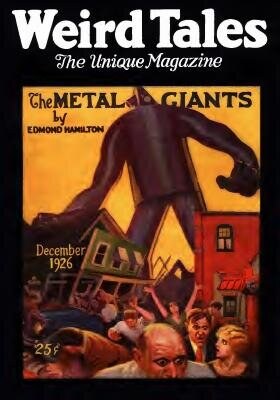
Issue cover by Joseph Doolin.
This text is printed as first published. It uses racial language from the period, including slurs.
"Is that you, de Grandin?" I called as the front door's slam was followed by the sound of quick footsteps on the polished boards of the hall floor.
"No!" an irate voice responded as my friend, Professor Frank Butterbaugh, strode into my study. "'Pologize for comin’ in without knockin', Trowbridge," he offered in excuse, "but I'm too confounded mad to pay 'tention to the amenities right now. Look at this, will you? Look at this dam', impertinent—" he broke off, choking with choler, and gave the paper another bellicose flourish. "Of all the unqualified, unmitigated—"
"What is it?" I queried, reaching for the offending document.
"What is it?" he echoed. "It's an outrage, a disgraceful outrage, that's what it is. Listen to this." Snatching at the wide black ribbon looped about his neck, he dragged a pair of gold-and-tortoise-shell pince-nez from the pocket of his white waistcoat, thrust them on his high-bridged nose with a savage, chopping motion, and read in a voice crackling with indignation:
Dr. Frank Butterbaugh, The Beeches, Harrisonville, New Jersey.
Dear Dr. Butterbaugh:—
The tombstone you ordered for your lot in Rosedale Cemetery has been prepared in accordance with your directions, and is now ready for delivery. We shall be obliged if you will indicate when you will meet our representative at the cemetery and direct where you wish the monument placed.
In accordance with your order, the stone has been inscribed:
DR. FRANCIS BUTTERBAUGH
August 23. 1852 October 18, 1926
Cave Iram Deorum
Very truly yours, Elgrace Monument Works.
"Well—" I began, but he shouted me down.
"'Well,' the devil!" he rasped. "It isn't well. I got that note in today's afternoon delivery, and came into town hot-foot to give the Elgrace people boiling hell for writing me such balderdash. Found they'd shut up shop for the day, so got John Elgrace on the ’phone at his house and made the wires sizzle with the dressing-down I gave him, and he had the brass-bound, copper-riveted gall to tell me he’d acted on my orders. My orders, d’ye understand? Claimed to have my written authority for pre paring a monument for my family plot, and-”
“And he didn’t?” I cut in incredulously. “You mean this letter is the first inkling you’ve had of a tomb- “Sulfur and brimstone, yes!” the professor yelled. “D’ye think I wouldn’t have remembered if I’d ordered a headstone for my own grave?—that’s what it amounts to, for my name’s on the thing. And what the triple-homed devil would I have had today’s date cut on it for? Today’s October eighteenth, in case you’ve forgotten it. And why in blazing Tophet should I have any thing as silly as ‘Cave Iram Deorum, on my tombstone, even if I had a rush of bone to the head and ordered the dam’ thing?”
“Wait a moment, professor,” I asked. “I’m a little rusty on my Latin. 'Cave Iram Deoram’ —let’s “It means ‘Beware the Wrath of the Gods,’ if that’s what you’re after,” he shot back, “but that’s of no importance. What I’d like to know is who the devil dared order a tombstone in my name-”
“ Pardonnez-moi, Monsieur, per haps it is that someone makes la mauvaise plaisanterie —how do you say it? the practical joke?—upon you.” Jules de Grandin, very debonair in faultless dinner clothes, a white gar denia in his lapel and a slender ebony walking stick in his hand, stood smiling at us from the study doorway.
“Trowbridge, mon cher,” he turned to me, “I did let myself in without knocking, in order to save the excel lent Nora the trouble of opening the door, and I could not well escape
overhearing this gentleman’s extra ordinary statement. Will you not tell me more, Monsieur?” He re garded the professor with his round, childishly wide, blue eyes.
“More, more?” Professor Butterbaugh barked. "That’s all there is; there isn’t any more. Some fool with a perverted sense of humor has forged my name to an order for a tombstone. By Set and Ahriman, I’ll be hanged if the Elgrace people get a red-headed cent out of me for it! Let ’em find out who ordered it and charge it to him!”
“Pardon, Monsieur, I did hear you refer to the malignant deities of Egypt and Persia; is it that “Oh, excuse me,” I broke in, com ing to a tardy recognition of my so cial obligations. “Professor Butterbaugh, this is Dr. Jules de Grandin, of the University of Paris. Dr. de Grandin, this is Professor Frank Butterbaugh, who headed-”
“Parbleu, yes!” de Grandin inter rupted, crossing the room hurriedly and seizing Butterbaugh’s hand in both of his. “No need for further introductions, Friend Trowbridge. Who has not heard of that peerless savant, that archeologist second only to the great Boussard? The very great, honor is entirely mine, MonProfessor Butterbaugh grinned a trifle sheepishly at the Frenchman’s enthusiastic greeting, fidgeted with the monument company’s letter and his glasses a moment, then reached for his hat and gloves. “Must be movin’,” he ejaculated in his queer, disjointed way. “Got to get home before Alice gives me double-jointed fits. Keepin’ dinner waitin’, you know. Glad to’ve met you,” he held out his hand almost diffidently to de Grandin, "mighty glad. Hope you an’ Trowbridge can come over tomor row. Got an unusual sort o’ mummy I’m figurin’ on startin’ to unwrap
tonight. Like to have you medics there when I expose the body.”
“Ah?” de Grandin assented, help ing himself to a cigarette. “This mummy, then, it is different-?”
“You bet it is,” Butterbaugh as sured him colloquially. “Don’t be lieve there’s another like it in the country. I’ve only seen one other of the kind—the one supposed to be Ra-nefer, in the British Museum, you know. It has no funerary statue, just linen and bitumen molded to con form to the body’s contours. Had the devil’s own time gettin’ it out of Egypt, too. Arabs went on strike half a dozen times while we were diggin’, Egyptian government tried to collar the body, an’, to top the whole business, a gang o’ swell headed young Copts sent me a batch o’ black-hand letters, threatenin’ all sorts o’ penalties unless I returned the thing to its tomb. Huh, catch me givin’ up a relic literally worth its weight in gold to a crew o’ half-baked Johnnies like that!”
“But, Monsieur le Professeur,” de Grandin urged, his diminutive blond mustache bristling with excitement, “this letter, this tombstone order, it may have some relation-”
“Not a chance!” Butterbaugh scoffed. “Egypt’s half-way ’round the world from here, and I’ve no more chance of runnin’ foul o’ those chaps in this town than I have of bein’ bitten by a crocodile; but”— his lips tightened stubbornly and a faint flush deepened the sun-tanned hue of his face—“but if all the Egyp tian secret societies from Ghizeh to Beni Hassan were camped on my front lawn, I’d start unwrappin’ that mummy tonight. Yes, by Jingo, an’ finish the job, too; no matter how much they howled!” He glowered at us a moment as though he expected us to forbid him, jammed his knockabout hat over his ears, slapped his thigh pugnaciously with his motoring gloves and strode
MUMMY 741 from the study, his back as stiffly straight as though a ramrod had been thrust down the collar of his Norfolk “Something terrible has hap- ^pened!”
“Eh, what’s that?” I muttered stupidly into the transmitter of my bedside telephone, still too immersed in sleep to understand the import of the message coming over the wire.
“This is Alice Butterbaugh, Dr. Trowbridge,” the fluttering voice re peated. “Alice Butterbaugh, Pro fessor Butterbaugh’s niece. Some thing dreadful has happened. Uncle Frank’s dead!”
“Dead?” I echoed, swinging my feet to the floor. “Why, he was over to my house this evening, and-”
“Yes, I know,” she interrupted.
“He told me he stopped to show you that mysterious letter he got from the Elgrace company. He was well enough then, doctor, but—but—I think —he was murdered! Can you come right over?”
“Of course,” I promised, hanging up the receiver and hustling into my clothes.
“De Grandin,” I called, opening his door on my way to the bathroom to wash the lingering sleep from my eyes with a dash of cold water, “de Grandin, Professor Butterbaugh is dead—murdered, his niece thinks.”
“Mille tonneres!” The Frenchman was out of his bed like a jack-in-thebox popping from its case. “The half of one little minute, Friend Trowbridge”—his silk pajamas were torn from his slender white body and he struggled furiously into a white crape union suit—“do you but wait until I have applied the water to my face, the brush to my hair and the wax to my mustache —nom d’un co chon! where is that wax?” He had drawn on socks, trousers and boots as he talked, and was already before the washstand, a bath sponge, dripping
with cold water, in one hand, a face towel in the other.
“Fly, my friend, hasten to the tele phone and advise the good Sergeant Costello what has occurred,” he ad monished. “I would that he meets us at the professor’s house. Pardieu, if some scoundrel has taken the life of that so great scholar, I, Jules de Grandin, will track him down and de liver him to justice—yes, though he take refuge beneath the throne of Satan himself!” Ten minutes later we were riding furiously toward the sinking moon over the smooth macadam road which led to The Beeches. H er pretty yellow hair in attrac tive disorder, an orchid negligee drawn over her filmy nightdress and French-heeled satin mules of the same color on her little white feet, Alice Butterbaugh met us in the wide reception hall of The Beeehes, a very much frightened and entirely inartic ulate butler at her elbow.
“Oh, Dr. Trowbridge,” she sobbed, seizing my arm in both her small hands, “I’m so glad you got here! I-” She started back, folding the negligee across her diaphanous nightrobe as she became aware of de Grandin’s presence.
“This is Dr. Jules de Grandin, my dear,” I introduced. “He is a mem ber of the faculty of the University of Paris, and has been stopping with me for a while. He will be of great assistance in case it develops your uncle met with foul play.”
“How do you do, Dr. de Gran din?” Alice acknowledged, extending her hand. “I am sure yeu will be able to help us in our trouble.”
“Mademoiselle,” de Grandin bowed his sleek blond head as he pressed his Bps to her fingers, “commandez-moi; j’ suis pret.
“And now”—his air of gallantry fell from him like a cloak as he straightened his shoulders—“will you
be good enough to take us to the scene and tell us all?”
“I’d gone to bed,” the girl began as she led the way toward her uncle’s library. “Uncle Frank was terribly excited all afternoon after he received that letter, and when he came back from Harrisonville he was still boil ing inwardly. I could hardly get him to eat any dinner. Just as soon as dinner was over he went to the Ubrary where he has been keeping the latest addition to his collection of mummies, and told me he was going to begin unpacking it, “I went to bed about half-past 11 and called good-night to him through the library door as I passed. I went to sleep almost immediately, but something—I don’t know what, but I’m sure it was not a noise of any kind—woke me up a few minutes after 2. I lay there trying to get back to sleep until nearly 3, then decided to go to the bathroom for a bromide tablet. As I walked down the pass age I noticed a light shining out of the library door into the lower hall, so I knew the door must be open.
“Uncle never left the- door un closed when he was working, for he hated to have the servants look in at him, and they would stand in the passage and stare if they thought he was doing anything with his mum mies—it seemed to fascinate them. Knowing Uncle’s habits, I thought he had gone to bed without shutting off the light, and went down to turn it out. When I got here I found-” She paused beside the door with averted eyes and motioned toward the room beyond. Professor Butterbaugh lay on his back, staring with sightless, dead eyes at the glowing globes of the electric chandelier, his body straight and stiff, legs extended, arms lying at his sides, as though he had fallen back ward from an upright position and remained immovable since his fall. Despite the post-mortem flaccidity of
his features, his countenance retained something of the expression it must have worn when death touched him, and, gazing at his face, it seemed to me he looked more startled than frightened or angry. Nowhere was there evidence of any sort of strug gle; not so much as a paper was dis turbed on the big, flat-topped desk beside which the dead scientist lay, and the only witness testifying to tragedy was the still, inert remnant of what had been one of the world’s foremost Egyptologists some three or four hours before.
“Beg pardon, Miss Alice,” the pale-faced man-servant, trousers and coat pulled over his night-clothes, tip toed toward the professor’s niece, “there’s a gentleman outside, a Ser geant Costello, from the police de partment-”
“The police!” the girl’s pallid face went paler still. ‘ *'Wh—what are the police doing here—who told them?”
“I—I don’t know, Miss,” the serv ing man stammered.
“I did notify the good sergeant, Mademoiselle,” de Grandin an nounced, looking up from beside the professor’s body.
“Send him to me at once, immedi ately, right away,” he ordered the butler, and walked quickly to the door to greet the burly, red-headed Irish- " Bold,, my friend,” he called as the detective crossed the hall, “we have here a wicked business to inves tigate. Some miscreant has struck down your famous fellow townsman from the back, and-”
“H’m, from th’ back, is it?” Cos tello replied, looking meditatively at Butterbaugh’s supine form. “An’ how d ’ye make that out, Dr. de Gran din? Seems to me there’s no marks o’ violence on th’ body at all, an’ th’ pore gentleman died from natural causes. Apoplexy, it was, belike. He was a peppery-tempered old divil, God rest his soul!”
MUMMY 743 “Apoplexy, yes,” de Grandin agreed with a mirthless smile, “since apoplexy is only a general name for the condition more definitely called cerebral hemorrhage. Behold the cause of this apoplexy, my friend.” Stooping, he raised the professor’s head, pointing to the occipital region. Against the dead man’s smoothly brushed iron-gray hair lay a stain of blood, scarcely larger than a twentyfive cent piece, and so meager in its moisture that the Turkish rug on which the head had rested showed hardly any discoloration. Parting the hair, de Grandin showed a small, smooth-edged wound about the cali ber of an ordinary lead-pencil, a bit of whitish substance welling up to the very edge of the opening and all but stopping any blood-flow from inside the head..
“Gun?” Costello bent to examine the puncture.
“I do not think so,” the French man replied. “Had a shot been fired from a pistol at close range or a rifle from a distance the bullet would probably have gone out of the head, yet there is only one wound here. Had a firearm of low power, unable to drive the missile through the head, been used, the bone would have shat tered at the point of entrance, yet here we have a clean-cut wound. No, my friend, this injury is the result of some hand-weapon. Besides, Ma demoiselle Butterbaugh was in the house, as were also the servants, yet none recalls having heard a shot fired.
“Mademoiselle,” he rose from his examination of the body, “you did mention that your uncle was unwrap ping a certain mummy tonight. This mummy, where is it, if you please?”
“I—I don’t know,” the girl fal tered. “I thought it was in here, but-”
“But it is not,” de Grandin sup plied dryly. “Come, mes amis, let us search for this missing cadaver.
There are times when the dead can tell us more than the living. ’ ’ We crossed the library, passed be tween a pair of heavy brocade cur tains, and entered a smaller room walled with smooth plaster, its only furniture being a series of glass cases containing small specimens of Egyptians and a rank of upright mummy cases standing straight and sentinel-like against the farther wall.
“Howly mither!” Costello exclaimed, his native brogue cutting through his acquired American accent, as he pointed one hand toward one of the mummy cases, signing himself piously with the cross with the other. The center figure in the rank of mummies stood in a case somewhat taller than its fellows, and, unlike the others, was not hidden from view by a coffin lid, for the cover from its case had fallen to the floor, disclosing the mummy to our gaze. The body had been almost entirely denuded of its bandages, the face, arms and lower portion of the legs having been freed, so that, had it been a living man in stead of a corpse, neither walking nor the use of the arms would have been impeded by the linen bands which re mained in place. This much I saw at a glance, but the cause of Costello’s outcry was not plain until I had looked a second time. Then I added my amazed gasp to the big Irishman’s exclamation, for in the right hand of the dead thing was firmly grasped a rod of polished wood tipped by a hawk’s head executed in metal, the bird’s beak being some three inches in length, curved and sharp as the hooked needles used by upholsterers to sew heavy fabrics. Upon the metal point of the beak was a faintly per ceptible smear of blood, and a drop of the grisly liquid had fallen to the floor, making a tiny, dark-red stain at the mummy’s desiccated feet. And on the mummy’s face, drawn by the embalming proeess into a sort of sardonic grin, was another reddish
smear, as though the dead thing had bent its lips to the wound inflicted by the instrument clutched in its dead " Pardieu, Friend Trowbridge, I think we need look no farther for the weapon which took Monsieur Butterbangh’s life,” de Grandin comment ed, twisting the end of his mustache with a nervous gesture.
“Wuz this th’ mummy th’ pro fessor wuz workin’ on?” Costello de manded, turning to the butler, who had followed us to the door of the specimen room.
“Oh, m.v Gawd!” the servant ex claimed with a shudder as he beheld the armed and sneering cadaver standing in its case, one mummified foot slightly advanced, as though the thing were about to step into the room in search of fresh victims.
“Never mind th’ bawlin’,” Cos tello ordered; “answer me question.
Wuz this th’ mummy Professor Butterbaugh wuz unwrappin, when— when it happened to him?”
“I don’t know, sir,” the servant quavered. “I never saw the thing before, an’, s’welp me Gawd, I never want to see it again. But I think it must be the one Dr. Butterbaugh had in mind, for there are the mummies there now, and this momin’, when I came in to open the blinds, there were only four standin’ against the walls and one was layin’ on the floor over by the door.”
"Humph, guess this is th’ one, then,” Costello replied. “Go outside there an’ git th’ other servants. Tell ’em I want to question ’em, an’ don’t tell what you’ve seen here.” De Grandin walked quickly to the grinning mummy and examined the pointed instrument in its hand min utely. “Tres bien,” he murmured to himself, giving the relic room a final appraising glance.
“Aren’t yon going to look into those other mummy cases?” I asked as he turned to leave.
“Not I,” he denied. “Let Ser geant Costello busy himself with them. Me, I have other matters of more importance to attend to. Come, let us examine the servants.” The cook, a large and very fright ened negress, a diminutive and like wise badly frightened colored boy who tended the garden and acted as chauffeur, two white maids, both safely past the heyday of youth, and the butler composed the domestic staff of The Beeches. Costello marshaled them in line and began a series of searching questions, but de Grandin, after a single look at the crowd, ap proached the sergeant and excused himself, saying we would talk the matter over the following morning.
“Thank you, sor,” Costello ac knowledged: “I take it kindly of ye to see that I got th’ first look-in on this case before any of th ’ newspaper boys had a chanst to spoil it. I’ll be cornin’ over to your house tomorrow an’ we’ll go over all th’ evidence to gether, so we will.”
“Très excellent,” de Grandin agreed. “Good night, Sergeant. I am not sure, but I think we shall soon have these murderers beneath the lock and key of your so efficiently strong jail.”
“Murderers?” Costello echoed.
“Ye think there wuz more’n one of ’em, then, sor?”
“Parbleu, yes; I know it,” de Grandin responded. “Good night, “VX 7 ’ ELL Dr: de Grandin,” Ser-, ’’ geant Costello announced as he entered my office the following afternoon, “we’ve got about as far as we can with th’ case.”
"Ah,” de Grandin smiled pleas antly as he pushed a box of cigars across the table, “and what have you discovered, cher Sergeant”
“Well, sor,” the Irishman grinned deprecatingly, “I can’t rightly say we’ve found out much of anythin’,
MUMMY 745 precisely. F’rinstance, we’ve found that somebody forged Professor Butterbaugh’s signature to th’ letter to th’ Elgrace Monument Works. We put it under a lens at headquarters today', an’ you can see where th’ name’s been traced as plain as day light.”
“Yes,” de Grandin encouraged.
“And have you any theory as to who forged that letter, or who killed the professor?”
"No, sor, we haven’t,” the detec tive confessed. “Between you an’ me, sor, that Miss Alice may know more about th’ business than she lets on. I wouldn’t say she wuz exactly glad to see me when I come last night, an’, an’—well, she hasn’t been any too helpful. This momin’, when I wuz puttin’ th’ servants through their paces agin, to see if there wuz any discrepancies between th’ stories they told last night an’ what they might be sayin’ this time, she ups an’ says, says she, ‘Officer,’ she says, ‘you’ve been over all that before,’ she says, ‘an’ I’ll not have my serv ants humiliated, ’ she says, ‘by havin’ you ask ’em every few hours which one of ’em killed me uncle.’ “So I ups an’ says, ‘All right, Miss. I don’t suppose you have any sus picions concernin’ who killed him?’ An’ she says, “Certainly not!’ just like that. An’ that wuz that, sor.
“Now, don’t you be gittin’ me wrong, Dr. de Grandin an’ Dr. Trow bridge. Miss Butterbaugh is a hightoned lady, an’ all that, an’ I’m not makin’ any wise cracks about her bein’ guilty, or even havin’ guilty knowledge: but-” The sharp staccato of my office ’phone cut his statement in half.
“Hello?” I called tentatively, as I lifted the receiver.
“Sergeant Costello; I want to speak to Sergeant Costello,” an ex cited voice demanded. “This is Schultz speaking.”
“All right,” I replied, passing the instrument to the sergeant.
"Hello?” Costello growled. “Yes, Schultz, tliis is Costello, what’s— whatt When? Oh, it did, did it? Yes, you bet your sweet life I’ll be right over, an’ you’d best git busy and cook up a sweet young alibi by th’ time I git there, too, young felly “Gentlemen,” he turned a blank face to us, “that wuz Schultz, th’ uni formed man I’d left on duty at Th’ Beeches. He tells me that mummy— th’ one with th’ little pickax in its hand—has disappeared from th’ house, right before his eyes.”
"Torn les demons!” de Grandin cried, springing from his chair. “I expected this. Come, my friends; let us hasten, let us speed, let us fly! Parbleu, but the trail may not yet have grown cold!”
“T was making my rounds, as you told me, sir,” Patrolman Schultz explained to Sergeant Costello. “I’d been through the house and looked in on that queer-lookin’ mummy in the little room, and seen everything was in order, then I went out to the ga rage. Julius, the chauffeur, was tell ing me that he was going to quit his job as soon as the police investigation was done, ’cause he wouldn’t dare live here after what’s happened, and I was wondering if he was suffering from a guilty conscience, or what, so I stopped to talk to him and see what he’d say. I couldn’t a’ been outside more than fifteen minutes, all told, and I came right back in the house; but that mummy was clean gone when I got back.”
“Oh, it wuz, wuz it?” Costello an swered sarcastically. “I don’t sup pose you heard it hollerin’ for help while it wuz bein’ kidnaped, or annythin’ like that while you wuz out Sherlock Holmesin’ th’ chauffeur, did you? O’ course not! You wuz too busy playin’ 01 ’ King Brady to pay
attention to your regular duties. Well, now, young felly, let me tell you somethin’. We’ll find that missin’ mummy, an’ we’ll find him toot sweet, as Dr. de Grandin would say, or badge number six hundred an’ eighty-seven will be turned in at headquarters tonight, d’ye git me?” He turned on his heel and walked toward the house, leaving the crest fallen young patrolman staring help lessly after him. We were about to follow him when the rattle of a Ford delivery wagon on the gravel driveway drew our at tention. A young man in white apron and jacket jumped from the machine and approached the service porch, a basket of groceries on his “Sorry to keep your order wait in’,” he told the cook as he handed her the hamper and a duplicate sales slip for her signature, “but I liked ta got kilt cornin’ up th’ road about twenty minutes ago. I was drivin’ out th’ pike slow an’ easy when a big touring car shot outa th’ lane an’ crowded me into the ditch. If I hadn’t had my foot on th’ gas an’ been able to skedaddle outa th’ way before they ran me down I’d most likely a’ been killed, an’ maybe th’ cake-eater an’ Sheba in th’ other car, “Where was it you had this so close escape?” de Grandin asked, approaching the youth with an ingra tiating smile.
“Down th’ road a piece,” the other replied, nothing loth to dilate on his adventure. “You know, there’s a lane that skirts th’ edge of Professor Butterbaugh’s place an’ runs out to th’ pike near Twin Pines. There’s a tall hedge growin’ on each side of th ’ lane where it comes out on th’ pike, an’ these folks musta been throwin’ a neckin’ party or sumpin up there, for they was runnin ’ in low —kind o’ sneakin along—not makin’ a bit o’ noise till they was within a
few feet of th’ main road, then they stepped on her for fair, an’ come out into th ’ highway runnin ’ like a scairt “Indeed?” de Grandin raised sym pathetic eyebrows. “And did yon notice the. people in this car? They should be arrested for such actions.”
“I’ll say I noticed ’em,” the gro cery boy answered with an emphatic nod. “The sheik who was drivin’ was one o’ them lounge-lizards noth patent leather hair, an’ th’ jane was little an’ dark, with big eyes an’ a sort o’ sneery look. She was holdin’ sumpin in her lap; looked like it might o’ been another girl’s head, or sumpin. Anyways, it was all cov ered up with cloth. An’ they didn’t even excuse theirselves for crowdin’ me into the ditch; just went on down th’ road toward Morristown like greased lightnin’.” De Grandin’s little mustache was twitching with eagerness, like the whiskers of a tom-cat before a rathole, but his voice was casual as he asked, “And did you notice the num ber of this car which so nearly wrecked you, more petitt”
“Whassat?” the other replied sus piciously.
“Did you make note of their license plate?”
“You betcha,” the lad produced a brown-paper-backed note-book, obvi ously intended for emergency orders from his patrons, and thumbed through its dog-eared leaves. “Yep, here it is: Y 453-677-5344. New Jer sey plate.”
“Ah, my excellent one, my incom parable little cabbage!” de Grandin restrained himself from kissing the white-aproned youth with the utmost difficulty. “My Napoleon among tpiciers —behold, I shall make resti tution for the fright these miscreants have given you! ’ ’ Prom his trousers pocket he produced a billfold and ex tracted a five-dollar note, which he pressed into the delivery boy’s hand.
MUMMY 747 “Take it, my wise one,” he urged, quite unnecessarily. “Take it and buy a plaything for one of your nu merous sweethearts. Pardieu, such a well-favored youth must play the devil with the maidens’ hearts, re’esfce-past” He thrust a playful finger into the astonished youngster’s ribs.
“Sure,” the other responded, pock eting the bill and backing away rather hastily- “Sure, I gotta jane; d’ye think I’m a dead one?” ‘‘Nom d’un coq, quite otherwise; you do possess the eye of Argus and the sagacity of Solon, more brave,” de Grandin assured him, then, to me: “Come, Trowbridge, my friend, let us fly with all celerity to the lane of which this so charming urchin has told us. Let us discover what we can We ran across the wide lawn to the tall, rank-growing privet hedge which marked the margin of the Butterbaugh place, slipped through the shrubbery, and began walking slowly down the unpaved roadway. ‘‘Nom de Dieu, we have it!” the Frenchman exclaimed, pointing dra matically to the soft sand at our feet.
“Behold, Friend Trowbridge, where a car, even as described by the youth ful Solomon, has been driven up this path and turned about at this point. Also, observe how two pairs of feet, one shod in wide-soled shoes, the other in slippers with the French heels, have walked from that car to the hedge, and—here, do you not see it?—back again, and with wider steps and deeper impressions in the earth. Parbleu, my friend, our noses are to the earth. Anon we shall bring the quarry into view!” Slipping through the hedge, he ran at top speed to the house, entered one of the open French windows and called excitedly for Costello.
“Quick, more t deux,” he urged when the sergeant came in answer to his repeated hails, “we must delay the expedition. I would that you
broadcast by telephone an alarm to all towns and villages in the direction of Morristown to have a touring car bearing the New Jersey license Y 453677-5344 stopped at all costs. It must be delayed, it must be held, it must be impeded until I arrive!”
Costello regarded him in openmouthed wonder, but proceeded to telephone headquarters to post a gen eral lookout for the wanted car.
“An’ now, Dr. de Grandin, sor,” he whispered, “if you’d be good enough to lend me a bit of a hand in questionin’ these here servants, I be lieve we could git somethin’ outa them. They’re beginnin’ to weaken. ”
“Ah, bah,” de Grandin replied.
“Waste not your breath on these in nocent ones, my friend. We shall be within reaching distance of these criminals when that car has been ap prehended. In truth, they did fit the description to a perfection.”
“Description?” echoed the ser geant. “What description? Has someone been spillin’ th’ beans to “Ha, yes, someone has talked to me, in silence,” de Grandin replied.
“There were at least two people in the library with Professor Butterbaugh when he was killed, and one of them, at least, had straight hair, smoothed down with some sort of un guent—hair, moreover, which had been cut about two weeks ago. This person must have been somewhat shorter than the professor, and must have stood immmediately before him when he was struck down from beSergeant Costello looked at him a moment in speechless wonder, then an ingratiating grin spread over his face. He rose, facing de Grandin with upraised forefinger, like an adult telling a fable to a dubious youngster. “An’ th’ wolf said to Little Red Riding Hood, ‘Where are ye goin’, me prett-ty child,’ ” he in terrupted. “I’ve seen ye do a lot o’
things which I’d a’ thought wuz magic if I hadn’t seen ’em with me own two eyes, Dr. de Grandin,” he confessed, “but when ye go into a trance like that an’ begin fortunetellin’ about how many people wuz present when th’ professor was kilt, an’ how long it had been since one of ’em had his hair cut, I’m havin’ to remind ye that it’s been many a year since I believed in fairy-tales, sor.”
“Fairy-tales, do you say?” de Grandin returned good-naturedly.
“Parbleu, my friend, do not you know that the most improbable of the of the fairies is sober logic itself beside the seemingly impossible mira cles which science performs each day? Nom d’un pore, a hundred years ago men were hanged as wizards for knowing not one-tenth as much as Jules de Grandin has forgotten these twenty years!
“Amuse yourself, clier Sergent. Question the servants to your heart’s content; but be ready to accompany me the minute that missing car is re ported caught, I do entreat you.”
“Tt’s th’ Templeton police depart- -*■ ment speakin’, Dr. de Grandin,” Costello announced some three-quar ters of an hour later as he looked up from the telephone. “Will ye be talkin’ to ’em, sor? Sure, I haven’t th’ ghost of an idea what it is you’re wantin’ with th’ young lad and lady that wuz ridin’ in th’ car ye wanted held up.”
"Alio, alio!” de Grandin barked into the telephone as he snatched the receiver from the sergeant’s hand.
“This is Jules de Grandin speaking, Monsieur le Chef. You have the oc cupants of that ear in custody? Bien, you do delight me! Charge? Parbleu, I had foi-gotten that you re quire a specific charge on which to hold persons in custody in this coun try. Tell me, Monsieur, you have searched that car, no?” A pause, during which he drummed nervously
on the telephone table with the tips of his slender white fingers, then: “Ah, so? Très bien, I and Ser geant Costello, of the Harrisonville police, come on the wings of the wind to relieve you of your prisoners. Re sponsibility? But of course. Hold them, my friend. Place them under the double lock, with gendarmes at door and window, and I shall indubi tably indemnify you against all re sponsibility. Only, I beseech you, hold them in safety until we arrive.” He turned to us, his small blue eyes sparkling with excitement. “Come, my friends, come away; let us make haste to that commandant of police at Templeton. He has there the birds for our cage!” We jumped into my waiting car and turned toward Templeton, Cos tello sitting in the tonneau, a black cigar at a rakish angle in his mouth, an expression of doubt on his face; de Grandin beside me, drumming on the leather upholstery of the seat and humming excitedly to himself.
“What’s it all about, de Gran din?” I asked as, responding to his urging, I pressed my foot on the ac celerator and drove the machine sev eral miles beyond the legal speed.
“Mean? Mean?” he answered, turning a twitching face and dancing eyes on me. “Possess yourself in pa tience, my friend. Restrain your curiosity for only a few little minutes. Curb your inquisitiveness only so long as it takes this abominably slow moteur to convey us to that police chief at Templeton. Then— parbleu! —you shall know. Yes, par la barbe du prophete, you and the good Cos tello, too, shall know r all—all!” He threw back his head and burst into a snatch of marching song: fold us when I brought my panting
MUMMY 749 motor to a halt before the little town’s near graystone municipal building.
“Far’s I can see, there’s no charge you can hold ’em on, legally, and there’s apt to be some trouble over this business.
“Sure, we found a mummy in the car”—in response to de Grandin’s eager question—“but I don’t know any law against transporting a mum my through the streets. Go in and talk to ’em, if you want to, but make it snappy, and remember; if there’s any comeback about a false arrest or anything like that, it’s strictly your funeral.”
“Parbleu, Monsieur le Chef,” de Grandin replied with a smile, “it is like to be a double funeral, with the State of New Jersey officiating, unless Jules de Grandin is more mistaken than he thinks he is! ” npwo people, a young man of twenty-five or twenty-six and a young woman of about the same age, sat on the polished oak benches of the muni cipal council room which the Temple ton police chief had turned into an improvised dungeon for their deten tion. The man was dressed with that precise attention to detail which char acterizes the better-class foreigner, while the woman’s modish traveling costume was more reminiscent of the Rue de la Paix than of the dressmak ers of America. Both were darkskinned with the clear olive com plexion of the South, black-eyed, and patrician of feature. And despite their air of hauteur, they were plain ly ill at ease.
“This is an outrage!” the man burst forth in a perfectly accentless voice which proclaimed more plainly than faulty speech that the words he used were not of his mother tongue.
“This is an outrage, sir. What right have you to hold us here against our will?” De Grandin fixed him with a level stare, rigid and uncompromising as a
750 WEIBD pointed bayonet. “And the murder of a respected citizen of this country, Monsieur,” he asked, “is that, per haps, not also an outrage?”
“What do you mean-?” the man began, but the Frenchman cut him off curtly.
“You and your companion did en ter the house of Professor Francis Butterbaugh last night, or, more def initely, early this morning,” he re plied, ‘ ‘ and one of you did engage him in conversation while the other took the scepter of Isis from the wrappings of the mummy and struck him with it, —from behind. Do not lie to me, my Egyptian friend; your tongue may be false— cordieu, are you not a nation of liars?—but the hairs of your head tell the truth. Parbleu, you did not think that your victim would throw out his arm at the moment you mur dered him and seize evidence which would put the rope of justice about your necks. You did not apprehend that I, Jules de Grandin, would be at hand to deliver you to the public executioner, heinf” The prisoners stared at him in as tonished silence. Then: “You have no proof that we were near Butterbaugh’s house last night,” the man answered, moving a step toward a sheeted object which lay on one of the council benches. De Grandin smiled unpleasantly.
“No proof, do you say?” he returned. ‘‘Pardieu, I have all the proof needed to put you both to a shameful death. I have—Trowbridge, Costello, stop He flung himself at the prisoner, who had rounded the end of the bench and reached suddenly toward the thing under the sheet, drawn forth a tiny, wriggling object, and pressed it quickly to his wrist.
"Too late,” the man observed, holding out his hand to the woman be side him and sinking to the bench be side the sheeted object. “Dr. Jules de Grandin is too late!”
The young woman hesitated the fraction of a second as her fingers met those of her companion, then, with widening eyes, thrust her hand into the low-cut bosom of her dress, drew herself up very straight, and, as a slight shiver ran through her frame, dropped to the bench beside the man.
“Vieu et le diable!” de Grandin swore furiously. “You have cheated me! I—back, Friend Trowbridge, back, Sergent; there is death on die He cannoned into me, sending me stumbling toward the row of council seats, poised himself on tiptoe, and leaped lithely into the air, coming down with both feet close together, grinding his heels savagely on the floor. Beneath the edge of his boot sole I made out the sharp-pointed, thrashing end of some small, cylin drical object.
“Five thousand years of life in death, and now eternal death beneath the feet of Jules de Grandin,” he announced, stepping back and re vealing a short, black thing, scarcely thicker through its crushed body than an angle worm, and no longer than a “What is it, sor?” Costello quer ied, looking at the still-writhing thing disclosed by the Frenchman’s lifted foot.
“I blame you not for failing to recognize him, cher Sergent,” the other replied; “the good St. Patrick did drive him and all his family from your native land some fifteen hundred years ago.” To me he said: “Friend Trow bridge, before you lies what remains of such a snake as did kill Cleopatra, no less. To discourage robbers from the graves of their great ones, I have heard, the Egyptians did sometimes secrete the comatose bodies of ser pents among the wrappings of their mummies. I have often heard such tales, but never before have I seen evidence of their truth. Like the
toad and the frog, who are found alive within fossil rocks, the snake has the ability to live indefinitely in suspended animation. When these miscreants did expose this viper to the air he was revived, and I make no doubt they allowed him to live against just such a contingency as this. ‘ ‘ Do you desire more proof? Is not their double suicide a confession suffi cient of guilt?” He turned question ing eyes from Costello to me, then glared at the prisoners shivering on the bench beside the sheeted object. ‘‘What’s this?” Costello demand ed, striding to the seat where the man and woman sat and snatching the sheet from the form beside them.
“Howly St. Judas, ’tis th’ grinnih’ mummy itself!” he exclaimed as he bared the sardonically smiling fea tures of the thing we had seen in Pro fessor Butterbaugh’s relic room the night of his murder.
“But of course,” de Grandin re plied, “what else? Did I not surmise as much when that young groceryman told us of the fleeing couple in the motor car? And did I not have you send out the alarm for the detention of that same car? And did I not particularly question the police chief of this city concerning the presence of a mummy in the motor when he did inform me that he had apprehended our fugitives? Most assuredly. Me, I am Jules de Grandin. I do not make mistakes.” He directed a quizzical gaze at the prisoners. “Your time grows short,” he stated. “Will you confess now, or must I assure you that I shall cut your hearts from out your dead bodies and feed them to carrion crows? Remember, I am a medical man, and my request that I be al lowed to perform an autopsy on you will unquestionably be honored. Yon will confess, or-” he waved an eloquent hand, the gesture express ing unpleasant possibilities.
MUMMY 751 The man twisted his thin lips in a mirthless grin. “You may as well know,” he replied, “but we must be assured our ashes will be taken to Egypt for burial before I tell you anything.” The Frenchman raised his hand.
“You have my assurance of that if you tell all, and my equal assurance that you shall be dissected as sub jects of anatomical study if you do not,” he promised. “Come, begin. Time presses and there is much to tell. Make haste.”
“ Tt does not matter who we are, you -*■ can find our names and resi dences from our papers,” the pris oner began. “As to what we are, you have perhaps heard of the movement to revive the secret worship of the old gods of Egypt among those who trace their ancestry to the ancient rulers of the earth?” De Grandin nodded shortly.
“We are members of that move ment,” the man continued. “We Copts possess the blood of Ramses, mighty ruler of the world, of Tutankh-amen and Ra-nefer; our race was old and glorious when Babylon was a swamp and you Franks were only naked savages. Pagan Greek and pagan Roman, Christian Frank and Moslem Arab—all have swarmed in upon us, forcing their religions down our throats at the sword’s point, but our hearts have remained constant to the gods we worshiped in the days of our greatness. For cen turies a faithful few have done honor to Osiris and Isis, to Horus and Nut and Anubis and mighty, ram-headed Ra, father of gods and fashioner of men; but only in recent years, with the weakening of the Moslems ’ hated power, have we dared extend our or ganization. Today we have a com plete hierarchy. I am a vowed serv ant of Osiris, my sister here is a dedi cated priestess of Isis.
“That the barbarians of Europe and America should delve among the tombs of our illustrious dead and drag their sacred relics forth for fools to gape at has long been intolerable to us—as the violation of the tombs of Napoleon or Washington would be to French or Americans—but for years we have been forced to suffer these insults in silence. Before this robber, Butterbaugh, desecrated the tomb of Ankh-ma-amen”—he mo tioned toward the uncovered, grin ning mummy on the bench beside him —“our priesthood had passed sen tence of death on all who despoiled our burying places in future. The Englishman, Carnarvon, died by our orders; other tomb-robbers met their just deserts at our hands. Now you knew why Butterbaugh was executed.
“We gave the thieving savage fair warning of our intent before he took the stolen body out of Egypt, but the English police—may Set bum them! —prevented our carrying out our sentence there, so we followed him to America. We had obtained a speci men of his signature in Cairo, it was easy to fbrge his name to the order for his tombstone.
“Last night my sister and I waited outside his house until his servants had gone to bed. We watched the thief gloating over the body of our sacred dead, saw him unwind the sacerdotal wrappings from it, and while he was still at his ghoulish work we entered an open window and read him the death sentence pronounced on him by the council of our priests. The grave-robber ordered us from his house—threatened us with arrest, and would have assaulted me, but my sister, who stood behind him, struck him dead with a single blow of the holy scepter of Isis which he had taken from the cerements of the body outraged by his profane hands.
“We restored the body of Ankhma-amen to its case and were about to take it to our car, that we might
carry it back to its tomb in Egypt, when we heard someone moving about up-stairs and had to make our escape. We put the scepter of Isis in the hand of our ancestor, for it was to avenge his desecrated tomb that we put Butterbaugh to death. A smear of the robber’s blood was on my sister’s hand, and she wiped it off on Ankhma-amen’s lips. It was poetic jus tice; our outraged countryman drank the blood of his ravisher!
“Today we returned and took our dead from the polluting atmosphere of Butterbaugh’s house—while your stupid police looked on and saw noth ing.
“How you discovered us we do not know, but may the lightnings of Osiris blast you; may Apepi, the ser pent, crush your bones and the pesti lence of Typhon wither your flesh! May-’’ A convulsive shudder ran through him, he half rose from the bench, then slid forward limply, his hands clutch ing futilely at the withered hands of the mummy which grinned sardoni cally into his face. I glanced hastily toward the girl, who had sat silent during her broth er ’s narrative. Her jaw had dropped, her head sagged forward on her breast, and her eyes stared straight before her with the inane, fixed stare of the newly dead. De Grandin studied the three bodies before us a long moment, then turned to Costello. “You will make what report is necessary, my friend?” he asked.
“Sure, I will, sor,” the detective assented, “an’ I got to hand it to ye for cleanin’ up th’ mystery so neat, too; but, beggin’ your pardon, how d’ye intend makin’ good on your promise to ship these here dead corpses back home?” De Grandin smiled quickly. “Did you not hear him demand my promise to ship his ashes to Egypt?” he asked. “When the official formalities
are concluded, we shall have them cremated.”
“'Excuse me for botherin’ you, Dr. de Grandin,” Costello apolo gized as we concluded dinner at my house that evening, “but I ain’t eddycated like you an’ Dr. Trowbridge here, an’ there’s a lot o’ things that’s plain as A B C to you gentlemen that don’t seem to mean nothin’ at all to me. Would you mind tellin’ me how you figured this here case out so easy, an’ ”—his florid face went a shade redder—“an’ excuse me for tryin’ to git funny with you this afternoon when you wuz tellin’ th’ kind o’ hair th’ gink we must find had?”
“Yes, de Grandin,” I urged, “tell usj I’m as much in the dark as Ser geant Costello.”
“Glory be,” the Irishman ex claimed fervently, “then I’m not th’ only dumb-bell in th’ party!” De Grandin turned his quick, elfish smile on each of us in turn, then knocked the ashes from his cigar into his coffee cup.
“All men have two eyes—unless they have one,” he began, “and all see the same things; but not all do know what it is that they see.
"When we did go to that Pro fessor Butterbaugh’s house after he had been murdered, I did first ob serve the size, appearance and loca tion of the wound whereof he died; next I did look very carefully about to see what autograph his murderers had left. Believe me, my friends, all criminals leave their visiting cards, if only the police can read them.
“Tres bien, I did find that in the professor’s right hand were clutched four or five short, black hairs— straight, glossy hairs, with traces of pomade still upon them.
"Now, at the Faculte de Medicine Legal, to which I have the honor to belong, we have spent much time in the study of such things. We know, for example, that in case of sudden
MUMMY 753 death, especially where there has been injury done the nervous system, the body undergoes an instantaneous rigidity, making the dead hand grasp and firmly hold any object within its reach. Thus we have found soldiers, shot on the field of battle, firmly hold ing their rifles; suicides clutching the pistols with which they have ended their lives, or, occasionally, drowned bodies grasping grass, weeds or gravel. Also we have learned that fragments of clothing, hair or other foreign substances clutched in a dead man’s hand—unless they be from his own attire or person—indicate the presence of some other person at the instant of death, and hence point to murder rather than suicide.
“Again, we have paid much atten tion to the evidence borne by the lo cation of wounds. Friend Trow bridge,”—he turned to me—“will you be so good as to take up that spoon, stand behind me, and make as though you would dash out my brains with it?” Wonderingly, I picked up a spoon, placed myself behind him, and struck him quickly, though lightly, on the head.
“Bon, tres bon!” he exclaimed.
“Make careful note where your blow did fall, my friend.—Now, Sergent, will you do likewise?” Costello obeyed, and I could not re press a start of surprize. The blow struck by Costello came into contact with the Frenchamn’s sleek light hair less than an inch from where my spoon had struck.
“You see?” de Grandin grinned delightedly. “Almost always it is so. Wounds of the head from axes, ham mers and the like are almost invari ably found on the left parietal area if the assailant is in front, if he stands behind his victim the injury will usually be found on the right side of the occiput—where both of you unconsciously struck me.
“Very well. When I did examine Professor Butterbaugh’s death-wound I knew he was struck down from behind.
“Excellent, so far. But if he was killed from the back, how came those hairs grasped in his hand? He could not have reached behind to seize his murderer, the hairs would not have been so clutched had the murderer first confronted him, then rushed behind to strike the fatal blow, and that wound could not pos sibly have been given by one standing before him. Voila, there were two persons, at least, present when the professor died. ‘' The weapon used we found in the hand of that mummy which did grin like the cats of Cheshire, and on his iips we found a smear of blood. That, coupled with the professor’s experi ences in Egypt, the so mysterious tombstone which he had not ordered, and which said, ‘Beware the Wrath of the Gods,’ and the fact that no rob bery had been attempted—all con vinced me it was a killing of revenge.
“C’est beau! I did examine those hairs under the microscope while my good Trowbridge slept that night. Their color and texture excluded the possibility of their belonging to the professor or to any of his servants, they could not have come from the mummy’s head, for he was shavenpated, and the condition of their ends —which was slightly rounded— show r ed they had been cut by a barber some two weeks hence.
“I say to me: ‘Suppose some per son have come from Egypt to kill this Professor Butterbaugh; suppose he have come on the sea some three or four weeks; suppose, again, he are a wealthy, fastidious man, what would be one of the first things he would do when he came to shore?’
“I answer: ‘Parbleu, he would undoubtlessly have his hair cut!’ “ ‘Correct,’ I reply. ‘And could he arrange to kill the professor and order a tombstone in two weeks?’ “ ‘He could,” I respond.
“Very well. I have argued so far with myself-and decided we must look for two people, one of them, at least, with brunette hair which have been cut some two weeks ago, both of them, probably, dark-skinned, because they are probably Egyptian, but not black, because the hair say he belong to a white man.
“Where shall we find these mur derers in a nation of One hundred million people of many different com plexions?
“ ‘I do not know; but I shall try,’ I promise me, and then— mordieu!— and then we meet that so charming lad from the grocery shop who tells us of the couple in the speeding car and of the young woman who holds some wrapped-up thing in her lap.
“The mummy is missing, these people speed, there are wheel tracks and footprints of a most suspicious kind in the lane by the professor’s house—Friend Trowbridge and I have seen them— parbleu, why are not these two runaways the persons we seek?
“We did seek them, my friends, and we did find them; and though that ancient snake did cheat your executioner, we did exact their lives in payment for that of Professor Butterbaugh.” He smiled contentedly as he resumed his seat and poured a thimble ful of glowing creme de menthe over the crushed ice in his liqueur glass.
“Justice, my friends,” he pronounced, “she is hard to evade. When she are accompanied by Jules de Grandin—grand Dieu, she are invincible!”
Shelved near: Ancient Fires · The Man Who Cast No Shadow · The Blood-Flower