WF Q56 .H68 1926
The House of Horror
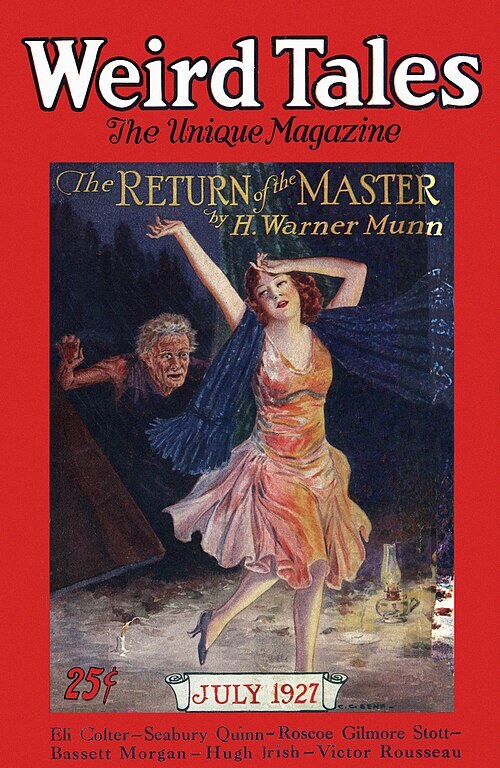
First published in Weird Tales, July 1926 (vol. 8, no. 1). Novelette. Jules de Grandin.
United States public domain. Held in the Reading Room of The Weird Library. Published by Weird Tales.
“MORBLEU, Friend Trowbridge, have a care,” Jules de Grandin warned as my lurching motor car almost ran into the brimming ditch beside the rain-soaked road. I wrenched the steering wheel viciously and swore softly under my breath as I leaned forward, striving vainly to pierce the curtains of rain which shut us in.
“No use, old fellow,” X confessed, turning to my companion, “we’re lost; that’s all there is to it.”
“Ha,” he laughed shortly, “do you just begin to discover that fact, my friend f Parbleu, I have known it this last half-hour.” Throttling my engine down, I crept along the concrete roadway, peering through my streaming windshield and storm curtains for some familiar landmark, but nothing but blackness, wet and impenetrable, met my eyes.
Two hours before, answering an insistent ’phone call, de Grandin and I had left the security of my warm office to administer a dose of toxin antitoxin to an Italian laborer’s child who lay, choking with diphtheria, in a hut at the workmen’s settlement where the new branch of the railroad was being put through.
The cold, driving rain and the Stygian darkness of the night had misled me when I made the detour around the railway cut, and for the past hour and a half I had been feeling my way over unfamiliar roads as futilely as a lost child wandering in the woods.
“Grace a Vieu,” de Grandin exclaimed, seizing my arm with both his small, strong hands, “a light ! See, there it shines in the night. Come, let us go to it. Even the meanest hovel is preferable to this so villainous rain.” I peeped through a joint in the curtains and saw a faint, intermittent WEIBD TALES light flickering through the driving rain some two hundred yards away.
“All right,” I acquiesced, climbing from the car, “we’ve lost so much time already we probably couldn’t do anything for the Vivianti child, and maybe these people can put us on the right road, anyway.” Plunging through puddles like miniature lakes, soaked by the winddriven rain, barking our 6hins again and again on invisible obstacles, we made for the light, finally drawing up to a large, square house of red brick fronted by an imposing whitepillared porch. Light streamed out through the fanlight over the white door and from the two tall windows flanking the portal.
" Parole u. a house of circumstance, this, ” de Grandih commented, mounting the porch and banging lustily at the polished brass knocker. I wrinkled my forehead in thought while he rattled the knocker a second time.
“Strange, I can’t remember this place,” I muttered.
“I thought I knew every building within thirty miles, but this is a new one - ”
“Ah bah!” de Grandin interrupted.
“Always yon must be casting a wet blanket on the parade, Friend Trowbridge. First you insist on losing us in the midst of a sacre rainstorm, then when I, Jules de Grandin, find its a shelter from the weather, you must needs waste time in wondering why it is you know not the place. ilorbleu, you will refuse shelter because you have never been presented to the master of the house, if I do not watch you, I fear.”
“But I ought to know the place, de Grandin,” I protested.
“It’s certainly imposing enough to - ” My defense was cut short by the sharp click of a lock, and the wide, white door swung inward before us.
"We Strode over the threshold, removing our dripping hats as we did so, and turned to address the person who had opened the door.
“Why - ” I began, and stared about me in open-mouthed surprize.
“Name of a little blue man!” said Jules de Grandin, and added his incredulous stare to mine. As far ae we could see, we were alone in the mansion’s imposing hall. Straight before us, perhaps for forty feet, ran a corridor of parquetry flooring, covered here and there by rieh-hued Oriental rugs.
White-paneled walls, adorned with oil paintings of imposing-looking individuals, rose for eighteen feet or so to a beautifully frescoed ceiling, and a graceful, curving staircase swept upward from the farther end of the room.
Candles in cut glass sconces lighted the highceiled apartment, the hospitable glow from a log fire burning under the high white marble mantel lent an air of homely coziness to the place, but of anything living, human or animal, there was no faintest trace or sign.
Click! Behind us, the heavy outer door swung to silently on well-oiled hinges and the automatic lock latched firmly.
“Death of my life!” de Grandin murmured, reaching for the door’s silver-plated knob and giving it a vigorous twist.
“Par 7a moustache du didble, Friend Trowbridge, it is locked! truly, perhaps it had been better if we had remained outside in the rain!”
“Not at all, I assure you, my dear sir,” a rich, mellow voice answered him from the curve of the stairs.
“Tour arrival was nothing less than providential, gentlemen.” Coming toward us, walking heavily with the aid of a stout cane, was an unnsually handsome man attired in pajamas and dressing gown, a sort of nightcap of flowered silk on his white head, slippers of softest Morocco on “You are a physician, sir?” he asked, glancing inquiringly at the medicine case in my hand. 79 “Yes,” I answered.
“I am Dr. Samuel Trowbridge, from Harrisonville, and this is Dr. Jules de Grandin, of Paris, who is my guest.”
“Ah,” replied our host, “I am very, very glad to welcome you to Marston Hall, gentlemen. It so happens that one — er — my daughter, is quite ill, and I have been unable to obtain medical aid for her on account of my infirmities ancl the lack of a telephone. If I may trespass on your charity to attend my poor child, I shall be delighted to have you as my guests for the night. If you will lay aside your coats” — he paused expectantly.
“Ah, thank you” — as we hung our dripping garments over a chair — “you will come this way, We followed him up the broad stairs and down an upper cox-ridor to a tastefully furnished chamber where a young girl — fifteen years of age, perhaps — lay propped up with a pile of diminutive pillows.
“Anabel, Amabel, my love, here are two doctors to see you,” the old gentleman called softly. The girl moved her fair head with a weary, peevish motion and whimpered softly in her sleep, but gave no further recognition of our presence.
“And what have been her symptoms, if you please, Monsieur?" de Grandin asked as he rolled back the cuffs of his jacket and prepared to make an examination.
“Sleep,” replied our host, “just sleep. Some time ago she suffered from influenza, lately she has been pven to fits of protracted dumber from which I can not waken her. I fear she may have contracted sleeping sickness, sir. I am told it sometimes follows influenza.”
“H’m.” De Grandin passed his small, pliable hands rapidly over the girl’s cheeks in the region of the ears, felt rapidly along her neck over the jugular vein, then raised a puzzled glance to me. * ‘ Have you some laudanum and aconite in your bag, Friend Trowbridge?” he asked.
“There’s some morphine,” I answered, “and aconite; but no lauda“No matter,” he waved his hand impatiently, bustling over to the medicine case and extracting two smai! phials from it.
“Iso matter, this will do as well. Some water, if you please. Monsieur,” he turned to the father, a medicine bottle in each hand.
“But, de Grandin” — I began, when a sudden lack from one of his slender, heavily-shod feet nearly broke my shin — “de Grandin, do you think that’s the proper medication ? ” I finished lamely.
“Oh, metis oni, undoubtedly.” he replied.
“Nothing else would do in this case. Water, if you please, Mon ■ sieur,” he repeated, again addressing the father. I stared at him in ill-disguised amazement as he extracted a pellet from each of the bottles and quickly ground them to powder while the old gentleman filled a tumbler with water from the porcelain pitcher which stood on the chintz-draped wash-stand in the comer of the chamber.
He was as familiar with the arrangement of my medicine case as I was, I knew, and knew that my phials were arranged by numbers instead of being labeled. Deliberately, I saw, he had passed over the morphine and aconite, and had chosen two bottles of plain, unmedicated sugar of milk pills.
What his object was I had no idea, but I watched him measure out four teaspoonfuls of water, dissolve the powder in it, and pour the sham medication down the unconscious girl’s throat “Good,” he proclaimed as he washed the glass with meticulous care.
“She will rest easily until the mom WEIBD TALES mg, Monsieur. When daylight comes we shall decide on further treatment. Will yon now permit that we retire!” He bowed politely to the master of the house, who returned his courtesy and led us to a comfortably furnished room farther down the corridor.
“Cee here, de Grandin,” I demand'J ed when our host had wished us a pleasant good-night and closed the door upon us, “what was your idea in giving that child an impotent dose like that - !”
“S-s-sh!” he cut me short with a fierce whisper.
“That young girl, mon ami, is no more suffering from encephalitis than you or I. There is no characteristic swelling of the face or neck, no diagnostic hardening of the jugular vein. Her temperature was a bit subnormal, it is true — but upon her breath I detected the odor of chloral hydrate. For some reason, good X hope, but bad I fear, she is drugged, and I thought it best to play the fool and pretend I believed the man’s statements. Pardieu., the fool who knows himself no fool has an immense advantage over the fool who believes him one, my friend.”
“But me no buts. Friend Trowbridge; remember how the door of this house opened with none to touch it, recall how it closed behind us in the same way, and observe this, if you will. ” Stepping softly, he crossed the room, pulled aside the chintz curtains at the window and tapped lightly on the frame which held the thick plate glass panes.
“Regardez vows,” he ordered, tapping the frame a second Like every other window I had seen in the house, this one was of the casement type, small panes of heavy glass being sunk into latticelike frames. Under de Grandin ’s directions I tapped the latter, and found them not painted wood, as I had supposed, but stoutly welded and bolted metal. Also, to my surprize, I found the tumbuckles for opening the casement were only dummies, the metal frames being actually securely bolted to the stone sills. To all intents, we were as firmly incarcerated as though serving a sentence in the state penitentiary.
“The door - ” I began, but he shook his head. Obeying his gesture, I crossed the room and turned the handle lightly. It twisted tinder the pressure of my fingers, but, though we had heard no warning click of lock or bolt, the door itself was as firmly fastened as though nailed shut.
“Wh — why,” I asked stupidly, “what’s it all mean, de Grandin!”
“Je ne sais quoi,” he answered with a shrug, “but one thing I know: I like not this house, Friend Trowbridge. I ’ ’ Above the hissing of the rain against the windows and the howl of the sea-wind about, the gables, there suddenly rose a scream, wire-edged with inarticulate terror, freighted with utter, transcendental anguish of body and soul.
“ Cordieu !” He threw up his head like a hound hearing the call of the pack from far away.
“Did you hear it, too, Friend Trowbridge!”
“Of course,” I answered, every nerve in my body trembling in horripilation with the echo of the hopeless “Pardieu,” he repeated, “I like this house less than ever, now ! Come, let us move this dresser before our door. It is safer that we sleep behind barricades this night, I think.” We blocked the door, and I was soon sound asleep.
“'T'rowbridge, Trowbridge, my A friend” — de Grandin drove a sharp elbow into my ribs — “wake up, I beseech you. Name of a green goat, you lie like one dead, save for your so abominable snoring!” 81 “Eh?” I answered sleepily, thrusting myself deeper beneath the voluminous bedclothes. Despite the unusual occurrences of the night I was tired to the point of exhaustion, and fairly drunk with sleep.
“Up; arise, my friend,” he ordered, shaking me excitedly.
“The coast is clear, I think, and it is high time we did some exploring.”
“Rats!” I scoffed, disinclined to leave my comfortable couch.
“What’s the use of wandering about a strange house to gratify a few unfounded suspicions? The girl might have been given a dose of chloral hydrate, but the chances are her father thought he was helping her when he gave it. As for these trick devices for opening and locking doors, the old man apparently lives here alone and has installed these mechanical aids to lessen his work. He has to hobble around with a cane, you know.”
“Ah!” my companion assented sarcastically.
“And that scream we heard, did he install that as an aid to his infirmities, also?”
“Perhaps the girl woke up with a nightmare, ’ ’ I hazarded, but he made an impatient gesture.
“Perhaps the moon is composed of green cheese, also, ” he replied.
“Up, up and dress; my friend. This house should be investigated while yet there is time. Attend me: But five minutes ago, through this very window, I did observe Monsieur our host, attired in a raincoat, depart from his own front door, and without his cane. Purlieu, he did skip as agilely as any boy, I assure you. Even now he is almost at the spot where we abandoned your automobile. What he intends doing there I know not. What I intend doing I know full well. Do you accompany me or not?”
“Oh, I suppose so,” I agreed, crawling from the bed and slipping into my clothes.
“How are you going to get past that locked door?” He flashed me one of his sudden smiles, shooting the points of his little blond mustache upward like the horns of an inverted crescent.
“Observe,” he ordered, displaying a short length of thin wire.
“In the days when woman's hair was still her crowning glory:, what mighty deeds a lady could encompass with a hairpin ! Pardieu-, there was one little grisette in Paris who showed me some tricks in the days before the war ! Regard me, if you please. ’ ’ Deftly he thrust the pliable loop of wire into the keyhole, twisting it tentatively back and forth, at length pulling it out and regarding it carefully.
“Trcs lien.” he muttered as he reached into an inside pocket, bringing out a heavier bit of wire.
“See,” he displayed the finer wire, “with this I take an impression of that lock’s tumblers, now” — quickly he bent the heavier wire to conform to the waved outline of the lighter loop — “voila, I have a key!” And he had. The lock gave readily to the pressure of his improvised key, and we stood in the long, dark hall, staring about us half curiously, half fearfully.
“This way, if you please,” de Grandin ordered; “first we will lookin upon la jeunesse, to see how it goes AVe walked on tiptoe down the corridor, entered the chamber where the girl lay-, and approached the bed. She was lying with her hands folded upon her breast in the manner of those composed for their final rest, her wide, periwinkle-blue eyes staring sightlessly before her, the short, tightly curled ringlets of her blond, bobbed hair surrounding her drawn, pallid face like a golden nimbus encircling the ivory features of a saint in some carved ikon. My companion approached the bed softly, placing one hand on the girl’s wrist with professional precision.
“Temperature low, pulse weak,” he WEIRD TALES murmured, cheeking off her symptoms. ‘ ‘ Complexion pale to the point of lividity, — ha, now for the eyes; sleeping, her pupils should have been contracted, while they should now be dilate — Die u de Dieu! Trowbridge, my friend, come here.
“Look,” he commanded, pointing to the apathetic girl’s face.
“Those eyes — grand Dieu,, those eyes! It is sacrilege, nothing less.” I looked into the girl's face, then started back with a half-suppressed cry of horror. Asleep, as she had been when we first saw her, the child had been pretty to the point of loveliness.
Her features were small and regular, clean-cut as those of a face in a cameo, the tendrils of her lightvellow hair had lent her a dainty, ethereal charm comparable to that of a Dresden china shepherdess.
It had needed but the raising of her delicate, long-lashed eyelids to give her face the animation of some laughing sprite playing truant from fairyland. Her lids were raised now, but the eyes they unveiled were no clear, joyous windows of a tranquil soul.
Rather, they were the peepholes of a spirit in torment. The irides were a lovely shade of blue, it is true, but the optics themselves were things of horror. Rolling grotesquely to right and left, they peered futilely in opposite directions, lending to her sweet, pale face the half-ludicrous, wholly hideous expression of a bloating frog.
“Good heavens!” I exclaimed, turning from the deformed girl with a feeling of disgust akin to nausea; “What a terrible affliction ! ’ ’ De Grandin made no reply, but bent over the girl’s still form, gazing intently at her malformed eyes.
“It is not natural,” he announced.
“The muscles have been tampered with, and tampered with by someone who is a master hand at surgery. Will you get me your syringe and some strychnin, Friend Trowbridge? This poor, one is still unconscious.” I hastened to our bedroom and returned with the hypodermic and stimulant, then stood beside him, watching eagerly, as he administered a strong injection.
The girl’s narrow chest fluttered as the powerful drug took effect, and the pale lids dropped for a second over her repulsive eyes. Then, with a sob which was half moan, she attempted to raise herself on her elbow, fell back again, and, with apparent effort, gasped, "The mirror, let me have the mirror!
Oh, tell me it isn’t true; tell me it was a trick of some sort. Oh, the horrible thing I saw in the glass couldn’t have been I. Was it 3”
“Item, ma petite,” de Grandin replied, "but you speak in riddles. What is it you would know!”
" He — he” — the girl faltered weakly, forcing her trembling lips to frame the words — “that horrible old man showed me a mirror a little while ago and said the face in it was mine. Oh, it was horrible, horrible!”
“Eh? What is this?” de Grandin demanded on a rising note.
“ ‘He’? ‘Horrible old man’? Are you not his daughter? Is he not your father!”
“No,” the girl gasped, so low her denial was scarcely audible.
“I was driving home from llackettsdale last — oh, I forget when it was, but it was at night — and my tires punctured. I — I think there must have been glass on the road, for the shoes were cut to ribbons. I saw the light in this house and came to ask for help. An old man — oh, I thought he was so nice and kind! — let me in and said he was all alone here and about to eat dinner, and asked me to join him. I ate some — some — oh, I don’t remember what it was — and the next thing I knew he was standing by my bed, holding a mirror up to me and telling me it was my face I saw in the glass. Oh, please, please, tell me it was some terrible trick lie played on. me. I’m not truly hideous, am II”
“Morbleu!” de Grandin muttered softly, tugging at the ends of his mustache.
“'What is all this?” To the girl he said : “But of course not. You are like a flower, Mademoiselle. A little flower that dances in the wind. You - ”
“And my eyes, they aren’t — they aren’t” — she interrupted with piteous eagerness — “please tell me they ‘‘Mais non, ma c/iere,” he assured her.
“Your eyes are like the pervenehe that mirrors the sky in springtime. They are - ”
“Let — let me see the mirror, please,” she interrupted in an anxious whisper.
“I’d like to see for myself, if you — oh, I feel all weak inside - ” She lapsed back against the pillow, her lids mercifully veiling the hideously distorted eyes and restoring her face to tranquil beauty.
“Cordieu!” de Grandin breathed.
“The chloral re-asserted itself none too soon for Jules de Grandin ’s comfort, Friend Trowbridge. Sooner would I have gone to the rack than have shown that pitiful child her face “But what’s it all mean?” I asked.
“She says she came here, and - ”
“And the rest remains for us to find out, I think,” he replied evenly.
“Come, we lose time, and to lose time is to be caught, my friend.” De grandin led the way down the hall, peering eagerly into each door we passed in search of the owner’s chamber, but before his quest was satisfied he stopped abruptly at the head of the stairs.
“Observe, Friend Trowbridge,” he ordered, pointing a carefully manicured forefinger to a pair of buttons, one white, one black, set in the wall.
“Unless I am more mistaken than I think I am, we have here the key to the situation — or at least to the front door.” He pushed vigorously at the white button, then ran to the curve of the stairs to note the result. Sure enough, the heavy door swung open on its hinges of cast bronze, letting gusts of rain drive into the lower hall.
“Pardieu,” he ejaculated, “we have here the open sesame ; let us see if we possess the closing secret as well! Press the black button, Trowbridge, my friend, while I watch.” I did his bidding, and a delighted exclamation told me the door had closed.
“Now what?” I asked, joining him on the stairway.
“U’m,” he pulled first one, then the other end of his diminutive mustache meditatively; “the house possesses its attractions. Friend Trowbridge, but I believe it would be well if we went out to observe what our friend, le vieillard horrible, does.
I like not to have one who shows young girls their disfigured faces in mirrors near our conveyance.” Slipping into our raincoats we opened the door, taking care to place a wad of paper on the sill to prevent its closing tightly enough to latch, and scurried out into the storm.
As we left the shelter of the porch a shaft of indistinct light shone through the rain, as my car was swung from the highway and headed toward a depression to the left of the ‘‘Parbleu, he is a thief, this one!” de Grandin exclaimed excitedly.
“Hola, Monsieur!” He ran forward, swinging his arms like a pair of semaphores.
“What sort of business is it you make with our moteurf” The wailing of the storm tore the words from his lips and hurled them away, but the little Frenchman was not to be thwarted.
“Pardieu,” he gasped, bending his head against the wind-driven rain, “I will stop the scoundrel if — non i d’un coq, he has Even as he spoke the old man flung open the ear’s forward door and leaped, allowing the machine to go crashing down a low, steep embank ment into a lake of slimy swamp-mud. For a moment the vandal stood contemplating his work, then hurst into a peal of wild laughter more malignant than any profanity.
“ParbUu, robber, Apache! you shall laugh from the other side of your mouth!” de Grandin promised, as he made for the old man. But the other seemed oblivious of our presence. Still chuckling at his work, he turned toward the house, stopped short as a sudden heavy gust of wind shook the trees along the roadway, then started forward with a yei! of terror as a great branch, tom bodily from a towering oak tree came crashing toward the earth He might as well have attempted to dodge a meteorite.
Like an arrow from the bow of divine justice, the great timber hurtled down, pinning his frail body to the ground like a worm beneath a laborer’s brogan. ‘ ' Trowbridge, my friend,” de Grandin announced matter-of-factly, ■'observe the evil effects of stealing We lifted the heavy bough from the prostrate man and turned him over on his back.
De Grandin on one side, I on the other, we made a hasty examination, arriving at the same finding simultaneously. His spinal column was snapped like a pipestem.
“You have some last statement to make, Monsieur?” de Grandin asked curtly.
“ If so, you had best he about it, your time is short.” ‘ ‘ Y — yes, ’ ’ the stricken man replied •weakly.
“I — I meant to kill you, for you might have hit upon my secret. As it is, you may publish it to the world, that all may know what it meant to offend a Harston. In my room you will find the documents. My — my pets — are — in — the— cellar. She — was — to — have — been — one— of — them.” The pauses between his words became longer and longer, his voice grew weaker with each labored syllable. As he whispered the last sentence painfully there was a gurgling sound, and a tiny stream of blood welled up at the comer of his mouth. His narrow chest rose and fell onee with a convulsive movement, then his jaw dropped limply. He was dead.
“Oh ho,” de Grandin remark":’ “it is a hemorrhage which finished him. A broken rib piercing his lung. U’m? I should have guessed it. Come, my friend, let ns carry him to the house, then see what it was he meant by that talk of documents and pets. A pest upon the fellow for dying with his riddle half explained! Did he not know that Jules de Grandin can not resist the challenge of a riddle? Parb'eu, we will solve this mystery, Monsieur le Mori, if we have to hold an autopsy to do so ! ”
“Oh, for heaven’s sake, hush, de Graudin,” I besought, shocked at his heartlessness. ‘ 1 The man. is dead. ’ ’ “Ah bah!” he returned scornfully.
“Dead or not, did he not steal your motor car?” WE laid our gruesome burden on the hall couch and mounted the stairs to the second floor. With de Grandin in the lead we found the dead man’s room and began a systematic search for the papers he had mentioned, almost with his last breath. After some time my companion unearthed a thick, leatherhound portfolio from the lower drawer of a beautiful old mahogany highboy, and spread its wide leaves open on the white-connterpaned bed.
“Ah,” he drew forth several papers and held them to the light, “we begin to make the progress. Friend Trowbridge. What is this?” He held out a newspaper clipping Actress Jilts Surgeon’s Crippled Son on Eve of Wedding Declaring she could not stand the sight of his deformity, and that she had engaged herself to him only in a moment of thoughtless pity, Dora Lee, well-known variety acmarry John^iersfield Marston, *Vr.. hopelessly crippled son of Dr.
John Biersfield Marston, the well-known surgeon and exx osteologist. - ~l _ r his father ■s from the Plane \ )uldbbe^en ‘‘Very good.'* de Grandin nodded, ‘‘we need go no fanner with that account.
A young woman, it would seem, once broke her promise to marly a cripple, and, judging from this paper’s date, that was in 1896. Here is another, what do you make of it?” The clipping he handed me read as follows : Surgeon’s Son a Suicide Still sitting in the wheel-chair from which he has not moved durinsr his waking hours since he was hopelessly crippled while playing polo in England ten years ago, John Biersfield Marston, son of the famous surgeon of the same name, was found in his bedroom this morning by his valet.
A rubber hose was connected with a gas jet, the other end being held in the young man’s mouth. Young Marston was jilted b; ” — ’ — — — Kle\-'” s reported to have been extremely low-spirited since his desertion by his fiancee.
Dr. Marston, the bereaved father, when seen by reporters from the Planet this morning, declared the actress was responsible for his son’s death and announced his intention of holding her accountable.
When asked if legal proceedings were contemplated, he declined farther information.
“Sot” de Grandin. nodded shortly.
“Now this one, if you please.” The third clipping was brief to the point of curtness: Dr. John BiersfleM Marston, widely try as an expert in operations concerning the bones, has announced his intention of retiring from practise. His house has been sold, and he Trill move from the city.
“The record is clear so far,” de Grandin asserted, studying the first clipping with raised eyebrows, “but — morbleu, my friend, look, look at this picture. This Dora Lee, of whom does she remind you? Eh?” I took the clipping again and looked intently at the illustration of the article announcing young marston ’s broken engagement. The woman in the picture was young and inclined to be overdressed in the voluminous, fluffy mode of the days before the Spanish-American War.
“U’m. no one whom I know - ” I began, but halted abruptly as a sudden likeness struck me. Despite the towering pompadour arrangement of her blond hair and the unbecoming straw sailor hat above the coiffure, the woman in the picture bore a certain resemblance to the disfigured girl we had seen a half-hour before. The Frenchman saw recognition dawn in my face, and nodded agreement.
“But of course,” he said.
“Now, the question is, is this young girl whose eyes are so out of alinement a relative of this Dora Lee, or is the resemblance a coincidence, and if so, what lies behind it ? Hein?”
“I don’t know,” I admitted, “but there must be some connection - ”
“Connection? Of course there is a connection,” de Grandin affirmed, rummaging deeper in the portfolio.
“A-a-ah! What is this? Nom d’un nom, Friend Trowbridge, I think I smell the daylight! Look!” He held a full-page story from one of the sensational New York dailies before him, his eyes glued to the flowing typo and crude, coarse-sereened half-tones of half a dozen yonng women which composed the article.
“WHAT HAS BECOME OF THE MISSING GIRLS?” I read in boldfaced type across the top of the page. TALES “Are sinister, unseen hands reaching out from the darkness to seize our girls from palace and hovel, shop, stage and office?” the article asked rhetorically.
“"Where are Ellen Munro and Dorothy Sawyer and Phyllis Bouchet and three other lovely, light-haired girls who have walked into oblivion during the past year?” I read to the end the sensational account of the girls’ disappearances. The cases seemed fairly similar; each of the vanished young women had failed to return to her home and had never been accounted for in any manner, and in no instance, according to the newspaper, had there been any assignable reason for voluntary de“Parbleu, but he was stupid, even for a journalist!” de Grandin asserted as I completed my inspection of the story.
“Why, I wager even my good Friend Trowbridge has already noticed one important fact which this writer has treated as though it were as commonplace as the ‘ ‘ Sorry to disappoint you, old chap,” I answered, “but it looks to me as though the reporter had covered the case from every possible angle.”
“Ah? So?” he replied sarcastically.
“Morbleu, we shall have to consult the oculist in your behalf when we return home, my friend. Look, look, I beseech you, upon the pictures of these so totally absent and imaecounted for young women, cTier ami, and tell me if you do not observe a certain likeness among them, not only a resemblance to each other, but to that Mademoiselle Lee who jilted the son of Dr. Marston? Can you see it, now I have pointed it out?”
“No — wh — why, yes, — yes, of course !” I responded, rmTning my eye over the pictures accompanying the story.
“By the Lord Hairy, de Grandin, you ’re right; you might almost say there is a family resemblance between these girls! You’ve put your finger on it, I do believe.”
“Helas, no!” he answered with a shrug.
“I have put my finger on nothing as yet, my friend. I reach, I grope, I feel about me like a blind man tormented by a crowd of naughty little boys, but nothing do the poor fingers of my mind encounter. Pah! Jules de Grandin, you are one great fool! Think, think, stupid one!” He seated himself on the edge of the bed, cupping his face in his hands and leaning forward till his elbows rested on his knees. Suddenly he sprang erect, one of his elfish smiles passing across his small, regular features.
“Norn d’um chat rouge, my friend, I have it — I have it!” he announced.
“The pets — the pets that old stealer of motor ears spoke of ! They are in the basement ! Pardieu, we will see those pets, cher Trowbridge ; with our four collective eyes we will see them. Did not that so execrable stealer declare she was to have been one of them? Now, in the name of Satan and brimstone, whom could he have meant by ‘she’ if not that unfortunate child with eyes like la grenouiXlet Eh?”
“"Why - ” I began, but he waved me forward. ' ‘ Come, come ; let us go, ’ ’ he urged.
“I am impatient, I am restless, I am not to be restrained.
"We shall investigate and see for ourselves what sort of pets are kept by one who shows young girls their deformed faces in mirrors and — parbleu! — steals motor cars from my friends.” Hurrying down the main stairway, we hunted about for the cellar entrance, finally located the door and, holding above our heads a pair of candles from the hall, began descending a flight of rickety steps into a pitch-black basement, rock-walled and, judging by its damp, moldy odor, unfloored save by the bare, moist earth beneath the house.
THE H0U3E OP HORROR 87 “Parbleu, the dungeons of the chateau at Carcassonne are more cheerful than this,” de Grandin commented as he paused at- the stairs’ foot, holding his candle aloft to make a better inspection of the dismal I suppressed a shudder of mingled chill and apprehension as I stared at the blank stone walls, unpierced by windows or other openings of any sort, and made ready to retrace my steps.
“Nothing here.” I announced.
“You eaa see that with half an eye. The place is as empty as - ”
“Perhaps. Friend Trowbridge,” he agreed, “but Jules de Grandin does not look with half an eye. He uses both eyes, and uses them more than once if his first glance does not prove sufficient. Behold that bit of wood on the earth yonder.
"What do you make “U’m — ?. piece of flooring, maybe,” I hazarded.
“Maybe yes, maybe no,” he answered.
“Let us see.” Crossing the cellar, he bent above the planks, then turned to me with a satisfied smile.
“Flooring does not ordinarily have ring-bolts in it, my friend,” he remarked, bending to seize the iron ring which was made fast to the boards by a stout staple.
“ Ha ! ” As he heaved upward the planks came away from the black earth, disclosing a board-lined well about three feet square and of uncertain depth. An almost vertical ladder of two-by-four timbers led downward from the trap-door to the well's impenetrable blackness.
“Allons, we descend,” he commented, turning about and setting his foot on the topmost rung of the ladder.
“Den’t be a fool,” I advised.
“You don’t know what’s down there.”
“True” — his head was level with the floor as he answered — “but I know, with luck, in a few moments. Do you come?” I sighed with vexation as I prepared to follow him. At the ladder’s foot he paused, raising his candle and looking about inquiringly. Directly before us was a passageway through the earth, ceiled with heavy planks and shored up with timbers like the lateral workings of a primitive mine.
“Ah, the plot shows complications, ” he murmured, stepping briskly into the dark tunnel.
“Do you come. Friend Trowbridge?” I followed, wondering what manner of thing might he at the end of the black, musty passage, but nothing but fungus-grown timbers and walls of moist, black earth met my questing gaze.
De Grandin preceded me by some paces, and, X suppose, we had gone fifteen feet through the passage when a gasp of mingled surprize and horror from my companion brought me beside liim in two long strides.
Fastened with nails to the timbers at each side of the tunnel were a number of white, glistening objects, objects which, because of their very familiarity, denied their identity to my wondering eyes.
There was no mistaking the things: even a layman could not have failed to recognize them for what they were. I, as a physician, knew them even, better. To the right of the passage hung fourteen perfectly articulated skeletons of human legs, complete from foot to ilium, gleaming white and ghostly in the flickering light of the candles.
“Good heavens!” I exclaimed'.
“Sang du diable!’’ Jules de Grandin commented.
“Behold what is there, my friend,” he pointed to the opposite walL Fourteen bony arms, complete from hand to shoulderjoint, hung pendulously from the tunnel’s upright timbers.
“Pardieu,’’ de Grandin muttered.
“I have known men who collected stuffed birds and dried insects ; I have known those who stored away Egyptian mummies — even the skulls of men long dead — but never before have I seen a collection of arms and legs! Parbleu, he was caduc — mad as a hatter, this one, or I am much mistaken!” ‘‘So these were his pets?” I answered.
“Yes, the man was undoubtedly mad to keep such a collection, and in a place like this. Poor fel“Nom d’un carton!” de Grandin broke in; “what, was that?” Prom the darkness before us there came a queer, inarticulate sound, such as a man might make attempting to speak with a mouth half-filled with food, and, as though the noise had wakened an echo slumbering in the cavern, the sound was repeated, multiplied again and again dll it resembled the babbling of half a dozen overgrown infants — or an equal number of full-grown imbeciles.
“Onward!” Responding to the challenge of the unknown like a warrior obeying the trumpet’s call to charge, de Grandin dashed toward the strange noise, swung about, flashing his candle this side and that, then: " Norn de Dieu de nom de Dieu!” he almost shrieked.
“Look, Friend Trowbridge, look and say that you see what I see, or have I, too, gone mad?” Lined up against the wall was a series of seven small wooden boxes, each with a door composed of upright slats before it, similar m construction to the coops in which country folk pen brooding hens — and no larger.
In each of the hutches huddled an object the like of which I bud never before seen, even in the terrors of nightmare. The things had the torsos of human beings, though hideously shrunken from starvation and incrusted with scales of filth, but there all resemblance to mankind ceased.
From shoulders and waist there twisted flaccid tentacles of unsupported flesh, the upper ones terminating in flat, paddlelike flippers which had some remote resemblance to hands, the lower ones ending in almost shapeless stubs which resembled feet only in that each had a fringe of five shriveled, unsupported protuberances of withered flesh.
On scrawny necks were balanced caricatures of faces, flat, noseless, chinless countenances with horrible crossed or divergent eyes, mouths widened almost beyond resemblance to buccal orifices, and — horror of horrors! — elongated, split tongues protruding several inches from the lips and wagging impotently in vain efforts to form words.
“Satan, thou art outdone!” de Grandin cried as he held his candle before a scrap of paper decorating one of the cages after the manner of a sign before an animal’s den at the zoo.
“Observe!” he ordered, pointing a stinking finger at the notice. I looked, then recoiled, sick with horror. The paper bore the picture and name of Ellen Munro, one of the girls mentioned as missing in the newspaper article we had found in the dead man’s bedroom.
Beneath the photograph was scribbled in an irregular hand: “Paid 1-25-97.” Sick at heart we walked down the line of pens. Each was labeled with the picture of a young and pretty girl with the notation, “Paid,” followed by a date.
Every girl named as missing in the newspaper was represented in the cages. Last of all, in a coop somewhat smaller than the rest, we found a body more terribly mutilated than any. This was marked with the photograph and name of Dora Lee.
Beneath her name was the date of her “payment,” written in bold red “Parbleu, what are we to do, my friend?” de Grandin asked in an hysterical whisper.
"We can not return these poor ones to the world, that would be the worst form of cruelty; yet — yet I shrink from the act of mercy I know they would ask me to perform if they could speak.”
"Let’s go up,” I begged.
“We must think this thing over, de Grandin, and if X stay here any longer I shall faint.”
“Bien,” he agreed, and turned to follow me from the cavern of horrors.
“Tt is to consider,” he began as we reached the upper hall once more.
“If we give those so pitiful ones the stroke of mercy we are murderers before the law, yet what service could we render them by bringing them once more into the world? Our choice is a hard one, my friend. ’ ’ I' nodded.
“Morbleu, but he was clever, that one,” the Frenchman continued, half to me, half to himself .
“What a surgeon ! Fourteen instances of W yeth ’s amputation of the hip and as many more of the shoulder — and every patient lived, lived to suffer the tortures of that hell-hole down there! But it is marvelous! None but a madman could have done it.
“Bethink you, Friend Trowbridge. Think how the mighty man of medicine brooded over the suicide of his crippled son, meditating hatred and vengeance for the heartless woman who had jilted him.
Then — snap! went his great mentality, and from hating one woman he fell to hating all, to plotting vengeance against the many for the sin of the one. And, cordieu, what a vengeance!
How he must have laid his plans to secure his victims; how he mnst have worked to prepare that hell-under-the-earth to house those poor, broken bodies which were his handiwork, and how he must have drawn upon the great surgical skill which was his, even in his madness, to transform those once lovely ones into the visions of horror we have just beheld !
Horror of horrors ! To remove the bones and let the girls still live!” He rose, pacing impatiently across the hall.
“What to do? What to do?” he demanded, striking his open hands against his forehead. I followed his nervous steps with my eyes, but my brain was too numbed by the hideous things I had just seen to be able to respond to his question. I looked hopelessly past him at the angle of the wall by the great fireplace, rubbed my eyes and looked again. Slowly, but surely, the wall was declining from the perpendicular.
“De Grandin,” I shouted, glad of some new phenomenon to command my thoughts, “the wall — the wall’s leaning!”
“Eh, the wall?” he queried.
“Pardim, yes! It is the rain; the foundations are undermined. Quick, quick, my friend! To the cellars, or those unfortunate ones are undone!” We scrambled down the stairs leading to the basement, but already the earth floor was sopping with water. The well leading to the madman’s subcellar was more than half full of bubbling, earthy ooze.
“Mary, have pity!” de Grandin exclaimed.
“Like rats in a trap, they did die. God rest their tired souls” — he shrugged his shoulders as he turned to retrace his steps— “it is better so. Now, Friend Trowbridge, do you hasten aloft and bring down that young girl from the room above. We must run for it if we do not wish to be crushed under the falling timbers of this house of abominations!” The storm had spent itself and a red, springtime sun was peeping over the horizon as de Grandin and I trudged up my front steps with the mutilated girl stumbling wearily be“Put her to bed, my excellent one,” de Grandin ordered Nora, my housekeeper, who came to meet us enveloped in righteous indignation and an outing flannel nightgown.
“Parbleu, she has had many troubles!” In the study, a glass of steaming whisky and hot water in one hand, a vile-smelling French cigarette in the other, he faced me across the desk. ‘‘How was it you knew not that house, my friend?” he demanded. I grinned sheepishly. ”1 took the wrong turning at the detour,” I explained, “and got on the Yerbysville Road. It’s just recently been hardsurfaced, and I haven’t used it for years because it was always impassable. Thinking we were on the Andover Pike all the while, I never connected the place with the old Olmsted Mansion I’d seen hundreds of times from the road.”
“Ah, yes,” he agreed, nodding thoughtfully, “a little turn from the right way, and — pouf! — what a distance we have to retrace.”
“Now, about the girl upstairs,” I began, but he waved the question “The mad one had but begun his devil’s work on her,” he replied.
“I, Jules de Grandin, will operate on her eyes and make them as straight as before, nor will I accept one penny for my work. 3Ieantime, we must find her kindred and notify them she is safe and in good hands.
“And now” — he handed me his empty tumbler — “a little more whisky, if you please, Friend Trowbridge.”