WF Q56 .D87 1930
The Dust of Egypt
First published in Weird Tales, April 1930 (vol. 15, no. 4). Novelette. Jules de Grandin. Text from the April 1930 Weird Tales appearance.
United States public domain. Held in the Reading Room of The Weird Library. Published by Weird Tales.
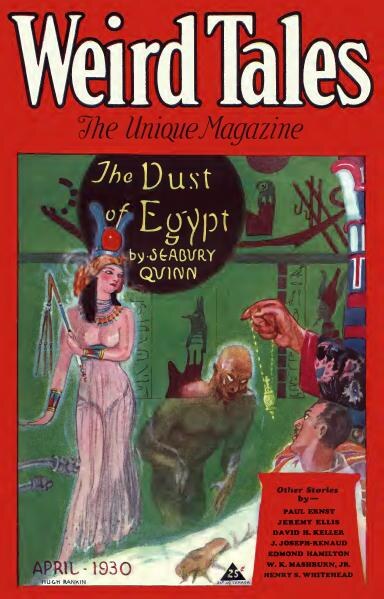
Cover by Hugh Rankin, illustrating this story.
IT WAS an odd couple Nora McGinnis ushered into my drawing-room that snowy February night. The man was good-looking, extraordinarily so, with fine, regular features crowned by a mass of dark hair, broad forehead and deep, greenish-hazel eyes set well apart beneath brows of almost startling blackness. His chest was deep and well developed, and his wide, square shoulders told of strength and stamina beyond the usual. Yet he was scarcely more than five feet tall, and the trousers of his well-tailored dinner suit hung baggily on limbs shriveled to mere skeletal proportions. His right knee bent awkwardly at a fixed, unchanging angle which made his walk little more than a lurching, painful hobble, and the patent leather oxfords on his feet were almost boyish in their smallness. Obviously, poliomyelitis had ravaged his once splendid body hideously, leaving a man half perfect, half pitiable wreck.
The woman, apparently almost of an age with her companion—somewhere near twenty-five, I judged—was in everything but deformity his perfect feminine counterpart. Close as a skullcap of black satin her mannishly shingled, jetty hair lay against her small, well-shaped head; her features were so small and regular as to be almost insignificant by reason of their very symmetry; her walk was one of those smooth, undulant gaits which announce a nervous balance and muscular co-ordination not often found in this neurotic age. A sleeveless evening frock of black net and satin fell in graceful folds almost to her narrow, high-arched insteps, and the tiny emerald buttons decorating her black-satin pumps were matched by the emerald studs set in the lobes of her small ears and, oddly, by the greenish lights in her black-fringed hazel eyes. She was devoid of make-up, save the vivid scarlet of her lips.
I examined the two small oblongs of cardboard Nora had handed me before admitting the visitors. “Mr. Monteith?” I asked tentatively.
“I am he,” the young man answered with a quick smile which lighted his somber, brooding countenance with a peculiar charm, “and this is my sister, Louella.” He paused a moment, as though embarrassed, then:
“We’ve been told you have a friend, a Dr. de Grandin, who occasionally interests himself in matters which have, or seem to have, a supernatural aspect. If you would be good enough to tell us how we might get in touch with him—”
“Avec beaucoup de félicité!” Jules de Grandin interrupted with a laugh. “Stretch forth your hand, and touch, mon ami: I am he whom you seek!”
“Ah?” young Monteith stared at the little Frenchman, scarcely knowing how to acknowledge the unusual introduction. “Ah—”
“Précisément,” de Grandin assented as he waved the callers to a seat upon the fireside lounge. “We are very well met. I think; this had promised to be a dull evening. Now, regarding this seemingly so supernatural matter concerning which you would consult Jules de Grandin—” he raised his narrow, black brows till they described twin Saracenic arches and paused expectantly.
Young Monteith ran his hand over his smoothly brushed black hair and directed a look almost of appeal at the little Frenchman. “I hardly know how to begin,” he confessed, then cast a puzzled glance about the room, as though seeking inspiration from the Dresden figurines on the mantelpiece.
“Why not at the beginning?” de Grandin suggested pleasantly as he drew out his slim gold cigarette case, courteously proffered it to the visitors, then held his pocket lighter for them to set the tobacco alight.
“The case concerns my uncle—our uncle’s—death,” Mr. Monteith replied as he expelled a cloud of fragrant gray smoke from his nostrils. “It may have been natural enough—the death certificate read heart failure, and there were no legal complications—but both my sister and I are puzzled, and if you can spare the time to investigate it, we’d—here,” he broke off, drawing a thin packet of papers from his inside pocket, “this is a copy of Uncle Absalom’s will; we might as well start with it as anything.”
The little Frenchman took the sheets of foolscap with their authenticating red seals and held them to the light.
“In the Name of God, Amen,” he read: “I, Absalom Barnstable”—Barn-stable, mon Dieu, what a name!—“being of sound and disposing mind and memory and in full bodily vigor, yet being certain of the near approach of unescapable and inevitable doom, do hereby make, publish and declare this, my last will and testament, hereby revoking any and all other will or wills by me at any time heretofore made.
“First—I commend my spirit to the keeping of God my Savior, and my body to be buried in my plot in Vale Cemetery.
“Second—”
“You can skip the second, third and fourth paragraphs,” Mr. Monteith interrupted; “the fifth is the only one bearing further on our problem.”
“Very well,” de Grandin turned the page and continued: “Fifth—And it is my will and desire that my said nephew and niece, David and Louella Monteith, aforesaid, do take up residence in my house near Harrisonville, New Jersey, as soon as they shall be apprised of the provisions hereof, and shall there remain in residence for the full term of six months, and at the end of that time, unless intervening occurrences shall have prompted them to take such action earlier, or unless it shall have become physically impossible so to do, they shall remove from the said house the mummy of the Priest Sepa and see it safely transported overseas and buried in the sands of the Egyptian desert; and I do especially make the faithful carrying-out of these injunctions conditions precedent to their succession to the residuum of my estate.”
De Grandin finished reading and glanced from the brother to the sister with his odd, unwinking stare.
“We are the residuary legatees of Uncle Absalom’s estate,” David Monteith explained. “It amounts to something like $300,000.”
“Parbleu, for half that sum I should undertake the interment of all the shriveled mummies in the necropolis of Thebes!” the Frenchman returned. “But where is the outré feature of your case, my friends? True, your estimable uncle seems to have been peculiar, but eccentricity is the privilege of age and wealth. Why should you not make yourselves comfortable in his late dwelling for half a year, then bury the so long dead Egyptian gentleman with fitting honors and thereafter enjoy yourselves in any manner seeming good to you?”
It was the girl who answered. “Dr. de Grandin,” she asked in a charmingly modulated contralto voice, “didn’t you notice the odd phraseology in the opening paragraph of Uncle Absalom’s will? If he had said ‘being certain of the near approach of unescapable and inevitable death’ we should have paid little attention to it, for he was past eighty years old, and even though he seemed strong and active as a man of sixty, death couldn’t have been so far away in the natural course of things; but he didn’t say ‘death’, he said ‘unescapable and inevitable doom’.”
“Exactement,” de Grandin agreed calmly, but the sudden light which shone in his little round blue eyes betrayed awaking interest. “Précisément, Mademoiselle; what then?”
“I’m certain that horrible old mummy he mentions in his will had something to do with it,” she shot back in a low, almost breathless voice. “Show him the transcription, David,” she ordered, turning to her brother.
Mr. Monteith produced a second paper from his pocket. “Louella found this in an old escritoire in the library the day before Uncle Absalom died,” he explained. “She meant to ask him about it, but never got the chance. It may shed some light on the case—to you. It only makes it more mysterious to us.”
“Transcription of the Tablet found in the Tomb of Sepa the Priest,” de Grandin read:
“Sepa, servant and priest of Aset, the All-Mother, Who Is and Was and Is to Be, to whoso looks hereon, greeting and admonition:
“Impious stranger, who hast defiled the sanctuary of my sepulcher, be thou accursed. Be thy uprisings and thy down-lyings accursed; accursed be thy goings-out and thy returnings; cursed be thou in labor and in rest; may thy nights be filled with terrifying visions and thy days with travail and with pain, and may the wrath of Aset, who Was and Is and Is to Be, be on thee and on thy house for all time. May thy body be the prey to kites and jackals and thy soul endure the torture of the Gods. Unburied shalt thou die, and bodiless and accursed shalt thou wander in Amenti forever and forever, and be this malediction on thee and on thy house until such time as my relics be once again interred in the sands of Khem. I have said.”
“Eh bien, he cursed a vicious curse, this one,” the Frenchman remarked as he concluded. “And what is this we have here?”
Pasted to the bottom of the sheet bearing the translation of the old priest’s curse was a newspaper cutting bearing a London dateline:
London. Nov. 16.—The strange death of Richard Bethell, son of Lord Westbury, today revived the legend of the curse of death that hovers over those who disturb the graves of the ancient lords of Egypt.
His death is the tenth among the leaders of Lord Carnarvon’s expedition to the Valley of the Kings in Egypt, which uncovered the tomb of King Tutankhamen.
Bethell, who was secretary to Howard Carter, leader of the expedition, was found dead in bed in the aristocratic Bath Club. Physicians are at a loss as to what caused his end.
“U’M?” de Grandin put the paper down and regarded the visitors once more with his direct, level stare. “And what of your late uncle?” he demanded. “Tell me what you can of his life; more particularly of his death.”
Again it was the girl who answered. “Uncle Absalom was educated for the Unitarian ministry,” she began, “but he never accepted the vocation. About the time he was to take up his ministerial work he met a young lady in New Bedford, Massachusetts, and fell violently in love with her. Yankee clippers still traded with the Orient and Near East in those days, and Miss Goodrich’s father, who was a ship-owner, offered Uncle Absalom a share in the business if he would give up his clerical career. He shipped as supercargo on the Polly Hatton at his future father-in-law’s suggestion, and in the course of a three-year cruise touched at Alexandria, Egypt.
“He seems to have had plenty of time to go inland exploring, for he made a trip up the Nile and with a party of Arabs broke into a tomb somewhere near Luxor and brought back several mummies, some papyri and some funerary statues. It was comparatively easy to get such things out of Egypt in those days, so Uncle had little difficulty in bringing his finds—or would you call them loot?—away. Oddly enough, they proved the foundation of his fortune.
“Unknown to Uncle Absalom and the master of the ship, Mr. Goodrich had died of smallpox while the Polly Hatton was on her cruise, and when they came to appraise his estate he was found to be practically bankrupt. Harriet, his daughter, married a wealthy young ship-chandler, and was the mother of two children when her ‘fiancé’ finally returned to New Bedford.
“But the mummies Uncle Absalom had found proved rather valuable ones. Egyptology was just beginning to be the important science it is today, and the papyri found in the mummy-cases gave a great deal of valuable information the officials of the British Museum had only guessed at before. They paid Uncle £200—a great deal of money in those days—for his finds, and made him a liberal offer for any further antiquities he might bring them.
“When Uncle Absalom returned to New England to find his expected bride already a wife and mother, his entire nature seemed to change almost overnight. The quiet, bookish divinity student was transformed into a desperate adventurer. The Civil War had been over five years, and the country was beginning to drift into the period of hard times which ended in the panic of 1873. Plenty of young men who’d served in the Union army and navy were out of work, and Uncle Absalom had no trouble recruiting a company of followers without respect either for danger or decency, provided there was money to be had for their work.
“Poor Uncle Absalom! I’m afraid everything he did during the next twenty years or so wouldn’t bear too close scrutiny! The returns from his first venture in grave robbery had proved so good that he went into it as a business.
“Even though most of them were Mohammedans and didn’t believe in the old gods, the Egyptians didn’t take kindly to foreigners despoiling the ancient tombs, and Uncle and his men encountered resistance more than once; but the men who had fought with Grant and Sherman and Farragut weren’t the kind to be stopped by unorganized Arabs, or even by the newly organized gendarmerie of Egypt. They robbed and plundered systematically, taking their loot to a sort of buccaneers’ cache they’d established at a desert oasis, and when they’d accumulated enough spoil to make it worth while, they’d take it out in an armed caravan, sometimes striking for the Red Sea, sometimes going boldly to the Mediterranean, and wo betide whoever tried to stop them!
“Of course, both the English and the French went through the motions of combatting this wholesale grave-robbery, but both countries had more important things to attend to, and Uncle’s men helped them subdue rebellious natives more than once; so many of his crimes were winked at officially. Also, the great museums of London, Paris, Berlin and St. Petersburg were glad to buy whatever he had for sale, and often bid against each other for his wares; so he grew rich and, in a way, respected. The curators of those museums weren’t so very different from people over here,” she added with a smile. “When I was in school in Washington it was common gossip that the Senators and Congressmen who championed prohibition most eloquently in the halls of Congress were the bootleggers’ best customers in private life.
“What had started as a purely commercial enterprise with the additional element of adventure to help him forget the way he had been jilted at length became a real passion with Uncle Absalom. He learned to decipher the Egyptian hieroglyphics, for he’d been a first-rate Greek scholar in college and Boussard’s discovery of the Rosetta Stone in 1799 had furnished the key to the old written language, you know. Long before he retired from his dangerous profession Uncle was rated as one of the foremost authorities on both ancient and modern Egypt, and two universities and the British government made him handsome offers for his services when he finally gave up tomb-robbing as a vocation.
“On his retirement he made a number of gifts to the Egyptian departments of the museums which had been his best customers, but the cream of his finds he retained for his private collection and kept them in his house near Harrisonville.
“I don’t suppose you ever even heard of him, Dr. Trowbridge?” she turned her odd, rather melancholy smile on me. “He’s lived just outside town for almost ten years, but when we came to visit him the taxi-driver had never heard of ‘Journey’s End’, where he lived, and we had a great deal of trouble finding him. You see, he had hardly been outside his own grounds once since settling here, and most of his things, including staple groceries, he bought from a mail order house in Chicago. I don’t believe half a dozen people in the whole city knew him, or even knew of him.
“David and I came to visit him last month in response to an urgent invitation. He intimated he intended making us his heirs, and as we’re orphans and were his only living relatives, it seemed no more than human charity to accede to his request.
“He was a wonderful-looking old man, courteous, gentle and very learned. He did everything possible to make us welcome, and we should have been very happy at ‘Journey’s End’ if it hadn’t been for an air of—well—uncanniness, which seemed to permeate the whole place. Somehow, both David and I seemed to feel alien presences there. We’d be reading in the library, or sitting at table, or, perhaps, just going about our affairs in the house, when suddenly we’d have that strange, eery feeling of someone staring fixedly at the backs of our heads. When we’d turn suddenly—as we always did at first—there’d be no one there, of course; but the feeling was always there, and instead of wearing off it became stronger and stronger. Since Uncle’s death I’ve noticed it more than David has, though.
“Uncle Absalom never mentioned it, and, of course, neither did we—except to each other—but I’m sure he felt it too, for there was a furtive, almost fearful, look in his eyes all the time, and the queer, haunted expression seemed to grow on him, just during the little time of our visit. It was only ten days before his death when he made his will, and you remember how he speaks of ‘unescapable and inevitable doom’—instead of ‘death’—in the opening paragraph.
“Now, I realize all this is not enough to excuse our belief in anything supernatural being involved in Uncle Absalom’s death; that is, not enough to convince a disinterested third party who hadn’t felt the queer, terrifying atmosphere of ‘Journey’s End’ and seen the look of hopeless fear grow into an expression of almost resignation in Uncle Absalom’s face,” she admitted, “and I’m not sure you’ll see anything so very unusual in what occurred the night he died. David will have to tell you about that; curiously enough, though everyone else in the house was awake, I slept through it all, and have no first-hand knowledge of anything.”
“I compliment you, Mademoiselle,” de Grandin declared with one of his characteristically courteous bows. “You tell your story most exceedingly well. Already I am convinced. I shall most gladly undertake the case.
“Now, young Monsieur,” he addressed the crippled boy, “add what you can to the so graphic narrative Mademoiselle your sister has detailed. I listen; I am all attention.”
DAVID MONTEITH took up the story.
“Uncle Absalom died shortly after New Year’s—the ninth of January, to be exact,” he began. “He and Louella had gone to bed about ten o’clock, but I stayed up in the library reading. It’s—pardon the personal reference—it’s rather difficult for me to dress and undress, and sometimes I sit up rather late, just to defer the trouble of going to bed. So—”
“It hurts him,” his sister interrupted, her eyes welling with tears. “Sometimes he suffers terribly, and—”
“Louella, dear, don’t!” the boy cut in. “As I was saying, gentlemen, I sat up late that night, and fell asleep over my book. I woke with a start and found the night, which had been clear and sharp earlier, had become stormy and bitter cold. A perfect gale was blowing, and soft, clinging snowflakes were being dashed against the window-panes with such force that they struck the glass with an audible impact.
“Just what wakened me I can’t say with certainty. I thought at first it was the shrieking of the wind, but, looking back, I’m not so sure; for, blending with the recollection of the dream I’d been having when I woke, was a sound, or combination of sounds—”
“Mille pardons, Monsieur, but what of this dream?” de Grandin interrupted. “Such stuff as dreams are made on are oftentimes of greatest importance in cases like this.”
“Why,” David Monteith colored slightly, “it was a silly hodgepodge I’d been dreaming, sir; it couldn’t possibly have any bearing on what happened later. I dreamed I heard two people, a man and a woman, come up the stairs from Uncle Absalom’s museum, which was on the ground floor, and pass the library on their way to Uncle’s room. And in the absurd way dreams have of making things appear, I thought I could look right through the solid wall and see them, the way you do in those illusional scenes they sometimes have in the theater. They were both dressed in ancient Egyptian costume, and were speaking together in some outlandish language. I’d been reading Munzinger’s Ostafrikanische Studien when I fell asleep; I expect that accounts for the dream.”
“U’m; possibly,” de Grandin conceded. “What then, if you please?”
“Well, as I said, when I woke I thought I heard a sort of soft, but very clear, chiming sound, something like sleigh-bells heard a long way off, yet different, somehow, and with it what I took to be a woman’s voice singing softly.
“I leaned back in my chair, half asleep still, wondering if some dream-image hadn’t carried over into my semi-consciousness, when there came a new sound, totally unlike the others.
“It was my Uncle Absalom’s voice, not very loud, but terribly earnest, arguing with, or pleading with someone. Gradually, as I sat there listening, his words became louder, he almost shouted, then broke off with a sort of scream which seemed to die half uttered, as though his mouth had suddenly been stopped or his throat grasped in a strangling hold.
“I lifted myself out of my chair and limped toward the upper story as well as I could, but the stairway leading to the third floor was some twenty feet down the corridor and the stairs were steep and winding; so, with my handicap, I couldn’t make very good time.
“While I was still half climbing, half crawling up the stairs, I heard a woman’s scream, ‘Howly Mither, ‘tis th’ banshee!’ and recognized Maggie Gourlay, my uncle’s cook and housekeeper. She and her husband, Tom, were his only servants, and shared all the household duties between them.
“When I finally reached the landing above, Maggie stood at the far end of the hall, her teeth fairly chattering, her eyes bulging with terror.
“‘Ouch, Misther David, ’tis all over wid Misther Absalom, God rist ’im!’ she hailed me as I came up. ‘’Tis meself just seen th’ banshee woman lave ’is room. Don’t go nigh, Misther David; she may be waitin’ fer others o’ th’ family.’
“‘Nonsense,’ I panted. ‘Didn’t you hear my uncle call? Come here; we must see what he wants.’
“Wurra, wurra, ’tis nothin’ but a praste an’ an undertaker he’ll be nadin’ now, sor!’ she answered, without coming a step nearer.
“I couldn’t wait for the superstitious old fool to get over her hysteria, for my uncle might be seriously ill, I thought; so I rapped sharply on his door, then, receiving no answer, pushed my way into his room.
“Uncle Absalom lay on his bed, the covers thrown back, one foot hanging just off the floor, as though he had been in the act of rising. His arms were folded over his breast, his fingers locked together, clasping a pillow tightly against his chest, and face.
“I switched on the light and removed the pillow; then I knew. I’d never seen a newly dead man before, but I needed no one to tell me my uncle was dead. I think we recognize death instinctively, just as a child recognizes and hates a snake without having been told reptiles are deadly. My uncle’s jaw had sagged and his tongue had fallen forward and outward, as though he were making an inane grimace, and there was a bright, transparent film over his still opened eyes.
“I turned back his pajama jacket to feel his heart, and then it was I noticed the mark. It was just to the right of his left breast, a sort of deep purple, like a discolored bruise or a St. Andrew’s birthmark, less than an inch high, and faintly raised, like the wale left by a whiplash. Here”—the young man leaned forward, took a slender gold pencil from his pocket and drew a design on the margin of his uncle’s will—“it was like this:”
“Mordieu, do you say it?” de Grandin exclaimed in a low, tense voice. “Barbe d’un singe, c’est le plus étrange!”
“Something else I noticed, though at the time it made little impression on me,” Monteith continued: “There was a distinct odor of spice or incense—almost the odor you find in a Catholic church after services—in the room. It wasn’t till considerably later, when I began rearranging my recollections, that I recalled it.
“Once I’d made sure Uncle Absalom was dead, Maggie and Tom seemed to have no more fear. They came into the room, helped me arrange his body, then assisted me down the hall to find Louella. She’d slept through it all, and I had to hammer on her door to waken her.”
“You, Monsieur?” de Grandin asked. “Did not the servants knock?”
“Why”—the young man seemed to catch his breath as sudden recollection struck him—“why no; they didn’t.
“D’ye know, Dr. de Grandin,” he leaned toward the little Frenchman in his earnestness, “I believe they kept behind me purposely. At the time I thought nothing of it, but since you asked me about who knocked on Louella’s door, I distinctly remember Tom held me under one arm and Maggie under the other, but both walked a little behind me, and both stood back when we halted at my sister’s room.”
“U’m?” de Grandin murmured. “And then what, if you please?”
“When Louella finally woke and let us in, she seemed so sleepy I had to shake her to make her understand what had happened. At first she just looked uncomprehendingly at me and kept repeating whatever I said to her in a dreamy, singsong voice.”
“U’m?” de Grandin murmured again. “And—”
“By George, yes! Now I think of it, there was that same scent of incense in her room, too. I’m positive it wasn’t in the hall or anywhere else; just in Uncle’s room and hers.”
“Tiens, at any rate, it was the odor of sanctity you smelled,” the Frenchman returned with a chuckle. “Now, concerning this so strange mark you found upon Monsieur your uncle’s breast. Was it—”
“I was coming to that,” Monteith interrupted. “As soon as we could, we got in touch with the nearest physician, Dr. Canby. He came about an hour later, examined Uncle Absalom’s body, and gave a certificate of death by heart failure.
“I asked him about the mark and wanted to know if, in his opinion, it had any significance. He just looked at me and asked, ‘What mark?’
“We argued about it for a while, and both of us lost our tempers a little, I think. Finally, distasteful as it was, I went into Uncle’s room, unbuttoned his sleeping-jacket and pointed to his breast.”
“Yes, and then?” de Grandin demanded, leaning toward the narrator, his little eyes fairly aglow with anticipation.
“Nothing,” Monteith returned in dull, anticlimactic voice. “There was nothing there. The mark had disappeared.”
“A-a-ah?” de Grandin let his breath out slowly between his teeth as he leaned back in his chair.
“But, Dave, are you sure you saw that mark on Uncle’s flesh?” the girl asked gently. “In the excitement and the poor light, mightn’t you have imagined—”
“No,” the young man answered positively. “I’m certain it was there when I found Uncle Absalom, and just as certain it had disappeared when I looked the second time.”
“Mais oui, Mademoiselle,” de Grandin put in. “Monsieur your brother is undoubtlessly right. This business, it promises interest. Dr. Trowbridge and I shall do ourselves the honor of calling on you tomorrow or as soon thereafter as may be.”
WE SAT long before the fire after David and Louella Monteith had gone. The Frenchman smoked cigarette after cigarette in moody silence, staring at the leaping flames in the fireplace as fixedly as a crystal-gazer seeking inspiration from his globe. At length:
“Friend Trowbridge, it is most remarkable, is it not?” he demanded abruptly.
“What?” I answered.
“That sign, that stigma on Monsieur the Grave-Robber’s breast.”
“Why, yes,” I agreed. “It is odd it should have showed a few moments after death, then disappeared. I wonder, after all, if the girl was right. Young David might have imagined it, and—”
“Non,” he cut in. “The disappearance is the least mystifying phenomenon of all. It is of its form I speak. Did not you recognize it?”
“Why, no. It looked something like the conventionalized outline of a boot to me, but—”
“Ah bah,” he exclaimed, “that sign, my friend, was the ideograph standing for the Goddess Aset, or, as she is better known to us, Isis, whom the Egyptians of old knew as the All-Mother. She Who Was and Is and Is to Be. It was she whom the priest Sepa, who so violently cursed the despoilers of his tomb, served, you will remember.”
“Well—”
“Exactly, precisely, quite so; I damn think we shall see interesting things before he have done with this matter, my friend.”
Early next morning he set off to visit the old priest in charge of the local Greek Orthodox Church. I stopped by the rectory something after four o’clock in the afternoon, and together we set out to visit the Monteiths.
“JOURNEY’S END,” the quaint old Georgian house where Absalom Barnstable had spent the closing uneventful decade of his adventurous life and finally met mysterious death, was three stories high, flat-roofed, not particularly beautiful, and unexpectedly comfortable. Built of time-mellowed red brick with slightly discolored facings of white stone, it stood a dozen yards or so back from the Albemarle Pike, in the sparsely settled country lying ten miles east of Harrisonville. An iron railing, ornamented with faces, javelins and twining garlands, after the fashion of the late eighties, divided the front yard from the road, and on each side of the door, which was approached by three white-stone steps, grew a small privet tree neatly clipped and trimmed into a pyramid of dull, rich green.
The entire ground floor, with the exception of kitchen, pantry and furnace room, was given over to a museum for housing the late owner’s antiquities. Partitions separating the big, high-ceiled rooms had been knocked out, and the major part of the story made into one great storehouse of curios—brightly painted mummy-cases, glass-fronted cabinets containing bits of ancient vertu, and tall, mahogany wardrobes, each furnished with secure locks, storing such relics as were not for open display.
The second story contained a large, old-fashioned formal drawing-room, a library with walls lined from base-board to molding with book-laden shelves, and an open fireplace of almost baronial proportions, a dining-room vast as a banquet hall, and two guest-bedrooms, each with private bath. Sleeping-quarters for the family and servants and two large lumber rooms occupied the top floor.
Old Tom Gourlay, butler and majordomo of the establishment, met us at the gate and helped us with our luggage when we arrived at the house shortly before six in the evening. Behind him, in the lower entranceway, waited his wife, Maggie, looking very demure in her black bombazine dress and white apron, but an expression of lurking suspicion—a certain grimness about her lips and hardness in her eyes—made me glance sharply at her a second time as we followed her husband up the wide stairway to the library where our host and hostess waited.
The Frenchman noted the woman’s odd air of constraint, too, for he whispered as we ascended, “She will bear watching, that one, Friend Trowbridge.”
Dinner was served shortly after our arrival, and despite de Grandin’s efforts at small talk the meal proved a gloomy one, for we caught ourselves looking furtively at each other from under lowered lids, and though the old butler maintained his air of well-bred, stoical calm, on more than one occasion I caught a glimpse of Maggie Gourlay standing at the serving-pantry door, her queer, hard gaze fixed intently on Louella Monteith’s sleek, bowed head.
Shortly after coffee had been served in the library de Grandin excused himself and, motioning me to accompany him, stole silently down the stairs. “The surest defense lies in attack, my friend,” he explained as he led the way toward the kitchen. Then, as we entered the big, steamy room without preliminary knock, he demanded:
“Tell me, my friends, what was it you observed the night your unfortunate employer met his end?”
The servants started as though he had flung an accusation at them. Old Tom opened his lips, licked them lightly with the tip of his tongue, then closed them again and averted his eyes, like a sullen schoolboy chided by his teacher.
Not so his wife. An angry, challenging light shone in her Celtic blue eyes as she answered: “Why don’t ye ask her about it, sor? She’ll be better able ter tell ye than Tom or me, good Christians that we be.”
“Dites,” de Grandin pursed his lips, “is it an accusation that you make, my old one?”
“I’m making no accusations, an’ I’m sayin’ nothin’ agin nobody,” the woman returned sullenly, “leastwise, not widin hearin’ distance of ears as miss nothin’. See here, sor”—she softened, as women always did when Jules de Grandin regarded them with that elfish, provocative smile of his—“ye’re from th’ other side; have ye ever been to Ireland—do ye know annything o’ her fairy lore?”
“Ah-ho,” de Grandin let his breath out with a half-chuckle, “the winds blows that way, hein? Yes, my excellent one, I have been to your so beautiful island, and I know much of her traditions. What is it you have seen which reminds you of the old sod?”
The woman hesitated, casting a half-defiant, half-fearful glance at the ceiling above her; then, confidentially: “What sort o’ folk is it as can’t call a name three times runnin’ or eat three helpin’s o’ food at wan meal, or drink three sups o’ drink?” she demanded with a sort of subdued ferocity.
The Frenchman met her earnest, searching stare with a level, unwinking look. “Fairy folk, and witches, and ghosts of the departed who masquerade as living men,” he answered glibly, as though reciting a lesson learned by rote. “Also those who have sold themselves to the Evil One, or they who have any manner of traffic with the Powers of Darkness—”
“True for ye, sor,” she interrupted with a satisfied nod. “Ye’re a gentleman, an’ none o’ these learned fools who laugh at th’ old-time truths an’ call ’em superstition. Then listen:
“When first they came here, th’ crippled Misther David an’ she who calls herself his sister, I wuz mightily afeared o’ th’ green eyes of her, an’ of her pale, bloodless face an’ her smilin’ red lips, so thin an’ cruel, wid th’ white teeth flashin’ so close behint ’em. So I sets a trap fer her. Whenever she wanted me, I pretended not to hear her call th’ first time, nor th’ second. Did she call twice? She did, sor. Did she call th’ charmed third time? Niver!
“An’, ‘Tom,’ sez I to me old man, ‘do ye be watchin’ how she eats an’ drinks at table while ye’re servin’ th’ dinners,’ an’ to make sure he wuzn’t fooled be th’ wicked, false beauty of her pale face, I climbs th’ stairs an’ watches her from th’ servin’-panthry door meself. More than wanst I watched her, sor, but niver, as God an’ th’ blessed St. Patrick hear me spake, did I see her put th’ third piece o’ meat or bread in her mouth, nor did she ever take a third cup o’ wine, though Tom at me express orders would fill her glass no more than half full, so she’d have all th’ chanct a Christian woman needed ter ask for a third helpin’ o’ th’ crater.”
“U’m?” de Grandin tweaked the tightly waxed ends of his diminutive blond mustache. “And what else, if you please? The night your master died, by example—”
“Jest so, sor,” she broke in eagerly. “’Twas afther we’d heard old Misther Abs’lom cry out in mortal anguish an’ whilst Misther Davy—poor lad!—wuz clumpin’ an’ clompin’ up th’ stairs from th’ libr’y below, we seen it come out from his room. All scairt an’ terror-shook as we wuz, I hollered out that ’twas th’ banshee that walked th’ house be night, but ’twarn’t, sor. ’Twuz her—or it—sor, as howly St. Bridget hears me say it, ’twas her!
“Sure, an’ I seen her come sneakin’ from out his door, wid her cruel, red lips parted in a divil’s laugh an’ her terrible green eyes shootin’ fire at me through th’ dark, freezin’ me where I stood.
“Down th’ hall she went, sor, so quiet-like ye’d have swore she floated, for niver mortal woman stepped so softly, an’ when she turned th’ corner o’ th’ corridor, I knew we’d seen an evil thing that night; a witch-woman from Kylenagranagh Hill, arrayed in th’ likeness o’ pore Misther Abs’lom’s blood-kin. Then it wuz me lips wuz loosened, an’ I called aloud for Misther Davy to beware—fer who knew but that she looked fer more o’ th’ masther’s blood to destroy, havin’ a’ready kilt th’ old man dead wid her magic power?”
“I DECLARE, I’m so sleepy I can scarcely keep my eyelids up!” Louella Monteith told us a few minutes after we rejoined her and her brother in the library upstairs. “I’ve not stirred from the house today, but I haven’t been so drowsy since—” she broke off abruptly, her eyes widening with something like horror.
“Yes, Mademoiselle?” de Grandin prompted softly.
“Since the night Uncle Absalom died,” she answered. “I was terribly drowsy from right after dinner that evening, too, and slept like a log from the moment I went to bed—remember what trouble David had to waken me when he and the servants came to my room, to tell me—”
“Précisément,” de Grandin agreed. “By all means, Mademoiselle, do not let us keep you from your needed rest. Dr. Trowbridge and I are here to help, not to make nuisances of ourselves.”
“You won’t mind?” she asked gratefully as she rose to leave. “Good-night, gentlemen; good-night, Davy, dear; don’t sit up too late, please.”
Midnight sounded on the tall clock in the hall; still we talked and smoked in the library. David Monteith was widely read and widely traveled, and his flow of conversation was as interesting as it was varied in subject-matter. We were discussing some comic idiosyncrasies of Parisian concierges and taxi-drivers when de Grandin halted the talk with upraised hand.
Quickly as a cat, and as silently, he stole to the door, motioning over his shoulder for me to shut off the library lights. A moment he stood silent in the doorway of the darkened room, then crept down the hall toward the stairs leading to the museum below.
Ten minutes or so later he rejoined us with a shamefaced smile. “Jules de Grandin grows old and nervous, I fear,” he admitted with a humorous lift of his eyebrows. “He starts at shadows and hears ghostly footsteps in the creaking of old floor-boards. My friends, it is late. My vote is that we retire: do you agree?”
“NON, my friend, it may not be,” he denied as I prepared to disrobe shortly after we had bid our host good-night. “Remove the shoes, by all means; otherwise remain clothed. I fear we shall have small sleep this night.”
“But,” I protested, “I thought you were so sleepy. You said—”
“Assuredly,” he agreed with a nod as he replaced his evening shoes with a pair of soft-soled slippers, “and the mother who would still her little one’s fear declares she hears nothing when she is most certain she hears a burglar prying at the window-latch. Attend me, my friend:
“While you, Monsieur Monteith and I talked all pleasantly in the library I did descry the soft, so silent step of someone creeping down the stairs. At once I bid you shut off the light, that I might not stand out in silhouette against its glow and thus betray myself; then I did reconnoiter.
“All quietly down the stairway Mademoiselle Louella did steal, and to one of those great, fast-locked cabinets she went unerringly, though the museum was dark as Pluto’s own subcellar.
“Today she told me she knew not where the keys of those locked cases were—that her late uncle had kept them in a secret place and that she knew it not—but with a key she did unlock that cabinet door, and though that key was one of many on a ring, she made no difficulty in finding it in the dark, or in fitting it to the lock. No.
“Anon she turned back, and on her arms and in her hands were many things; objects I could not certainly identify, but seeming to be articles of clothing and ornaments—grave-loot from the old ones’ tombs, I doubt not, and worth a kingly ransom for their great antiquity, whatever their intrinsic worth might be.”
“But, why did you pretend you’d seen nothing?” I demanded. “Do you suspect—”
“I suspect nothing; I know nothing,” he rejoined. “I declared my mission fruitless that the young monsieur might not have new perplexities added to those he already has. What sort of business Mademoiselle Louella makes—or purposes to make—I do not know. At any rate, her actions were most strange, and we shall be advised to sit with one eye and one ear fast-glued to our keyhole throughout the night.”
WRAPPING myself in a dressing-gown, I dropped into one of the deep wing chairs flanking the bedroom fireplace and lighted a cigar.
Jules de Grandin paced the length of the chamber, lighted a cigarette and flung it aside after two or three puffs, drew something from the pocket of his lounge-robe and examined it, replaced it, finally seated himself on the extreme edge of the easy-chair across the hearth and seemed to freeze statue-still.
Once or twice I essayed a remark, but his quickly lifted hand cut me short each time. His attitude was one of intent listening for some expected sound, and I found myself thinking again how suggestive of a feline the little fellow was. With his round, blue eyes widened by the intentness of his attention, the sharp, needle-fine ends of his waxed mustache fairly quivering with nervous tautness and his delicate, narrow nostrils now and again expanding as though he would discover the presence of that for which he waited by virtue of his sense of smell, he was for all the world like a tensed, expectant, but infinitely patient tom-cat stationed at the entrance of a promising rathole.
Time crept by with weighted feet. I yawned, stretched myself, tossed away my cigar, and fell into a doze.
“Trowbridge, mon vieux, arouse!” de Grandin’s sibilant whisper cut through my nap. “Awake, my friend—listen!”
In the room above us, the chamber where crippled David Monteith slept, there sounded the indistinct murmur of a voice—a woman’s voice—and blending with it like a cunningly played accompaniment to a soloist’s recitation was the faint, musical chiming of a bell. Yet it was not like any bell I had ever heard; rather it was like a staff of chimes with a single, tri-toned note, or a major note with two undertones pitched differently.
“Sounds like—” I began.
“Zut! Be quiet—come!” commanded Jules de Grandin.
Silently as a panther stalking through the jungle, he led the way into the corridor and up the stairs. Before the door of David’s room he paused, raising his hand in an arresting, minatory gesture.
The voice behind the panels was that of Louella Monteith, yet strangely different from it; deeper, more reverberant than the girl’s usual contralto. The words she spoke were in a language strange to me, but reminiscent, somehow, of such few phrases of Hebrew as I had learned when as a young hospital intern I’d ridden an ambulance through the crowded foreign sections of the city. And blending with the cold, passionless monotone of the woman’s voice was a second one, a man’s voice, quivering with passion, accusatory, low and vindictive as a serpent’s hiss.
With a quick movement of his left hand de Grandin thrust the door back and advanced across the threshold. The tableau thus revealed struck me numb with blank amazement.
Although no light burned, the scene was clear-cut as though enacted in brilliant moonlight, for a silvery, radiant luminance without apparent source seemed to permeate the atmosphere of an Egyptian room.
Crouched on a couch, his eyes wide with grisly, unbelieving horror, was David Monteith. Kneeling on the drugget in an attitude half of adoration, half cringing servility, was a man clothed only in a loin-cloth. His shaven head accented his lean, cruel features. One of his long, bony hands was extended, pointing fiercely at young Monteith, and, it seemed to me, the pointed hand was like an aimed weapon, serving to direct the unabating flood of invective the kneeling creature hurled toward the man upon the bed.
But it was the woman that stood in regal, awful majesty in the midst of the moon-like effulgence who caught and riveted my attention. Louella Monteith it was, but a changed, transmuted version of the girl we knew. Upon her head was the crown of Isis—the vulture cap with beaten gold, and blue-enamel wings and the vulture’s head with gem-set eyes, above it two upright horns between which shone the red gold disk of the full moon, beneath them the uraeus, emblem of Osiris.
About her neck lay a broad collar of hammered gold thick-set with emeralds and carnelian, and round her wrists were bands of gold and gleaming, blue enamel in which were studded emeralds and coral. Her bosom was bare, but high beneath her breasts was clasped a belt of blue and gold from which cascaded a diaphanous garment of web-fine linen gathered in scores of tiny, narrow pleats and fringed about the hem with a border of sparkling gems which hung an inch or less above the narrow, arching insteps of her white and tiny feet. In one hand she held a gold and crystal instrument fashioned like a T-cross with an elongated loop at its top, while in the other she bore a three-lashed golden scourge, the emblem of Egyptian royalty.
All this I noted in a sort of wondering daze, but it was the glaring, implacable eyes of her which held me rooted to the spot. Like the eyes of a tigress, or a leopardess, they were, and glowed with a horrid, inward light, as though illumined from behind by the phosphorescent luminance of an all-consuming, heatless flame.
Even as we halted spellbound she raised her golden scourge and aimed it at the man upon the bed, while the crouching thing at her feet gave vent to a wild, demoniac cachinnation—a triumphant laugh of hatred appeased and vengeance satisfied. A low, weak moan came from David Monteith, a groan of abysmal agony, as though his tortured soul were being ravished from his tormented flesh and tore his crippled body into tatters as it was dragged forth.
I started forward with a cry of horror, but Jules de Grandin was before me. “Accursed of God!” he shouted, and his voice was harsh and strident as a battle-cry. “Fallen foes of the Lord Jehovah; upstarts against the power of the Most High; in nomine Domini, conjuro te, sceleratissime, abire ad tuum locum! Hence, loathed remnants of a false and futile faith; in the name of Him who overcame ye, I command it!”
For a moment—or an eternity, I know not which—there was dead, frozen silence in that weirdly lighted room. Every actor in the drama stood sculptured-still, like a figure on a graven monument, and only the frantic pulsation of my heart sounded in my ears.
The Frenchman thrust his right hand into the pocket of his lounge-robe and brought forth something—a tiny golden reliquary, a little thing of gold and modest, purple amethyst so small a man might hide it in the hollow of his hand—and letting it slip through his fingers swung it by a slender golden chain, waving it slowly to and fro in the air as though it were a censer. “By the power of the one who cast ye out, O Aset, Aset of olden Egypt, by the memory of Cyrillus of Alexandria, I conjure ye,” he chanted slowly. “Behold the thing which I have brought from out the Land of Khem, even that which the holy one of old upraised against ye and against your power; behold, and be afraid!” He swung the little golden cross ceremonially before him and advanced into the room.
The groveling man-shape cut short its horrid laughter, and with jaws still agape, half rose, half crawled across the door, its lean and claw-like hands upraised as if to ward away some stream of invincible power which flowed from out the bit of gold de Grandin held.
Jabbering half-formed words in an outlandish tongue, words I could not understand, but which were clearly an appeal, the thing retreated as de Grandin pursued inexorably.
I held my breath in horror, then almost screamed aloud as the Frenchman and his adversary reached the room’s boundary, for the hunted creature passed directly through the wall, as though brick and mortar had no substance!
The little Frenchman turned from his quarry and approached the form of Isis, which seemed to stand irresolute beside the bed. Only, it was no longer a goddess we beheld, but a woman. True, she was still beautiful and queenly in her trappings of barbaric splendor, but the odd and moon-like light no longer shone around her, nor was there an aura of dread and fearsomeness about her, and the awful, glowing eyes which filled my soul with fear were now recognizable for what they were—the likeness of staring, vengeful eyes drawn in luminous paint upon her lowered lids!
“To your chamber, Mademoiselle, I command it!” de Grandin ordered in a low, authoritative voice. Then, to me:
“Look to Monsieur David, Friend Trowbridge. You will find him suffering from shock, but not greatly hurt otherwise, I think.”
Quickly, I ministered to the fainting man upon the bed, forced water mixed with brandy down his throat, pressed a vial of sal volatile to his nostrils and bathed his wrists and temples. He rallied slightly, gasped once or twice, then lapsed into a heavy, natural sleep. When at last he lay quietly on his pillow I opened his pajama jacket to listen to his heart, and on the flesh of his left breast, faint, but still recognizable for what it was, lay a tiny, reddish stigma, thus:
I hurried to de Grandin to tell him of my find, and met him tiptoeing from Louella Monteith’s room. “Softly, my friend,” he warned with upraised finger; “she sleeps.”
“WHERE’S David?” Louella Monteith asked as she joined de Grandin and me at breakfast the following morning. “He’s usually an early riser—I hope he’s not ill today?” She turned to ascend the stairs to her brother’s chamber, but de Grandin put forth a detaining hand.
“Your brother had rather a trying night, Mademoiselle,” he said. “Dr. Trowbridge has given him an opiate; it will be some time before he wakes.”
“Oh”—the concern in her eyes was very real—“don’t tell me the poor boy’s had another of his spells! He suffers so! Usually he calls me if he’s ill in the night, and I do what I can to help him; but last night I didn’t hear a thing. I slept so soundly, too. Do you—”
She brightened as a consoling thought seemed to come to her. “Of course,” she smiled. “Why should he have called me when we had two physicians in the house? I’m sure you did everything possible for him, gentlemen.”
“Precisely; we did, Mademoiselle,” Jules de Grandin returned non-committally as he gave his undivided attention to the well-filled plate of bacon and eggs before him.
“NO! I tell you; I’ll never willingly look at that she-devil again, so long as I live!” David Montieth almost shouted in response to de Grandin’s suggestion. “Talk all you will of her being my sister; I tell you she’s the vilest, most unholy thing unhanged. Oh God, why doesn’t the law recognize witchcraft today? How I’d enjoy denouncing her, and seeing her tied to the stake!” He leaned back on his pillow, exhausted by the vehemence of his emotion, but his deep-set, greenish hazel eyes glowed with fury as he looked from one of us to the other. Then:
“She killed Uncle Absalom, too. I know it. Now I understand what old Maggie Gourlay meant when she warned me against the banshee. It was Louella—my sister! She killed our uncle, and she almost finished me last night. I tell you—”
“And I tell you, Monsieur David, that you talk like an uncommonly silly fool!” de Grandin broke in sharply. “Hear me, if you please—or if you do not please, for that matter. Attend me, listen, pay attention, forget your chuckle-headedness! You talk of witch-burning, and, parbleu, you do well to do so, for you assuredly show the shallow-emptiness of head which so characterized those old ones who sent innocent women to the flames!
“Non, listen to me,” he bade sharply as the other would have spoken. “You will hear me through, if I must knock you senseless and bind you to the bed in order to keep you quiet!
“Your story of your uncle’s death did greatly interest me when first you told it. That old Sepa, the Priest of Aset, or Isis, as we call her nowadays, had any personal part in it I did not seriously consider; but that the constant, continuous, subconscious thought of that old one’s curse had much to do with it I was very certain. Consider, my friend, you know how half a dozen people, thinking together, can sometimes influence one in a company? You have seen it demonstrated? Good. So it was in this case, only more so; much more so. For generations the dwellers in Egypt bowed the knee to Aset, the All-Mother, she whom they worshiped as She Who Was and Is and Is to Be. Now, whether such a personality as hers ever existed or not is beside the question; let but enough persons loose thoughts of her, and they have created a thought-image of such strength that only le bon Dieu knows its limitations.
“So with the vengeance of the dead. For more generations than you have hairs upon your head the Egyptians believed implicitly that he who broke the rest of the entombed dead laid himself open to direst vengeance. And to strengthen this belief, those who were buried were wont to place a curse-stone in their tombs, denouncing the disturbers of their long rest in such language as old Sepa directed against your late uncle. Yes, it is so.
“Your late lamented kinsman spent much time among the ancient tombs. It was inevitable he should have absorbed some sort of half-agnostic belief in the potency of the old ones’ curses. That sort of thing grows on one.
“Anon, having retired, he sets himself to translating the various tablets and papyri he had collected. At length he comes upon the curse-stone from old Sepa’s grave.
“Now, we do not realize when the Uncinaria americana infects our systems with its eggs, but anon we suffer drowsiness, anemia and dropsy. We have no desire to do anything but sit about and sleep—we have the disease known as hookworm, for the eggs have germinated. So it was with old Sepa’s curse. Monsieur your uncle wrought out the translation of the curse-stone, and paid little heed to what he read—at first. But all the same the idea of a dreadful doom awaiting him who invaded that wicked old one’s tomb was firmly lodged in his subconscious mind, and there it germinated, and grew into a mon-strong thing, even as the hookworm’s eggs grow in the body of their victim. And when your uncle read of the young Englishman’s death, and how he was the tenth to die of those who opened Tutankhamen’s tomb, such doubts as he might have had disappeared utterly. He did resign himself to death by Sepa’s vengeance.
“Your sister, being sensitive to thought-influence, at length became infected, too. It was as if your uncle, all unknowingly, transferred his fearful thoughts to her subconscious mind, much as a hypnotist imposes his thought and will upon his subject. Your sister is tall, stately, beautiful. She had the peculiar greenish eyes which go with mysticism. What more natural than that your uncle should have conceived the Goddess Aset as in your sister’s image, and, so conceiving, impregnated your sister with his thought. All unknowingly, she was to him, and to herself, the very incarnation of that olden one—that probably non-existent one—whose wrath had been called down on Monsieur your kinsman by the curse-stone found in Sepa’s grave.
“Very good. Upon the night in which your uncle died your sister did arise, descend the stairs into the museum, and there equip herself with the garments once worn by some Egyptian priestess. Consider, now: She did not consciously know what was in those cabinets below, she knew not which keys fitted the locks, she did not know how the ancient priestesses arrayed themselves, for she had no knowledge of archeology; yet she went unerringly to the proper case, chose the proper trappings, and donned them in the proper manner. Why? Because your uncle’s thought guided her!
“All this she did at the urge of her subconscious mind. Her conscious mind, by which she recognized external things, was fast asleep meanwhile. Yet so deftly did her dream-commanded mind order the disguise that she even went so far as to trace the likeness of open, staring eyes upon her lids with phosphorescent paint.
“And then, arrayed as Aset, she did repair to your uncle’s room, and with her went the thought-concept of another one, the thought-induced and thought-begotten likeness of the long-dead Sepa.
“With ancient ritual she read aloud your uncle’s doom, the doom he had decreed upon himself by his persistent thought, and he—poor man!—believing that his doom was sealed, did die for very fright.
“Now, concerning yourself: Like her, you knew of the curse; like her you had read of the death of the young Englishman who violated the tomb of Tutankhamen. Very well. Subconsciously you feared the curse which Sepa had put upon your uncle and your uncle’s kin hovered over you. Although you strove to shake it off, the thought would not die, for the more you dismissed it from your conscious mind, the deeper it penetrated into your subconscious, there to fester like a septic splinter in one’s finger. Yes.
“Last night was the crucial time. Once more Mademoiselle your sister donned Aset’s unholy livery; once more she did pronounce the doom of Sepa upon your uncle’s kin—and, parbleu, she did almost succeed in doing it! Friend Trowbridge and I were not a second too soon, I damn think.”
“But the mark—the mark on Uncle Absalom’s breast, and which Dr. Trowbridge said appeared on mine, too; what of that?” young Monteith persisted.
“Perhaps you have not seen it, but I have,” de Grandin returned: “a hypnotist can, by his bare mental command, cause the blood to leave his subject’s arm, and make the member become white and cold as death. So with the death-sign on your uncle’s breast, and yours. It was but the stigma of a mental order—a thought made physically manifest.”
“But what did you do—what did you use?” Monteith demanded. “I saw you drive the ghost of Sepa from the room with something. What was it?”
“To understand, you must know the history of Isis,” de Grandin answered. “Her cult was one of the most powerful of all the ancient world. Despite the sternest opposition she had her votaries in both Greece and Rome, and she was the last of the old gods to be expelled from Egypt, for notwithstanding the Christianizing of the land and the great strength of the Alexandrian Church, her shrine at Philae continued to draw worshipers until the Sixth Century of our era.
“Now, while Christianity still struggled with the remnant of the olden faiths there lived in Alexandria a certain priest named Cyril, a very holy man, who by virtue of his piety wrought many miracles. Also, when more than once the women of his congregation declared themselves spellbound by the ancient Goddess Aset, he was wont to cast the spell from off them by the use of a certain sacred amulet, a little cross of gold supposed to hold a tiny remnant of the True Cross within itself. This very sacred reliquary is in the present custody of the Papa of the Greek Orthodox Church in Harrisonville. Often have I heard the old man speak of it.
“Accordingly, when we came here to ‘Journey’s End’ to try conclusions with the ancient gods of Egypt, I begged the use of that same relic from its custodian and brought it with me.
“And, as I have said, thoughts have power. It was the thought of Priest Sepa’s ancient curse which worked the death of your uncle and all but caused your own; yet here was a little, so small piece of gold which also carried the concentrated thought of centuries. Adored as a caster-out-of-spells by generations of pious Christians, once regarded as efficacious against the same old goddess by whom your house was so beset, it was ideally suited to my purpose. I did fight thought with counter-thought; against the evil thought-concepts of Aset and of Sepa her priest I set the defensive thought-power of Cyril, the Alexandrian monk, who once cast Aset forth from out the bodies of his bewitched parishioners. The tiny relic in my hand focussed, so to speak, the thoughts which negatived the harmful power of Aset and her followers, and—Aset and her ghostly worshiper are gone. If—”
“I—don’t—believe—a—word—of—it!” Monteith interrupted slowly. “You’re saying all this to shield Louella. She’s bad—wicked clear through, and I don’t ever want to see her again. I—”
“Monsieur!” de Grandin’s voice was sharp-edged as a razor. “Look at this!”
Once more he drew the little golden cross of Cyril from his pocket, holding it before the young man’s eyes. As young Monteith gazed wonderingly at it, the Frenchman continued in a low, earnest voice: “You will hear and obey. You will sleep for half an hour, at which time you will awake, completely forgetting all which occurred last night, remembering only that the thing which menaced your family and household has forever departed. Sleep. Sleep and forget. I command it!
“And that, my friend, is that,” he announced matter-of-factly as Monteith’s eyelids lowered in compliance with his order.
“Now what?” I asked.
“I think we would better burn the mummy of Priest Sepa and the translation of his curse-stone,” he responded. “The uncle’s will absolved his legatees from burying the mummy if it became physically impossible—I purpose rendering it so. Come, let us cremate the old one.”
Together we dismembered the desiccated corpse of the Egyptian, casting the pieces on the glowing coals of the furnace, where they burned with sharp, fierce spurts of flame and quickly turned to light, gray ashes which wafted upward through the draft of the firebox.
“What about that uncanny feeling Louella complained of, de Grandin?” I asked as we pursued our grisly task. “You know, she said she felt as though someone were staring at her from behind?”
“Mais oui,” he chuckled as he fed a mumified forearm to the flames. “I shall say she had good cause to feel so. Did not the excellent Maggie and her husband stare her out of countenance from the rear, always seeking to see her take a third helping of food or wine? Parbleu, Mademoiselle Louella desired the boyish figure, therefore she eats sparingly, therefore she is tried and condemned by the so excellent Irish couple on the charge of being a fairy! C’est drôle, n’est-ce-pas?”
WHEN we returned to the upper floor, David Monteith was up and disposing of an excellent breakfast.
“Good old Lou,” we heard him tell his sister, “of course, I wasn’t ill last night. I slept like a top—overslept, in fact; aren’t I an hour late to breakfast?” He smiled and patted his sister’s hand reassuringly.
“Ah, parbleu, Jules de Grandin, you are clever!” the little Frenchman murmured delightedly. “You have removed all danger from these young people and assured their happiness by exorcising the devil of bad memories. Yes. Come with me, Jules de Grandin; I shall take you to the library and give you a magnificent-great drink of whisky.”