WF Q56 .C45 1929
Children of Ubasti
First published in Weird Tales, December 1929 (vol. 14, no. 6). Novelette. Jules de Grandin. Text from the December 1929 Weird Tales appearance.
United States public domain. Held in the Reading Room of The Weird Library. Published by Weird Tales.
This text is printed as first published. It uses racial language from the period, including slurs.
Jules de Grandin paused in the act of helping himself to a second—and larger—portion of broiled weakfish from the hot-water dish and regarded the big, red-headed man entering the breakfast room with a quick, affectionate smile. “C’est véritablement toi, mon vieux?” he exclaimed. “Morbleu, I have joy in this meeting, my friend!”
“It’s me, right enough, sor,” Detective Sergeant Jeremiah Costello admitted with a somewhat rueful grin as he seated himself in response to my invitation and accepted a cup of steaming, well-creamed coffee, “an’ I’m in a peck o’ trouble, as I usually am when I come disturbin’ you an’ Dr. Trowbridge at yer breakfasts.”
“I am glad—I mean I grieve—no, pardieu, I mean I sorrow at your trouble, but rejoice that you have come!” the little Frenchman returned. “Besides, in addition to your own so excellent self, you undoubtlessly bring me a problem worthy of my cleverness. Seldom have you failed to do so when you come with a sad mouth and laughing eyes to tell me of your worries. Say on, my friend; I listen.”
The big Irishman emptied his cup with a gigantic gulp and wrinkled his weather-tanned forehead like a puzzled mastiff. “Beggin’ yer pardon, Dr. de Grandin, sor,” he replied, “I ain’t even sure I’ve got what ye might rightly call a case a-tall. It’s just sumpin sort o’ peculiar-like I run into today. Have ye been readin’ th’ newspaper accounts o’ th’ accident that kilt young Tom Calebson last night?”
“H’m,” de Grandin spread a bit of butter on his fish and watched it slowly dissolve, “you do refer to the mishap which occurred on the Albemarle Pike—the unfortunate young man who died when his car crashed against a roadside tree and he went through the windshield?”
“That’s what they say, sor.”
“Eh, how is that?”
“Th’ coroner’s jury returned a verdict o’ death by misadventure,” the detective answered. “O’ course, it wuzn’t anny o’ my business, strictly speakin’, to be nosin’ into things that didn’t concern me, but us men on th’ force gets that way, ye know, sor—has to turn over every stone we find along th’ road. Annyhow, I thought I’d drop round to th’ morgue an’ take a look at th’ pore lad, an’ give th’ autymobile he died in th’ once-over, too. Well, sor—” he paused, a diffident smile hovering on his lips.
“Yes, and then?”
“Well, sor, I’ve seen lots o’ bodies that’s ben kilt in motor accidents, an’ some o’ them was pretty awful, but I never seen nothin’ like this. Th’ only wounds th’ lad had on ’im was a big, jagged gash in th’ throat—just one—an’ some funny-lookin’ scratches alongside his neck, an’—” again he paused, as though undecided whether to continue er not.
“Cordieu, is it a game of patience we play here?” de Grandin demanded testily. “Get on with your recital, great slow one, or I must twist your neck!”
I laughed outright at this threat of the sparrow to chastise the turkey cock, and even Costello’s gravity gave way to a grin, but he sobered quickly as he continued: “Well, sor, onct, when I wuz servin’ in th’ Phillypines, one o’ th’ fellies in our outfit got took for a ride be th’ Moros on Mindanao. They grabbed th’ pore chap unawares, sor, an’ took ’im back in th’ jungle for torture. He wuz hung up be th’ feet, wid his throat cut an’ all th’ blood drained from his pore carcass when we found ’im. That’s th’ way young Calebson looked to me, sor—all empty-like, if ye get what I mean.”
“Parfaitement. And—”
“Yes, sor, I wuz comin’ to that, too. I went round to th’ garage where they’d put his car and looked it over most partic’lar.”
“Yes?” de Grandin’s narrow black brows moved upward till they described twin narrow, saracenic arches.
“No, sor, th’ divil of a stain wuz annywhere, except maybe a drop or two on th’ floor an’ a little, tiny patch o’ dried blood on the seat. Th’ front o’ th’ windshield an’ th’ hood o’ th’ car wuz clean as th’ palm o’ me hand. Besides that, sor—say, did ye ever see a felly that had been all chawed up by one o’ them big cats?”
“Cats?”
“Yes, sor—tigers, or lions, an’ th’ like o’ that. They moved th’ outfit I served wid over to China durin’ th’ Boxer Uprisin’, an’ some o’ th’ boys got a tour o’ duty up country. I wuz at a village inland where a woman had been mauled to death by one o’ them big blue tigers they have over there—th’ brute tore her throat out an’ clawed her up sumpin’ dreadful before th’ heathens come out wid drums an’ firecrackers an’ a few guns an’ scared him away. An’—”
“Mort d’un rat, do you tell me so? This poor one’s injuries were like those of the unfortunate Chinawoman?”
“Per-cise-ly, sor. That’s why I’m here. I figgered out that if he’d died natural-like, as a result o’ th’ accident, his car ought to been wringin’ wet wid blood, but, as I wuz after tellin’ ye—”
“You have said it!” de Grandin agreed with a vigorous nod. “This business, it has the smell of herring on it, my friend. Come, let us go.” He disposed of the remaining morsel of fish, drained his coffee cup and rose abruptly.
“Never fear, Friend Trowbridge,” he declared as he thrust his arms through the sleeves of his topcoat, “I shall return in ample time for Madame Heacote’s soirée tonight; but at present I am consumed with curiosity to view this strange young man who died of a cut throat, yet bled not at all.”
I watched them as they strode down the street beneath the autumn-tinted leaves. The big Irish policeman, treading lightly as a dancer, for all his great bulk, marched along with a slight sway from left to right, the lasting souvenir of his years of service with the infantry; beside him, advancing almost at a run, the slight, diminutive Frenchman walked with the sharp, jerky quick-step characteristic of the army of France. An oddly assorted couple they were, far apart as the poles in birth, upbringing and education, yet knit together by that bond of brotherhood which unites all born man-hunters. Probably, I reflected, nothing more than vague surmise was behind Costello’s half-formed suspicions; yet were any evil-doer involved in the business, he would be well advised to put as much distance between himself and that incongruous partnership as the limitations of earth allowed.
Jules de Grandin pirouetted on gleaming, patent-leather-shod toes like a preening bird. “Consider me, Friend Trowbridge,” he commanded. “Behold and admire. Am I not superb, magnificent? Parbleu, this night I shall dazzle; I shall scintillate; I shall be the pride of all the ladies, the despair of all the men. Is it not so?”
To do him justice, he was more than usually ornate. Though his excursion with Sergeant Costello had kept him from breakfast till a few minutes before dinner time, and he had spent less than twenty minutes at his toilet, he was arrayed in a manner to challenge the reputation of Solomon and his glory. About his neck hung the insignia of the Legion of Honor; a row of miniature medals including the French and Belgian war crosses, the Médaille Militaire and the Italian Medal for Valor decorated the left breast of his faultless evening coat; his little wheat-blond mustache was waxed to needle sharpness and his sleek blond hair was brushed and brilliantined till it fitted flat against his shapely little head like a skull-cap of gleaming beige satin.
“Humph,” I commented as I surveyed him, “if you’ll behave as well as you look, I suppose you’ll be all right.”
“O, là, là, hear him preach!” He grinned elfishly as he patted the white gardenia in his buttonhole with gentle but unqualifiedly approving fingers. “Come, let us go. I desire to arrive at Madame Heacote’s before the refreshments are entirely exhausted, if you please.” He flung his long, military-cut evening coat about him with the air of a comic-opera conspirator, picked up his lustrous top hat and gold-headed ebony walking-stick and strode debonairly toward the door.
“Just a moment,” I called as the desk ’phone gave a short, chattering ring.
“Hullo, Trowbridge, Donovan speaking,” a heavy voice announced as I picked up the receiver. “Can you bring that funny little Frog friend of yours over to City Hospital tonight? I’ve got a brand new variety of nut in the psychopathic ward here—young girl, sane as you or I, apparently, except for an odd fixation. I think she’d interest de Grandin, I—”
“Sorry,” I cut in, “de Grandin and I were just going to a shindig at Mrs. Heacote’s—I expect it’ll be a frightful bore, but the family are valuable patients, and—”
“Aw, rats!” Dr. Donovan interrupted. “If I had as much money as you, I’d tell all the tea-pouring old ladies to go fly kites. Come on over; this nut is good, I tell you. Put your toad-eater on the ‘phone; maybe he’ll listen to reason, if you won’t.”
“Hélas, I am desolate!” the Frenchman declared as Donovan delivered his invitation. “At present Friend Trowbridge and I go to make great whoopee at Madame Heacote’s—later in the evening, if you will be so kind, we shall give ourselves the pleasure of interviewing your so intriguing Mademoiselle with the idée fixe. You agree? I am delight. We shall be there, my friend; do not doubt it.”
“Now, let us depart in haste, right away, at once, before someone else delays us,” he urged as he hung up the receiver. “Me, I know these cake-devouring habitues of parties such as tonight’s—they will have drunk up all the punch containing champagne and rum, and left us nothing but lemonade, unless we hurry. Let us go.”
Mrs. Heacote’s was the first formal affair of the autumn, and most of the élite of our little city were present, the men still displaying the floridness of golf course and mountain trail on their faces, sun-tan, painfully acquired at fashionable beaches, lying in velvet veneer on the women’s arms and shoulders. The big, red-brick house was lit from street to attic, and the strains of a stringed orchestra mingled with the dissonance of shrill feminine chatter as we entered, gave our wraps into the keeping of a trimly uniformed maid and proceeded to pay our duty to our hostess.
Famous lion-huntress that she was, Mrs. Watson Heacote had managed to impound a considerable array of exotic notables for her home-town guests to gape at, and I noted with a hidden smile how her large, pale eyes lighted with momentary elation at sight of de Grandin’s decorations. The little Frenchman was quick to understand the situation, and chuckled delightedly as we crossed the room. “Madame,” he bent over Mrs. Heacote’s hand with more than usual ceremony, “believe me, I am deeply sensible of the honor you have conferred on me.” He lifted her plump, well-manicured fingers to his lips.
What would have been a simper in anyone less distinguished than Mrs. Watson Heacote spread over the much massaged and carefully lifted features of Harrisonville’s social arbiter. “It was sweet of you to come, Dr. de Grandin,” she assured him. “Do you know Monsieur Arif? Arif Pasha, Dr. Jules de Grandin—Dr. Trowbridge.”
The slender, sallow-skinned young man she presented had the small, regular features, sleek, black hair and dark, slumbrous eyes which made the late Rudolph Valentino the idol of a million women. He bowed jerkily, from the hips in Continental fashion and murmured a polite acknowledgment in stilted English.
“You are, I take it, a stranger like myself, in strange company?” he asked de Grandin as we moved aside for a trio of newcomers.
Further conversation developed that he was attached to the office of the Turkish Consul General at New York, that he had met Mrs. Heacote in London the previous summer and that he would be exceedingly glad when he might bid his hostess good-night.
“Tiens, they stare so, these Americans,” he complained. “Now, in London or Paris—”
“Monsoor and Modom Bera!” announced the butler, his impressive, full-throated English voice cutting through the staccato of drawing-room chatter as the booming of the surf sounds through the strains of a sea-side resort band.
We turned casually to view the newcomers, then kept our eyes at gaze; they were easily the most interesting people in the room. Madame Bera walked a half-pace before her husband, tall, exquisite, exotic as an orchid blooming in a New England garden. Tawny hair, combed close to her small head, framed a broad, white forehead, and under fine, dark-brown brows looked out the most remarkable eyes I had ever seen. Widely separated, the roundness of their shape gave them an illusion of immensity which seemed to diminish her face, and their color was a baffling shade of greenish amber, contrasting oddly with her leonine hair and warm, maize-tan complexion. From cheek to cheek her face was wide, tapering to a pointed chin, and the nostrils of her sensitive, aquiline nose flared slightly, like those of an alert feline scenting hidden danger. Her evening dress, cut rather higher than the prevailing mode, encased her large, supple figure with glove-tightness from breast to waist, then flared outward to an uneven hem which almost swept the floor. Beneath the edge of her sand-colored chiffon gown her feet, in sandals of gold kid, appeared absurdly small as she crossed the room with a lithe, easy stride which seemed pantherine in its effortless grace.
Older by two-score years than his consort, Monsieur Bera yet had something of the same feline ease of movement which characterized her. Like hers, too, his face was wide from cheek to cheek, pointed at the chin and adorned with a hawk-beak nose with unusually wide nostrils. Unlike his wife’s, his eyes were not round, but long, inclined to be oblique, and half closed, as though to shade them from the glitter of the electric lights. Fast-thinning gray hair was combed back from his brow in an effort to conceal a noticeable bald spot on his cranium; his heavy mustache, whiter than his hair, was waxed and tightly twisted after the style affected by the former German emperor, and a tiny tuft of white goatee adorned his lower lip. For the rest, he wore a rimless, stringless monocle in his right eye, and through its polished lens seemed to view the assemblage with a sort of sardonic contempt. One thing more in common betwen husband and wife I noticed as they crossed the room—the pale white crystal of their teeth beneath their thin red lips.
“Va Allah!” the young Turk, who stood between de Grandin and me, sunk his fingers into our elbows. “I do not like them—they look as though they belonged to that people!”
“Eh, what is it you say?” de Grandin demanded in a sharp whisper.
“It is nothing, sir; you would not understand.”
“On the contrary, Monsieur, I understand very well, indeed,” the Frenchman retorted in a tense voice. “I dislike to remind you, but it has not been many year’s since your country and mine were at war. The threat of a religious uprising, induced by the Sublime Porte among the tribesmen of North Africa, occupied much thought in our Colonial Office, and I was sent to Tunis to investigate. Disguised as a Père Blanc—and other things—I mingled with the natives.—It was vile—I had to shave off my mustaches!—but it was instructive. I learned much. I learned, by example, of the djinns which haunt the ruins of Carthage, and of the strange ones who dwell in tombs; a weird, terrible folk without a name—at any rate, without a name which a man may speak aloud, even in the confines of his own house.”
Arif Pasha regarded de Grandin with a fearful glance. “You have seen them?” he asked in a low breath.
“I have heard much of them, and their stigmata have been described to me,” the Frenchman answered evenly. “Come, let us seek introduction to la belle Bera.”
“Allah forbid!” the Turk denied, walking hastily away.
The lady proved gracious as she was beautiful. Viewed closely, her strange eyes were stranger still, for they had a trick of contracting their pupils in the light, bringing out the full beauty of their fine irises, and of expanding in shadow until they seemed black as night. Too, I noted, when she smiled her slow, wide smile, all four canine teeth seemed unduly prominent and sharp. This, perhaps, accounted for the startling contrast between her crimson lips and her perfect dentition. Her hands were unusual, too. Small and fine they were, with supple, slender fingers, but extraordinarily broad of palm, and the nails, trimmed to points and very brightly rouged and polished, till they resembled the hennaed finger-tips of a harem odalisk, curved oddly downward over her fingers; had they been longer they would have suggested talons. Her voice was a rich, heavy contralto, and when she spoke slow, hesitant English a purring undertone seemed to run from syllable to syllable.
The odd characteristics which were somehow exotically attractive in his wife were intensified to a degree of unpleasantness in Monsieur Bera. The over-prominent teeth which lent a piquant charm to her smile were a deformity in his cruel, thin-lipped mouth; the overhanging nails which made her long, beautifully formed hands only more attractive were definitely claw-like on his skinny fingers; the queer trick of contracting and expanding his pupils in changing lights gave his narrow, watchful eyes a furtive expression unpleasantly reminiscent of the eyes of a dope-fiend—or of a cruel treacherous cat.
“I am interested,” de Grandin declared with the frankness which only he could employ, yet not seem discourteous; “your name, Madame, intrigues me greatly. Bera, it is not a French name, yet I heard you announced as Monsieur et Madame—”
“We are Tunisians,” she replied with a languid smile which displayed her crimson lips and ivory teeth to advantage. “Both my husband and I were born and reared in northern Africa. We came to this country only a short time ago.”
“Ah, then I am indeed fortunate,” de Grandin smiled delightedly. “Is it by any great good fortune that you reside in this city? If so, I should greatly esteem permission to call and—”
I heard no summons, but Madame Bera evidently did, for with another smile and a friendly little nod she turned from de Grandin before he could complete his request and hastened to Mrs. Heacote’s side.
“Beard of a little blue man!” de Grandin made a humorous grimace as he rejoined the young Turk and me; “it would seem Jules de Grandin is losing his appeal for the sex. Was ever the chilled shoulder more effectively presented than by la charmante Bera a moment hence?
“Come, my friends,” he linked his hands through our elbows and drew us toward the farther room, “women may smile or women may frown, but champagne punch is always pleasant to the taste.”
We sampled several varieties of punch, discussed an ice and a surprizing array of small, sweet cakes and sandwiches, then made our adieux to our hostess. Outside, young Arif Pasha was about to enter his taxi when de Grandin tapped him on the shoulder. “We may see more of each other anon, mon vieux,” he promised. “‘It may well be that I shall seek your help.”
The Turk met his gaze with a level look of understanding. “I shall be ready when you call,” he promised with a nod.
Dr. Donovan held his automatic lighter to de Grandin’s cigarette, performed a similar service for me, then snapped down the wick-shield with a click, extinguishing the flame before striking a fresh one for his own smoke. “No use taking unnecessary chances with a three-on-one light, you know,” he explained with a sheepish grin. “I don’t know whether the same rules that apply to matches govern these gimcracks, but it’s better to play safe. Now, about this girl they brought in today:
“It was early this morning—half-past four or so—when a State Constabulary patrol found her wandering around the woods west of Mooreston with nothing but a nightdress on. They questioned her, but could get no information, for most of the time she didn’t speak at all, and when she did it was only to slobber some sort of meaningless gibberish. According to Hoyle they should have taken her to the State Hospital for observation, but they’re pretty full over there, and prefer to handle only regularly committed cases, so the troopers brought her here and turned her over to the city police.
“Frankly, the case has my goat. Familiar with dementia precox, are you, Doctor?” he turned questioningly to de Grandin.
“Quite,” the Frenchman returned. “I have seen many poor ones suffering from it. Usually it occurs between the ages of fifteen and thirty-five, though most cases I have observed were in the early twenties. Wherever I have seen it, the disease was characterized by states of excitement or depression accompanied by delusions of aural or visual type. Most patients believed they were persecuted, or had been through some harrowing experience—occasionally they posed, gesticulated and grimaced.”
“Just so.” Donovan expelled a cloud of smoke from his nostrils. “You’ve got it down pat, Doctor. I thought I had, too, but I’m not so sure, now. What would be your diagnosis if a patient displayed every sign of ataxic aphasia, couldn’t utter a single intelligent word, then fell into a stupor which lasted the better part of eight hours and woke up with a case of the horrors? This girl’s about twenty-three, and absolutely perfect. What’s more, her reflexes are all right—knee-jerks normal, very sensitive to pain, and all that, but—” He looked inquiringly at de Grandin.
“H’m; from your statement, I should suggest dementia precox. It is well known that such dements frequently fall into comatose sleeps in which they suffer nightmares, and on waking are so mentally confused that they can not distinguish between the phantoms of their dreams and their waking surroundings.”
“Precisely. Well, I had a talk with this child, heard her story, then gave her a big dose of codein in a glass of milk. She slept three hours with that, and woke up seemingly as normal as you or I, but I’m darned if she didn’t repeat the same story, chapter and verse, that she gave me when she first came out of her stupor. I’d say she was sane as a judge if it weren’t for this delusion she persists in. Will you come up and have a look at her?”
Donovan’s patient lay on the neat, white-iron hospital cot, staring with wide, frightened eyes at the little observation-grille in the unlocked door of her cell. Even the conventional high-necked and long-sleeved muslin bedgown furnished by the hospital could not hide her frail prettiness. With her pale, smooth skin, her light, short hair and big, violet eyes in which lay a look of perpetual terror she was like a little, frightened child, and a wave of sympathy swept over me as we entered the room. That de Grandin felt the same I could tell by the kindly smile he gave her as he drew a chair to her bedside and seated himself. He took her thin, blue-veined hand in his and patted it gently before placing his finger on her pulse.
“I’ve brought a couple of gentlemen to see you, Annie,” Dr. Donovan announced as the little Frenchman gazed intently at the tiny gold watch strapped to the under side of his wrist, comparing its second-hand with the girl’s pulsation. “Dr. de Grandin is a famous French detective as well as a doctor; he’ll be glad to hear your story; maybe he can do something about it.”
A tortured look swept over the girl’s small face as he finished. “You think I’m crazy,” she accused, half rising from her pillow. “I know you do, and you’ve brought these men here to examine me so you can put me in a madhouse for always. Oh, it’s dreadful—I’m not insane, I tell you; I’m as sane as you are, if you’d only listen—”
“Now, Annie, don’t excite yourself,” Donovan soothed. “You know I wouldn’t do anything like that; I’m your friend, and—”
“My name ’s not Annie,” she interrupted hotly, “and you’re not my friend. Nobody is. You think I’m crazy—all you doctors think everyone who gets into an asylum must be crazy, and you’ll send me to a madhouse and I’ll really go crazy there!”
“Well, Annie—”
“My name’s not Annie, I tell you. Why do you keep calling me that?”
Donovan cast a quick wink in my direction, then turned a serious face to the girl. “I thought your name was Annie,” he apologized. “I must have been mistaken. What is it?”
“I’ve told you it’s Trula, Trula Petersen. I used to live in Paterson, but lost my position there and couldn’t get anything to do, so I came to Harrisonville looking for work, and—”
“Very good, Friend Donovan,” de Grandin announced, relinquishing the girl’s wrist but retaining her fingers in his, “when first this young lady came she could not tell her name; now she can. Bon, we make progress. Her heart action is strong and good. I think perhaps we shall make much more progress. Now, Mademoiselle,” he gave the girl one of his quick, friendly smiles, “if you will be so good as to detail your adventures from the start, we shall listen with closest attention. Believe me, we are friends, and nothing you say shall be taken as proof of madness.”
The girl gave him a pitiful little smile which was a weak copy of his own. “I do believe you, sir,” she returned, “and I’ll tell you everything, for I know I can trust you.
“When the Clareborne Silk Mills closed down in Paterson I lost my place as timekeeper. Most of the other mills were laying people off, and there was no chance for me to get another situation. I’m an orphan, with no relatives, and I had to get work right away, for I didn’t have more than fifty dollars in bank. After trying several places I came to Harrisonville, where nobody knew me, and registered at a domestic servants’ agency. It was better to be a housemaid than starve, I thought.
“The very day I registered a Mrs. Afrique came looking for a maid, and picked two other girls and me as possibilities. She looked us all over, asked a lot of questions about our families, where we were born, and that sort of thing, then chose me, because she said she preferred a maid without relatives or friends, who wouldn’t be wanting to run out every evening. Her car was waiting outside, and I had no baggage except my suitcase, so I went along with her.”
“U’m,” de Grandin murmured. “And she took you where?”
“I don’t know.”
“Eh? How do you say?”
“I don’t know, sir. It was a big foreign car with a closed body, and she told me to sit in the tonneau with her instead of up front with the chauffeur. When we’d started I noticed for the first time that the windows were of frosted glass, and I couldn’t see where we went. We must have gone a long way, though, for the car seemed traveling very fast, and there were no traffic stops. When we finally stopped we were under a porte-cochère, and we entered the house directly from the tonneau; so I couldn’t get any idea of the surrounding country.”
“Dites! Surely, in the days that followed, you could look about?” de Grandin persisted.
A look of terror flared in the girl’s eyes, and her pale lips writhed in a grimace of hideous fear. “The days that followed!” she echoed with a thin scream; “it’s ‘the days that followed that brought me here!”
“Ah? Do you say so?” the Frenchman demanded sharply.
“Now we’re gettin’ it!” Donovan whispered in my ear with a low chuckle. “Go ahead and ask her, de Grandin; you tell him, Annie. This is going to be good!”
De Grandin and the girl could not understand his words, but his tone and laugh were obvious. “Oh!” the patient wailed, releasing her hand from de Grandin’s and putting it to her eyes. “Oh—you’re all making game of me!”
“Be silent, âne,” the Frenchman commanded savagely. “Parbleu, cleaning the roadways would be work more fitting for you than treating the infirm of mind! Do not mind him, Mademoiselle.” He repossessed himself of the girl’s fingers and smoothed them gently. “Proceed with your narrative, I pray. I shall listen and believe.”
For a moment the little patient shook as with an ague, and I could see her grip on the Frenchman’s fingers tighten, for the lines of her flexor muscles showed white against the back of her hand. “Please, please, believe me, Doctor,” she begged, “It’s really the truth I’m telling you. They—they wanted—to—”
“Eh, did they so, parbleu?” de Grandin replied. “Very good, Mademoiselle, you escaped them. No one shall hurt you now, and no one shall persecute you. Jules de Grandin promises it. Now, to proceed.”
“I was afraid,” she confessed, “terribly afraid from the moment I got in the car with Mrs. Afrique and realized that I couldn’t look out the windows. I’d have screamed and tried to jump out, but I was hungry and out of work; besides, she was a big woman, and could have overpowered me without trouble.
“When we got to the house I was still more frightened, and Mrs. Afrique seemed to notice it, for she smiled and took me by the arm. Ugh, her hands were strong as a man’s—stronger—and when I tried to draw away she only held me tighter and sort of chuckled deep down in her throat—like a big cat purring when it’s caught a mouse! She half led, half shoved me down a long hall which was almost bare of furniture, through a door and down a flight of steps into the basement. The next thing I knew she’d pushed me bodily into a little room, no bigger than this, and locked the door!
“The door was of solid, thick planks, and the only window was a little barred opening almost up to the ceiling, which I couldn’t reach even when I pushed the bed over and stood on it. This air-hole let in a little light, but didn’t give me any chance to see outside.
“I don’t know how long I stayed in that place. At first I thought the window let outdoors, but the light seemed the same strength all the time, so I suppose it really looked out into the main basement and what I at first thought weak sunlight was really reflected from an electric bulb somewhere. At any rate, I determined to fight for my freedom the first chance I had, for I’d read stories of white-slavers who kidnaped girls, and I was sure I’d fallen into the hands of some such gang. If I only had!
“I don’t know how they knew when to do it, but they never opened that door except when I was asleep. I’d lie awake for hours, pretending to be sleeping, so that someone would open the door and give me a chance to die fighting, but nothing ever happened; then the moment I grew so tired that I couldn’t keep my eyes open another moment, and really fell asleep, the door would be opened, my soiled dishes taken out and a fresh supply of food brought in. I’d find it there when I woke. The food was good, and plentiful. There was always some sort of meat—veal or young pork, I think it was—and bread and vegetables and a big vacuum bottle of coffee and another of milk. If I hadn’t been so terribly frightened, I might have enjoyed it, for I’d been hungry for a long time.
“One night I woke with a start. At least I suppose it was night, though there was really no way of telling. I heard voices outside my door, the first I’d heard since I came there. ‘Please, please let me go,’ a girl was pleading sobbingly. ‘I’ve never done anything to you, and I’ll do anything—anything you ask, if you’ll only let me go!’
“Whoever it was she spoke to answered in a soft, gentle, purring sort of voice, ‘Do not be afraid, we seek only to have a little sport with you; then you are free.’
“It was a man who spoke; I could tell that by the heavy voice, and I could hear the girl sobbing and pleading in terror till he took her up the stairs and closed the basement door.
“I didn’t know what to think. I’d supposed I was the only prisoner in the house, but now I knew there was at least one other. ‘What were they doing to her—what would they do to me when my turn came?’ I kept asking myself as I lay there trembling. Presently I heard some heavy thuds on the floor right over my head, as though several people were running about in tennis shoes or bare feet. Then there was a scream, then more running, then more screams. After that everything was still, so still I could hear my heart beating. I lay there trembling, waiting for them to bring her back; but they never did. At last I fell asleep.”
Dr. Donovan was chuckling in undisguised amusement, and I began to revise my first impressions. It was only too sadly evident that the poor girl had been through some distressing experience, and that her nerves were badly shaken, but the story she told was so preposterous I was wondering seriously if this were not a case of delusional insanity when de Grandin’s sharp comment broke in.
“This Madame Afrique, what did she look like, my child?”
“She was a large woman—tall, that is,” the Petersen girl answered. “Big and blond, with queer-looking, brown-green eyes and odd, long nails that turned down over her finger-tips, like claws. She—”
“Name of an intoxicated pig, I was sure, I was certain; now I am positive! They are undoubtlessly one and the same! Stupid me, why did I not recognize it at once?” de Grandin exclaimed. “Say on, my child. Tell us all; I wait with interest.”
The girl swallowed twice convulsively, and gave her other hand into de Grandin’s keeping. “Hold me, Doctor, hold me tight,” she begged. “I’m afraid; terribly afraid, even now.
“I knew something dreadful was going to happen when he finally came for me, but I hadn’t a thought how terrible it would be. It must have been three days later, judging by the number of times my food had been replenished, that he came for me. I was sound asleep when I felt someone shaking me roughly by the shoulder. ‘Get up,’ I was told; ‘we’re going to let you go—if you can.’
“I tried to ask questions, to get him to wait till I put on some clothes, but he fairly dragged me, just as I was, from the bed. When I got upstairs I found myself in a big, bare room, brightly lighted by a ceiling electric fixture, and with only a few articles of furniture in it—one or two big chairs, several small foot-stools and a big couch set diagonally across one corner. It was night; I could see the rain beating against the window-pane and hear the wind blowing outside. In the sudden, unaccustomed light I saw a tall old man, with scant white hair and big white mustache and queer, greenish eyes, held me by the shoulder. He was dressed in a sort of bathrobe or gown of some dark-colored stuff and his feet were bare. Then I saw the woman, Mrs. Afrique. She was in a sort of short nightgown, one that reached only to her knees, and, like the man, she, too, was barefooted.
“He shoved me to the middle of the room, and all the time the woman stood there smiling and eyeing me hungrily.
“‘My wife and I have a little game we sometimes play with our guests,’ the old man told me. ‘We turn out the lights and enjoy a little romp of tag. If the guest can get away in the darkness, she is free to do so; if she can not—’ He stopped and smiled at me—the cruelest smile I’ve ever seen.
“‘Wh—what happens if she can not?’ I faltered.
“He put out his hand and stroked my bare arm. ‘Very nice,’ he murmured, ‘nice and tender, eh?’ The woman nodded and licked her red lips with the tip of her red tongue, and her queer green eyes seemed to shine as she looked at me.
“‘If the guest can not get away,’ the man answered with a dreadful, low laugh, then looked at the woman again. ‘You’ve eaten well since you came here,’ he went on, apparently forgetting what he’d started to say; ‘how did you like the meat we served?’
“I nodded; I didn’t know what to say. Then: ‘Why, it was very nice,’ I answered, fearing to anger him if I kept silent.
“‘Ye-es,’ he agreed with another laugh. ‘Very nice; very nice, indeed. That meat, dear, tender young lady—that meat was the guests who couldn’t get away!’
“I closed my eyes and thought hard. This couldn’t be true, I told myself. This was just some dreadful dream; such things couldn’t happen in Twentieth Century New Jersey.
“It was a lucky thing for me I did close my eyes, for while I stood there swaying with nauseated horror I heard a faint click. Instantly I opened my eyes to find the light had been shut off and I was standing alone in the center of the great room.”
“How did you know you were alone if the light had been shut off? The room was pitch-dark, wasn’t it?” Dr. Donovan demanded.
The girl never turned her head. Her terrified eyes remained steadily, pleadingly, on de Grandin’s face as she answered in a choked whisper:
“By their eyes!
“The woman stood at one end of the room, the man had moved silently to the other, and in the darkness I could see their eyes, like the phosphorescent, green orbs of wild jungle-beasts at night. The steady, green-gleaming eyes came slowly nearer and nearer, sometimes straight, sometimes circling in the darkness, but never for an instant did they turn from me. I was being stalked like a mouse by hungry cats—the creatures could see in the dark!
“I said a moment ago it was fortunate for me I’d closed my eyes. That’s all that saved me. If they’d been open when the lights went out, I’d have been completely blinded by the resulting blackness, but, as it was, when I opened them the room was just a little lighter than the absolute darkness of closed eyes. The result was I could see their bodies like moving blotches of shadow slightly heavier than that of the rest of the room, and could even make out the shapes of some of the furniture. I could see the dull-gray of the rain-washed window, too.
“As I turned in terror from one creeping shadow-thing to the other, the female let out a low, dreadful wailing cry, like the gradually growing miaul of a hunting cat, only deeper and louder. The he-thing answered it, and it seemed to me there was an undertone of fiendish, half-human laughter in the horrible caterwaul.
“It seemed to me all the forces of hell were let loose in that great, dark room. I heard myself screaming, praying, shrieking curses and obscenities I’d never realized I even knew, and answering me came the wild, inhuman screeches of the two glowing-eyed things that hunted me.
“Without realizing what I did, I snatched up a heavy footstool and hurled it at the nearer pair of eyes. They say a woman can’t throw straight, but my shot took effect. I saw the blurred outline of a body double up with an agonized howl and go crashing to the floor, where it flopped and contorted like a fish jerked from the water.
“With a shrill, ear-splitting scream the other thing was on me, and I dodged to my knees just in time to avoid the threshing blow it aimed at me—I felt my flimsy nightdress rip to tatters as her long, sharp nails tore through it.
“I rolled over and over across the floor with that she-devil leaping and springing after me. I snatched at another hassock as I rolled, and flung it behind me. It tripped her, and for a moment she went to her knees, but her short dress offered no hindrance to her movements, and she was up and after me, howling and screaming like a beast, in another second.
“I’d managed to roll somewhat nearer the window, and as I came in contact with another stool I grasped it and hurled it with all my might at the panes. They shattered outward with a crash and I dived through the opening. The ground was scarcely six feet below, and the rain had softened it so that it broke my fall almost like a mattress. An instant after I’d struck the soft, rain-soaked lawn, I was on my feet and running as no woman ever ran before.”
“Yes, and then—?” de Grandin prompted softly.
The girl shook her slim, muslin-clad shoulders and shuddered like one waking from a fearsome dream. “That’s all there is,” she stated simply. “The next thing I knew I was waking in this bed and Dr. Donovan was asking me about myself.”
“That’s letter perfect,” Donovan commented. “Exactly the way she told it twice before. What do you make of it?”
“Make of it?” de Grandin echoed, almost wonderingly. “Beard of a blue mouse, what can one make of the truth more than that which it is already? Yes. C’est la vérité she speaks, beyond a doubt, my friends. I damn think our beauteous Madame Bera and her so detestably ugly spouse have overreached themselves. There is no doubt they and the Afriques are the same couple. Why should they not choose that name as a nom de ruse; are they not of Tunis, and is not Tunis in Africa? But yes.”
“Holy smoke!” Donovan emitted a low whistle. “You don’t mean you actually believe all this bunk?”
“Mais certainement,” de Grandin replied. “So firmly do I believe it that I am willing to stand sponsor for this young lady immediately if you will release her on parole to accompany Friend Trowbridge and me.”
“We’ll, I’ll be—oh, all right; it’s your funeral, if you want to take the responsibility. Want to go with these gentlemen, Annie?” He regarded the girl with a questioning smile.
“Yes! I’ll go anywhere with him; he trusts me,” she returned; then, as an afterthought, “And my name’s not Annie.”
“All right, Annie, get your clothes on; we’ll be waiting for you in the office,” Donovan replied with a grin as he led the way from her cell.
Almost before we had entered the hospital office de Grandin was at the telephone, calling Police Headquarters. “I would that you give this message to Sergeant Costello immediately he arrives; it is Dr. de Grandin who speaks,” he called when his connection was put through. “Request that he ascertain the address given by Monsieur and Madame Afrique when they went to secure domestic help from Osgood’s Employment Agency; ascertain, if possible, the names and addresses of all young women who entered their employ from the agency, and have him take steps to locate them at once, if he can.”
“Très bon,” he nodded as the Petersen girl made her appearance, “you are in good time, my child. Come, let us depart.”
It was something after four o’clock the following afternoon when Detective Sergeant Costello rang up. “I got some o’ th’ dope ye wuz after wantin’, Dr. de Grandin, sor,” he announced. “Th’ Africays hired four gur-rls from Osgood’s about a week apart; didn’t seem to find anny of ’em satisfactory, sor.”
“Ah, and the young women are now where?” the Frenchman demanded eagerly.
“None of ’em’s been located as yet, sor. It so happens they wuz all strangers in town, or at least didn’t have anny folks here, an’ all of ’em wuz livin’ in furnished rooms at th’ time they wuz hired. None of ’em has reported back to her roomin’-house or applied to Osgood’s for re-employment. We’ll look round for ’em a bit more, if ye say so, sor, though I don’t think ’twill do much good. They’re mostly fly-by-night, them gur-rls, ye know.”
“You say truly, mon ami,” the Frenchman muttered. “Hélas, their poor spirits have flown by night long since, I fear.” Then:
“And the address given by Monsieur and Madame Ber—Afrique; could the agency supply that?”
“Sure they could, sor; ’twas 762 Orient Bullyvard.”
“Ah? Bon; I shall go there and—”
“Needn’t be troublin’ yerself, sor. I’ve been there already.”
“Ah bah; I fear you have spoiled it. I did not wish them to suspect we knew. Now, I much fear—”
“Ye needn’t, sor; 762 Orient Bullyvard is a vacant lot.”
“Hell and ten thousand furies! Do you tell me?”
“I sure do, sor; but here’s sumpin solid for us to sink our teeth into. I think I’ve uncovered a lead on th’ Calebson case.”
“Indeed?”
“Well, ’tain’t much, sor, but it’s more than we knew before. He wuzn’t alone when he died; leastwise, he wuzn’t alone a few minutes before. I run across a pair o’ young fellies that seen ’im takin’ a lady into his coupé on th’ Albemarle Pike just a little way outside Mooreston late th’ night before they found ’im dead wid his car jammed up agin a tree.”
“Chapeau d’un bouc, is it so? And have you a description of the lady of mystery?”
“Kind o’; yes, sor. She wuz a big gur-rl, wrapped in some sort o’ long cloak, an’ didn’t have no hat on. They place that be th’ fact that they seen her hair in th’ light from th’ car’s lamps, sor. It wuz light blond, sor.”
The little Frenchman set down the ’phone, and his small blue eyes were sparkling with a light as cold and hard as polar ice reflecting the aurora borealis. “My child,” he exclaimed, seizing both Trula Petersen’s slender hands in his, “le bon Dieu has been very good to you. He has delivered those who hunted and harried you like a brute beast into the hands of Jules de Grandin.”
“What are you going to do?” I asked, wondering.
“Do?” his waxed mustache quivered like the whiskers of an irritable tom-cat. “Do? Parbleu, am I one to slap the face of Providence? Mille nons. I shall serve them as they deserve, no less. May Satan fry me in a skillet if I do not!”
A moment later he was thumbing through the telephone directory. “Ah, Madame Heacote,” he announced when that lady finally answered his urgent call, “I am unhappy, I am miserable; I am altogether desolate! At your so charming reception I met that delightful Monsieur and Madame Bera, and we discovered many friends in common. Of the goodness of their heart they invited me to call, and I made careful note of their address. Now, hélas, like a great stupid-head, I have misplaced it. Can you—ah, a million thousand thanks!
“Triomphe!” he cried a moment later, turning from the ’phone. “It is even as I suspected. They are clever, but Jules de Grandin is cleverer. Yes. They dwell near Mooreston; their house abuts the Albemarle Pike. To find them will be a small task.
“Trowbridge, mon vieux, I pray you have the capable Nora McGinnis, that queen among cooks, prepare us a noble dinner this night. There is much to be done, and I would do it with a full stomach. Meantime, I call that Monsieur Arif and bid him hasten to us. It was he who first roused my suspicions; he deserves to be present when it is finished. Yes, assuredly.”
Shortly before dinner de Grandin returned from the errand which had occupied his entire afternoon, a bulky brown-paper parcel clutched tightly under each arm. For half an hour or more he was busily engaged in some secret business in his room, and, though I was fairly bursting with the pressure of a hundred questions, he gave me no opportunity to satisfy my curiosity during dinner.
Instead he kept up a running fire of conversation, most of it witty, all of it inconsequential. Stories of student life at the Sorbonne, droll tales of the War, anecdotes of his travels in the far places of the world—anything but the slightest reference to the mystery of Monsieur and Madame Bera he rattled off like a wound-up phonograph.
Finally, when coffee was served in the drawing-room, he lighted a cigar, stretched his slender, patent-leather-shod feet toward the blazing logs in the fireplace and regarded Trula Petersen and me in turn with his quick, bird-like glance. “You trust me, ma petite?” he suddenly asked the girl.
“Oh, yes.”
“Très bon: we shall put that trust to the test before long.” He smiled whimsically, then: “You have never hunted the tiger in India, I assume?”
“Sir? No! I’ve never been anywhere except Norway, where I was born, and this country, where I’ve lived since I was ten.”
“Excellent. I see I must enlighten you. In India, when they would bring the striped one within gunshot, they tether a little, so helpless kid to a stake. The tiger scents a meal, approaches the small goat; the white man, waiting, gun in hand, squeezes his trigger and—voilà. A tigerskin rug for some pretty lady’s boudoir. It is all very simple.”
“I—I don’t think I understand, sir,” the girl faltered, but there was a telltale widening of her eyes and a constriction of the muscles of her throat as she spoke.
“Very well. Permit that I explain in detail. Anon our good friend, Arif Pasha, will come. When all is ready you will assume the same costume you wore when they brought you to the hospital, and over it you will put warm wrappings. Thereafter Friend Trowbridge will drive us to Monsieur Bera’s house and you will descend, clad as you were when you fled. Across the lawn you will stagger, calling for help. Unless I am more mistaken than I think, one or both of them will sally forth to see who cries for help in the night. Then—”
“O-o-oh, no!” the girl wailed in a stifled voice. “I couldn’t do that; I wouldn’t go there for all the money in—”
“Zut! Who speaks of money? This is a thing I would have you do for humanity’s sake, my child. Consider: Did not you tell me you woke one night in your prison cell to hear Bera the Monster leading another girl to torture and to death? Did you not thereafter hear the stamping of feet which fled and feet which pursued, and the agonized scream of one who was caught?”
The girl nodded dumbly.
“Very good. Suppose I now tell you four girls were hired by these beast-people from the same agency whence you went to their service. That much we know; it is a matter of police record. It is also a matter of record that none of them, save you, has ever since been seen. How many other unfortunate ones went the same sad road is a matter of conjecture, but unless you are willing to do this thing for me those we seek may escape. They may move to some other place and play their so infernal games of hide-and-seek-in-the-dark with only the good God knows how many other poor ones.
“Attend me further, little pretty one: The night you escaped by what was no less than a miracle of the blessed saints, a young man named Thomas Calebson—a youth of good family and position—young, attractive, in love, with everything to live for, drove his coupé through Mooreston along the Albemarle Pike toward this city, where he lived. A short distance from Mooreston he was hailed by a woman, a big blond woman, who sought for something in the roadside woods.
“In the kindness of his heart he offered the woman a ride to Harrisonville. Next morning his motor car was found in collision with a wayside tree. The windshield was smashed to fragments—I myself saw it—and through the broken glass the young man’s head protruded. His throat was severed; he was dead. But nowhere was there any blood. Neither on the car nor on his clothing was there stain, yet he had bled to death. Also, I who am at once a physician and an observer of facts, examined his poor, severed throat. Such tears as marred his flesh might have been made by teeth, perchance by claws; by broken glass, never. The pig-ignorant jury of the coroner returned a verdict of death by accident, but Sergeant Costello of the gendarmerie and I know better.
“What happened in that young man’s car we do not certainly know, but we can surmise much. We suspect, by example, that a thing which dotes on human flesh and blood, a foul thing made after the semblance of a woman, had whetted its appetite for a feast, then been disappointed in the moment of expectation. From her lair she rushed forth in search of her escaped prey, but her search was vain. Along comes this unsuspecting young man. Into his car the she-fiend gets. They ride together for a time. They arrive at a lonely spot where road and woodland and swamp come together. There is a sudden shrill, inhuman scream, the glare of green beast-eyes in the dark, the stifling weight of a body, hurled on unsuspecting shoulders and the rending of shrinking flesh by bestial teeth and claws. The car is stopped, then started; it is run forcibly against a tree; a head, already almost severed from its body, is thrust through the broken windshield and—the nameless horror which wears the guise of woman returns to its den, its lips red from the feast, its gorge replenished.”
“De Grandin!” I expostulated. “You’re raving. Such things can’t be!”
“Ha, can they not, parbleu?” He tweaked the ends of his diminutive blond mustache, gazing pensively at the fire a moment, then:
“Regard me, my friend; listen, pay attention: Where, if you please, is Tunis?”
“In northwest Africa.”
“Précisément. And Egypt is where, if you please?”
“In Africa, of course, but—”
“But me no buts, good friend. Both lie on the same dark continent, that dark mother of darksome mysteries whose veil no man has ever completely lifted. Now, attend me: In lower Egypt, near Zagazig, are the great ruins of Tell Besta. They mark the site of the ancient, wicked city of Bubastis, own sister to Sodom and Gomorrah of accursed memory. It was there, in the days of the third Rameses, thirteen hundred years before the birth of Christ, that men and women worshiped the cat-headed one, she who was called Ubasti, sometimes known as Bast. Yes. With phallic emblems and obscenities which would shock present-day Montmartre, they worshiped her. Today her temples lie in ruins, and only the hardest stones of her many monuments endure.
“Ha, but there are things more enduring than granite and brass, my friend. The olden legends tell us of a race apart, a race descended from the loins of this cat-headed one of Bubastis, who shared her evil, feline nature, even though they wore the outward semblance of women and of men. The fellaheen of Egypt are poor, wretchedly poor, and what the bare necessities of living do not snatch from them the tax collector does; yet not for all the English gold that clinks and jingles at Shepard’s Hotel in Cairo could one bribe a fellah to venture into the ruins of Tell Besta after sunset. No, it is a fact; I myself have seen it.
“Pourquoi? Because, my friend, that cursed spot is ghoul-haunted. Do not laugh, it is no laughing matter; it is so.
“The ancient gods are dust, and dust are all their worshipers, but their memory and their evil live after them. The fellaheen will tell you of strange, terrible things which dwell amid the ruins near Zagazig, things formed like human creatures, but which are, as your own so magnificent Monsieur Poe has said, neither man nor woman, nor brute nor human—they are ghouls. Yes, certainly. Like a man or like a woman their faces are, so too are their bodies, to some extent; but they see in the dark like her from whom they are whelped, they wear long nails to seize their prey and have beast-teeth to tear it, and of the flesh and blood of living men—or dead, if the live be not available—they make their food and drink.
“Not only at Tell Besta are they found, for they are quick to multiply, and their numbers have spread. In the ruined tombs of all northern Africa they make their lairs, awaiting the coming of the unwary traveler. Mostly they are nocturnal, but they have been known to spring on the lone voyager by day, as well. The Arabs hate them as a man may hate a serpent, but they fear them also, and speak of them by indirection. ‘That people,’ they call them, nor does one who has traveled in Arabia need ask a second time what the term connotes.
“Very good. When our friend Arif Pasha first showed fright, like a restive horse in the presence of hidden danger, at sight of those we know as Monsieur and Madame Bera, I was astonished. Such things might be in darker Africa, in Persia, perhaps in Asiatic Turkey, I told me, but in America—New Jersey—non!
“However, Jules de Grandin has the open mind. I made it a duty to meet this so strange couple; I observed their queer, cat-like eyes, I noticed the odd, claw-like nails of their hands, but most of all I watched the white, gleaming teeth and the carmine lips of them, and listened to the soft, purring intonation of their words.
“‘These folk are most queer,’ I tell me. ‘They are not like others.’
“That very night we visited the City Hospital and listened to our little Trula tell her fearsome story. What she had to say of those who hired her and would have hunted her to death convinced me of much I should otherwise not have believed.
“Came then Sergeant Costello’s report of the four girls hired by this Madame Afrique, whom now we know to be Madame Bera—girls who did not return to their former haunts, though they had lost their service places. Then comes the information of the strange woman who rode with the unfortunate young Calebson the night he met death.
“‘Jules de Grandin,’ I tell me, ‘your dear America are invaded. The land which came so gallantly to the aid of la belle France in her extremity has been entered by unclean monsters, by night-seeing things which slay her citizens and citizenesses and batten on their flesh.’
“‘Yes, it are undoubtlessly so,’ I answer.
“‘Very well, Jules de Grandin,’ I ask me, ‘what are you to do about it?’
“‘Mordieu,’ I tell me, ‘I shall exterminate the invaders.’
“‘Bravo, it are agreed.’
“Now, all is prepared. Mademoiselle Trula, my little pretty one, my little half orange, I need your help. Will not you do this thing for me?”
“I—I’m dreadfully frightened,” the girl stammered, “but, I—I’ll do it, sir.”
“Bravely spoken, my pigeon. Do not fear; your guardian angels are with you. Jules de Grandin will also be there.
“Come, let us make ready. The doorbell sounds; it are undoubtlessly Friend Arif, perhaps another, also. Let us proceed.”
Arif Pasha was not alone. In strange contrast to the slim, dark and elegant Turkish cosmopolite, Detective Sergeant Jeremiah Costello heaved his six feet four of red-headed, blue-eyed Irish bulk into the drawing-room, grinning rather sheepishly at de Grandin. “Sure, ’tis meself don’t know what it’s all about, Dr. de Grandin, sor,” he admitted as he accepted the chair the little Frenchman indicated, “but when this here gentleman stopped by headquarters an’ told me ye were after wantin’ me to go find th’ murderer o’ th’ pore young Calebson felly, I didn’t stop to ask no fool questions.”
“That is well,” de Grandin replied. “This night, unless I am more mistaken than I think, I shall show you that which killed the poor young man.”
“What’s that, sor?” the detective asked. “Wuz ye after sayin’ ‘that’? Ain’t it a person, then? Sure, ye’re not goin’ to tell me ’twuz an accident, after all?”
“Let us not quibble over pronouns, my old one,” de Grandin replied with a smile. “Wait until you have seen; then say whether or not the thing from hell be man, woman, beast or fiend. Come, we waste time here.”
Led by de Grandin as ceremoniously as though he were escorting her to the dancing-floor, Trula Petersen ascended the stairs to don the ragged nightrobe she wore the night she fled for life through the shattered window. She returned in a few moments, her pale, childish face suffused with blushes as she sought to cover the intimate attire by wrapping de Grandin’s fur-lined overcoat more tightly about her slender form. Above the fleece-lined bedroom slippers she wore I caught a glimpse of an inch or so of slim, bare ankle; and mentally revolted against the Frenchman’s penchant for realism which would send her virtually unclothed into the biting autumn night.
There was no time to voice my protest, however, for de Grandin followed close upon her heels, the contents of his parcels of the afternoon beneath his arms. “Behold, my friends,” he ordered jubilantly, displaying four repeating shotguns, “are they not lovely? Pardieu, with these we shall be equipped for any emergency!”
The guns were twelve-gage models of the unsportsman-like “pump” variety, and the barrels had been cut off with a hack-saw close to the wood, shortening them by almost half their original length. “What’s th’ armament for, sor?” inquired Costello, examining the weapon de Grandin handed him; “is it a riot we’re goin’ out to quell?”
The Frenchman’s only answer was a grin as he handed guns to Arif Pasha and me, retaining the fourth weapon for himself. “Trowbridge, mon vieux, you will drive?” he asked.
Obediently, I slipped into a leather jacket similar to that worn by de Grandin and led the way to the garage. A minute later we were speeding toward Mooreston.
The Frenchman had evidently made a reconnaissance that afternoon, for he directed me unerringly to a large, graystone structure on the outskirts of the town. On the north was a patch of dense second-growth pine through which the autumn wind soughed mournfully. To the east and west lay fallow fields, evidently reservations awaiting the surveyor’s stake and the enthusiastic cultivation of glib-tongued real estate salesmen. The house itself fronted south on the Albemarle Pike, on the farther side of which lay the grove of oak and chestnut into which Trula had made her escape.
“Quiet, pour l’amour d’un rat mort!” de Grandin besought. “Stop the motor, Friend Trowbridge. Attendez, mes braves. Allons au feu!
“Now, my little lovely one!” With a courtesy which he might have shown in assisting a marchioness to shed her cloak, he lifted the overcoat from Trula Petersen’s shivering shoulders, bent quickly and plucked the wool-lined slippers from her feet, then lifted her in his arms and bore her across the roadway intervening between us and the lawn, that the gravel might not bruise her unshod soles. “Quick, toward the house, ma petite,” he ordered. “Stagger, play the drunken one—cry aloud!”
The girl clung trembling to him a moment, but he shook her off and thrust her almost roughly toward the house.
There was no simulation in the terror she showed as she ran unsteadily across the frost-burnt lawn, nor was the deadly fear which sounded in her wailing, thin-edged cry a matter of acting. “Help, help—please help me!” she screamed.
“Excellent; très excellent,” de Grandin murmured from his covert behind a rhododendron bush. “Make ready, my friends, I damn think they come!”
As he spoke there came a momentary flash of light against the dark background of the house, as though a baleful, fiery eye had winked, and something a bare shade darker than the surrounding shadows of the night detached itself from the building and sped with pitiless quickness toward the tottering, half-swooning girl.
Trula saw it even as we did, and wheeled in her tracks with a shriek of sheer, mortal terror. “Save me, save me, it’s he!” she cried wildly.
Half a dozen frenzied, flying steps she took, crashed blindly into a stunted cedar, and fell sprawling on the frosty grass.
A wild, triumphant yell, a noise half human, half bestial, came from the pursuer. With a single long leap he was on his quarry.
“Parbleu, Monsieur le Démon, we are well met!” de Grandin shouted, springing from his ambush and leveling his sawed-off shotgun.
The dim, leaping form seemed to pause in midair, to retrieve itself in the midst of its spring like a surprized cat. For an instant it turned its eyes on de Grandin, and they gleamed out in the night like the glowing orbs of an infuriated leopard. Next instant it sprang.
There was a sharp click, but no answering bellow of the gun. The cartridge had missed fire.
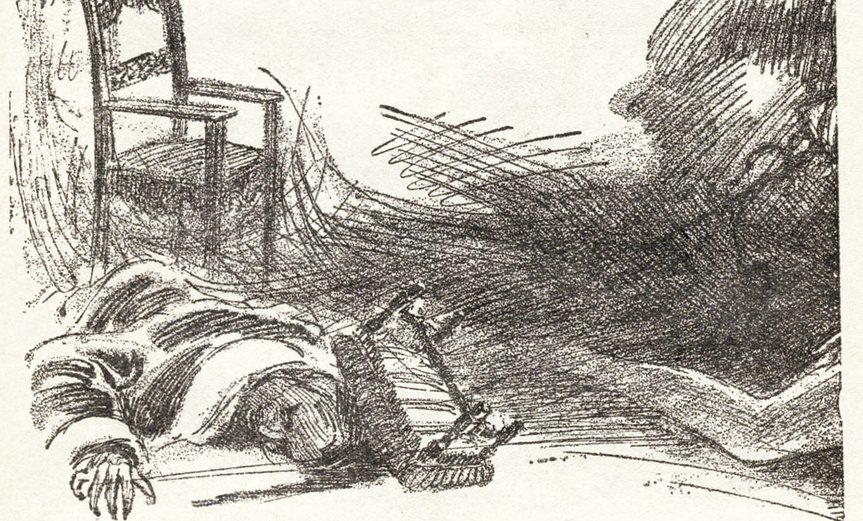
“Secours, Friend Trowbridge; je suis perdu!” the little Frenchman cried, going down under a very avalanche of flailing arms and legs. And as he fought off his assailant I saw the flare of gleaming, green eyes, the flash of cruel, white teeth, and heard the hoarse, beast-like growl of the thing that clawed and worried at his throat.
Nearer than the other two, I leaped to my friend’s rescue, but as I moved, a second shadowy form seemed to materialize from nothingness beside me, a battle-cry of feline rage shrilled deafeningly in my ears, and a clawing, screaming fury launched itself upon me.
I felt the tough oiled leather of my wind-breaker rip to shreds beneath the flailing talons that struck at me, looked for an instant into a pair of round, blazing phosphorescent eyes, then went down helpless under the furious assault.
“There is no power nor might nor majesty save in Allah, the Merciful, the Compassionate!” Arif Pasha chanted close beside me. “In the glorious name of Allah will I take refuge from Satan, the stoned, the rejected!” A charge of B. B. shot sufficient to have felled a bear tore through the clawing thing above me; there was a sharp snapping of metal, and a second blaze of searing light as the riot-gun roared again.
The ear-piercing scream of my assailant diminished to a growl, and the growl sank to a low, piteous moan as the form above me went limp, rolled from my chest and lay twitching on the frosted earth beside me.
I fought unsteadily to my knees and went sick and faint at the warm stickiness that smeared the front of my tattered jerkin. No need to tell a doctor the feel of blood: he learns it soon enough in his grisly trade.
Costello was battering, with the stock of his gun, at the infernal thing that clung at de Grandin’s throat, for he dared not fire for fear of striking the struggling Frenchman.
“Thanks, good friend,” the little fellow panted, wriggling from beneath his assailant and jumping nimbly to his feet. “Your help was very welcome, even though I had already slit his heart in two with this.” He held aloft the murderous, double-edged hunting-knife with which he had systematically slashed and stabbed his opponent from the moment they grappled.
“Good Lord o’ Moses,” Costello gasped as de Grandin’s flashlight played on the two still, supine forms, “’tis Mr. and Mrs. Bear! Who’d’a’ thought swell folks like them would—”
“Folks, parbleu, my friend, I damnation think you call them out of their proper name!” de Grandin interrupted sharply. “Look at this, if you please, and this, also!”
Savagely he tore asunder the black-silk negligée in which the woman had been clothed, displaying her naked torso to his light. From clavicle to pubes the body was covered with coarse, yellowish hair, curled and kinky as a Bushman’s wool, and where the breasts should have been there was scarcely any perceptible swelling. Instead, protruding through the woolly covering was a double row of mammillæ, inhuman as the dugs of a multiparous beast.
“For the suckling of her whelps, had she borne any, which God forbid,” the Frenchman explained in a low voice. “Regardez.” He turned the shot-riddled body over. Like the front, the back was encased in yellowish, woolly hair, beginning just below the line of the scapulæ and extending well down the thighs.
A hasty examination of the male creature showed a similar coating, but in its case the hair was coarser and of an ugly dirty-gray tone, like the discolored patch upon the back of an elderly gorilla.
“You see?” he asked simply.
“No, I’m hanged if I do,” I retorted as the others held silence. “These are terrible malformations, and their brains were probably as far from normal as their bodies, but—”
“Dites!” he interrupted. “Here is no abnormality, my friend. These creatures are true to form. Have I not already rehearsed their history? From the tumuli of Africa they come, for there men pursued them with gun and dog, like the savage beast-things they are. In this new land where their kind are unknown they assume the garb and manners of men. With razor or chemical depilatories they stripped the hair from off their arms and legs, and other places where it would have made them remarkable, and then they lived the life of members of the community—outwardly. Treasure from ravished tombs gave them much money; they were educated like human beings in the schools conducted by well-meaning but thick-headed American missionaries, and all was prepared for their invasion. America is tolerant—too tolerant—of foreigners. More than due allowance is made for their strangeness by those who wish to make them feel at home, and unsuspected, unmolested, these vile ones plied their dreadful trade of death among us. Had the female not let her appetite and bestial nature overcome her caution when she slew the young Calebson for his blood, they might have gone for years without the danger of suspicion. As it was”—he elevated his shoulders in an expressive shrug—“their inborn savageness and Jules de Grandin wrought their undoing.
“Come, our work is finished. Let us go.”
Trula Petersen, once more wrapped in de Grandin’s greatcoat, wept softly against the little Frenchman’s shoulder as we drove slowly homeward.
“Ah, my little brave one, you are cold, you tremble, you shiver,” he sympathized. “Come, this will warm your frozen blood.” From the pocket of the car door he produced a wide, flat flask of cognac and put it to her lips.
She took a swallow, gasped and choked. “Th—thank you, sir,” she stammered when she had recovered her breath.
“Parbleu, it was an act of simple charity for which I deserve no thanks,” he returned. “You have finished? you are through? you have had enough?”
“Yes, thank you.”
“Sergeant, a drink? I know Friend Arif does not use it.”
“Thank ye kindly, sor,” the big Irishman took a man’s-sized pull at the bottle and returned it.
“Très bien,” said Jules de Grandin; “’twould be shame to us if we bore this back filled.” And he proceeded to drain the big flask to the bottom.