WF Q56 .C88 1930
The Curse of the House of Phipps
First published in Weird Tales, January 1930 (vol. 15, no. 1). Novelette. Jules de Grandin. Text from the January 1930 Weird Tales appearance.
United States public domain. Held in the Reading Room of The Weird Library. Published by Weird Tales.
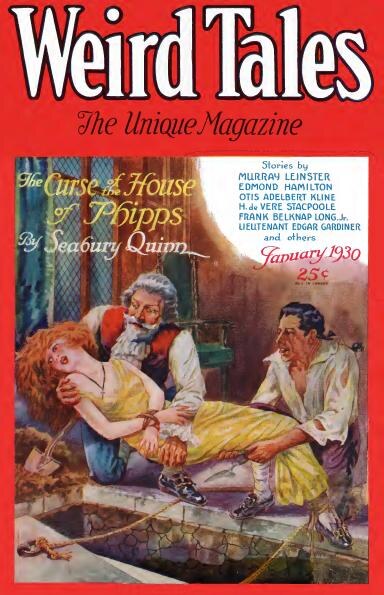
Cover by C. C. Senf, illustrating this story.
This text is printed as first published. It uses racial language from the period, including slurs.
JULES DE GRANDIN drew a final long puff from his cigarette, ground the fire from its glowing butt out against the bottom of the cloisonne ash-tray and emitted a tapering cone of gray smoke from his pursed lips, regarding the young man seated across the study desk with thoughtfully narrowed eyes. “And your gran’pere, likewise, Monsieur?” he asked.
“Yes, sir,” the visitor returned, a slight flush darkening his tanned cheeks, “and my great-great-grandfather, and his father, too. Not a man of my branch of the family since old Joshua Phipps has lived to see his children. Joshua fell dead across the threshold of his wife’s room ten minutes after she became a mother. Eliab Phipps, the son Joshua never saw, died in the last assault on Cornwallis’ works at Yorktown. News traveled slowly in those days, but when the men of his command came back to Massachusetts they told his widow the details of their captain’s death. All agreed he was shot through the lungs a little after ten in the morning. Half an hour earlier the same day his wife had given birth to a son. That son died at Buena Vista the same day his son was born back in Woolwich, Massachusetts, and that son, my grandfather, was shot in the draft riots in New York during the Civil War. His twin children, a son and daughter, were born the same night.
“I was born December 26, thirty years ago. The doctor sent my father post-haste to the drug store for some forgotten medicines, and as he returned from the errand a brick blew from a chimney, striking him on the head and killing him instantly. His wife became mother and widow almost at the same moment.”
The young man paused with a short, hard laugh. “Call it superstitious, coincidence—anything you like,” he went on challengingly, “but it’s gotten to be an obsession with me. I can’t shake the thought of it. It’s driving me almost to frenzy, sir.”
“Parfaitement,” the little Frenchman agreed with a nod. “You are nerveux; the remembrance of all these so remarkable deaths has bored into your inner thought like a maggot in a cheese. You are—how do you say it in American? Sans bouc—goatless?”
“Exactly,” the other smiled wanly. “I’m just about shot to pieces with the thought of it. If it were something I could sink my hands in—something tangible I could shoot or stick a bayonet into—I’d stand up to it and say, ‘You be damned!’ but it’s not. All the men of my family, except old Joshua, perhaps, seem to have been pretty good fellows, as far as I can make out. They fought their country’s battles; they paid their debts; they were good to their wives, but—there it is. The birth of a child is the death warrant of every Phipps descended from Joshua of the Massachusetts Bay Colony, and I don’t mind admitting I’m frightened of this thing, whatever it is. I’ve been more than ordinarily successful in my work—I’m an architect, you know—and I’ve several good commissions to execute right now, but I just can’t seem to get my mind working on ’em. I’ve as much to live for as most men—work, achievement, possibly a woman’s love and children of my own, some day; but there’s this constant threat eating into me like a canker-worm, walking at my elbow, lying down to sleep with me and rising with me in the morning. I can’t shake it any more than I could shake my skin, though I’ve done everything possible. It hangs on like Sindbad’s Old Man of the Sea. I’ve consulted half a dozen of these so-called occultists, even went to a clairvoyant and a couple of mediums. Did they help? Like hell they did! They all say, ‘Fear not, the evil from without can not prevail against the good that lies within you; cultivate inward tranquillity and seek the light of truth and be of good cheer,’ or some sort of fiddle-faddle like that. I’m not after fairy-tale comfort. Dr. de Grandin; I want some assurance of safety, if it’s to be had.
“Once I tried a psychoanalyst. He wasn’t much better than the other quacks. Talked a lot of learned tosh about relative subconsciousness, fear-complexes and inhibitions, then assured me it was all in my mind—but you can damned well bet he couldn’t explain why all my male ancestors died the instant they became fathers, and he didn’t attempt to. Now”—the visitor straightened and looked almost challengingly into de Grandin’s thoughtful eyes—“they tell me you’re a scientist with an open mind. You don’t slop over about the spirits of the departed, and you don’t pooh-pooh any intimation of the supernatural. The mediums and occultists I’ve been to were a lot of ignorant charlatans. The psychoanalyst couldn’t seem to grasp the idea that there’s something more than the merely natural behind all this—he waved aside everything which couldn’t be recorded on one of his instruments or which hadn’t been catalogued by Freud. That’s why I’ve come to you. I believe you can help me, if anyone can; if you can’t do something for me, God have mercy. That’s all there is to hope for if you fail, and it hasn’t seemed to do much for the others.”
“Grand merci,” the little Frenchman murmured almost ironically. “I greatly appreciate both your confidence and your frankness, Monsieur. Also, I concur in your pious wish that you may have the assistance of Deity. It may be true that heaven’s mercy did little or nothing for your ancestors, but then, in the olden days. Providence was not assisted by Jules de Grandin. Today it is different. Suppose, now, we commence at the commencement, if you please. You have, perhaps, some intimation concerning the untimely taking-off of your forebears? You have heard some possible reason why your so distinguished ancestor, Monsieur Joshua, found Death’s grinning countenance where he thought to look upon the features of his first-born?”
“Yes!” young Phipps answered tersely, the flush mounting to his face again. “You’ll probably call it a lot o’ nonsense, but I’m convinced it’s—it’s a family curse!”
“U’m?” De Grandin thoughtfully selected a long, black cigar from the humidor, bit its end and struck a match. “You interest me, Monsieur. Tell me more. Who cursed your family, and why was it done, if you know?”
“Here,” Phipps drew a small, brown-leather volume from the inner pocket of his jacket and thrust it into the Frenchman’s hand, “you’ll find the history of it there. Obediah Phipps, Joshua’s younger brother, wrote it in his diary, ’way back in 1755. Start reading there; I’ve checked the salient entries in red,” he indicated a dog-eared page of ancient, porous paper closely barred with fine writing in time-faded ink. “Obediah’s comments may seem melodramatic, read in the cold light of the Twentieth Century,” he added half apologetically, “but when we remember how Joshua fell strangled with blood at the entrance of his wife’s chamber, and how his son and his son’s sons died to a man without seeing their children, it doesn’t seem so overdrawn, after all. Something else: Every man jack of ’em died in such a way that his mouth was smeared with blood. Oh, the old curse has been carried out, letter for letter, whether by coincidence or not!”
“U’m?” de Grandin repeated non-committally, taking the slender booklet in his hand and examining its binding curiously.
It was a cap octavo volume, bound in beautifully tanned brown leather carved and embossed with scrolls, œils-de-bœuf and similar ornaments dear to the heart of Eighteenth Century bookbinders. Across the back was stamped in gold:
OBEDIAH PHIPPS HIS JOURNAL
“Trowbridge, my friend,” de Grandin ruffled quickly through the book’s yellowed leaves, then passed it to me, “do you have the kindness to read to us that which this Monsieur Obediah—mon Dieu, what a name!—set down in the long ago. Me, I understand the barbarities of your language passably well, but I think we should get the fuller effect by hearing you read aloud. I greatly fear I should make sad hash of this old one’s entries. Read on, my friend; I am all attention.”
Adjusting my pince-nez I moved nearer the desk lamp, glanced hastily at the indicated page, then, bending closer, for the once-black ink had faded to pale sepia with the passage of two hundred years, I read:
“3d Sept. 1755—This day came the trained band from fighting with the French; Joshua, my brother, at their head and looking mighty fine and soldier-like in his scarlet coat and sash and the long sword which swung from his leathern baldric. With them are come a parcel of prisoners of war, holden at the King his Majesty’s pleasure. Mostly children and young folk, they be, and though they be idolaters and not of our Christian faith, I find it in my heart to pity them for the hardness of their lot, for from this day onward must they be bearers of burdens, huers of wood and drawers of water, bound to menial service to our people that the Commonwealth’s substance may not be eaten up in keeping them in idleness.
“What is it that I say? Obediah, it is well that you are for Harvard College and the law, for the sternness of the soldier’s trade or the fiery Gospel of the Lord God expounded by the preachers are things too hard for your silly heart, meseemeth. And yet, while none shall hear me murmur openly against the fate of these poor wretches, I do pity them with all my soul.
“One among them, of all the rest, arouseth my compassion. A lissome chit of a girl, she, with nut-brown hair and eyes as gray as is the sea, and such a yearning in her pale, frightened child-face as might move any man’s heart. I hear tell she will be placed at sale on Wednesday next, though it is already understood that Brother Joshua will have her for household drudge in part requital of his valliant work against the enemy. If this be so, God pity the poor wench, for Joshua is a hard man and passionate, never sparing of himself or others, and ever prodigal with fist or whip to urge to greater diligence those who serve him. Already there have been murmurs amongst his black and Indian slaves against his harshness, but so great and dominant is he that none dare stand against him and charge him to his teeth with cruelty.”
“EH BIEN, Monsieur,” remarked de Grandin as I sought the next, marked passage in the diary, “it would seem this Monsieur Joshua of yours was the very devil of a fellow.”
“Huh, you haven’t got to first base yet,” Phipps answered, but the grimness of his expression denied the lightness of his words.
I found the second red-checked entry and began:
“29h Sept. 1755—Have pity, gentle Saviour, for I, the meanest of Thy creatures and a sinfull man, harbour thoughts of blood and death against mine own kin. On Lord’s Day I visited my brother, and as I made to enter at the kitchen did behold Marguerite DuPont, the Popish serving wench, bearing water from the well. A brace of heavy buckets, oaken-staved and bound with brass, she staggered under, and their weight was like to have borne her down, had not I hastened to her succour.
“A look of passing wonder she gave me as I took the bucket-yoke from off her shoulders and placed it on mine own, and, ‘Merci beaucoup, M’sieu’,’ she whispered, with the words dropping me a curtsey as though she were a free woman and mine equal in station.
“Her hands are red and rough with toil, but small and finely made, and in the wide greyness of her eyes dwells that to make a man’s heart beat faster. Perchance she is a witch, like most of the idolators, as Parson did expound at meeting that very morning, and works wickedness on men, to the damnation of their souls and bodies. Howbeit, she is very fair to look on, nor do I take shame to myself for that I took her burthen on me.
“‘C’est le sabbat, n’est-ce-pas, M’sieu’?’ she asks as I set the buckets down beside the doorstep, and when I nodded, she looked at me so sadly that I was like to weep for very pity.
“From out the bodice of her gown she drew a tiny, cross-shaped thing, a bit of sinfull vanity fashioned like the tree whereon our Lord suffered for the vileness of humankind, and would have raised the symbol to her lips.
“‘And what means this heathenry, ye Papist slut?’ bellows my brother Joshua, bursting from the house-door like a watch-dog from out his kennel at scent of a marauder. ‘What means such demonry in a Christian man’s house?’ with which he struck the fond thing from her hand and caught her such a cuff upon the ear that down she fell beside it.
“Quickly the lass picked the cross from out the sand and would have bestowed it in her breast again, but Joshua was quicker than she, maugre his towering bulk, and ground it under heel, well-nigh crushing her frail hand.
“She sprang erect like a pantheress, her mild eyes all aflame, her cheeks red with rage, and defied him to his face.
“‘Thou harlot’s brat. I’ll learn ye to speak so to your betters!’ raged he, and struck her on the lips with his clenched hand, so that blood flowed down her chin upon her kirtle.
“‘Nay, brother,’ I opposed, ‘entreat her not thus despitefully. ’Tis Lord’s Day, and she, of all the townsfolk, labours. “Remember the Sabbath Day to keep it holy,” saith the Scripture. And as for her vanity in kissing the cross, bethink you that her faith, mistaken though it be, is dear to her as ours is to us.’
“‘Now as the Lord liveth,’ my brother sware, ‘meseemeth thou art half a Papist thyself, Sir Cockerel. Whence cometh this sudden courage to champion the Popish slut? The Sabbath Day, quotha? What knows she of sabbaths, save those wherein the witches and warlocks make merry? Is she not already foredoomed by God his great mercy to burn in hell from everlasting unto everlasting? Sabbath rest and meditation are for the Lord’s elect, not such as she. As for thee, go thy ways, and quickly, else I forget thou art my brother, thou but a sniveling coward, and do thee injury.’
“Lord Christ, forgive! In that moment I could have slain him where he stood, nor took a thought of guilt for doing it. Alas, in thought, if not in deed, I am another Cain!”
“2d Nov. ’55,” the next marked entry read. “At college, and hard upon my studies all the day, labouring right toilsomely with the middle voice of Greek, yet making sorry business of it.
“Mea culpa; I have sinned. Into my heart has crept insidiously a lustfull and unhallowed love, for between mine eyes and the book wherein I read there floats the vision of the kitchen-drudge, the French girl. Marguerite DuPont.
“What boots it that she be a servant of the Antichrist, a beggar and a charge upon the town, bound forever to labour for her scanty fare? What matter though she be joined to her idols like Ephraim of old? Surely, though we approach God through Christ, our Lord and Saviour, or through Mary, His maid-mother, the goal we seek is still the same, however different be our roads. And yet I may not tell her of my love; I dare not clip her in mine arms and whisper ’dearments to her, for she is my brother’s thing and chattel, bound to him even as his blackamoors and Indians, though by the letter of the law she is a war-captive and subject to release or ransom or exchange. Wo me, that I have loved a Hagar in the tents of Abraham!”
“Death of a little blue man. Friend Trowbridge”—de Grandin twisted the waxed tips of his small blond mustache—“I damn think I sniff the odor of a romance here. Read on, proceed, I pray you. I burn, I itch, I am consumed with desire for further information!”
“9h June, ’56,” I read, turning to the next entry marked in red. “O Lord Christ, fill me plentifully with love of Thee, for love of woman never shall be mine! This day sennight Marguerite gave birth to a child, a boy. She holds her peace right stubbornly, though many of the good wives, and even the Parson himself, have urged her to declare her partner in iniquity that he may stand his trial with her for adultery. Anon, when she be taken from her bed, she must make response for this her sin, and if her paramour be not discovered, must bear the brunt upon herself.
“Brother Joshua shows strange kindness for one so stern and upright, so ever hatefull of all sin. The child is cared for by his orders, and he has even visited the wretched mother to see that all goes well with her. Forgive me, brother, I did thee wrong when I declared thy heart was like a flint. Methinks Marguerite is gratefull for this unexpected comfort, for her eyes brighten when he entereth the room, and dwell on him with the look a gentle dog may give its master when he leaves. The child is dark, unlike its mother, and well favoured withal. ’Tis pity it must go through life as filius nullius, according to the lawyers’ phrase.”
“My brother builds a house without the town,” the next entry, dated early in December, read. “The foundations are already digged, and soon the chimneys will be raised. The idea likes me much, for when the building is completed he will take Marguerite and the child to dwell with him, and she shall thus have respite from the townsfolk’s jeers. O Marguerite, my Marguerite, how fondly would I have held thee to my heart, had I but dared; but now it is too late—have pity, Heaven!—too late!”
“Joshua’s charity is explained,” the next passage, which was undated, announced. “’Twas passing strange that he, who would have flayed a flea for its hide and tallow, should expend money on a bond-woman’s brat thus lavishly. Alas, the child she bore is his. Woe unto you, Joshua, my brother, for you have devoured the fatherless! A man of war you call yourself, a valliant battler for the Lord, yet did you hide your shame behind a woman’s petticoat, and leave her lonely to brave the storm of calumny, while she, for very loyalty to you, her child’s father, forbore to name you to the elders, though they protested never so much.
“25h Dec. 1756—Wo and calamity. The light has gone from out the stars and the sun is consumed in darkness. Marguerite is no more, and on my brother’s brow there sits indelibly the mark of Cain. From Cudjo, his blackamoor slave, I have the story, and though I may not denounce him to the court, for that I have only my unsupported word, since slave may not testify against his master, yet here and now I brand him murderer. Joshua, my brother, Thou art the man!
“Together with his black slaves and his Indians, as cut-throat a crew as ever hung in irons, my brother did repair to his new house to lay the hearth. With him went Marguerite and the child. In the darkness of the night he heard her singing softly, and entering her room found her suckling the boy, and round his baby neck she had hanged a garland of plaited vines and from it hung a cross.
“Wild with rage, my brother seized the child from out her arms, and made as though to brain it against the wall, whereat she rose up like a she-bear which sees her cubs threatened, and snatched a dagger from her dress, wherewith she wounded him in the breast.
“‘What, wouldst murder thy benefactor, slut?’ he bellowed, and the greatness of his angry voice roared through the half-built house like winter tempests through the forest-aisles. ‘By Abraham and Isaac, and by that Joshua whose name I bear, we’ll lay the hearth tomorrow morn according to the ancient rites, and my house shall have that to guard it which none other in the colony may boast!’
“With that he summoned help to bind her to the bed and bare the child away.
“At sun-up next day they heard her singing in her chamber, ‘Venite adoremus,’ the hymn wherewith the Papists greet the Christmastide, but Joshua laughed deeply in his beard and sware a great oath and vowed they’d give her other tunes to sing e’er that day’s work be finished.
“When all had been prepared they brought her forth, all bound like any captive for the gallows, and led her to the hearth-place, where a great hole had been digged beneath the setting for the stone.
“At first she did not understand, but presently they made her know that she must be immured alive within that stone-sided grave, for that, my brother saith, her spirit might protect his house and all that therein dwelt. And as he said it he laughed a great laugh, and pointed to his wounded breast wherein her dagger had been fleshed the night before.
“And now she knew her end was come, and hope had fled from her, so there upon the threshold of the grave to which she must all quick descend, she stood and cursed him in the English tongue she scarce could frame to form aright.
“‘Wo to thee, defiler of the innocent and craven hider of thy shame,’ she told him. ‘May the wrath of God be on thy head and countenance, and may thou and thy sons and thy sons’ sons from generation unto generation have blood to drink in that hour wherein thy first-born is delivered. May thou and thy seed never look on the faces of thy children or on thy wives in motherhood, and may this curse last while hate shall last and be strong as hatred is strong!’
“What more she would have said they know not, for even Joshua paled before her maledictions, and gave the signal whereat his myrmidons laid her living in the open grave and set the hearth-stone over her. Thereafter they fixed the stone right firmly with cement, and none could hear her cries as she struggled in the tomb like a drowning man fighting for the breath of life.”
DE GRANDIN was leaning forward in his chair, and his little, round blue eyes were fixed on me in a set, unwinking stare as I turned to the next entry. Once or twice his long, flexible fingers twitched nervously, and I had no difficulty in imagining what would have happened to old Joshua Phipps could the wiry little Frenchman have set those steel-strong fingers round his hairy throat. Dapper as a dandy, slightly made as an adolescent girl, Jules de Grandin is none the less a born killer, and when his anger is aroused he can, to use the old frontier phrase, “whip his weight in wildcats,” and have both strength and inclination left to fight a fresh lot to the death.
Young Phipps, too, sat stone-still in his chair, his breath rasping harshly in his throat as he listened to this tragedy of old New England, and, it seemed to me, the very atmosphere of my peaceful study was pregnant with the presence of those tragic actors whose bodies had molded to dust long years before any of us had seen the light of day.
“3d Mar. ’58,” I read. “Joshua this day wed with Martha Partridge.”
The next item was the last in the book, and seemed fresher than the others, for the ink retained some semblance of its original blackness:
“25h Dec. 1758—The curse has fallen. This night, Martha, my brother’s wife, who hath been gravid, was delivered of a son whom they will call Eliab. Joshua sate before the fire in his great chair, gazing into the flames and on the hearth-stone which hides the evidence of the filthy act he wrought two little years agone, and thinking the Lord God knows only what thoughts. Did you see Marguerite’s pale face in the flames, brother, and did the wind in the chimney recall her pleading voice to you as you waited on the midwife’s summons to ascend the stairs? Who shall say?
“Anon they came and said he had a son, and straightway he rose up and went to look on him. At the entrance to his wife’s chamber he paused to cast a downward look of triumph at the great flat stone which shelters her whose curse he bore, then laid his hand upon the door-knob.
“And in that moment he who never knew adversity save to conquer it tasted salt and bitterness, for even as he flung aside the door he fell upon his face, and from his open lips gushed forth a spate of blood which dyed his beard a ruddy hue and stained the planking of the floor. He never saw the features of his lawfull first-born son.
“Have pity, Jesu!”
IT WAS dead-still in the study as I closed the little book in which Obediah Phipps had scrawled his record of futile love and stark tragedy. The soft hiss of a pine log in the fireplace sounded distinctly through the shadows and the mournful hoot of a motor horn outside came to us through the closed and curtained windows like a doleful period to the tale.
“It sounds fantastic to me,” I commented, returning the book to young Edwin Phipps. “I remember the Acadians were expatriated by the New England colonists during King George’s War—Longfellow tells the story in Evangeline—but I never heard the poor devils were made virtual slaves by the New Englanders, or that they—”
“Many unpleasant things concerning our histories we easily forget, my friend,” de Grandin reminded with a slightly sarcastic smile. “Your Monsieur Whittier takes up the tale where Monsieur Longfellow leaves off. However”—he raised his shoulders in a quick shrug—“why hold resentment? The crime the ancestors committed against New France was nobly atoned for by their descendants. Did not the young men of your Yankee Division pour out their virile blood like water in one vast transfusion when la belle France bled white with the sale Boche’s bayonet wounds? But yes. Meanwhile, the descendants of these very Acadians rested comfortably at home, enjoying the protection of Britain’s arm, yet lifting no hand to help the land from whence they sprang. I—”
“But that other,” I interrupted, for, like all true Frenchmen, my little friend will talk for hours on the war, “that seems preposterous to me. The idea of burying a live woman beneath a hearthstone—why, it’s incredible. Such things might have been done in heathen times, but—”
“Hélas, Friend Trowbridge, your ecclesiastical learning seems little greater than your political knowledge,” de Grandin cut in. “Those older ones, both pagan and Christian, laid the foundations of their houses and fortresses—even their churches—in blood. Yes. Saint Columba, founder of the abbey of Iona, inhumed one of his monks named Oran alive beneath the walls, because he feared the demons of the earth might tear the holy structure down unless appeased by human sacrifice. Later historians have endeavored to sugar-coat the facts, but—later writers have revised the story of Chaperone Rouge to make the little girl and her gran’mère come forth alive from the wolf’s belly, also.
“Again, no later than 1885, was found another evidence of such deeds done by Christians. That year the parish church of Holsworthy, in north Devonshire, England, was restored, and in the southwest angle-wall the workmen found a human skeleton interred, and its mouth- and nose-places were stopped with mortar. The evidence was plain; it was a live-burial designed to make the walls stand stedfast because of human sacrifice to the earth-demons. Once more; In tearing down an ancient house in Lincolnshire the workmen found a baby’s skeleton beneath the hearth. Yes, my friends, such things were undoubtlessly done in the olden times, and our Monsieur Joshua was but reviving a dead-but-not-forgotten custom of the past when he did lay the poor one, Marguerite, beneath his hearth.”
“H’m,” I reflected, “it hardly seems possible such bigotry could have obtained so late, though; just think, the Revolutionary War began only some fifteen years later, yet here was a man so intolerant that—”
“Eh bien,” the Frenchman chuckled, “again you do forget, my friend. Your war of revolution was fought and won, also your second war with England, and our own so glorious Revolution was an accomplished fact while yet Catholics burned Protestant and Jew with fine impartiality. It was 1814 when Spain’s last auto da fé was held. However, we grow unduly reminiscent. It is with Monsieur Phipps’ problem we must deal.
“Tell me, young Monsieur,” he turned directly to our visitor, “is this house of blood and sorrow where your wicked ancestor met his death still standing, and if so, where?”
“Yes,” Phipps replied. “I’ve never been there, but it’s still owned by the family, though it’s been unoccupied for twenty-five years or more. I’m told it’s in remarkably good condition, however. It stands just outside the present city of Woolwich, Massachusetts.”
“H’m,” de Grandin took his narrow chin between a thoughtful thumb and forefinger, “I think we should be well advised to go there without delay, my friend.”
“What, out to that old ruin, now?” Phipps demanded.
“But of course. When water is polluted the wise man seeks the source of the stream. It seems to me the fountainhead of this family curse of yours may well be found where Marguerite DuPont lies buried in a grave of hatred without benefit of clergy or the tribute of a single tear, save such as your great-uncle Obediah may have shed for her in secret.”
“CAB, sir? Taxi? Take you to the best hotel in town,” a lean, lank Yankee youth challenged as we alighted from the B. & M. train and lugged our handbags from the Woolwich station.
“Hola, mon brave,” de Grandin challenged in his turn, “you know the country hereabouts, I doubt not—and the old-time landmarks, as well?”
“Ought to,” the other answered with a grin, “been here all my life.”
“Très bon, excellent; you are the man we seek, and none other. Tell me, can you deliver us in good condition at the old Phipps homestead—you know the place?”
An expression of blank amazement, half fright, half disbelief, came on the jehu’s lean, weather-stained face. The Frenchman’s request, it seemed, was much like that of a tourist in Naples directing that he be forthwith driven to the rim of Vesuvius’ crater.
“D’ye mean ye want to go there?” the youth demanded.
“Utterly,” de Grandin returned. “It still stands and may be reached, may it not?”
“Oh, yeah, you can git there all right,” the other responded doubtfully, “but—”
“But getting back is something else again, n’est-ce-pas?” the little Frenchman retorted with one of his quick, infectious smiles. “No matter. Do you transport us thither; we shall take responsibility for the rest.”
The youth led us to a dilapidated Ford which got under way protestingly and seemed in imminent peril of dropping to pieces at almost every revolution of its wheels, but somehow took us through the wide, well kept streets of the newer part of town, along a smooth macadamed highway between rows of pretty white houses, finally up a rutty clay-surfaced road to the massive cedar gate-posts of a wide and weed-choked park.
“Enfin, we are arrived, it seems,” de Grandin announced as we alighted. “Do you bear a hand with the portmanteaux, mon vieux,” he tapped the driver on the arm as I felt in my pocket for the fares.
“No, sir, not me,” the other declared with emphasis. “I contracted to bring ye here, an’ I done it; but nothin’ was said about me goin’ into that place, an’ I ain’t goin’, neether!”
“Eh, what do you tell me?” de Grandin tweaked his mustache ends alternately. “Is it then, perhaps, a place of evil reputation?”
“Is it?” the driver echoed. “Say, brother, you couldn’t get the State militia to camp in them grounds overnight, an’ I don’t mean maybe. O’ course, I don’t believe in ghosts nor nothin’ like that, but—”
“Certainement, so much is evident,” the Frenchman’s features creased in one of his quick, elfin smiles, “but at the same time you prefer not to test your disbeliefs too strongly, is it not? Very well; we thank you for the transportation; as to that in which you disbelieve so staunchly, we shall endeavor to cope with it unaided—also with the burden of our luggage.”
The old Phipps farmhouse was, as Edwin had told us, in remarkably good repair for its age and the neglect it had suffered during the past quarter-century. Built at the time when Georgian elegance was just beginning to impress itself on the ruder architecture of the colony, it presented a curiously hybrid appearance. A rounded bay climbed the full height of its facade, porticoes supported by once-white columns ran along the front, but all its many windows were firmly closed with heavy, slab-wood shutters. The door which pierced the center of the building was of adz-cut timber, roughly smoothed with a jack-plane and hung on massive “holy Lord” hinges of hand-wrought iron. It seemed strong enough to withstand a siege supported by anything less than modern artillery.
Edwin Phipps produced a key of hammered brass which seemed to me massive enough to have locked the Bastille, fitted it in the iron-rimmed keyhole and shot back the bolts. Hardly conscious that I did so, I wondered that the lock should work thus readily after so many years of disuse.
“Entrez,” de Grandin stood aside and waved us forward; “the great adventure is begun, my friends.”
The room we entered was like a setting on a stage. Obviously, it was originally intended as both entrance-hall and living-room, possibly as dining-room as well. Lofty and paneled in some sort of age-darkened wood, with an open fireplace large enough to drive a limousine through in the blank wall to the left, it gave me the impression of immensity and chill one gets in going through a Continental cathedral. A broad staircase, balustraded in hand-wrought oak, ran up to a gallery above, whence three doors, one to the right, two to the left, gave off. There were also doors letting through the right wall of the hall, but none to the left. At the stairway’s foot, by way of newel post, stood a massive bronze cannon, muzzle down, evidently the spoil of some raid led by Joshua Phipps against the French, for engraved on its breach were the Bourbon arms and a regal crown surmounting a flourishing capital L. A great table of Flemish oak stood near the center of the hall; several straight-backed chairs, faded and moldering with age, stood sentry against the walls. Before the monstrous, gaping fireplace, almost on the hearthstone, yawned a massive armchair upholstered in tattered Spanish leather. I wondered if this could be the “great chair” in which old Joshua sat meditating that night so long ago when the midwife came to call him to his son, and to the doom pronounced on him and his by the martyred French girl.
De Grandin glanced appraisingly about the place and shook his shoulders as though a chill even more bitter than that of the December day had pierced his fur-lined greatcoat. “Pour l’amour d’un bouc, a little fire would help this place immensely,” he murmured. “Phipps, my friend, do you dispose our belongings as seems good to you. Trowbridge, mon vieux, by your leave you and I will sally forth in search of fuel for yonder fireplace. Pardieu, I damn think it will require an entire forest to warm this place to hospitality once more!”
We had included a pair of Boy Scout axes in our outfit, and in a few minutes cut a plentiful supply of dry wood from the fallen trees in the grove outside.
“Mille pardons, little one,” de Grandin murmured almost humbly as he crossed the wide slate hearthstone to lay the logs in the fireplace; “we do not tread upon your grave with wanton feet.”
The short New England twilight faded into dark almost before we had completed preparations for the night. We ate a dinner of fried bacon and potatoes, washed down with plentiful drafts of strong boiled coffee, set up our camp cots on the flagstone floor of the great hall and rolled ourselves in several thicknesses of blankets before ten o’clock had sounded on the tiny folding clock de Grandin had taken from his kit bag.
“Bonne nuit, my friends,” he murmured sleepily. “Let us sleep like a clear conscience this night, for we have much to do tomorrow.”
THE fire had died to a sullen, smoldering ruin and the blackness the leaping flames had driven back once more advanced from the corners of the great, cold hall like a hostile army counter-attacking doggedly, when I wakened with a start. Had I been dreaming, or had there actually been a Presence bending over me, I wondered as I opened sleepy eyes and glanced about. Whatever it was, it had not been hostile, that I knew. For a moment, while I crossed the no man’s land between sleep and waking, I had sensed something, something white and slim, bending above me, a pleasant, comforting something like a mother soothing her restless child in the night—smooth, calming hands passing lightly over my features, a gentle, murmuring voice, a faint, familiar lovely scent breathing through the darkness.
“Trowbridge, mon ami, did you see—did you feel it?” de Grandin’s sharp, sibilant whisper came to me.
“Ye-es, I think so—” I began, but stopped abruptly at the sound from Phipps’ cot.
“Ug—ou!” Half exclamation, half frightened, strangling cry it was, and in the quarter-light we saw him rear upright from his blankets, fighting and wrestling for his life with something invisible to us.
Before either de Grandin or I could reach him he rolled from his bed, threshed wildly about the stone floor, then lay still, panting deeply. “It—something tried to choke me!” he gasped as we rushed to his aid. “I was sleeping, and dreamed someone—a woman, I think—bent over me, stroking my cheeks and forehead, then suddenly it—whatever it was—seemed to change, to go savage as a lunatic, and grasped me by the throat. Lord, I thought I was done for, for a while!”
He rose with an effort, accepted a sip of brandy from de Grandin’s flask, then sank down on his cot, feeling gingerly at his neck. “’Spect it was a dream,” he murmured with a shamefaced grin, “but ‘such stuff as dreams are made on’ is mighty solid hereabouts, if it were. Ugh, I can feel those long, bony fingers squeezing my gullet yet!”
I was about to reply with some soothing commonplace remark when de Grandin’s minatory hiss and upraised finger cut me short. Distinctly through the outside darkness came the echo of a shot, a second report, and a woman’s wailing, terrified scream, both curiously faint and far-away seeming, like the sound of a gramophone played in a distant room with closed doors between.
For a moment we waited tensely, then, as the woman’s cry was repeated, nearer, this time, de Grandin crossed hastily to the front door, snatched up his coat, and flung the portal open. Instantly the muffled quality of the sounds was explained. While we slept before the fire a torrential rainstorm had come up, and, though there was little wind, the skies seemed suddenly converted into sieves which let down countless cataracts of black water.
As I joined him at the door and peered intently through the drumming rain, I descried some kind of indistinct form blundering and splashing through the welter of mud and water and heard another faint hail: “Help, please help me!”
Side by side the Frenchman and I dashed into the storm, seized the half-fainting girl and dragged her to the shelter of the house.
“Thanks!” she gasped, shaking her head to clear the water from her eyes. “I think I’d have been done in another moment if—you—hadn’t” her voice trailed off, and she bent limply at the knees, as though her bones had suddenly softened, landing in an inert little huddle on the hall’s stone floor.
“Mademoiselle!” de Grandin cried in quick concern, bending over her, “Mademoiselle, you are—grand Dieu, Friend Trowbridge, she is wounded!”
It was so. On the left arm of the suede trench coat she wore showed a spot of angry red, and as I leaned down beside de Grandin to help him take away the garment, I saw the leather was pierced by two small holes, one at the rear of the sleeve, the other at the front. Obviously, a bullet-wound.
Working quickly, we removed the girl’s overcoat and Fair Isle sports vest, then washed and bandaged the wound as best we could. For lack of better styptics we made a pack of boric acid powder, of which we fortunately had a small can, and crushed aspirin tablets, thus approximating Senn’s first-aid dressing. For bandage we requisitioned three clean handkerchiefs from de Grandin’s dressing-case. Tearing a towel long-wise, we knotted it behind her neck and contrived a fairly satisfactory sling.
“How comes it, Mademoiselle, that you flee wounded through the storm?” de Grandin asked, removing the cup of brandy and water from her lips and watching her returning consciousness with keenest satisfaction. “What sacré bête has done this monstrous thing? Cordieu, tell me his name, and I shall twist his neck so thoroughly that in future he must walk backward to see what lies before him!”
The girl gave him a smile that was half a grin and wrinkled her nose at him. “I only wish I knew,” she answered. “I’d help you do it.
“Joe Darnley and I were driving home from Branchmoor when this storm hit us like a circus tent collapsing. The water must have gotten into the gadget that works the jigger-macrank, or something, for we went dead at the foot of the lane leading here. The storm had us all turned’round, and neither of us know just where we were, so while he got out to tinker with the thingummy in the engine I looked around for landmarks. Just as he got the motor to working and we were ready to start, another car came rushing down the road—no lights going, either!—and someone in it shouted for us to get to hell out of there. Guess we didn’t move fast enough to suit ’em, for one of them fired on us and struck me in the arm. It hurts like fury, too!” She made a little face, then turned to de Grandin with a brave effort at a smile.
“Joe Darnley’s a swine. The contemptible thing stepped on the gas and left me there, wounded and lost. Then I screamed for help and started to run—I didn’t realize which way I ran; just ran, that’s all. In a few minutes I saw your light, and—here I am.” She gave de Grandin another friendly smile, then seemed to stiffen with sudden frightened realization.
“I say,” she demanded, “this is the old Phipps house, isn’t it? Who—who are you? What are you doing here? I thought this place was deserted—I’ve always heard it was haunted by—” She broke off with another effort at a smile, but it was easy to see the local superstition was troubling her.
“Eh bien, that is a long story, Mademoiselle,” de Grandin answered. “However, we are quite lawfully in possession, I assure you. Permettez-moi, s’il vous plaît: This is Monsieur Edwin Phipps, one of the owners of the property; this Dr. Samuel Trowbridge, of Harrisonville, New Jersey. I am Jules de Grandin, of Paris and elsewhere, all very much at your service.”
She nodded in frank friendliness. “It’s no mere figure of speech when I tell you I’m glad to meet you,” she assured us. “My name’s DuPont—Marguerite DuPont, of Woolwich, Massachusetts, very much in your debt for services rendered, gentlemen.”
“Good gracious!” I exclaimed.
“Marguerite DuPont!” young Phipps repeated in a sort of awed whisper.
“Sacré nom d’un fromage! Is it so?” de Grandin ejaculated.
She regarded us with a sort of puzzled resentment. “Of course, it’s so!” she answered. “Why shouldn’t it be? It’s a good name, isn’t it?”
“Good?” de Grandin echoed. “O, là, là, it is a most excellent good name, indeed!” Then:
“Your pardon, Mademoiselle. That name is connected most intimately with the tragic history of this sad and bloody old house, and the coincidence struck us all with force. Tomorrow, or the next day, or the next day after that, when you are feeling stronger, we shall explain in detail. Now, if you please, you shall lie down and rest. We shall take especial pains that no harm comes to one of your name in this place, of all others.”
After some good-natured argument, we agreed that the girl should occupy Phipps’s cot, for the similarity of the charming guest’s name to the author of the family curse seemed to have completely unnerved the youngster, and he declared sleep impossible.
Nevertheless, we all dropped off after a time, de Grandin once more rolled in his blankets like an Indian, I lying on my cot watching the leaping flames of the replenished fire, the girl sleeping lightly as a child, her uninjured hand pillowing her cheek; Edwin Phipps sat humped forward in his ancestor’s great chair before the fireplace.
IT WAS Marguerite’s stifled terrified scream which awakened me. Bolt upright, wide awake as though sleep had not visited my lids, I looked about the great dark hall Phipps still nodded in the deep leather chair before the smoldering remnant of the fire; de Grandin, apparently, slept undisturbed in his blankets; Marguerite DuPont sat erect in her bed, her eyes wide with terror, her lips parted to emit another horrified cry.
A creak on the wide, oaken stairs leading from the gallery diverted my attention from the frightened girl. Slowly, seeming more to float than to walk, a tall, white-draped form descended the stairs, and behind the folds of fluttering winding-sheet I espied the burning, phosphorescent glow of a pair of dreadful, luminous eyes fixed on us with a gaze of direful fury.
“Conjuro te, sceleratissime, abire ad locum tuum!” the sonorous words of the Latin exorcism rang through the high-ceiled, echoing hall as de Grandin, now thoroughly awake, hurled them at the gigantic, white-shrouded form bearing down on us.
A moment he paused, as though to test the efficacy of the spell. From the fluttering folds of the advancing thing’s cerements there burst a sudden yell of wild, derisive laughter; mad laughter, which seemed to sound the death-knell of all sanity. Time stood still for us as the delirious peal sounded again through the dark place. Then:
“Ha—so? Pardieu, you would make one sacré singe of Jules de Grandin, hein?” The Frenchman had risen from his bed, his little, round blue eyes ablaze with concentrated, deadly fury, and the dying firelight glinted balefully on the blue-steel barrel of his pistol.
The shots, following each other in such quick succession that they seemed a single prolonged report, bellowed through the gloom, and the sharp, acrid fumes of cordite stung our nostrils.
The mocking laugh stopped short, like a tuned-out radio, and the sheeted thing wilted, toppled crashing down the last half-dozen steps, and lay twitching spasmodically on the stone floor before us.
“Good heavens!” I gasped. “I—I thought it was a—a—”
“Un fantôme, eh?” de Grandin supplied with a half amused, half hysterical laugh. “Me, I think that was the intention of the masquerade, my friend. Also, I damnation think they set their stage poorly. In the first dullness of my awakening, I also was deceived, but I heard a step creak beneath his tread, and ghosts do not cause squeaky boards to complain as they walk upon them. Friend Trowbridge. Alors, I turned from exorcism to execution, and”—he indicated the prostrate form before us—“it would seem I made a real ghost where a make-believe one was before. I am skilful at that, my friend.”
Bending above the sheeted figure he drew aside its wrappings. Beneath the shrouding of cheesecloth was a frame of light wickerwork attached to the man’s shoulders, giving him the appearance of being at least ten feet tall. At the top of the frame was fixed a globular arrangement of papier-mache through which two eye-holes were pierced. Behind each of these burned a small electric flashlight with a green-glass bulb. This accounted for the glare of ghostly eyes we had seen in the specter’s shrouded face.
The man within the winding-sheet was dead. Six tiny nickel-capped bullets from de Grandin’s vicious little Belgian automatic had riddled his chest within an area which might be covered by the palm of a man’s hand, and from the corners of the dead man’s mouth there trickled twin streamlets of blood from his punctured lungs.
“Why, it’s Claude Phipps!” Marguerite DuPont’s awe-stricken voice announced. Frightened almost senseless at sight of what she thought a ghost, she had completely regained her courage when the visitant fell before de Grandin’s pistol, and stood at the Frenchman’s elbow, regarding the dead man’s features with wide, fascinated eyes.
“Eh, what is it you do say—Phipps?” de Grandin shot back.
“Yes. His family’s lived in Woolwich since I don’t know when. He was always a wild sort of chap—never able to keep any kind of employment or stick to anything for long. A little while ago, though, he seemed to be making lots of money, and his funds seemed to increase all the time. We all thought he was playing the stock market. He married Marcia Hopkins last year, and they built a lovely home over by Andover. But—”
“‘But,’ indeed, Mademoiselle,” de Grandin cut in. “One wonders. Me, I greatly suspect the stock in which this one dealt was of the kind found in the cellars of gentlemen who preach the virtues of prohibition in public and entertain themselves and their friends with cocktails in private. This ancient, fear-ridden house with its reputation of being haunted—the warning you and your uncourageous escort received when you approached it in the storm—this childish masquerade to frighten off intruders, they point to—”
“Down, my friends! Ventre à terre! Keep away from the light!”
Matching his own command with performance, he flattened himself to the floor, and the rest of us followed instant suit.
Nor were we a second too quick. The thunderous roar of sawed-off shotguns resounded even as we dropped, and a shower of slugs whistled murderously over us.
The Frenchman’s little pistol barked shrewish rejoinder to the fusillade, and Edwin Phipps, revolver in hand, wriggled forward across the floor, firing rapidly. Somebody screamed hoarsely in the dark, and the sound of rending wood was followed by a hurtling body falling to the hall floor with a sickening thud. For a moment the silence succeeding the melee was oppressive; then a whimper from the fallen man before us and a piteous groan from the balcony above told us the battle was ended, all casualties being on the other side.
By the light of our electric torches we examined our late foemen. The fallen man had a shattered tibia, the result of a lucky shot from Phipps’s revolver, and a broken collar-bone, sustained when he crashed through the rotting balcony rail and fell breast forward to the stone floor of the hall. The man on the balcony was shot through the left shoulder and the thigh, neither wound being serious, but both bleeding profusely.
For a few moments, with improvised bandages and splints, de Grandin and I worked feverishly. We were rigging a crude Spanish windlass to staunch the wound in our late enemy’s leg when Marguerite DuPont’s shrill hail came:
“Fire! The house is burning!”
“My God!” our patient cried hoarsely. “Get us out o’ here, quick. It’s th’ stills. There’s five hundred gallon o’ raw liquor downstairs in th’ cellar an’ two hundred gallon o’ mash. Quick, f’r th’ love o’ God, before th’ place blows up!”
No second warning was necessary. We piled the wounded men on cots and rushed them from the house, found the high-powered car concealed in the crumbling woodshed, and set the motor going. Five minutes later, directed by Marguerite, I piloted the machine along the road to Woolwich.
Our departure was none too soon. Dry as tinder, the old house burned like lighted paraffin, and before we had traveled half a mile along the concrete country road, there came a dull, reverberating roar like the eruption of a miniature volcano, and showers of sparks and burning brands shot into the rain-washed December night.
“Eh bien,” de Grandin commented, “it seems our task is somewhat delayed by this night’s business.”
“How’s that?” I asked, glancing momentarily from the road.
“I mean we must wait till the embers of that wicked old house have cooled—a week, perhaps—then we proceed to draw the fires of an ancient grudge,” was his enigmatical retort.
THE tale the wounded bootleggers told the police surgeon to whose care we turned them over was not an unusual one. Claude Phipps, ne’er-do-well descendant of the proud old family, had grown to manhood with all the vices and few, if any, of the virtues of his ancestors. Disinclination to work, a passion for spending all the money he could acquire by whatever dubious means came to hand, and a feeling of superiority, ground in him by the futile boastings of his impoverished and snobbish parents, had made him something of a town character, shunned by his own class, granted a sort of grudging welcome by the petty criminals, race touts and cheap gamblers with whom he consorted. Like many others of his kind, prohibition had provided him with the means of living without appreciable labor. Beginning as lieutenant to a professional rum-runner, he graduated to captaincy of his own small crew, finally adopted the expedient of manufacturing his stock in trade in preference to the more hazardous course of running it in from Canada or the sea.
Knowledge of the legends surrounding the old house belonging to the other branch of his family, and the fact that the place had been unoccupied for years, provided him a cheap and relatively safe headquarters for his operations. In the cellar of the old homestead he set up a still, and with the assistance of two companions proceeded to engage in the preparation of liquor of sorts on a wholesale scale. Once or twice natives familiar with the old house had attempted half-hearted investigation of the strange lights and sounds observed there after dark, but the ghost outfit with which the unbidden tenants had provided themselves, accompanied by appropriately eery shrieks and demoniacal laughter, had frightened away the amateur detectives, and Claude and his gang were left in undisputed possession of the place.
Recently, however, more serious opposition had developed, for Salvatore Giolotti, local overlord of the bootlegging industry, had delivered an ultimatum. Claude must either suspend opposition or join forces with him. It was with the threats of the larger organization still fresh in their minds that Claude and his henchmen had discovered Marguerite and her escort apparently reconnoitering the approaches to the house, and fired on them.
The two survivors were for shooting us at once when our presence was discovered, for they had no doubt we were the advance guard of Giolotti’s army of occupation, but Claude prevailed on them to let him try his spectral masquerade before resorting to firearms.
“U’m,” de Grandin muttered thoughtfully as the wounded youth concluded his recital. “And this Monsieur Claude, your leader, he lived in Andover, did he not? Will you be good enough to furnish his address?”
As soon as our business with the officers was concluded, de Grandin rushed us from the station house and summoned a taxicab. “To 823 Founders’ Road,” he commanded when we were ensconced in the vehicle.
A light burned brightly in the upper front room of the pretty little suburban villa before which the taxi-man deposited us half an hour later, and through a rear window there showed another gleam of lamplight. A large closed car was parked at the curb, and as we passed it I noticed it bore the device of Mercury’s caduceus beside its license plate, thus proclaiming its owner a member of the medical fraternity.
No answer came to de Grandin’s sharp ring at the doorbell, and he gave a second imperative summons before a light, quick step sounded beyond the white-enameled panels. A pleasant-faced woman in hospital white opened the door and regarded us with a half-welcoming, half-inquiring smile. “Yes?” she asked.
“Madame Phipps—she is here? She may be seen?” de Grandin asked, and for once his self-assurance seemed to have deserted him.
The nurse laughed outright. “She’s here,” she answered, “but I don’t think you can see her just now. She had a little son two hours ago.”
“Sacré nom! Le sort—the curse—it still holds!” the little Frenchman exclaimed. “I knew it, I was certain, I was sure; I was positive we should find this, my friends, but I had to prove it! Consider: Monsieur Claude, the worthless, I shot him in self-defense two hours ago; he died with blood upon his mouth. Almost in that same instant his wife became a mother! This is no business of the monkey with which we deal, mes amis; mille noms; it is grave, it is earnest. But certainly.” He nodded his head solemnly.
“Nonsense!” I broke in. “It was a coincidence; nothing more.”
“You may have right, my friend,” de Grandin acceded somberly, “but men have died for less reason than such coincidences as this, and unless we can—”
“Can what?” I prompted as we turned and retraced our steps toward the waiting taxi.
“No matter,” he answered shortly. “Hereafter we stand in need of deeds, not words, my friend.”
IT WAS almost a week before the fire-ravaged ruins of the old house had cooled sufficiently to permit us to rummage among charred timbers and fallen bricks. The great central chimney stood like the lone survivor of a burned forest amid the blackened wreckage. The heat-blasted stone paving of the hall, supported by the heavy arches of the vaulted cellar, remained intact, as did the mighty fireplace with its arch of field-stones; otherwise the house was but a rubble of fallen brick and burned joists.
The little Frenchman had been busily engaged during the intervening days, making visits here and there, interviewing this one and that, accumulating stray bits of information from any source which offered, particularly interviewing the Italian priest who served the Catholic parish within the confines of which the ancient house stood.
Beginning with a call of perfunctory politeness to inquire concerning her wound, Edwin Phipps had spent more and more time in Marguerite DuPont’s company. What they talked of as they sat before the pleasant open fire of her home while he assisted her with the tea things, lighted her cigarettes and otherwise made his two hale hands do duty for her injured member I do not know, but that their brief acquaintanceship was ripening into something stronger was evident from the glances and covert smiles exchanged—silent messages more eloquent than words, intended to deceive the other members of the party, but easily read as hornbook type.
I was not greatly surprized when Edwin drove Marguerite up to the site of the old house late in the forenoon of the day appointed by de Grandin for “la grande expérience.”
Beside the little Frenchman, his stole adjusted on his shoulders, service book ready and open, stood Father Rizzio of the Church of Our Lady of Perpetual Help. Near the clergyman, viewing the scene with a mixture of professional dignity and wondering expectation, stood Ricardo Paulo, sexton of the church and undertaker to the congregation, and near him rested an open casket, a handsome bronze-plated product of the factories of Boyertown, Pennsylvania, the white silk of its tufted interior shining pallidly in the bright December sunshine.
From a roll of burlap de Grandin produced a short, strong crowbar, inserted its wedge-end between the slate hearthstone and the pavement of the hall and threw his weight upon the lever. “Quick, Friend Trowbridge, lend me your aid,” he panted, bearing heavily against the bar; “helas, I lack the bulk to budge it!”
I joined him, bore down upon the crowbar, and wrenched the iron sidewise at the same time. With a scraping, rasping sound the slab came away from its anchorage, tilted obliquely a moment, then rolled back.
Before us lay a stone-sided crypt some two and a half feet deep by four feet wide, more than six feet long, floored with a second slab of slate like that we had just wrenched loose. What I expected to see inside I do not know. Certainly, I was unprepared for the sight which met my eyes.
Calm as though she had lain down to sleep an hour before, lay a girl, young, slim, delicate. From the tip of her head to the soles of her heavy brogans with their wide brass buckles she was as carefully arrayed as though clad to attend a meeting of the townsfolk of old Woolwich. True, her wrists were bound with a twist of knotted rawhide, but the fingers of her hands lay placidly together as though folded in prayer, and on her fresh, girlish features was a look of peace and calm such as few who die “naturally” in their beds are privileged to wear. Too, the preservation of her body was well-nigh perfect; time and death alike appeared to have passed her by, or paused reluctant in their work of destruction at sight of her frail beauty.
But what amazed me more than anything was the startling resemblance the dead girl bore to Marguerite DuPont of Twentieth Century Woolwich, Marguerite DuPont who even now stepped timidly forward to gaze upon the features which had lain beneath the stone of sacrifice for upward of two hundred years.
“A-a-ah!” de Grandin let his breath out slowly between his teeth. “She died horribly, this poor one, but peace was hers at last, it seems. Now, Friend Pasteur, the time had come for you to—”
Something—a wisp of vapor generated by the burning of the house and confined in a cranny of the hearth-grave, perhaps—wafted upward from the martyred French girl’s tomb, floated lightly a moment in the chill midwinter air, and seemed to settle like a cloud upon the shoulders of young Edwin Phipps. Next instant he had fallen to the pavement, clawing at his neck with impotent hands, making uncouth, gurgling noises in his throat. Already, at the corners of his lips, appeared twin tiny stains of blood, as though a vessel in his throat had ruptured.
“No—no; you shall not have him! He’s mine; mine, I tell you!” The cry seemed wrung from Marguerite DuPont, who, fallen to her knees beside the struggling man, fought frantically to drive the hovering vapor off, beating at it as if it were a swarm of summer gnats.
“To prayers, Friend Priest! Pour l’amour d’un canard, proceed quickly!” de Grandin cried. “You, too, mes braves! Attend your duties!” He waved imperatively at the undertaker and his assistants.
“Enter not into judgment with Thy servant, O Lord; for in Thy sight shall no man be justified, unless through Thee he find pardon,” the priest intoned.
Quickly, but gently, the undertaker’s men lifted the calm cold body from beneath the hearthstone, placed it with practised hands in the waiting casket, and closed the lid.
Astonishingly, like steam dissolving in the cold morning air, the baleful white cloud surrounding young Phipps’s head began to vanish. In a moment it had disappeared and he lay panting, his head pillowed in the crook of Marguerite’s uninjured arm, her little handkerchief wiping away the tiny gouts of blood from his lips.
Father Rizzio followed the casket. “Eternal rest grant unto her, O Lord, and let perpetual light shine upon her,” he murmured.
The little Frenchman began to laugh. Sharply his chuckle sounded in contrast to the devotional chant of the clergyman who now stood beside the hearse in which the mortician and his men disposed the casket preparatory to the journey to the graveyard.
“Barbe d’un bouc, my friends, it is too droll!” he cried, pausing to wipe his eyes, then giving himself up once more to unbridled merriment. “Me, I know all; I have made much inquiry of late, yet never did I foresee that which has transpired. Jules de Grandin, the very good jest is on you!” And once again he laughed until I thought his sides would surely break.
“Observe them, Friend Trowbridge,” he ordered, nodding delightedly to Edwin Phipps and Marguerite. “Is it not an excellent-good joke?”
I looked at him in wonder. Young Phipps was recovering quickly under the girl’s ministrations, and as he opened his eyes and murmured something she bent quickly and kissed him on the mouth.
“What’s funny about that?” I queried almost angrily.
“Forgive my unseemly merriment,” he begged as we set out for the cemetery to witness the interment of poor Marguerite DuPont’s body, “but as I said before, I knew much which is withheld from you, and might easily have seen that which has happened had I not been one great muttonhead. Attend me, if you please:
“You wonder that Mademoiselle Marguerite resembles her whom we have but a moment ago raised from her unconsecrated grave? Pardieu, ’twould be strange if it were otherwise. The one is great-great-grand-daughter to the other, no less! Consider: When first the young Monsieur advised us of this so mysterious fate which overtook his ancestors, I was greatly interested. If, as old Monsieur Obediah recounts in his diary, the poor one, Marguerite DuPont, lay buried beneath the wicked hearth-stone of that evil house, I greatly favored the idea that the memory of an ancient grudge—resentment which held fast like death—was focused there, for where the misused body lay, I thought, there, in all probability, would be found the well-spring of the malediction which has pursued the Phippses. Therefore, I told me, we must go there, untomb the poor, murdered body of the unfortunate woman, and give it Christian burial. A fervent Catholic she had lived; such, presumably, she had died, though there was no priest to shrive her soul or commit her body to a restful grave. These omissions, they must be remedied, I told me, and then, perhaps, she should have peace, and the bane of her old curse might be loosened.
“Very well, to this so execrable old house we did repair, and on that very night comes Mademoiselle Marguerite the second, praying shelter from the storm and from the miscreants who had wounded her.
“Anon, comes that Monsieur Claude, intent on frightening us from out the house, but I am not deceived, and shoot him through the lungs. He dies, and in the same hour his son is born. Thus by accident or deliberate design of the malignant dead, the family curse is once more fulfilled. Yes.
“What I did not then know, however, was that the lady we have rescued was a lineal descendant of that Marguerite DuPont whose body lay almost beneath our feet at the moment. Remember how it are recorded that she bore a son to wicked old Monsieur Joshua? The son assumed his mother’s name, since craven cowardice had caused his father to disown him. It is always so, when women love with greater strength than wisdom, my friends.
“At first the scandal of his birth hung on him like a dirty cloak, but those were stirring times, the freedom of a people trembled in the balance, and men were measured more by deeds than by paternity. From out the crucible of war Jonathan DuPont emerged with glory, and became a leading citizen of the township which had cast verbal stones—if nothing worse—upon his poor, dead mother. His progeny retained his virtues, and the family which he founded now ranks with that from which he sprang. DuPont is now an honored name in Woolwich.
“This much I learned by much discreet inquiry; what I could not know, because my eyes were everywhere but where they should have been, was that the hatred of the ancestors offered no bar to the love of their descendants. Parbleu, that Monsieur Cupid, he shoots his arrows where he pleases, and none may say him nay!
“Today, when the last gasp of dying hatred would have overwhelmed Friend Edwin, Mademoiselle Marguerite does battle with her ancestress for the life of him she loves, and—grâce à Dieu—it did appear that love is lord of hate, and the victory was hers. I am very glad.”
HALF an hour ago de Grandin and I returned from the pretty home Edwin and Marguerite Phipps have built in Harrisonville. This afternoon their first-born son, Edwin de Grandin Phipps, was christened with all the ceremony ordained by the Book of Common Prayer. There was much to eat, and more to drink attendant on the function, and I regret to state that my little friend returned in a condition far removed from that approved by the ladies of the W. C. T. U.
Seated on his bed, one patent leather shoe removed, he gazed with philosophical concentration at the mauve-silk sock thus exposed. “Friend Trowbridge,” he declared at length, “I wish Monsieur and Madame Phipps as many progeny as the Grand Turk boasts. I hope they are all christened in due and ancient form; I sincerely hope they have as much liquid refreshment at future christenings as at this afternoon’s so delightful service.” A moment he paused, struggling manfully with the other shoe; then, as the footgear came away in response to a tremendous tug, he added:
“And may Jules de Grandin be there to drink it!”