WF P946 .P43 1926
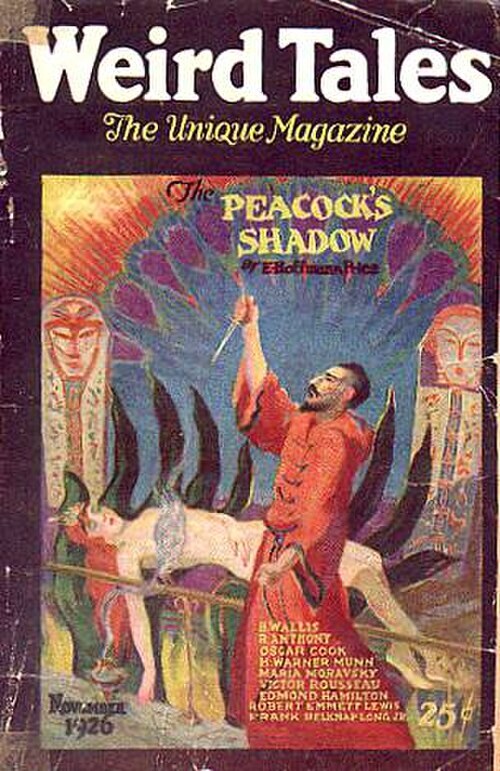
The Peacock’s Shadow
First published in Weird Tales, November 1926 (vol. 8, no. 5). Novelette. Pierre d’Artois.
United States public domain. Held in the Reading Room of The Weird Library. Published by Weird Tales.
Eh, vieux, what do you say to a bit of housebreaking?”
This, from Pierre d’Artois, a gentleman of France and a master of the sword, seemed unusual, to say the least.
“Well, why not?” I agreed, not to be outdone by the d’Artois nonchalance. “But whose house do we invade? What the devil, do you fear I will become homesick if from time to time there is not something to remind me of my own native land of liberty?”
“Mais non! No, we are not going as prohibition agents. Not at all! And it is no ordinary house into which we are to break. We invade the chateau of Monsieur the Marquis de la Tour de Maracq,” announced Pierre as he stepped on the accelerator of his favorite car, the Issotta roadster.
“But what of Monsieur the Marquis?” I suggested with what seemed to be a touch of reason.
“He is very busy at Biarritz at a fencing tournament.”
Well, this solved one riddle: I now knew why d’Artois, that fierce old ferrailleur, had overlooked a chance to demonstrate his exquisite mastery of the sword.
“But, mon Pierre, what of the housebreaking? What loot are we after?” I ventured as we cleared Pont de Mousserole and left behind us the gray battlements of Bayonne.
“The truth of it is, I am playing what you call the hunch,” he evaded, then continued: ‘ 4 But he is the good hunch. There has been an elopement, and it is for me to locate the lady.”
Worse and worse yet! A quiet month in Bayonne....
“Who is the girl?”
D’Artois laughed.
“A princess, and the daughter of a king.”
“Not bad for a marquis. And young and beautiful?” I retorted to
the mockery I saw in his keen old eyes.
“Beautiful, yes; if you like such beauty. But young, no. In fact, older than I am. ’ ’
“The devil!”
‘ ‘ The truth! Thirty-seven hundred years old at least.”
This was too much!
“Mais non. I do not jest,” continued Pierre. “She was stolen from the Guimet museum of Lyons and carried all the way to the chateau of the marquis.”
“Well, and that is a case for the police, is it not?”
“No. For one is not really certain; it is hut strongly suspected that he accomplished the almost impossible feat of looting the museum and carrying the mummy to his chateau. Monsieur the Prefect of Police, not being any too sure of himself, has taken me into his confidence and asked me to investigate unofficially. A false move would ruin him, since Monsieur the Marquis is a man of influence. ’ ’
“But why should anyone steal a mummy, especially de la Tour de Maracq, who is rich as an Indian prince, and of a house as old as Charlemagne?”
“A scholar, a soldier, a man of letters,” enumerated d’Artois, continuing my thought, “and a fantastic madman, if this report is correct. He is too talented for sanity. ’ ’
‘ ‘ Even as yourself, ’ ’ I hinted.
“Touche!” acknowledged d’Artois. “But I do not elope with ladies 3700 years old.”
He fingered a pack of Bastos, but thinking better of so foul a deed, decided to light the Coronado I had given him.
“All very quaint. But let’s get to facts,” I urged. “What have you to work on in this love affair? ’ ’
“I have the good hunch. And it is more of a love affair than you realize.”
Which was logical enough. Those whom gold could not tempt, might indeed steal objects of art, jewels over which to gloat in secret, a relic, an antique rug; but a shriveled mummy! Well, tastes vary.
And the case should be simple of solution, at least as regarded the marquis; for the missing lady could not be concealed with any degree of facility. A simple matter of walking or climbing into the chateau, and leaving again with our princess; or else reporting that she was not to be found, and that Monsieur the Marquis was not her abductor. A jewel could be hidden; but a mummy....
T he chateau was perched upon a crest some hundred meters off the road.. We parked the Issotta and proceeded on foot.
Instead of knocking at the door, as seemed to be his intent, despite his quip about housebreaking, d’Artois selected a key from his ring, tried it; selected another, picked at the lock, but to no avail. The third, however, was applied with more success; the heavy door yielded to his touch, admitting us into a vestibule, thence to a salon.
“Welcome to Tour de Maracq,” murmured d’Artois with a courtly bow. “Quick about it, and we’ll be out of here long before he has fought his last bout. ’ ’
“But the servants?” I suggested. ‘ ‘ They are few in number. It seems the marquis has an aversion to women, so that there are no female domestics to contend with. Thus it is that one of the menage has gone to Bayonne to negotiate with a stranger who sought to buy some rare vintages which are to be pilfered from the master’s cellars. Another is keeping a rendezvous with a demoiselle who hailed him a week ago and made an engagement for today. Each has some illicit engagement whereof he will not babble. Now it would have
been inconvenient to arrange on short order for lovers for any female servants... praise be to the eccentricity of Monsieur the Marquis! ’ ’
I noted the rich tapestries; the massive teakwood furniture; the floor of rare hardwoods partly masked by Chinese and Indian rugs. And on the walls were arms of infinite variety; wavy-bladed kresses, kampilans, simitars; halberds, assegai, lances; maces and battle-axes in endless number, all grouped in clusters. Some of these arms were burnished; but many bore dark, ominous stains.
And thus we roamed through the house, from one apartment to another, I wondering at the beauty, the grotesquerie, the oddness of the furnishings and adornments, d’Artois regarding all with an appraising glance that revealed nothing of whatever interest he might have felt.
Strange gods in bronze and onyx and basalt glared at us, brandished their distorted arms in futile rage, mouthed threats with their twisted lips; resented our presence in every way possible to inanimate things; inanimate, yes, but enlivened with the spiritual essence absorbed from their centuries of devotees. But no mummies. Nevertheless, d’Artois studied his surroundings. But nothing seemed to arouse his interest, until...
“Ah... look!”
He indicated a tiny darabukek, a small kettledrum whose body was of grotesque carven wood, its head of a strange hide; strange to me, at least.
“Curious, yes. But what has this to do with mummies?”
“Nothing at all. But I fancied that drumhead...”
A smile concluded his remark. Now what the devil significance had that little tom-tom?
"But no mummies, Pierre.”
“True. But one can picture a man’s mind from the house he keeps. Fancy then the odd brain that twists
in the skull of de la Tour de Maracq! ’ ’
And thus, room by room, we searched the chateau proper, servants’ quarters, basements, passages and all. Toward the end of our tour we stumbled upon a stairway which led to an apartment which we had overlooked.
It was a large room of contradictory appearance: a study, if one judged from its desk, table, bookcases; a bedroom, surely, if gaged by the lordly canopied bed of antique workmanship; or a museum, if one drew conclusions from the ornaments.
As we had done in the salon, we found again a collection of arms, armor, polycephalous gods with contorted limbs and features. And this time, mummies, two of them: one in its sycamore case, the other, not only encased, but enshrined in its massive granite sarcophagus.
Naturally I was exultant.
“Useless!’’ exelaimed Pierre. “See how they fit their cases; and see also that none of the cases would fit the princess we seek.”
With a tape he laid off the dimensions of the mummy we sought, showing clearly that those present were of greater stature.
“Not so good, Pierre, not so good. Apparently we’re stuck.”
“Not entirely,” muttered Pierre absent-mindedly.
I saw him examining an epee, a slim, three-edged duelling sword. The pommel, which was adorned with a tiny silver peacock, seemed to fascinate d’Artois. Which was natural enough, Pierre being a connoisseur of the sword, and its undisputed master. Still, business was business...
A dried, mummified human head, wrinkled and shrunken, a Patagonian relic, hung by its hair from a cluster of arrows. And this, attracting my eye to the library table over which that gruesome trophy hung, drew me to the table itself. I picked up from
the inestimable Kurdish rug which covered its top a thick book, leatherbound, and emblazoned with a peacock.
‘ ‘ Hell’s fire! It’s bound in human skin!”
“So it is,” agreed Pierre. "I wondered how long it would take you to recognize human hide when it was tanned. You passed up that little drum without noticing it. ’ ’
And then Pierre thumbed the pages, began to read to himself, ©lancing over his shoulder, I saw that he well spared himself the trouble of reading aloud. The book was either in Arabic or Persian, neither of which I could understand.
As Pierre read, and fumed, and muttered, apparently quite interested, I devoted myself to the one bright spot in that necrophagous apartment: a painting in oils, a portrait of a young woman, lovely beyond all description, with smoldering, Babylonic eyes, full, -delicately sensuous lips; fine features whose every line and curve bespoke calm, aristocratic insolence. And this smiled from a cluster of swords, and was enshrined in an atmosphere of death and doom, and gruesome relics! Whether or not the kidnaper of a mummy, this marquis was surely a freak.
Pierre’s smile, as he laid down the book he had been reading, resembled that of a cat who has just had a pleasant tete-a-tete with the canary.
Whether the worthy marquis had expressed his unusual humor by having a book of Arabic jests bound in human hide, I couldn’t say; but Pierre seemed on the inside of something which had been evading him.
The portrait caught his eye.
“Very lovely. Yes, I met her, twenty years ago, shortly before her untimely death. His last mistress.. ”
Death... death... even that loveliness enshrined by morbid trophies was itself a memento of death. I shuddered, chilled, despite the sun’s
slanting rays which warmed and illumined that necrophiliac roam.
“And he sleeps here. Or is this but an antique, a decoration?”
I glanced again at the lordly bed, half expecting to find festoons of skulls about the canopy, fringes of scalp locks, strands of teeth. Then I noted an unnatural curvature of the drawn curtains, something which forced them forward, and out of their natural drape.
“Que diable! Another mummy! And no case to match.”
D ’Arkus took from his vest pocket his tape-line, took measurements, compared them with his notebook; studied the wrappings, the markings.
“The very lady!”
I advanced to pick up the aged beauty. Simplicity, this quest. And this, after all Pierre’s halo of mystery!
“ JamaisJ Pas du tout! We must locate the case; all or nothing. If we alarm him, who knows what may happen to the case? Allans /”
But before leaving, he paused to regard once more the portrait of the girl with the Babylonic eyes.
“That was a lovely little epee, that one with the peacock on its pommel. It seems strangely familiar... well, and since the marquis has probably fought his last bout and is on his way back, we leave opportunely,” remarked d’Artois, as the Issotta’s long nose headed toward Bayonne.
At Place de Theatre we parked, found a table on the paving, well within the shade of the awning. D’Artois called for a weird favorite of his, whose two ingredients he himself mixed, and then diluted with charged water: a milky, curiously flavored drink, Anis del Oso and Cor • diale Grentiane, a suave, insipid madhouse in a slim, tall glass. The springs of the Isle of Patmos must have flowed with Anis del Oso!
As we ripped and smoked, I noted
the great limousine of Monsieur the Marquis de la Tour de Maraeq draw up to the curbing, returning from Biarritz. Lean, aquiline-featured, elegant and courtly in bearing, and haughty as Lucifer was the marquis. Touching the brim of his high hat with the head of his stick, he acknowledged the salute of the footman, then handed from the limousine a woman whose features, to say the very least, startled me.
“What in-!”
“No, mon cher,” murmured d’Artois, “she is no ghost, though she may be the reincarnation of the lady whose portrait we saw at Chateau Maraeq. There is no telling what deviltry the marquis has worked in his day, but this is a flesh-and-blood woman. And now do you see a light?”
“A light? What in the world has she to do with this mummy?”
D’Artois laughed maliciously.
“I’ll swear you have mummies on the brain! But just wait. Well, that is Mademoiselle Lili Allzaneau of 34 rue Lachepaillet. Like her scriptural counterpart, she lives on the city wall in an apartment overlooking the park.”
Which last was of course superfluous: for the mention of her address was quite sufficient. Yet La Belle Allzaneau bore the stamp of the thoroughbred; the patrician insolence, the smoldering Babylonic eyes, long, narrow, veiled; the slim, gracious hands of a princess of the blood. And her dress, and her figure, and her bearing were all in accord. Behold the grand dame of the chateau, and her double, La Belle Allzaneau of rue Lachepaillet!
A few days elapsed, during which Pierre left me to my own devices.
And then, emerging from his preoccupation, he sought relaxation in a stroll which took us along the Adour,
around, and back to the ramparts of Lachepaillet.
To our right was the Gate of Spain, its drawbridge and guardhouse; far beneath us, at the foot of the city walls, on whose parapet we sat, was the bottom of the dry moat; while ta our left front, across the moat and a hundred meters beyond its outer bank, was the Spring of St. L^on and the cluster of ancient trees that half concealed it. Though their crests almost met, their trunks were widely separated, so that the spring and its low, hemispherical cupola were in a small clearing.
The sun was setting. Long shadows marched slowly across the gently rolling ground beneath us, and to our front. Pierre d’Artois, as he took from his case and lit a villainous Bastos, stared at the Spring of St. Leon. And then he resumed the thread of his rambling discourse, continuing a tale he had so often before begun and abruptly abandoned.
“With that lunge I could have impaled the devil himself, for I had him swinging like a windmill, skilful swordsman though he was. Yes, and had it really been Monsieur the Devil himself, and not Santiago with whom I crossed swords, I still hold that someone must have struck me down from the rear to save his lord and master! ’ ’
He spoke of his secret duel by moonlight with Santiago the Spaniard, two years ago, in the small clearing by this very Spring of St. Leon, and of the outcome of the affair: how, as after hard, fierce fighting he had slipped through the Spaniard’s guard to impale him with a thrust to the chest, there had been an awful flare of elemental flame, followed by blackness and oblivion; how Jannicot, his servant, had come in search of him, carried him back to the car; and how, on the return trip, they had found Don Santiago dead beneath his own car, wrecked on the way from Spain,
hurrying, apparently, to keep his rendezvous with d’Artois.
“Since Santiago never reached Bayonne to meet me, then who? A double? For that stout wrist was not that of an apparition, nor do illusions or phantoms leave footprints, nor can they heat one’s blade so that one’s arm tingles up to the shoulder. Impossible! ’ ’
“But then what did hit you?”
“Who knows? Perhaps a confederate, despite our having agreed to meet without seconds. But by the time. I recovered full possession of my wits, several days later, any bruise the blow might have left had subsided. Yet something must have struck me...”
In the lengthening shadows, the Spring of St. Leon appeared less and less as a place for midnight trysts, either for love or war. And though listening to Pierre’s dissertation, my thoughts were of Bayonne, this “pet” city of mine which is still girdled by walls' and moats and earthworks; whose ground is steeped with blood spilled in centuries of warfare, and undermined with casements, and passages, and dungeons. Some of the passages had been built by Vauban when he fortified the town; but there were many others, of much greater antiquity; vaults wherein Roman legionaries had worshiped Mithra, Saracen emirs practised necromancy, and medieval alchemists sought the immutable Azoth, and dabbled in thaumaturgy.
“A curious thing I noted,” continued d’Artois, “was that a small silver peacock adorned the pommel of his epee... strange how one notes such details before a duel...”
Silver peacock... why, we had seen a similar sword at Chateau de la Tour de Maracq the other day!.. I wondered...
And out of that network of passages, what might not have emerged from a mining casemate to strike
Pierre from the rear and save the day for Santiago, or Santiago’s double, or the devil, or what it was that d’Artois had met?
Something had loosened the ordinarily well-shackled d’Artois tongue.
I marveled, and encouraged its wagging. And then he stopped short, pointing toward the Spring of St. Leon.
“By the-!” he exclaimed,
quaintly distorting a selection from the American doughboy’s lexicon, which he strove most valiantly to master. “What is she doing there?”
A girl stood at the spring; a slim girl whose white arms and shoulders and iridescent gown gleamed boldly against the shadows of the grove and the dark cupola of the spring.
“La Belle Allzaneau,” explained Pierre; for I lacked that old man’s keen vision.
As he spoke, she rounded the cupola of St. Leon, its low gray mass hiding her from sight.
“But how can you recognize anyone at that distance and in this light, Pierre? ’ ’
“Her general outline, the gown she wears... which by the way is a
trifle inappropriate for the locality.
.. I have often seen her at the Casino at Biarritz.”
'T'hat evening, as Jannicot brought our coffee, d ’Artois, after theorizing for a while about the duel at St.
Leon, abruptly switched to the mummy, poor neglected lady whom he seemed to have entirely forgotten.
“Your imagination, mon cher, is entirely dead,” he declared.. “And in this quest of the mummy case (for we have the lady herself located) one needs much imagination. Alors, to you shall fall the duty of private soldier; that of sentry-go, by night. Jannicot shall walk post during the day.”
“What?”
“Yes. Sentry-go. You watelx by night. ’ ’
‘ ‘ Why pick on me V ’
“You are too conspicuous in this small town. Jannicot, watching a cow staked on the city wall, would never be noted, for he will look like any other yokel similarly occupied. Whereas you... ”
I bowed elaborately in appreciation of the compliment.
“Whereas you, under cover of darkness—but that is obvious.”
“But how will watching 34 rue. Lachepaillet assist you?”
“It will prevent your disturbing my meditations.”
“Still, what has that girl to do with mummies?”
‘ ‘ Imbecile! You have no imagination. So take your post at sunset, watch until morning, and report to me all the exits, entries, and doings of La Belle Allzaneau, and her visitors as well. Though few but Monsieur the Marquis call at her apartment.”
And thus I spent a week, walking post by night. Not truly walking, but rather lounging on the parapet of the 'ancient battlements, always keeping an eye on the door of Lili Allzaneau, who lived on the city wall, who had ensnared a marquis; “a peer of France,” as they used to put it.
And what was Pierre, beau sabreur and master of devices, doing as I frittered away my time, noting the princely cars which stopped at the door of Lili of the City Wall; listening to the sound of merriment subdued to a patrician pitch: an aristocratic reserve in keeping with the lorette who designed to accord only to the lords of the world the pleasure of her presence?
Each morning I rendered my report. usually with mocking formality, imitating the supposed manner of a private detective. I especially enjoyed the report of the fourth vigil: “Monsieur Pierre d’Artois, noted
boulevardier and swordsman, was seen entering the apartment of Mademoiselle Allzaneau at about 11:30 p.. m., apparently having returned with mademoiselle from the theater. When I quit my post at sunrise, he had not yet left. ’ ’
‘ - Idiot! ’ ’ snapped Pierre, relishing the jest. “You slept on post.’’
‘ ‘ The devil I did; I watched most vigilantly. ’ ’
“Well, since you must know it all, the apartment of Mademoiselle Allzaneau has an exit on 43 rue des Faures, the alley which parallels rue Lachepaillet. Now, are you ashamed of your base insinuations? ’ ’
I was properly squelched. Later, I checked up on rue des Faures and verified his claim. But what in all creation had Pierre been doing in the company of La Belle Allzaneau? A man of his age! Though I could well conceive that any lady of the world could take pride in being seen with Pierre d’Artois, that fine, courtly old master of the sword.
What a mess! Not a trace of connection between any of the diverse elements that danced before my eyes: a marquis, a mummy he had stolen, her still missing case; a duel, fought two years ago at St. Leon, and a lorette with Babylonic eyes... yes,
and the lady of the portrait at the chateau, the double, the deceased original whose reincarnation La Belle Allzaneau seemed to be. Too much for me!
But one does not question d’Artois to any purpose.
A w r eek, as I said, had passed: uneventful espionage. And then, just as I was to leave Pierre’s house to resume my vigil, he detained me.
“A moment, mon vieux. I have again the hunch. It will happen tonight.”
“What, for the Lord’s sake, will happen? The mummy seek her case, or you elope with Lili? Or challenge your rival the marquis?”
“Anything is more than likely to happen tonight. I hear that Monsieur the Marquis has gone to Spain. And Mademoiselle Allzaneau will receive no -Visitors this evening, not even me. And so on... I have the hunch, as you so elegantly put it, the hell will he popping tonight.”'
“Well, where do I come in?”
“You? You shall follow her should she leave her apartment; follow her, and see it to a finish, whatever it be. It may be to a strange place, mon vieux; therefore take these with you.”
He passed me a Luger automatic, a blackjack, and what appeared to be a left-handed, fingerless, mailed glove; strangely like a Roman cestus, at least as to its obvious purpose.
“Looks like trouble, Pierre,” I remarked, as I strapped the Luger and its holster under my left arm. “But why this glove?... and... what the devil! A peacock decorating it! ”
“Yes. It may serve you well. If you are accosted, exhibit the peacock, and you will be passed on without question.”
“Lay off, Pierre, lay off! Have you a dime novel complex?”
“Mais non. Do not laugh. You may have no occasion to try it. But remember the peacock. A full moon will make your task easier, or more difficult... that depends... As for me... we may meet unexpectedly. But if not, see it to a finish, and do not fail me. ’ ’
With this command firmly impressed upon me, I took my post, wondering at the assortment of junk which he had forced upon me. A Luger... well, that was sound
judgment; a pistol is an excellent playmate. And a blackjack could conceivably come in handy. But that fingerless glove with its peacock!
T^eakly midnight. Not a car in front of her apartment all evening. La Belle Allzaneau evidently was carrying on revery and not riot
during the absence of her lover in Spain.
A copper kettle of a moon was rising.
“Do not fail me. Follow her and use your judgment.”
Well, and into what sort of mess would Pierre be venturing in the meanwhile? Rich entertainment somewhere for someone!
Lord, what a sleepy night! Silence along rue Lachepaillet, and more silence in the park beneath me, beyond the dry moat that girdled the walls. The night before Christmas was fairly spiked to the mast for pure stillness.
Follow Lili... where? Why the pistol, the blackjack, the ornamental brass knuckles?.. brass, the devil! I’d have sworn they were gold... or perhaps it was the moonlight..
A light in Lili’s window, just for a moment. Then darkness again.
And then the door on the rez-dechaussee opened. Lili herself, in a gown of star-dusted, metallic luster stepped into the street, crossed, paused within a meter of my lurking place.
In the entire world had I never seen a woman half as lovely, as perfectly formed, as faultlessly arrayed as she was, from her silver slippers to her dusky hair... great Lord! a peacock tiara, all aflame with small rubies, and emeralds, and sapphires and diamonds glowed in the darkness of her coiffure! It began to seem as though I had but to step forth, show her my brass knuckles and their silver peacock, and claim her as a partner in whatever devil’s dance was in store for us.
“Follow her, and use your judgment. ’ ’
No, better not accost her; else he’d have said, “Accompany her.”
All this in an instant; then she turned to a low, narrow entrance directly beneath my position on the
parapet, and vanished into its opening.
Now what on earth was that faultlessly gowned girl doing in an ancient powder magazine or storeroom which used to serve the garrison in days past? I’d prowled around in many of them; all were crowded with rubbish, and filth, and the dust of centuries.
Now when should I begin to trail her? If immediately, I should betray my presence; if I paused, I’d lose thie trail. And then I became aware of the aura of perfume she had left behind her, a rich, heavy, arabesque fragrance. The very scent a sample of which Pierre had let me smell the other evening! Now, by the rood, I could trail that persistent, curious perfume anywhere... So, after a pause of a few more moments, I leaped from the parapet and plunged into the magazine.
"Plunged” is the right word, though I didn’t begin plunging until my third step into the darkness, when I Stepped into vacancy. I came to a stop at a landing, ten steps down. With belated good judgment, I sized things up with my electric torch.
More steps, steep, narrow, rubbishladen, leading to abysmal blackness far below. And in darkness I edged my way down. The haunting, persistent fragrance of La Belle Allzaneau led me on.
I paused at the foot of the last flight. My feet were on sandy bottom. I listened, but heard nothing save the breathing of that fierce silence. And from the subterranean mustiness came the perfume of Lili, reaching from the blackness to enfold 'me. She had been there, and had not branched off into any lateral passages on her way down.
Luger in one hand, torch in the other, I stabbed the gloom. Vacancy. I was alone in that ancient "vault, alone with the perfume of a girl who wore a jeweled peacock in her hair.
There were tiny footprints on the sand. And then I noted a low archway, an exit, which, being on the shadowed side of a bastion, had not had its presence betrayed by the entrance of outer moonlight. Lili had left the vault, whose bottom was on a level with the bottom of the dry moat; had left the enclosure of Bayonne, and was without the walls, somewhere.
Then I picked up the trail, tiny footprints in the sand. She had kept close to the wall, heading along toward Porte d’Espagne. But I knew she would not pass that point: for no woman would ruin her footgear in the slime and mud of the moat bottom past the Gate of Spain, the result of seepage from the locks of the Adour.
Beneath the drawbridge of Porte d’Espagne, I picked a lingering trace of perfume; and likewise her footprints, which for several paces I had lost. She had edged away from the wall, crossed the moat, ascended the steep bank.
Her destination? Logically, any place; she had choice of the whole countryside. Nor could I trail her any farther. Tracking in sand is the limit of my skill!
I took stock of my surroundings. If she continued in a straight line...
Hell’s hinges! She was bound for the Spring of St. Leon, that unsavory spot where d’Artois, in his moment of victory over Santiago, had been struck from the rear.
Conceivably she might be keeping a rendezvous with the marquis, or more likely, some other lover. And we had seen her there a week ago, at sunset.
Things seemed to be pulling together, but leaving me still confused. The girl had some connection with this spot where Santiago, armed with a sword whose pommel was adorned with a peacock, had met d’Artois. The marquis had a similar sword; and the marquis was the girl's lover. And die girl was the living image of
the former mistress of the marquis. She wore a peaeoek in her coiffure, and I wore one on my left hand. Well, what of it? Something, yes; but what?
A sequin glistened on the ground. In the stillness of the clearing, the heavy air still bore a trace of her perfume. But die was nowhere in sight.
I sized up the ground near the spring. There, in that small, flat space, Pierre and Santiago had crossed swords. There was the rock on which he had laid his hat and coat. Here he had taken his position, sword in hand, on guard....
I whirled in my tracks. Pure nervousness; a reflex occasioned by the memory of that something which had struck d’Artois from the rear. There, in the shadow of a small knoll, was the entrance to a casemate, seemingly at least. Another sequin gleamed on,the ground. On her way, she had severed a thread of her gown, and was now shedding sequins every few paces. With her short start, she could scarcely have left my range of vision, unless she were deliberately hiding. Then... logically, she had entered the casemate; had at least paused at its entrance, as the sequin dropped from her gown indicated.
Without any excessive eagerness or exultation, I entered the casemate. Darkness, absolute. But a trace of her perfume 1 I smelled not only perfume, but trouble; here, for a fact, I was really getting into something.
A few steps, feeling my way in the dark. I dared not risk the torch. Ahead of me, apparently around a curve, was a faint glow, as of a dim light still farther beyond, a shadowy reflex of a half-concealed illuminant; so dim that I had not perceived it for a moment. Well...
alt! ’ ’ snapped a voice.
The flare of an electric torch smote me full in the face, blinding me. But before I could draw the Huger...
“You are late,” continued the voiee, “and I doubt that the master will receive you in that garb..
“Never mind my clothes,” I temporized, catching my wits and also a glimpse of my aecoster, now that the ray had left my face. ‘ ‘ Has the lady of the peacock-?”
I touched my forehead with my left hand, a more instinctive than deliberate gesture to indicate Dili’s coiffure. As I lowered my hand, the wateher bowed low, kissing the peacock’s figure.
That was an excellent little blackjack I wielded with my right, smacking neatly across the inclined head of the warder.
“Well, and if the master is particular about costumes, perhaps this will answer.”
After stripping the hood and cape from the sentry, I hound and gagged him, arranged him snugly against and parallel to the wall, and continued my way down the passage; down, literally, as it inclined at a rather quick slope, curving ever to the right, so that it led back toward the citadel of Bayonne, and far beneath its foundations. At regular intervals, candles cast a dim light.
I had noted the swarthy, foreign features of the warder I had blackjacked, and wondered still more. Almost anything was likely to happen... and where was Pierre?.
Then came steps, winding, circular steps, leading to the very heart of the earth. Chilly dampness had displaced the outer warmth. To what strange festival was that girl bound? And what was that peacock which had such talismanic effect on the warder? Who the master? And why the costume?
At the foot of the winding stairs I found a twisting passage, this time level. Turns... more turns... a murmur of voices, chanting sonorously... and then...
A heavy iron grillwork, a gate,
barred my progress. I flattened myself close against the door jamb, peering through the bars at a unique sight. Before me, at the end of the passage, was a great vaulted chamber, illumined with a deep red glow. As much of the walls as I could see was covered with black arras, figured grotesquely in silver embroidery, monstrous designs of intertwining forms and unheard-of creatures alternating with medallions inscribed in characters resembling Arabic. At the far end of the vault was an altar, behind which stood the enshrined image of a great peacock, his painted fan fully spread, and enameled in naturalistic colors. A bronze railing rose waisthigh before the altar; and from a cleft in the platform between the railing and altar, two great black hands, palms uplifted, reached forth.
Kneeling on the floor in crescent formation were a dozen robed and hooded figures, worshipers at the peacock’s shrine. The chanting had ceased; and from the group rose one who advanced to the altar steps, facing the image, extended his arms, and began the recital of a ritual. At times he paused for the response of the communicants; resumed his chant, ceasing again to make gestures and genuflections. But not a word of it could I understand; neither of the priest, nor of the worshipers.
Well, and where was La Belle Allzaneau, she who wore on her forehead the unusual symbol which seemed to be the key to this secret place into which I had wandered? And Pierre? Certainly he had not sent me on into this place and stayed off the scene himself; or had he miscalculated, sending me to real action instead of reserving it for himself?... And thus I wondered, wondered at the scene, at the rites, at the unholy tapestry of the walls, and the cornices which depicted in sculptured panorama the unsavory themes of Asian mysteries... the predecessors of the peacock.
Pierre?... No, Pierre could not have miscalculated so far as to send me into the midst of things and follow a false lead himself...
great Lord, could it be Pierre who conducted the ritual? Absurd; but the audacity of the man knew no limits!
On and on rolled the rich, resonant voice of the priest. Acolytes marched about the crescent of kneeling communicants, swinging censers and chanting; retired, grouped themselves about the altar. And then...
The priest turned to face the congregation. Not Pierre, but Etienne, Marquis de la Tour de Maracq! He who had stolen the mummy of a princess; he who lived surrounded by death’s symbols, a servant of polycephalous idols, he who studied an obscure book bound in human hide, found time also to act as high priest of the silver peacock.
A sweeping gesture; another sonorous phrase; and the assemblage rose, bowed, backed out of the vault, toward the iron grating through which I peered.
I shrank back against the wall, becoming a shadow among the shadows, and waited for the grill to swing open and let the worshipers enter the passage so that, emerging from my angle, I could mingle with them, one of them, disguised in my hood and mask, and guarded by the peacock on my wrist. And once they had passed on, I could return.
And then I remembered the warder I had bound and gagged., Would they notice him lying in the shadows? Should I hasten on ahead of them, conceal the sentry outside the passage, and thus avoid the alarm caused by his discovery? Damn that sentry! Why had I left him where he dropped?
The door clicked. Too late to run on ahead to clear the way. The cloaked worshipers crowded even into my comer in that narrow passage, not
even noticing me. One, however, seemed to mistake me for a comrade who had knelt beside him, and had left at his elbow.
“The master seemed N hasty tonight, don’t you think, Raoul?”
I shrugged my shoulders, mumbled a phrase in Tagalog. The ruse served well. Evidently men of all languages met there.
“Oh, pardon, Monsieur...”
And he went on through the passage in search of his comrade.
I mingled with the dozen who w r ere leaving, contriving to fall back unobtrusively, thus avoiding the appearance of lingering in a place from which all were departing. And as the tail of the file of hooded men rounded the first turn, I dropped back and resumed my post at one side of the grill, deep in the shadows, seeing, but unseen.
T he marquis descended from the altar steps, halted in the center of the vault; stroked his black mustache; frowned... Three swift
steps to his left brought him to the heavy black arras, which he parted. “They have gone, cherie.”
And from behind the embroidered hangings came La Belle Allzaneau, white arms and shoulders and iridiscent gown agleam under that deep, lurid light.
“Etienne, I’m somewhat disappointed... I had expected-”
“To see something grotesque and awful, and outlandish? Ma chere, those whom you saw were neophytes, and the rites of the innermost shrine are not for their eyes, ’ ’ explained the marquis as he again parted the arras and drew from behind it a low r table laden with refreshments.
He then drew up a chaise longue among whose cushions the girl enthroned herself. The marquis took his place opposite her, and facing me, so that while I could look him full in the eye, I eould see but the profile of
La Belle Allzaneau, Lili of Lachepaillet, the lorette who had the manner of a queen.
“No, petite,” continued the marquis, “those were neophytes. But to you I shall reveal-”
“Yet am I not even more of a neophyte?” interrupted the girl as she selected a wafer from the tray before her.
‘ ‘ Nevertheless, I shall reveal to you, as I promised, the innermost secrets; you shall enter the adytum, the awful holy of holies.”
“But, Etienne, you must explain. Who is this peacock, and what is his significance? ’ ’
Who, indeed, was the peacock? I forgot, for the moment, that the bound and gagged sentry might be discovered by the departing communicants, thus betraying the fact that someone had intruded. Still, it had taken me ten minutes to enter; and they, going upgrade, up flights of steps, would require more time. And should they return, they would search each passageway, taking their time, in all thoroughness, probably twenty minutes or half an hour.
Well then, and what was that glittering bird whose image had caused the warder to bow and kiss my left hand?
“The peacock,” explained the marquis, answering the gifl, as well as myself, “is the symbol of him we serve: Malik Taus, which in the Persian signifies ‘Lord Peacock’.”
“Which explains exactly nothing, Etienne! ’ ’
“Malik Taus,” he repeated, as one who humors a captivating but unruly child, “is none other than he whom they call Ahriman... Lucifer, the Morning Star... Satan, the outlaw, he whom we, the rebels, the battered but unvanquished ones serve. Now do you understand?”
Eavesdropping on devil-worship! What next?
And La Belle Allzaneau smiled her
slow, enigmatic smile, unterrified at that which made me shudder.
Thus, as they ate and drank, the marquis explained the monstrous scenes depicted on the cornices, Oriental perversions antedating Malik Taus, the girl interrupting from time to time. I watched, and wondered.
Very curious it was that their voices seemed to come from my right clearly, but as from a greater distance than the speakers seemed to be. It was as if I were watching some fantasmagoria. Her voice I heard as her lips parted; but it seemed to come not from her lips, but from my right.
And then it struck me as odd that they both were left-handed. Both ate left-handed, picked up their goblets with their left hands. The marquis, striking a match, struck it with his left. Was this left-handedness another manifestation of the rites of Malik Taus, or was it but coincidence that both the girl and her host were left-handed?
“This is an ancient shrine,” continued the marquis, his voice clear, but coming not from in front of me, down a long, narrow passage, but seemingly from my right. “This is an ancient shrine in which Mithra was worshiped by Roman legionaries; and renegade Moslems and those who followed the Moorish forees into Spain bowed here before Tanit, and Istar, Mylitta, and Anaitis, all of whom are one, one goddess who came out of Egypt... Isis, the Great Goddess..
I listened, fascinated by the rich voice of that strange, dark man; nor wondered that the girl was ensnared by his pagan chant, his intoned syllables which sang of monstrous rites and unheard-of lore. I forgot, remembered, and straightway dismissed the thought of the possible return of the departed neophytes. My Luger would serve me well, if necessary; and hand to hand, the brass knuckles.
As the marquis smoked and drank,
and expounded, I saw that his gaze went past the girl, seeming to seek me in my alcove of blackness. But no, surely he could not see me, where I crouched in darkness. He frowned passingly, shook his head, made a fleeting gesture of annoyance, as of one who is irritated by the buzzing of a mosquito. Then, continuing his speech, he reached again behind the arras.
I heard a click, and at the same time a faint, droning, humming sound. For a moment the lights dimmed. And then, suddenly, I awoke to the significance of that which had occurred. In the darkness I saw very distinctly a bluish violet glow, an aureole which surrounded each of the bars of the gates before me. That click had been the sound of a latch slipping into place; and that glow was the leakage into the air of a high tension electrical current!
Hell’s bells! Had he seen me? Did he know of my presence? Or... perhaps... most likely it was that he suspeeted the presence of some loitering neophyte, some eavesdroper who had paused, and who would, as he leaned against the grillage, be seared and seorched lifeless by the flaming death that lurked in that ironwork. My advance was barred beyond all hope.
Well, I eould watch; and in case of a pinch, a shot from my Luger would reach down the passage. For I felt sure that the marquis designed some outlandish deed; not only the words of Pierre, but the atmosphere of the place, the very expression of the man himself so worked on my nerves that I sensed the presence of something hideous and unheard of. That lurid light, that glittering peaeock, those black hands upraised toward the altar, and the hypnotic words and chanting tones of the marquis... I shuddered. It is not pleasant to consider shooting an unarmed man from ambush, but... as these
French put it, que voulez-voust
“Without evil, there could be no good,” continued the sonorous rhythm of the marquis. “They are extremes of the same essence, even as heat and cold are of the same nature. And to serve the Lord of Evil (if evil indeed there is) is to pay a just tribute to him without whom there could be none of the so-called good, if good indeed there is. Thus in time to come, when Malik Taus spreads his painted fan over all the earth, we who now serve him shall be princes and lords, and shall inherit the world. Look!” he commanded, his voice rising imperiously as he pointed to the shrine; “look and see his thousand eyes that watch over us!”
The girl turned, following with her eyes his compelling gesture. And in that instant the marquis, never pausing in his speech, dropped into her wine a tiny pellet.
The man was mad with a fearful, unspeakable. madness. And here I was, barred from preventing what I now sensed to be impending, a sequel to the preliminary rites I had witnessed, a manifestation of demonaltry in which none but the high priest would officiate.
‘ ‘ Those black hands? They are the hands of Abbadon, the Dark Angel who serves Malik Taus; and on them we lay that which we dedicate to the Lord Peacock,” explained the marquis.
I loosened the Luger in its holster. At times one must shoot from ambush... but not yet.
“And so you are the only adept, Etienne? ’ ’ queried the girl, resuming her wine.
‘ ‘ There was another, but he is dead. Through my fault. Don Santiago de las Torres Negras.”
Lord, what a revelation! Here, in this awful place, I was about to learn another side of that uncanny duel fought by Pierre d’Artois at midnight, at the Spring of St. Leon.
“He challenged one Pierre d’Artios,” continued the marquis, “to fight in secret, at midnight, at the Spring of St. Leon. And the Master forbade-”
“And why did you forbid, Etienne? ’ ’
“I didn’t. No. The Master of Masters... ” The marquis lowered his voice. “A stranger out of Kurdistan, one whom I recognized as a master of adepts, by the signs he gave... the Master, I now believe.... Malik
Taus himself, the Lord Peacock incarnate as man! He forbade the duel. I feared for Santiago, and wished to prevent it, out of deference to the Master’s wishes, and from fear of d’Artois, a swordsman without like or equal. So I invited Santiago to a chateau across the border, in Spain, set back all the clocks, sought to divert him, deceive him until, when at last he did sense my device, it would be too late for him to keep his rendezvous. Rob him of his honor, yes; make him fail in his word, yes; but I sought to spare him that meeting with d’Artois, and from the vengeance of the Master.”
“And did you succeed?”
“No. Santiago detected the trick before it was absolutely too late, leaped into his car, and drove fiercely into the night, with still a chance to keep his word inviolate. ’ ’
“So he fell in the duel?”
The marquis winced.
“No, cherie. He never reached the rendezvous. A storm arose; and he skidded on a dangerous turn, doubly dangerous on account of the rain. The wrecked car crushed the life out of him. Had I but let him go, he might have won; or at least died like a man... thus I killed Santiago, my friend... And this stranger from Kurdistan may have been an impostor, a fraud. „. Imbecile! I believed him to be the Lord Peacock incarnate!”
Christ, what a tale! Wns it then the Kurdish stranger whom d’Artois had met, and almost vanquished? The
devil who had inspired the marquis to meddle,, and’ caused the death erf Santiago on that lonely road from Spain? My brain reeled with the madness of it all...
And then I raised my eyes again to Tegard that marquis who chanted sonorously to that lovely girl, serene and calm, reclining among silken cushions in the Adytum of Darkness, in the very shrine of die Oriflamme of Iniquity, face to face with its high priest... and this without changing expression, save to shake her patrician head in pity... what a
woman!
Had they discovered the gagged warder? Were they returning? I was in a devilish mess, literally.
Devils on all sides, and in an atmosphere of demonaltry.
T he girl nodded... sank back among the emblazoned cushions. Drugged. Inert. The tiny pill had done its work.
The marquis rose, thrust the table behind the arras; listened to the breathing of the sleeping madonna; straightened himself to his full height. Madness and despair flamed in his somber eyes; his lips drooped; his lean cheeks were drawn. The muscles at the point of his jaw were knotted and quivering.. If not the devil, then was this marquis his double: Satan overcome with sorrow, but unrelenting.
What now? Madness was his. But what form would it assume?
With swift, sure fingers he removed the silver slippers of La Belle AIIzaneau; stripped from her the glittering, iridescent gown; and then the tenuous silk which clung to her form.
Cristo del Graof What had that madman in mind?..
And then he lifted her bodily from the chaise longue, strode up the cinnabar-strewn pathway toward the shrine, ascended the altar steps, and placed his burden upon the npraiseef,
black palms of those great hands that reached for their prey.
Turning from the altar, he took a small mallet and struck a gong whose thin note shivered and hissed, with a rustling, lingering vibration, chilling, sighing, not full-throated as bronze should be. And from panels on either flank of the altar emerged those same hooded, sheeted figures that had passed me a short time ago, filed now to their places and knelt before the shrine, a vermilion crescent of demonaltors bowing before their chief and their god.
One of the number, after his salaam, arose and advanced to the altar steps, leaned over the brazen railing, and with a stick of rouge marked on the side of the unconscious girl; then a mark on her breast; and then on her forehead a mark. At the same time, coming from the right, just beyond my angle of vision, were four who pushed forward on rollers a massive stone trough; a trough over whose sides slopped some of the liquid it contained. Trough? No- trough at all, hut a sarcophagus, chiseled with Egyptian hieroglyphics! And is if by symmetry, there came from the left four others, each pair of whom bore a mummy case. These cases were placed on either side of the altar, standing upright. One, the mummy case of a man; the other, of a woman. This I knew from their sizes, and from the gilded masks which depicted the features of the deceased.
The case of the man seemed heavy. But those who carried the case of the woman bore it as though it were empty. And I wondered if indeed that could be the case we sought; Pierre and I.
The hooded figures, after putting their burdens into position, resumed their places in the crescent of devotees, leaving the marquis alone on the altar steps, facing the shrine.
Well, and at least I need fear no attack; for those who had passed me
at the gate had but doubled back and waited behind the scenes for their signal to reappear. It had all been stage-setting. And it all apparently amounted to nothing more than an initiation of the girl into the secret order of demonaltry. I relaxed and let the Luger sink into its holster.
And then I noticed what under normal circumstances I would have noted immediately; the solution of that which made both the marquis and the girl seem left-handed, and that which made the voiees seem to come from my right, instead of from direetly in front of me. I was looking into a mirror, into one, or three, or some odd number of mirrors which caused a reversal of left and right. Had I not shrunk back into my corner, qgainst the door jamb, I would have noted that those who filed past me had not come direetly toward me, but rather from one side. I could now distinguish my image before me, very faint, almost imperceptible, yet there, nevertheless.
So! And here I was to witness an initiation into the inner circle of demonaltry. My fears for the girl had been panie, and nerves, almost hysteria. And the mummy case, the smaller one, was doubtless that whieh Pierre sought.
But where was Pierre? No matter. In the morning we would return and loot the place....
The marquis, after bowing before the shrine of the peacock, extended his arms, ehanted in a tongue unknown to me. Then, after tossing ineense into the brazier on the altar, he began anew, this time in French.
“Malik Taus, Standard-bearer of Iniquity, Lord of the Outer Marches, Prince of the Borderland, thee we revere, and before thee we bow! Hear then our prayer, Malik Taus, Thousand-eyed Lord Peacock, Sovereign Rebel, Dark; Prince! To thee we consecrate this sacrifice on behalf of Santiago who defied thee; and for him
we crave pardon and peace, for him across the Border we raise our prayer!”
“Amin! ’ ’ intoned the congregation, bowing their heads to the floor. “ So be it!”
A pause. And again the marquis raised his voice.
“Santiago, Santiago my friend, whose death I caused, concede to me your pardon, and accept from me our prayer! I who sent you to your death, and these my servants alike seek to make atonement!”
“Amin!”
“And this woman without like or equal, I offer to you, Santiago; and to you I consecrate her, to be yours until the end of time. Santiago, you whom I sent to your death, accept her who is the very image and likeness of her I loved very long ago; accept as my peace -offering this wondrous one who is my lost one incarnate. Santiago, in the name of Thousand-eyed Malik Taus, I offer to you this woman whom I shall embalm in rich spices and wind in linen, and encase in sycamore and enshrine beside you to be yours for ever and ever!”
“Amin!”
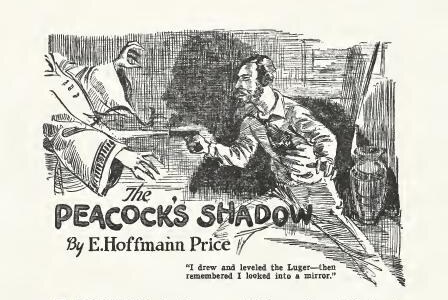
Lord God! A poniard gleamed in his upraised hand. I drew and leveled the Luger... remembered I looked into a mirror... dropped my eyes, sick with horror....
A blinding, awful incandescence flared about me, illuminating that vault with the blue-white flame of noonday sun... a muffled, choked report... the mirror before me
was elouded. A dense mist fogged the air. Hooded figures rushed to and fro, confused, colliding with each other, clawing and rubbing their eyes, blinded by that devastating flame.
And among them strode one not hooded, who moved with sure, swift certitude. Pierre d’Artois, wielding a blackjack! Each swing brought down a hooded figure; down they went before those cool, deliberately
placed strokes... one stroke, one man... the cruel precision of machinery... the last man had taken the count. Pierre stepped to the wall, reached behind the arras; withdrew his hand, snatched from the wall an antique battle-ax, and dashed down the passage toward me.
“Don’t touch that grill!” I shouted.
‘ ‘ The juice, he is turned off. ’ ’
And to prove it, Pierre assaulted that grillwork with his massive ax, smiting fiercely, bending and deforming the sturdy bars. I crawled through, followed him back to the Adytum of Darkness.
‘ ‘ Take the girl, ’ ’ he commanded, as, true to his nature, and never forgetting his mission, he seized the mummy case, the one designed for a woman, and led the way to the exit.
As I leaped to the altar railing, lifted the still unconscious girl from the black hands, and wrapped her in my cape, I noted that the other mummy case was empty, and that its cover had been kicked aside.
One or two devil-worshipers stirred and twitched. Others groaned. Striding over that miniature battlefield, I followed in Pierre’s trace.. And we made good time, Pierre and I, for the devil, though down for the count of ten, still lurked in that awful vault.
XTo one accosted us as Pierre led the way across the park to his car. What a pair we were: a vermilion-robed figure embracing a mummy case, and I, likewise robed, bearing in my arms a girl whose hair streamed to the ground, whose limbs gleamed brightly in the moonlight.
Well, the madman’s jubilee ended in Pierre’s apartment.
Lili, quite calm and magnificient in Pierre’s silken lounge robe, sipped a bit of cognac and took the entire affair as a matter of course, though she did have certain regrets.
“Those lovely shoes! Monsieur Landon, perhaps you would return for them?” she mocked.
And then, to Pierre, “Do tell me what it all was about.”
“Chere petite, it is a very long story. The stolen mummy would not interest you, directly; but my search for Madame the Princess and—what you call in English, her wooden negligee, n’est-ce-pas?—her sycamore case is what made me cross your trail. Voyez!”
Pierre showed us a photograph.
‘ ‘ This, Mademoiselle, does it not resemble you?”
“Quelle betise!” flared Lili. “What a notion!”
And then she admitted the resemblance, acknowledged, that that face of gilded sycamore, carved 3700 years ago, might pass as an Egyptianesque version of her own loveliness.
“So? It does resemble, yes? And the painting in the chateau, that of the mistress he adored twenty years ago, that cou],d be your portrait of today, were not the lady’s costume a shade out of date. Behold the succession of resemblances, partly real, partly fancied. That I noted, immediately. And moreover, I saw, as did you, mon ami, that book bound in human hide; but unlike you, I read therefrom, many strange things. Then those drums whose heads were of human hide, and the arms, and all the other trophies of death, death... death which has haunted Monsieur the Marquis, turned his brilliant mind, and made him do this madness which we witnessed.
“And the duel at St. Leon, two years ago. I knew that Don Santiago was the good friend of Monsieur the Marquis; and I knew also that there had been something very odd about that midnight meeting. Thus when I saw you, Mademoiselle, all so lovely in the sunset, I added the two ( “And this Santiago,” continued the old man, “wore on the pommel of his sword a peacock; as also did Monsieur the Marquis on that sword at his chateau. None of which really proved anything; however, I began to think. Thus it was but a matter of having you watched, Mademoiselle, until things happened.
“And while you watched, mon vieux, I prowled around, and found the plans of Vauban’s fortifications and engineering works, and saw that he had not built the passage leading to St. Leon. And as for last night, I attended the preliminary rites, having, as you so nicely put it, beaned one of the worshipers and assumed his costume.”
“What the devil! You joined in their ceremonies?”
“Yes. It was I who spoke to you; but you did not take the tumble, so you missed some rare sport. I had but to put myself into the case which had contained the embalmed body of my ancient enemy, Santiago. And thus they carried me into position at the altar. Then, at the crucial moment, I kicked off the cover, and fired a press photographer’s flashlight gun. Dazzled by that fearful light, they could see nothing. As for me, I closed my eyes as I fired, and then, after the flash..
He affectionately caressed the blackjack.
“And with this wonderful little implement, I worked them over, as you might say it, while they still blinked and rubbed their eyes, utterly blinded by that sudden flare.”
“He really was going to kill me?” queried the queen of Lachepaillet, ( (Continued from, page 718) who had scarcely grasped the entire sequence of events, and their significance.
* ‘ Exactly that, chere petite. In his way, he loved you, for yourself, and for the sake of his departed sweetheart; and therefore he was to sacrifice you, and embalm you, and set you up in state, in the mummy case of a princess, thus performing the supreme penance, making his peace with the Lord Peacock, and with Santiago alike. An artistic soul, Monsieur the Marquis! He is leaving for Spain.
. unless unhappily I struck him too hard! But he will not annoy you again.”
‘ ‘ These uncanny resemblances, Monsieur d’Artois... it is all so fantastic,” suggested Lili. “I resemble his former mistress, and I resemble a mummy. Am I then a mere - shadow?”
“That is really not so incredible. For you, Mademoiselle, are the niece of her whom Monsieur the Marquis loved twenty years ago; so that that resemblance is not at all a subject of wonder, even if extraordinary. This, however, he did not know, nor I either, until I investigated! nor did you know. As for the mummy, well, coincidence... and a stretch of
fancy.”
“But your duel. Pierre, at St. Leon?”
“Who knows? Illusion... a
stranger from Kurdistan... I attempt no explanation. Santiago is dead, even as may be the marquis and some of his followers; but the Stranger still lives, and the Peacock’s shadow still hangs over us.