WF P946 .S25 1927
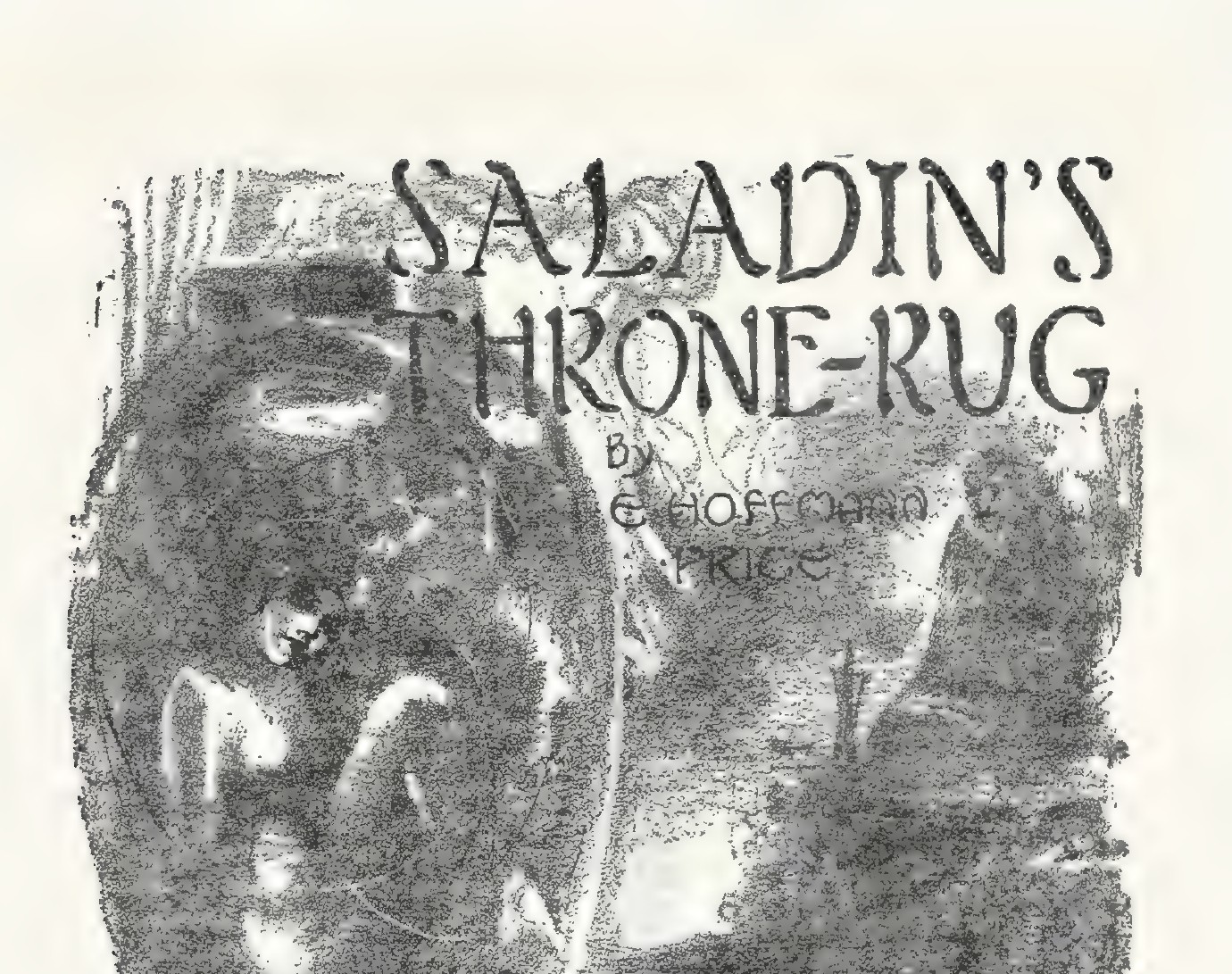
Saladin’s Throne-Rug
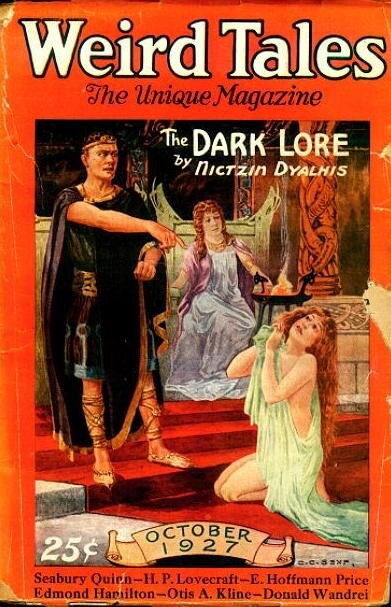
First published in Weird Tales, October 1927 (vol. 10, no. 4). Novelette.
United States public domain. Held in the Reading Room of The Weird Library. Published by Weird Tales.
This text is printed as first published. It uses racial language from the period, including slurs.
I would cheerfully have committed murder for that rug; but as it is...”
Morgan Revell smiled at the memory of his exceeding cleverness, and regarded the throne-rug of Saladin with that fanatic affection comprehensible only to a collector...
The savage jest of it is that he did commit murder. Only he doesn’t know it. Nor, for that matter, do I absolutely know. But, piecing it all together, and taking into account the emotions that take possession of a rug collector, I can draw but one inevitable conclusion. And that is -
But to approach the matter at all, some explaining is necessary. First of all, you who regard a rug as somew. t. — 2
thing to hide the nakedness of a floor must revise your conception of things. It is all very true that the machine-made atrocities of this country, as well as the preeious weaves of the Orient, are indeed used as floor coverings; something on which to walk, something to give the vacuum cleaner its excuse for existing. But that is only a part of it: Oriental rugs are works of art, the peer hf any of the numerous products of man’s instinct to create unbelievable and imperishable beauty. And just as there are those who collect the works of ancient silversmiths, armorers, cabinetmakers, and bookbinders, so likewise are there those whose consuming passion and sole aim in life is
the accumulating of antique specimens of Oriental weaving: rugs from Bokhara and silken Samarcand, from Shiraz, and Herat of the Hundred Gardens; prayer rugs, palace carpets, or the priceless fabric that graced the floor of a nomad’s tent in Turkestan.
Rugs are many, and their enumeration lengthy; and the study of their personality and traits is the pursuit of a lifetime. Some are prized for their beauty and matchless craftsmanship; others for their exceeding rarity; and some for the sake of all those qualities.
Once one has succumbed to the sorcery of a Bijar that covered the dirt floor of a Kurdish hovel, or a silken Kashan that hung, suspended by silver rings, on the walls of a king’s palace, one is beyond redemption, or the desire of redemption. It is even as though one had become addicted to the smoke of the poppy, or to the grain of hasheesh dissolved in wine. One’s house becomes a place designed for the sheltering and storing of rare rugs; though, of course, the collector himself has no moral scruples about utilizing a bit of that same shelter for himself.
One may wear last year’s overcoat, and have last year’s shoes half-soled; but one can always raise the price, however exorbitant, of a threadbare Ladik, a battle-scarred Ghiordes, or a moth-eaten Feraghan.
Thus, though Morgan Revell was exaggerating when he smiled in a way reminiscent of a cat who has just had a pleasant tete-a-tete with a canary, and remarked, “I’d cheerfully have committed murder for that rug,” he was well within the limits of poetic license. Not that he would actually consider going as far as rope, pistol, or poison; in fact, I think he would stop short of breaking and entering. But the fact remains that trifles can not stand in one’s way when a really rare rug is in sight. And very often a jest is the essence of truth.
Well, and that is that: either you still maintain that a rug is but something to put on the floor, or else you have grasped some conception of the fanaticism that consumes the confirmed collector of antique rugs. If the former, well and good: de gustibus non disputandum est. But if the latter, if you have grasped the idea, then perhaps you will understand why I crave a bit of fresh air and a change of scene whenever I catch a whiff of attar of roses, or a glimpse of a fine, hard-spun silken cord.
I was making one of my customary reconnaissances, prowling tours in search of the perfect rug, the wondrous prize; though what I’d have done with it is a bit beyond me, unless I ’d have tacked it to the ceiling. All other space is occupied. Furthermore, I am at times heretical enough to fancy that it is better to know that the rent, due on the morrow, will be in cash available for payment to the landlord instead of being draped over a lounge, or parked on the last bit of vacant wall or floor space.
A chubby, oily little fellow from somewhere in Asia Minor, with features that combined Mephisto with Kewpie, approached and offered his services, assuring me that some rare bargains would be auctioned off that afternoon. I assured him that I was merely prowling about.
“A fine Kirman. Worth seven hundred dollars,” he began, just from force of habit. “Perhaps you will bid on it? Get it for two-three hundred.”
I didn’t bother to tell him that I’d not use it for a bath mat; that it was a sickly-looking mess, with its flabby texture, its aniline dyes, bleached to unnatural softness, and its fearful, glassy luster gained from glycerin and hot rollers, and that it would hardly be a fit companion for a Kirman rose-rug of the old school. So he left me to my own devices, to tear
down several piles, shoulder-high, of rugs of varying quality; mainly atrocities recently woven to satisfy the ever-increasing demand for Oriental rugs: wretched rags which the auctioneer would later exhibit, glassily agleam under a powerful floodlight and describe as “Royal” Bijar, “Royal” Sarouk, or “Royal” Kashan, or “Royal” whatever travesty it was on some ancient, honorable weave.
Weariness and more weariness. I worked my way through the second pile, and with like result. An old Feraghan tempted me, but I decided that though honest and ancient, it would cost too much to have the worn spots rewoven. Nor did the third pile bring forth anything of interest. Then, poking about in a dark comer, I found behind a baled, room-sized carpet, a scrap of something which even in that dim light had the look of antiquity, the stamp of personality possessed only by one of the old guard. And it had the feel of ancient weaving.
I dragged it out. Through all its coating of dust and dirt, the unbelievable richness of the dyes, the “bald-headedness” of the back and subdued luster of the face were apparent. Then — horrible sight! — I saw that I had but a portion of a rug, between half and two-thirds of one, the remnant of something which if complete would be priceless. Judging from the fragment, the complete piece would be about five feet wide and twelve feet long, or thereabout. Some barbarian had sliced it in two, crosswise, with a clean, sweeping cut that left in this fragment about half of the medallion which had been the central design of the complete piece.
What fool would commit such a wanton infamy, such an uncalled-for blasphemy? And then I recalled that classic incident of early Moslem history, wherein one of the prophet’s fanatic generals, in apportioning the
loot of a Persian palace, had dismembered a gold-threaded carpet, giving each of his captains a portion, saying that it would have been unfair to let any one individual retain the entire rug; and offering the equally good reason that such a pagan vanity deserved mutilation!
Under stronger light, I saw that my instinct for a rarity had indeed been true. The weave was incredibly fine, at least six or seven hundred knots to the square inch; the pile, worn to the warp, was of silk; and the ground inside the main border, and surrounding the central medallion, was of silver bullion thread, woven tapestrywise about the warp threads instead of being tied and clipped so as to make a nap, as is the practise when weaving with silk or wool.. Here, certes, was the adornment of a palace, the gift of one prince to another!
Fortunately for my chances of buying the fragment, the silver bullion ground was so tarnished and caked with dirt that its true nature would scarcely be noticed: for if some collector with a bottomless wallet would see, recognize, and bid against my poverty, I’d surely lose out. But the chances were that even a keen observer, unless he had examined the relic closely, would pass it up as a mere scrap unworthy of consideration.
But then I had to take the auctioneer into account. If in handling that fragment, displaying it to the assembled bidders, he ever noticed that its ground was of silver thread, I ’d be strictly out of luck. However, there was little chance he’d notice the pile was of silk; for it was worn to the warp; and since all ancient rugs, either of silk or wool, have a greasy, slick surface, his sense of touch might not enlighten him.
I had to buy that ancient fragment; and I had to get it without the auctioneer’s realizing what was going on.
Just what device would minimize his chances of noticing the true nature of what was passing through his hands? And then came the solution.
“Boy, come here a minute!’’
One of the uniformed porters approached, I gave him his instructions, also a couple of dollar bills, and the promise of as much more if the ruse worked; also the promise that I’d hunt him up and down the earth with a sawed-off shotgun if he failed me.
It was now 1:30, and the auction was to begin at 2. Prospective bidders were already taking seats before the auctioneer’s rostrum. The average bargain hunter has such sublime confidence in his or her ability to pick a rug or other precious article at first glance that few bother to examine the treasures before bidding; and thus no one intruded on my final study of the fragment I had unearthed.
I contrived to decipher the inscription in the remaining half of the central medallion I’d stumbled across. And although I’m no scholar, I can in a pinch hammer out a few words of Arabic, and get enough to supply at least the context of an inscription.
This much I could gather; the upper half of the inscription, in the missing upper half of the medallion, doubtless contained the preliminary honorifics, and perhaps even the name of the prince to whom the rug had been presented. Presented where? At Trebizond, Damascus, Ispahan, Baghdad...? What king? Shah Abbas? Nadir Shah? Who had received the servile protestations of this princeling, Abimilki?
The opening of the daily auction broke into my reflections. I caught the eye of the porter I had bribed, and then found a seat.
“Royal” Bijars and “Royal” Sarouks were extolled and lauded with all the dramatic art and perjury at the command of auctioneers hailing from the Near East. And under the floodlights, those pseudo-royal rugs did have a magnificent appearance.
“How much am I offered for this Royal Sarouk? This magnificent, lustrous carpet! It is worth a thousand dollars! Am I offered seven hundred? Seven hundred? They are getting scarcer every day! A genuine, Royal Sarouk! Do I hear five hundred? Is there no one here who really knows rugs? This is not a floor covering, this is — four hundred? Thank you. I am offered four hundred dollars. That shouldn’t even buy the fringe! Will someone give me five hundred? Did I hear four fifty? Seventy-five... Eighty?
Thank you. Who offers five hundred?...”
And thus through the heap of rugs. Then came some Bokhara saddle-bags, one at a time; then more “Royal” Bijars, and Kashans, and Kirmans.
Valiantly the plump Mephisto, pleading, groaning, holding out for just one more dollar, perjured his way through the stacks beside the rostrum. And all the while the porter paraded up and down the aisle, giving the bidders a glimpse of the articles in question.
Finally, after an hour’s exhorting, after the perspiration was trickling down his cheeks and glistening on his brow, after fatigue had left its marks on the chubby auctioneer, the porter handed him the fragment I had discovered.
Under that powerful light, its suave magnificence glowed forth through the coating of dust and dirt. Devil take that light! But thanks to the nap’s being worn so close, the now weary auctioneer, somewhat dulled by fatigue, did not sense that he held the remains of a silken rug in his hands; nor did the silver bullion ground below the meSALADIN’S THRONE-RUG
dallion betray itself. The porter had handed him the end nearest the original center, where the medallion reached from border to border, and where consequently there was no silver ground to meet his fingertips. Then, scarcely had the orator opened his harangue, the porter snatched the precious fabric and was dashing down the aisle, holding it as well knotted up as he could contrive without seeming to do so.
Noble African! Nevertheless, it was a ticklish moment.
“How much am I offered for this antique rug?” he had begun, flashing it beneath the flaring floodlight, before yielding it to the eager porter. “Yes, sir, I know it is half of a rug, but it is old and very rare. It is an antique Tabriz... ”
Which proved that he’d never seen it before I’d exhumed it from that dark, dusty corner! That he’d not noticed the silver ground! Tabriz... pure and simple improvisation on his part.
‘ ‘ Sixty dollars? Thank you. I am offered sixty. It is worth several hundred. A rare old Tabriz. Seventy? Thank you, madam!”
Damn that school-teacher! What made her think it was worth seventy? Though she might be a decoy to raise the bids.
So I came up five.
“Will anyone offer a hundred? Ninety? Give me ninety for this rare old — I am offered ninety! Will someone make it a hundred?”
I rather fancied that my ninety-five would land it.
“Ninety-five... once... ninetyfive... twice..
The porter was already thrusting another piece into the auctioneer’s weary fingers.
But before the hammer could drop -
“El hatndu li-lldh!” gasped someone at my right. ‘ ' One hundred! ’ ’
A lean foreigner with a nose like
the beak of a bird of prey took the seat next to me; a Turk, perhaps, or a Kurd whom civilization had not robbed of his alert, predatory air and desert gauntness.
“And ten!” I snapped back.
“One-fifty,” enunciated the newcomer.
Hell ’s hinges! Who was that fool? And who ever heard of an Oriental, unless he were a dealer, caring a happy hoot about the threadbare, worn fragment of an antique ring.
“And seventy-five!”
That ought to stop him. But it didn’t. Not for a moment.
“Two hundred,” he pronounced.
And when I raised him twenty-five, he did as much for me, and without batting an eyelash. I prayed that some angel would slip me the handle of a meat-ax, and then offered fifty more.
The auctioneer beamed and gloated and rubbed his hands, and praised heaven for connoisseurs who appreciated antiques. The porter, from force of habit, once more began to deploy the precious piece to egg on the bidders, but, catching my eye, he desisted; though it could have done no harm, for that relentless heathen at my right was out for that rug. That “El-hamdu li-lldh!” was the incredulous gasp of one who has stumbled around a corner and met fate face to face; it would be my roll against his.
“Three-fifty!” he announced, scarcely giving the overjoyed auctioneer a chance to acknowledge my last bid.
“Five hundred!” was my last despairing effort.
And five-fifty came like the crack of doom.
The stranger rose from his seat, peeled a wad of bills from a roll that would have choked a rhinoceros, and claimed his prize. Have it delivered? Absolutely not! And when I saw the look in his eye, and the gesture with which he
draped that scrap over his arm, I kaew that all the wealth of the Indies could not separate him from one thread of that ancient relic.
I climbed to my feet and strode down the aisle, talking to myself in non-apostolic tongues. But as I reached the paving, my meditations were interrupted.
“Allow me to thank you, effendi.” It was the foreigner, still caressing the nap of the precious fragment he had draped over his arm.
“I owe you a great deal for having discovered this piece. Though I was almost too late.”
I couldn’t resist that courtly manner, that cordial good-fellowship. The bird of prey had laid aside his predatory maimer and seemed really overjoyed about something; happiness, exaltation were mingled with his triumph.
‘‘Don’t thank me; thank my slim bank roll,” I laughed, and swallowed the remnants of my disappointment.
“I have been hunting that piece for years,” continued the stranger. ‘ ‘ In Stamboul, Sultanabad, Tabriz... New York... London... wherever rugs are sold. And now I, or rather you, have found it. I regret your disappointment. But I had to have that rug,” he concluded, speaking his last phrase in the tone of a bigoted Moslem announcing his belief in the unity of Allah.
“So I noted,” was my reply; though it wasn’t as ill-natured as it may sound.
“If you can spare the time, I shall tell you the story. And show you the other half of the rug. You knew of course that there was another half.” This was becoming interesting.
' ‘ I suspected as much; though who, and where - ”
“I am Ilderim Shirkuh bin Ayyub,” announced the stranger, and bowed in response to my acknowledgment of the introduction.
Ilderim Shirkuh bin Ayyub. Very impressive. But what of it? Though there was something familiar about that resonant handle.
He led the way to a car parked at the curbing.
During our drive north, bin Ayyub maintained a reflective silence that gave me a bit of time for my own thoughts. And as the long, aristocratic car purred its way toward the Gold Coast, I began to sense that I had indeed fallen into something. True, I had lost the prize I had sought to capture; but had I made the grade, I’d probably have remained in ignorance of its entire significance.
A few blocks past the Edgewater Beach Hotel we drew up before an ancient, bulky mansion set back of an acre of lawn; a great house, its dignity still overshadowing its approaching decrepitude; an outlaw, a rebel that still withstood the encroachment of apartments and apartment hotels.
A negro, arrayed in a striped kuftdn and wearing a massive, spirally twisted turban, ushered us into a dimly lit salon which, though almost bare of furniture, was magnificently carpeted and tapestried with ancient, lustrous Persian rugs. Clusters of arms and armor placed at intervals along the walls gleamed icily in the dull light of several great, brazen floor-lamps. It seemed almost sacrilege to tread on that magnificent palace carpet whose exquisite loveliness, framed by a border of hardwood floor, reminded me of a diamond set off by its background of onyx.
Bin Ayyub finally broke the silence he had maintained; for as we entered, he had with a gesture invited me to be seated, he himself remaining on his feet, preoccupied, regarding the precious fragment he had captured, looking at it as though all the splendor about him was cheap and tawdry
in comparison to that threadbare, eroded scrap he held in his hands.
“Unintentionally — and involuntarily also — you have done me a great service, ’ ’ he at last began, as he seated himself. “As I told you, I am Ilderim Shirkuh bin Ayyub.”
Again he paused, as if to let that impressive title sink home. And as I saw him against that background of lustrous rugs and damascened simitars and armor, I wondered whether I had been wrong in having omitted a salaam.
Bin Ayyub turned to the negro and — I can in no other way describe his manner — published an order. Then, to me, “You have heard of Salah ad Din Yusuf bin Ayyub? In your language, Saladin?”
“Certainly. Who has not?”
“I am descended in direct line from Saladin; that fragment is part of the throne-rug of my ancestor, the nephew of Shirkuh of Tekrit, and sultan of Syria and Egypt. Now do you begin to see why I value that scrap? ’ ’
“Do you mean to say that that rug covered the throne of Saladin? ’ ’
‘ ‘ Exactly. And I shall prove it. ’ ’
Even as bin Ayyub spoke, the African returned, carrying a small chest of dark wood, elaborately carved, and bound in bands of discolored metal, bluish black, like age-old silver.
“Look how the pieces match!” exulted bin Ayyub, as he took from the chest that which I saw at a glance was the other part of the relic I had discovered. The pieces did indeed match perfectly; though the last-acquired fragment was somewhat the more worn and eroded by the rough use of those who had possessed it, ignorant of its worth.
“Read, effendi! Surely you can read, else you would never have bid this afternoon.”
But I insisted that bin Ayyub read and translate into English. I felt rather foolish about strutting my
halting Arabic before this polished Oriental whose very English was better than my own.
And here it was, threadbare and eroded by the passing of eight centuries, the throne-rug of Saladin, that great prince who elevated himself from the castle of Tekrit, in Kurdistan, to the throne of Syria and Egypt, and reigned as Defender of the Faith and Sword of Islam...
Had the auctioneer’s hammer fallen just an instant earlier -
“Allahu akbar!” ejaculated bin Ayyub, sensing my thoughts. “To think of how close a race it was! A second later, and I might now be bargaining with you for your prize, offering you all my possessions for that one fragment of carpet. And you would have refused.... I would go barefooted through the tall flames of Oehetmem for what I took from you an hour ago.” Then, to the negro: “Saoud! Prepare some coffee!
“I wonder,” he resumed, “if you have any truly rare rugs in your collection? Like that Ispahan, for example? ’ ’
Bin Ayyub plucked from the wall what even in that dim light I recognized as an ancient Ispahan: that deep wine-red and solemn green, that classically perfect rendition of the Shah Abbas border and field were unmistakable. It was indeed an old Ispahan, that final, supreme prize of the collector; that rarest and most costly of all rugs..
I admitted that I had not attained, and probably never should attain, to such a fabulously scaree piece of weaving.
“You are wrong, quite wrong. For since I need that wall space for Saladin’s throne- rug, I shall give you that Ispahan with my thanks and apologies - ”
* ‘ Apologies? ’ ’
“Yes. For what I am giving you is a worthless rag compared with what I took from you this afternoon.”
Such generosity is dizzying. That small, perfect Ispahan would be worth several thousand dollars even had it been ragged as a last year’s bird’s nest. I was stumped, stopped dead.
Saoud, entering with coffee, interrupted my thanks. After having served the steaming, night-black, deathly bitter beverage, the negro took his post at the farther end of the salon, in front of a pair of heavy curtains that I fancied must conceal an alcove.
“In El-Kahireh it is the custom to perfume one’s coffee with a tiny bit of ambergris,” remarked bin Ayyub. “But I have devised a more subtle combination. ’ ’
In response to the master’s nod, Saoud parted the silver-embroidered curtains and caught them on the hilts of the simitars that hung at each side of the alcove. A great jar, fully as tall as the negro, and gracefully curved as a Grecian amphora, glowed in the level, sunset rays like a monstrous, rosy-amber bead.
He lifted the cover of the jar: and from it rolled a wave of overwhelming sweetness, an unearthly fragrance so curiously blended that I could not pick the dominant odor. Jasmine, or the rose of Naishapflr, or all the mingled spices of Cebu and Saigon... with undertones of sandalwood and patchouli... A dizzying madness, a surge of intoxicating warmth and richness poured resistlessly from the glowing, pulsating, almost transparent depths of that great urn.
I wondered how Saoud could endure it at such close range. And then, drinking fully of the potent wave that swept past me, I lost all physical sensation save that of floating in a sea of torrid, confusing sweetness. And then the African replaced the cover of the jar. I fancied that he reeled ever so slightly as he withdrew from that throbbing luminous fountain of unbelievable fragrance, and wondered that he did not collapse.
Bin Ayyub had apparently forgotten my presence. He sipped his coffee, and with half-closed eyes stared into the depths of the urn. The unfathomable, perfect peace which Moslems wish each other with their “ Es-Salaam Aleika” has descended upon him: keyf, the placid enjoyment of wakefulness that is half sleep.
The silence, the utter repose was contagious. I found myself gazing, eyes half out of focus, at the thronerug...
And then I sensed that eyes were staring at me from some place of concealment. I turned and caught a glimpse of a dainty armful, shapely and elegantly contoured: a girl with smoldering, saracenic eyes, pools of dusky enchantment. Just for an instant I held her level, unabashed gaze which lingered long enough to let me fully sense her imperious calm and composure. It was just a glimpse, barely enough to let me recognize the transparent, olive complexion and faintly aquiline features of a Transcaucasian, a Gurjestani, the most flawlessly lovely of all Oriental women. And then the portieres closed on the vision.
What a mad afternoon! The throne-rug of Saladin... and then the descendant of that great prince... and that girl, with her smoldering, kohl-darkened eyes... the familiar spirit of the urn whose
Byzantine curves imprisoned that glowing, rosy-amber sea of sweetness... wild thought!... but she was small and dainty enough to have emerged from that great jar, and then vanished back into its shimmering, pulsating depths....
“The contents of that jar,” began bin Ayyub, emerging from the silence, “would make a rich perfume of all the seas of the world. It would be folly to try to imagine the countless myriads of blossoms and herbs, spices and gums that are imprisoned in that essence. A drop, a thousandfold diluted, and a drop of that dilution, equally diluted, would be more potent than the strongest scents known to your Feringhi perfumers.”
“It seems you took a fearful risk in shipping such a fragile and precious article in this country,” I suggested.
‘ ‘ It was risky. Still, I would rather have had it shattered en route than fall into the hands of the spoilers who looted my house in Stamboul. But as luck would have it, there was a babbler among my enemies, so that I had warning. I packed my treasures, and smuggled them out, one at a time. And the night before the bowstring was to grace my throat, my family and I left in disguise.”
Bin Ayyub paused to reflect a moment, wondering, perhaps, whether to carry on or change the subject.
And then the darkness of his deepset eyes flared fiercely.
“Do you see that cord?” He indicated a fine strand of hard-braided silk which hung from the peg that supported the simitar at the right of the alcove containing the Byzantine urn. “My enemy was so careless as to walk by moonlight the evening before a doom was to settle on my house. And as a souvenir of the promenade, I brought with me that fine, stout cord which, for all he cared, I might have left there to chafe
his throat, ’ ’ concluded bin Ayyub, as he stroked his black mustache.
And then he showed me how the bowstring is employed; that flickering, swift gesture of his long, lean hands was gruesomely convincing. Bin Ayyub was indeed a versatile man.
“Swift and probably painless?” I volunteered.
“Yes. But if I had my choice of deaths, ’ ’ mused bin Ayyub, ‘ ‘ I would elect to be drowned in a pool of that perfume, with my breath so rich with its fragrance that my senses would entirely forsake me....”
A tinkle of bracelets interrupted his musings. The portieres parted, and the lady from Gurjestan reappeared. In that strange atmosphere, it never occurred to me to commit the faux pas of rising as she entered. This was doubtless bin Ayyub ’s “family”; and, though the United States were on the street, they had not quite penetrated to this dim salon, so that I felt it would be tactful not to seem to take any notice of the girl. Upon more intimate acquaintance with bin Ayyub, I might be presented to her; but not at present.
Bin Ayyub replied to her purring, rippling syllables, speaking some language unknown to me; and then the tapestried portieres closed and hid her from sight.
“You will surely pardon me, effendi. Though Djenanc Hanoum speaks English, she prefers her native language,” he remarked, then clapped his hands to summon Saoud.
Fresh coffee was served. And then, as my cigarette smoldered to its finish, bin 'Ayyub rose, rolled up the precious Ispahan and again offered it to me.
“And in ten days or two weeks the throne-rug of Saladin will be spliced by skilled weavers. I would be very glad to have you return and see it after it is restored.”
The clicking of the latch behind me reminded me that I was again in the city of Chicago; and the Ispahan did not let me forget that I had actually been awake the past few hours.
Whenever there has been a killing, the vultures assemble. I had marveled that Morgan Revell had not stumbled across the thronerug of Saladin before I did. Thus it was that I was not surprized to have him call at my apartment that very evening..
“Well... most extraordinary, that. Where did you get it?” he demanded, as he paused in the doorway, stripping off his gloves in preparation for the inspection of the Ispahan that bin Ayyub had so generously given me. “Shades of Shah Abbas! Strike me blind, but it seems genuine. And perfect.”
He then parked his bulk in my favorite chair, and poured himself a drink, and proceeded to extract the story. And naturally I was not at all averse to enlightening him; for this would about even up for his eternal boasting of the mosque carpet of Eski Shehr: a remarkable tale, but one which eventually wears on one’s nerves.
“On the level now, did anyone actually make you a present of this Ispahan?” he inquired as I concluded my account of the day’s doings.
“Idiot,” said I, “do you think I could have bought it?”
“Well, no. But still - ” His
features parted in a reminiscent grin. “Perhaps you remember the mosque carpet of Eski Shehr?”
“Lay off that mosque carpet! No, I got this honestly and without any of your clever devices.”
“Score one for you! But really now, old egg, don’t you know, this is a most unusual tale you’re telling. Quite preposterous, quite! First of
all, this bin Ayyub person is a rara avis, and all that, if at all. Who ever heard of one of those beggars who had any appreciation of an antique rug?”
“What about -?”
“Rot! Whoever you were going to cite is probably a dealer. It’s simply preposterous, this bin Ayyub who collects ancient rugs. And that descendant of Saladin; why really, old fruit, that doesn’t hold water at all.”
I insisted that there were Orientals who did appreciate the beauty of the wondrous rugs which they wove.
“Quite so, quite so. But just consider,” countered Revell, “that this Ispahan which you treasure as an antique was painfully new in the days when good old Shah Abbas was so partial to fine weaving and inventing new designs. That jolly prince had nothing but antiques on his hands, and he craved new ones; also new patterns. So much so that he sent artists to Italy to study design. ’ ’
“But, damn it, I tell you - ”
“Ah yes, surely. Nevertheless, I insist that the appreciation of antiques is an Occidental taste, and one which is jolly well artificial. Remember that little Armenian in Ashjian’s showrooms and how much he felt that we were upset above the ears for preferring a threadbare Kabistan to a new Sarouk?”
I remembered.
“Well, now go to Ashjian’s and let that same lad catch you admiring a Kirman rose-rug. Hear him sigh with much ecstasy; see him caper about; get the gallons of praise he pours on the heads of those fine old eggs who really knew how to weave a rug. He knows his litany now; but he wasn’t born that way.”
Revell scored.
“But bin Ayyub is a cultured gentleman. I’ll take you out to his house, and then you’ll be convinced about it all, including his being a descendant of Saladin.”
SALADIN ’S THRONE-RUG
“Very well, have it your own way.
You know, it really may be quite possible. Only, it’s just a bit unusual, if you know what I mean,” Revell finally conceded as I completed my repetition of the story, and added bits of color I had omitted the first time. ‘‘Not that I doubted your word. But in all honesty, old onion, can you blame me for being a shade skeptical? When even the Shah’s palace in Teheran is cluttered with gilt bric-a-brac, and modern Sultanieh rugs, and all that sort of atrocious thing. Beastly taste these beggars show. But this bin Ayyub fellow may be an exception. Though I contend that whatever the art the Orient provides is the result of instinct and not intent.”
I granted most of his contentions. And then we discussed the great jar of attar, and the surpassing loveliness of bin Ayyub ’s ‘‘family.”
‘‘Most fascinating, really. This sounds like what people think the Orient ought to be, but never actually is. Hour is, and incense, and all that sort of thing. ’ ’
Then, just as he left: ‘‘By the way, did you ever read the quaint little tale of Aladdin’s lamp?”
‘‘Sure. What of it?”
‘‘Nothing, really nothing at all. Merely curious, you know.”
Now what had that buzzard meant by that remark? A subtle way of calling me an out-and-out romancer? Or did he mean that in getting my Ispahan I had stumbled into something, Aladdinlike?
And then I carefully examined the Ispahan. No, Revell had not palmed it and left a replica in its place. Strangely enough, he had not even tried to trade or bargain for it.
Tt was fully two weeks before I A could find time to call on bin Ayyub to inspect the restoration of the throne-rug. But finally I did contrive to find some spare time, and just
to convince Revell that I had not been releasing an Arabian fantasy, I decided to take him along.
‘ ‘ Cheers, old bean! ’ ’ greeted Revell. ‘ ‘ I was just thinking.... But how do you like it?”
It, the throne-rug of Saladin, stared me in the face: rich, lustrous, magnificent, now that it had been cleaned, and the pieces spliced together.
‘‘Where in -?”
Revell laughed at my amazement.
‘‘Most amazing, what? But don’t rub your eyes. It is exactly what it looks like: the rug of the justly popular Saladin. I was just thinking of asking you to translate the inscription. Couldn’t remember the exact wording you gave me several nights ago.”
‘‘Devil take inscriptions! How did you get it? Unless he suddenly needed the money. ’ ’
‘‘You could have done the same thing,” Revell began, as he poured himself a drink, then painstakingly selected a cigar. ‘‘Especially after I told you in so many words how to go about it.”
‘‘How come, told me how to go about it?”
This was too much for me. He VI been up to dirty work of some kind.
It was unbelievable that he had purchased that rug; and I doubted that he was clever enough to have outwitted bin Ayyub. Then what? Breaking and entering? Well, not very likely.
“The last thing I said the other night was something about Aladdin’s lamp. I fancy you recollect. But I was jolly well certain you’d not follow my train of thought. Well... the magician from El Moghreb paraded up and down in front of Aladdin’s palace, offering to exchange old lamps for new ones. And the princess — Mrs. Aladdin — was tickled pink to take an unfair advantage of an old man’s foolishness.
So she joyously swapped the greasy, tarnished old magic lamp for a nice, new one. Never occurred to Aladdin to tell the young person his wife that the rather crude old lamp was of some value. Simple, really.”
“Do you mean to say -?”
“Oh, yes, quite. Exactly, in fact. Mrs. bin Ayyub greatly fancied a lovely Anatolian silk rug about the same size as the revered Saladin’s throne-rug, which, by the way, she thought was a bit passe. Liked my silk rug; bright colors, and not at all worn, and all that sort of thing. So we swapped; and I fancy I noted a gleam of triumph or something like that in her most fascinating eyes. Charming creature, yes?”
And then I exploded.
“You ought to be shot! He’ll beat the tar out of her. He’ll flay her alive - ”
‘ ‘ Regrets, and all that, surely. But caveat emptor still holds good. She had no business messing around with the master’s trinkets. After all, a bit of deceit - ”
“And that girl will surely smell hell - ”
“Much regret, certainly. But really, would you have me pass up such an opportunity? I’d cheerfully have committed murder for that rug. As
Revell smiled at the memory of his exceeding cleverness, and gazed at the throne-rug of Saladin with that fanatic affection comprehensible only to a collector.
And that smile drove me mad. Thanks to my babbling, Revell had turned a very clever trick; and thanks also to me, that dainty girl’s shoulders... no, bin Ayyub wouldn’t beat her himself; he’d have black Saoud lay aside his duties of footman, pipe-bearer and coffee-grinder, and peel every inch of skin off her shoulders. The noble Turk is a man of few words and short temper when dealing with his family. All of which
went to my head, seeing that it was mainly my fault for having set Revell on the trail.
“Listen, you damned coyote!”
I gripped Revell by the shoulder by way of emphasis. He blinked in amazement.
“Listen and get me straight: you’re going to return that rug here and now. Bin Ayyub treated me like a gentleman. And moreover, it’s my fault if that girl gets the daylights hammered out of her; my fault, and yours. ’ ’
“Come now, try and act naturally, ” mocked Revell, who had mastered his amazement at my outburst. “I, return that rug? Absurd. Really preposterous. Why, as I said, I’d have committed - ”
And then Revell stared as I leaped to the arm of a davenport, reached up, and yanked Saladin’s throne-rug from its place on the wall.
“Wait a minute. This is getting a bit thick. I say - ”
By this time I was seeing red and also other colors.
“One more word out of you and I ’ll knock your head off! I’m taking this rug back to its owner. Get me?”
Revell is far from yellow. But somehow, I convinced him. The last glimpse I had of him, he was the color of an old saddle, and choking for breath.
“Really now, but this is a bit thick,” he contrived, as I slammed the door. I missed the rest, but I am sure that for the next fifteen minutes it was a bit thick in the Revell apartment.
Throne-rug trailing over my shoulder, I hopped a taxi and proceeded to bin Ayyub ’s house.
Bin ayyub himself admitted me. I recognized him simply because no mask could disguise those lean, aquiline features; but this which faced me was but a simulacrum of the vital personality I had -met two weeks
ago. His face was unshaven; his eyes were cavernous and dull, lifeless; gone was all save the shell of Saladin’s descendant. The change was so startling, so dismaying, that for the moment I forgot the thronerug I carried, rolled up under my arm.
In view of the denunciation and wrath I expected, accusations of having played a part in the trickery of Revell, this listlessness of bin Ayyub left me dazed and wondering.
“I am glad to see you, effendi,” he murmured, as he conducted me into the salon. He had not offered to take my hat and coat; had not noticed the bundle I carried.
‘ ‘ The throne rug, ’ ’ I began, offering him the precious roll. “I regret - ”
“Spare your regrets. It was my fault. I should have told Djenane Hanoum of its value.”
He took the rug with a listlessness that amazed me, and, moving as one suddenly aroused from sound sleep, spread it across a couch.
“I feared - ”
“That I suspected you?” interrupted bin Ayyub. “No. I knew you were not guilty. You know who is guilty; but since he must be one who has eaten your bread and salt, I can not ask you to betray him.”
Bin Ayyub seemed to forget that I was not bound by the Moslem’s belief in the sanctity of bread and salt. But now that I had returned the rug, why bother about the trickster, Revell?
“Nor have I time to hunt him,” continued bin Ayyub. “I have been waiting for you to return Saladin’s throne-rug. And now that that is done, I have little time for hunting him.”
“But now there’s no need of hunting him,” I suggested. “You have your rug.”
Which I fancied was a sensible answer. But the look that flitted across bin Ayyub ’s face and took form in his eyes told me that my remark had been the thrust of incandescent iron.
Bin Ayyub rose. I wondered if this was to terminate the interview. It seemed that he might at least have thanked me, despite my having been the cause of his annoyance.
“I have dismissed Saoud for the day. But I myself will prepare coffee. One moment, please.”
The aura of unbounded misery and corroding despair remained, lingering after the portieres had hidden bin Ayyub from sight. Not even the clanging of the brazen pestle wherewith he pulverized the freshly roasted coffee could infuse a trace of life into the somber magnificence of that rich salon. The order of nature had been upset: this was the house of one whose spirit had died a thousand deaths without having deprived the body of life. Not even the return of the throne-rug had aroused a sparkle of the vital, predatory spirit of that fierce Kurd whose eyes had but two weeks ago flamed exultantly as he told of the enemy who had unwisely walked by moonlight.
Bin Ayyub ’s entry with a tray interrupted my reflections.
One of the tiny eggshell cups was white, the other, deep blue.
“No, effendi, blue is the color of mourning; take the white one.”
A light began to dawn on me. The color of mourning... he had taken this tactful way of letting me know that my presence was an intrusion on his sorrow. But, if there had been a death in the family, why that flash of abysmal despair when a few moments ago I had suggested that jsinee he once more had the tlirone-rug, he need not bother to hunt whoever it was that had tricked Djenane Hanoum?
“Bismillnhi!” murmured bin Ayyub, then tasted his coffee. After a moment’s silence, he continued, “I bear you no ill will for what has happened Naturally you would speak to your friends of the Ispahan I gave
you, and of the throne-rug. It was my fault; I should have told her.”
Worse and worse! That rug again. Hadn’t I returned it? Wasn’t he sitting on it even as he spoke? Well then...
“It was my fault. I should have told her,” he repeated.
He drained his cup.
The brooding silence forbade even an attempt at making conversation. My nerves were rapidly getting on edge; and I hoped bin Ayyub would end the interview.
“I am leaving very soon, effendi,” he finally resumed. “Saoud will pack up my goods. I have been waiting for you to return the throne-rug; and I was right in waiting. For the sake of my illustrious ancestor, I treasure it. But much has happened in the last few days. I do not care to have it in my house any longer. My brother’s son in Tekrit will take it.”
I could think of no appropriate comment.
‘‘Here is the piece which was exchanged for the throne-rug. Take it with you when you leave, and return it to its owner.”
Which was also fair enough; though Revell deserved no such fortune after his shabby trick. The loss might be a lesson to him.
‘‘May I ask you to be so kind as to lift the cover of the jar of attar?” requested bin Ayyub, as he set aside his empty cup.
I could see that he was momentarily becoming paler. There was not a drop of blood beneath his bronzed skin. The corners of his mouth and the muscles of his cheeks twitched perceptibly; so that his request did not seem at all out of order. Though if I myself felt as he looked, the last thing in the world I’d want would be a whiff of that overpowering perfume.
“Certainly,” I replied.
Poor devil! He seemed to be having a chill, shivering noticeably. No
wonder he wanted me to take Saoud ’s place in the ritual of the perfume jar.
As I advanced across the wondrously carpeted floor, I heard him mutter to himself, “One is at times hasty...”
I parted the curtains that veiled the great urn of Byzantine glass, and lifted the heavy cover; then, dizzied by the overwhelming surge of sweetness, recoiled a pace.
And then I dropped the cover.
Christ in heaven! But why deny my own eyes? In the throbbing, glowing rosy-amber jar was the shapely form of Djenane Hanoum! Faintly distorted by the refraction of the curved surfaces of the urn and the attar, but nevertheless and beyond any mistake, that was the Gurjestani girl. I stared, fascinated.
Then looked behind the jar, hoping... ridiculous hope!... to find that she was standing on the other side, and that I had seen her through, and not in, the urn.
It is strange how in such a moment one notices trifles.
“La illah ilia allah... wa Muhammad rasul allahi...” came the murmuring accents of bin Ayyub, very low, but distinct.
Even in the grip of that horribly lovely sight, I had distinctly caught the Moslem’s “There is no God but Allah...” And then, scarcely perceptible, “Djenane...”
My movements must have been those of a mechanical toy.
As I caught the curtains on the hilts of the simitars hanging at each side of the alcove, I noted that the fine, hard-woven cord of silk was missing. And then I found myself wondering what poison the blue cup of mourning had contained.
Not until fully a minute later did it dawn on me why bin Ayyub ’s eyes had flamed with immeasurable despair when I had reminded him that since I had returned the throne-rug
of Saladin, he had no cause to concern himself about the thief.
That awful sweetness was rolling from the uncovered jar, strangling me with its richness. I wondered how a girl in the heart of an ocean of perfume could endure its fragrance... and whether the silken cord was chafing her throat.
Bin Ayyub’s drawn features were now overlaid with a shadow of a smile.
“If it were given me to elect the manner of my death, I would choose to be drowned in that perfume...’’
he had once said. So instead of covering the jar, I left Ilderim Shirkuh bin Ayyub enthroned on the rug of Saladin, and facing the loveliness which he had imprisoned in attar.
Revell was still frothing when I returned and tossed his Anatolian silk rug on the floor.
“I’d have committed murder for that throne-rug, ” he growled. “And now - ”
Some day I’m going to tie an anvil to Revell's ankles and then kick him into Lake Michigan.