WF Q56 .J49 1928
The Jewel of Seven Stones
First published in Weird Tales, April 1928 (vol. 11, no. 4). Novelette. Jules de Grandin. Text from the April 1928 Weird Tales appearance.
United States public domain. Held in the Reading Room of The Weird Library. Published by Weird Tales.
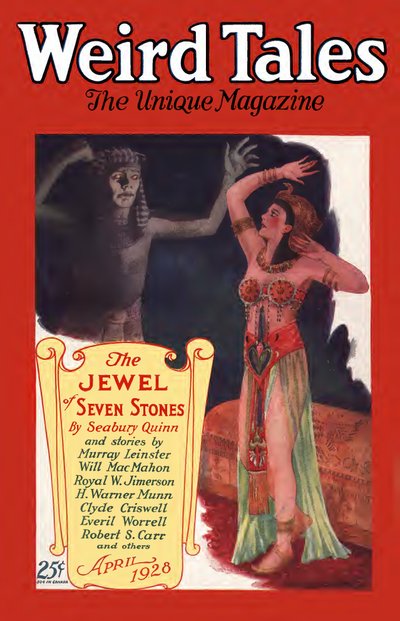
Issue cover by C. C. Senf.
This text is printed as first published. It uses racial language from the period, including slurs.
1. The Coffins from Alexandria
“Hello, Dr. Trowbridge,” a cheerful hail accosted me as I turned the corner, hastening on my round of afternoon calls, “I’ve been meaning to look you up for the last two months, but never got ’round to it. Good thing I met you now; I’m figuring on pulling off a show this evening, and maybe you’d like a ringside seat.”
“Oh? How do you do?” I responded somewhat doubtfully, for the grinning young man in the shabby little red roadster at the curb was unknown to me. “I’m afraid you’ve the advantage of me; I—”
“Oh, yes, you do,” he replied with an infectious smile. “I’m Ellsworth Bennett, you know. You used to come out to our house a lot when Father was living, and—”
“Why,” I broke in, “Ellsworth, boy, I never would have known you. You’ve grown so—”
“Quite right,” he agreed. “It’s a habit we all have during early life. Now, what do you say to coming out to my little diggings tonight? I’m parked in the old Van Drub cottage for the season, and I’ve really got something worth looking at.”
“Well,” I temporized, “I’d be delighted to have you in to my place to dinner, but I’m so tied up with night calls these times that I fear I’ll not be able to accept your invitation.”
“Oh, rats!” he returned. “Try to come, won’t you? You know, I’ve been connected with the Museum of Ethnology ever since I got my degree, and this spring I ran across the trail of something really big while traveling in Egypt. I think I can show you something brand-new if you’ll drop out my way tonight or tomorrow. I seem to recall that you and Father used to spend no end of time talking about Rameses and Ptolemy and the rest of those antique gentlemen when I was too small to know what it was all about.”
I regarded the lad speculatively. He was his father’s own son, no mistake about it. Those honest, humorous blue eyes beneath the sandy brows, that wide, mobile mouth and square chin cleft with the slightest suggestion of a dimple, even the flecks of russet freckles across the bridge of his aquiline nose reminded me of my dear old classmate whose house had been a second home to me in the days before the influenza pandemic took him off. “I’ll come,” I decided, clasping the youngster’s hand in mine. “You may expect me sometime after 8 this evening—office hours have to be observed, you know—and, if you don’t mind, I’ll bring a friend with me, a Dr. de Grandin, from Paris, who’s stopping with me.”
“Not Jules de Grandin?” he demanded incredulously.
“Yes; do you know him?”
“No, but I’d like to. Jules de Grandin! Why, Dr. Trowbridge, I’d no idea you traveled in such highbrow company.”
“I’d hardly call him highbrow,” I replied, smiling at his enthusiasm.
“Oh, Lord!” he threw up his hands in mock despair. “You fellows who have all the luck never do appreciate it. Why, man, de Grandin’s one of the foremost ethnologists of the age; his studies in evolution and anthropometry are classics. I’ll say you can bring him. I’ll be hanging out the window waiting for you tonight. G’bye.” With a warning double toot of his horn he set his decrepit motor going and dashed down the street at a speed bound to bring him afoul of the first crossing policeman who spied him.
The Van Drub cottage where young Bennett had his “diggings” was a relic of the days when Swede and Dutchman contended for mastery of the country between the Delaware and the Hudson. Like all houses of its day, it was of the story-and-a-half type, built of stone to the edge of the overhanging roof and of hand-split chestnut shingles above. The ground floor was entirely occupied by a single large combination living-room and kitchen paved with brick and walled with roughly split planks, and small cubby-holes of storerooms flanked it at each end. Bennett’s living arrangements were as typical of himself as a photograph. Bookshelves lined the walls and displayed a most improbable array of volumes—de Morgan’s Les Premières Civilisations and Munzinger’s Ostafrikanische Studien huddled cheek by jowl with a much-worn copy of Thomas à Kempis’ Imitation of Christ. A once fine but now badly worn Sarouk rug covered the major portion of the brick floor, and the furniture was a hodgepodge of second-hand mahogany and new, cheap pine. In the middle of the room, as though on exhibition, were two long covered objects, roughly resembling a pair of mummy-cases, raised some three feet above the floor on rough saw-horses. Two kerosene-burning student lamps of the sort used in the late nineties, their green shades removed for greater radiation of light, illuminated the room’s center with an almost theatric glare, leaving the corners in shadow all the deeper from the contrast.
“Welcome to the humble student’s cave, gentlemen,” Bennett greeted as we stepped through the wide, low doorway. “Tonight’s the fateful hour; I either uncover something to set ’em all talking for the next ten years, or get myself a free ticket to the booby-hatch.”
With sudden soberness he turned directly to de Grandin and added: “I’m on special leave from the Museum to work out a theory that’s been haunting me for the last year or so. It’ll be an important contribution to science, if I’m right. Here”—he waved his hand toward the sheeted objects on the trestles—“is the evidence. Shall we begin?”
“U’m.” Jules de Grandin gave his little blond mustache a vicious tweak as he regarded our host with his direct, challenging stare. “What is it that you wish to prove by the evidence, mon brave?”
“Just this”—Bennett’s frank, boyish eyes lost something of their humorous gleam and took on the earnest, enthusiastic expression of the fanatic’s—“that not all the traces of the Greek civilization were obliterated when the Moslems sacked and burned Alexandria.”
“Ah? And you will prove it by—?” De Grandin’s delicately arched brows lifted slightly as he glanced significantly at the sheeted things.
“By these,” Bennett returned. “This spring, while I was over in Africa, I got in with a scoundrelly old Arab who rejoiced in the name of Abd-el-Berkr, and, in return for several liberal applications of bakshish, he agreed to turn over two ancient Greek coffins he had found in an old native cemetery in the desert. The old villain knew enough to distinguish between Christian coffins and Egyptian mummy-cases—there aren’t any of the latter left in the neighborhood of Alexandria, anyhow—and he was too good a Moslem to disturb the tombs of his coreligionists, even if they had used substantial coffins for burial, which they hadn’t.
“I took the old beggar on, for if he were telling the truth his find was worth a lot more than it cost me, and if he were lying—which he probably was—I’d not be so very much out of pocket. As you know, the Mohammedans took about everything that wasn’t nailed down when they captured the city, and their descendants have been keeping the good work up. The few Christian cemeteries which survived the first onslaught of Islam were gradually uprooted and their inmates ruthlessly ripped from their tombs and despoiled of such trifling ornaments as happened to be buried with them. So, even if we don’t find anything of great importance in these two cases, the chances are we may recover a few old coins or some antique jewelry—enough to take back to the Museum and prove my time hasn’t been entirely wasted.”
He paused, eyes shining, lips parted as he surveyed us each in turn, almost pathetically anxious for a word of encouragement.
“I fear we have come on a chase of the wild goose, my friend,” de Grandin replied a trifle wearily. “Me, I have unearthed coffins of the olden days from the vicinity of Alexandria, of Tunis and of Sidon, but nothing save the most abominable evidence that all flesh is subject to decay have I ever found. For your sake I hope your hopes are justified. Speaking from experience, I should say the Arab gentleman has driven a most advantageous bargain, for himself. Undoubtlessly he first despoiled the tombs of such trifles as they contained, then sold you the empty boxes for as much as he could. I fear you are—how do you say it?—holding the sack, mon enfant.”
“Well, anyway, here goes,” responded Bennett with a shamefaced grin as he whipped the threadbare table-cover from the nearest case and took up mallet and cold-chisel. “We may as well begin on this one, eh?”
The coffin was roughly like a bathtub in shape, perhaps six feet long by two and a half high, and composed of some sort of hard, brittle pottery, evidently baked in a brick-kiln, and apparently shaped by hand, for traces of the makers’ thumb-marks still showed on its exterior. About its upper portion, an inch or so below the junction of lid and body, ran an ornamental molding of the familiar Greek egg-and-dart design, crudely impressed on the clay with a modeling mold before baking. There was no other attempt at decoration and no trace of inscription on the lid.
“Here we are!” Bennett exclaimed as he finished chipping away the sealing of the casket. “Give me a lift with this lid, Dr. Trowbridge?”
I leaned forward to assist him, tugged at the long, convexly curved slab of terra-cotta, and craned my neck to glimpse the coffin’s interior.
What I had expected to see I do not quite know. A skeleton, perhaps; possibly a handful of fetid mold; more likely nothing at all. The sight which met my eyes made them fairly start from their sockets, and but for Bennett’s warning cry I should have let my end of the casket cover clatter to the brick floor.
Cushioned on a mattress of royal purple cloth, a diminutive pillow beneath her head and another supporting her feet, lay a woman—a girl, rather—of such surpassing beauty as might have formed the theme of an Oriental romance. Slender she was, yet possessing the softly rounded curves of budding womanhood, not the angular, boyish thinness of our modern girls. Her skin, a deep, sun-kissed olive, showed every violet vein through its veil of lustrous, velvet tan. Across her breast, folded reposefully, lay hands as softly dimpled as a child’s, their long, pointed nails overlaid with gold leaf or bright gilt paint, so that they shone like ten tiny almond-shaped mirrors in the rays of the hissing student lamps. Her little bare feet, as they dimpled the purple cushion on which they lay, were pinked about sole and toe like those of a baby, and so soft, so free from callouses or roughening of any sort, that it seemed they must have trodden nothing harder than velvet carpets in life, even as they rested on pillows of velvet in death. About ankles, wrists and arms hung bangles of beaten rose-gold studded with topaz, garnet and lapis-lazuli, while a diadem of the same precious composition encircled her brow, binding back the curling black locks which lay about her small face in thick clusters. A robe or shroud of thinnest gauze enveloped her from throat to knees, and about her lower limbs from knee to ankle was wrapped a shawl of brilliant orange silk embroidered with wreaths of shells and roses. Black antimony had been rubbed on her lids to give added size and depth to her eyes, and her full, voluptuous lips, half parted, as though in the gentle respiration of peaceful sleep, were stained vivid vermilion with powdered cinnabar. There was nothing of death, nothing of the charnel-house, about the vision. Indeed, it required a conscious effort to convince me her bosom did not rise and fall with the softly-drawn breath of slumber, and the faint, subtle perfume of violets and orange blossoms which wafted to us from her raiment and hair was no delusion, but a veritable scent imprisoned in the baked-clay tomb for fifteen centuries.
“Ah!” I exclaimed in mingled surprize and admiration.
“Good Lord!” Ellsworth Bennett murmured, staring incredulously at the lovely corpse, his breath rasping sharply between his teeth.
“Nom d’un chat de nom d’un chat!” Jules de Grandin almost shouted, standing on tiptoe to gaze over my shoulder. “It is the Sleeping Beauty en personne!”
With a quick movement he turned to young Bennett, and before the other was aware of his intention had kissed him soundly on each cheek. “Embrasse moi, mon vieux!” he cried. “Me, I am one great fool of a doubly-damned doubting Thomas! In all my head there is not the sense with which the good God had endowed a goose! Parbleu, we have here the find of the age; our reputation is assured; we shall have fame comparable to that of Boussard. Mordieu, but we are already famous!”
Characteristically, he had assumed charge of the entire proceeding. “We shall take her to the Museum!” he continued, elatedly; “she shall display her so marvelous beauty for all to see our handiwork. She shall—misère de Dieu, behold, my friends, she vanishes!”
It was true. Before our eyes, like a shadowgraph fading on the screen, the lovely being in the ancient coffin was dissolving. Where the full-rounded beauty of feminine perfection had lain a moment before, there stretched a withering, shriveling thing, puckering and wrinkling like a body long immersed in chilled water. The eyeballs had already fallen in, leaving cavernous, unfilled sockets in a face from which every semblance of the bloom of youth had vanished and which showed pinched and desiccated like that of a mummy. The symmetrical, full-fleshed limbs were no more than skin-covered bones as we bent our gaze on the rapidly spreading desolation, and within a space of ten minutes even the skeleton lost its articulation, and nothing but a pile of dust, gray-white and fine as the ashes of cremation, lay upon the purple fabric. While we stared, horrified, even the pillows and mattress which had supported that once-beautiful body, the ethereal, transparent gauze and the heavy, broidered silk of the shawl crumbled like a gaslight filament crushed between thumb and forefinger. Sealed away from contact with the atmosphere for centuries, every vestige of perishable matter, both animal and vegetable, had shuddered into ashes in our oxygen-laden air almost as quickly as if brought in contact with living flame. Only the hard, glittering facets of the gems and the duller gleam of the gold composing her ornaments assured us that the body of a lovely girl had lain before us a short quarter-hour ago.
Ellsworth Bennett was the first to recover his self-possession. “Sic transit gloria mundi!” he remarked with a half-hysterical laugh. “Shall we open the other one?”
De Grandin was shaking like a leaf with emotion. Like all his countrymen, he was as susceptible to the appeal of beauty as a sensitive-plant’s fronds are to the touch, and the spectacle he had witnessed had shocked him almost past endurance. Taking his narrow chin between his forefinger and thumb, he gazed abstractedly at the floor a moment, then turned to our host with a shrug and one of his quick, elfin smiles. “Regard not my foolishness, I beseech you,” he implored. “Me, I would not suffer such another sight for the wealth of the Indies, but—so great is my curiosity—I would not forego the experience of beholding the contents of that other casket for ten times the Indies’ wealth!”
Together he and Bennett broke the clay sealing of the coffin, and within five minutes the lid was loosened and ready to be lifted from its place.
“Careful, careful, Trowbridge, my friend!” de Grandin besought as the three of us gently raised the slab of brittle clay. “Who knows what we may discover this time? Beneath this cover there may be—quoi diable!”
Instead of the open coffin we had expected to find beneath the earthen lid, a second covering, curved and molded to conform to the outer lid’s shape, met our gaze.
Bennett, intent on seeing what lay beneath, was about to strike the opaque white substance with his hammer, but a quick cry from de Grandin halted him. “Non, non!” the Frenchman warned. “Can not you see there is an inscription on it? Stand back, my friends, approach, do not crowd, lean forward”—his sharp, contradictory orders rang out in quick succession like military commands. “Lights, lights for the love of heaven! Bring forward the lamps that I may decipher these words before I die from curiosity!”
Bennett and I each seized a lamp and we held them above the coffin’s inner sealing while the little Frenchman leaned forward, eagerly scanning the inscription.
The curving cover seemed to be made of some softer, less brittle substance than the outer lid—wax, I decided after a hasty inspection—and on it, from top to bottom, in small Greek unicals some sort of message had been etched with a stylus.
De Grandin studied the legend through intently narrowed eyes a few moments, then turned to Bennett with a gesture of impatience. “It is no good,” he announced petulantly. “My brain, he has too much burden on him this night; I can not translate the Greek into English with the readiness I should. Paper, paper and pencil, if you please. I shall make a copy of this writing and translate him at my leisure this evening. Tomorrow we shall read him aloud and see what we shall see. Meantime, swear as you hope for heaven, that you will make no move to open this coffin until I shall return. You agree? Bon! To work, then; the writing is long and of an unfamiliar hand. It will take much time to transcribe it on my tablets.”
2. A Portent from the Past
Golden waffles and rich, steaming coffee were waiting on the table when I descended the stairs next morning, for Nora McGinnis, my household factotum, maintained a soft spot in her Celtic heart for de Grandin and his gallant manners, and delays which would have made her nearly snap my head off brought only an indulgent smile when occasioned by the little Frenchman’s tardiness. “Sure, Doctor darlin’,” she greeted as I seated myself and looked about for my companion, “Dr. de Grandin wuz doin’ th’ divil’s own bit o’ studyin’ last night, an’ ’twould be unfair ter call ’um from his rist, so ut would,”
“Fear not, my excellent one,” a cheerful voice hailed from the stairs, “already I am here,” and de Grandin stepped quickly into the sunlit dining-room, his face glowing from the recent application of razor-blade and cold water, his little blond mustache waxed to twin needle-points at the corners of his small, sensitive mouth, and every blond hair on his head lying as perfectly in place as though numbered and arranged according to plan.
“Mordieu, what a night!” he exclaimed with a sigh as he drained a preliminary draft of well-creamed coffee and passed the cup back for replenishment. “Cordieu, even yet I doubt me that I saw what I beheld at Monsieur Bennett’s cottage last night, and I am yet in doubt that I translated what I did from the notes I made from the second coffin!”
“Was it so remarkable?” I began, but he cut me short with an upraised hand.
“Remarkable?” he echoed. “Parbleu, my friend, it is amazing, nothing less. Come, let us first discuss this so excellent food, then discuss the message from the past.
“Attend me, if you please,” he ordered, picking up a sheaf of manuscript from the study table when we had finished breakfast. “Give careful ear to what I read, my friend, for I shall show you that which makes even our vision of yesternight fade to insignificance by comparison. Listen:
Kaku, servant and priest of Sebek, dread God of Nilus, son of Amathel the son of Kepher, servants and priests of Sebek, to whoso looks hereon, greeting and admonition:
Not of the creed and belief of Christians am I, neither of the bastard cult of the Greek usurpers. Flesh of the flesh and blood of the mighty blood of the race which ruled Upper and Lower Egypt in the days when Ra held sway is Kaku, servant and priest of Sebek. Learned in the laws and magic of the olden priesthood am I, and by the lore and cunning of my forebears have I sealed the virgin Peligia in unwaking sleep beneath this shield of time-defying cerus, even the wax which sets at naught the father of acids.
Greek and Christian though she be, and daughter of the race which trod upon my ancestors, my heart inclined to her and I would have taken her to wife, but she would not. Wherefore, I, being minded that she should take no other man to husband, devised a plan to slay her and bury her with the ancient rites and ceremonies of my people, that her body should not know corruption, but lie in the tomb until the Seven Ages were passed, and I might take her to myself and dwell with her in Aalu. Nathless, when I had taken her beyond the city gates, and all was ready for her death, my heart turned water within me, and I could not strike the blow. Therefore, by my magic, and by the magic of my priesthood, have I caused a deep sleep to fall on her, even a sleep which knows no waking until the Seven ages be past and she and I shall dwell together in Amenaand.
For the Seven Ages shall she sleep within this coffin, obedient to the mystic spell I have put on her, and if no man openeth the tomb and waken her before the Seven Ages be past, then she shall become as the dust of Egypt, and be mine forever and forever in the land beyond the setting sun. But if a man of later days shall lift the covering from off this coffin and take her hand in his and call on her by name, and in the name of love, then shall my magic be valueless, and she shall waken and cleave unto her deliverer, and be his own in that land and generation yet unborn. This is the sum of all my spells and learning unable to withstand.
Yet, ye who look hereon, be warned in time or ever ye seek to open this tomb of the living-in-death. I, Kaku, priest and servant of Mighty Sebek, have sealed this virgin within this tomb that she may be mine and not another’s. My shadow, and the shadow of Sebek which is my god, is upon her. Yea, were it seventy times seventy ages instead of seven, and were the earth to perish under our feet, yet would I pursue her until her heart inclines to me.
I, Kaku, servant and priest of Sebek, have sealed this tomb with clay and wax and with my curse, and with the curse of Sebek, my god and master, and the curse of Kaku, and of Kaku’s god, shall smite with terror him who openeth this tomb. And on him in ages yet to come who looks upon this coffin with presumptuous eyes and makes bold to open it, I do pronounce my curse and the curse of Sebek, and I do set myself against him in wager of battle, that his days be not long in the land; neither his nor hers to whom life returns and youth and love for the duration of the seven stones upon the jewel, according to the obedience of the eternal gods of Egypt whose kingdom shall have no end.
I have said.
De Grandin laid the manuscript on the desk and looked at me, his little blue eyes round and shining with excitement.
“Well?” I asked.
“Well?” he mimicked. “Parbleu, I shall say it is well! Many remarkable things have I beheld, my friend, but never such as this. Come, let us hasten, let us fly to the cottage of Monsieur Bennett and see what lies beneath that shield of wax. Mort d’un Chinois, though she subsist but for five little minutes, I must gaze, I must feast my eyes upon that paragon of womanhood whose beauty was so great that even the hand of jealousy forbore to strike!”
3. The Jewel of Seven Stones
Differing from her companion in death as dawnlight differs from midnight, the virgin Peligia lay in her terra-cotta coffin when Bennett, de Grandin and I had lifted off the curving shield of wax. She was some five and twenty years of age, apparently; slightly above middle height, golden-haired and fair-skinned as any Nordic blonde, and as exquisitely proportioned as a Grecian statue of Aphrodite. From tapering white throat to blue-veined, high-arched insteps she was draped in a simple Ionic robe of snowy linen cut in that austerely modest and graceful fashion of ancient Attica in which the upper part of the dress falls downward again from neck to waist in a sort of cape, hiding the outline of the breast while leaving the entire arms and the point of the shoulders bare. Except for two tiny studs of hand-beaten gold which held the robe together over the shoulders and the narrow double border of horizontal purple lines at the bottom of the cape, marking her status as a Roman citizen, her gown was without ornament of any sort, and no jewelry adorned her chaste loveliness save the golden threads with which her white-kid sandals were embroidered and a single strand of small gold disks, joined by minute links and having seven tiny pendants of polished carnelians, which encircled her throat and lay lightly against the gentle swell of her white bosom.
To me there seemed something of the cold finality of death about her pose and figure. After the glowing beauty and barbaric splendor of her unnamed companion, she seemed almost meanly dressed, but de Grandin and Bennett were mute with admiration as they gazed on her.
“Mordieu, she is the spirit of Greece, undebased by evil times, brought down to us within a shell of clay,” the little Frenchman murmured, bending over her and studying her calm, finely molded features like a connoisseur inspecting a bit of priceless statuary.
Young Bennett was almost speechless with mingled excitement and homage. “What—what did you say her name was?” he asked thickly, swallowing between words, as though the pressure of his breath forced them back into his throat.
“Peligia,” de Grandin returned, bending closer to study the texture of her robe.
“Peligia,” Bennett repeated softly. “Peligia—” Scarce aware of what he did, he reached downward and took one of the shapely hands crossed above her quiet breast in his.
Jules de Grandin and I stood fascinated, scarce daring to breathe, for at the whispered name and the pressure of the boy’s fingers on hers, the woman in the coffin stirred, the slender, girlish bosom heaved as if with respiration, and the smooth, wax-white lids fluttered upward from a pair of long gray eyes as gentle as the summer and as glowing as the stars. A wave of upward-rising color flooded her throat, her cheeks; the hue of healthy, buoyant youth showed in her face, and her calmly set lips parted in the faintest suggestion of a smile.
“My lord,” she murmured softly, meeting young Bennett’s gaze with a look of gentle trust. “My lord and my love, at last you have come for me.”
And she spoke in English.
“Morbleu, Friend Trowbridge, look to me, assist me hence to some asylum for lunatics,” de Grandin implored. “I am caduc—mad like a hare of March. I see that which is not and hear words unspoken!”
“Then I’m crazy too,” I rejoined, leaning forward to assist Bennett in his task of lifting the girl from her coffin-bed. “We’re all mad—mad as hatters, but—”
“Yes, parbleu,” he agreed, fairly dancing before us to toss back the covers of the camp bed and ease the girl upon it, “mad we are, of a surety, but who would own sanity if madness brings visions such as this?”
In another moment the blankets had been drawn about the girl’s shoulders, and with Bennett seated at her left, de Grandin at her right, and me standing at the bedstead’s foot, she held her little levee like some spoiled beauty of the Louis’ court at her salon.
“How comes it you speak English, Mademoiselle?” de Grandin demanded, putting in blunt words the question which burned in all our brains.
The girl turned her agate eyes on him with a puzzled little frown. “English?” she repeated. “What is English?”
“Nom d’un nom! What is”—de Grandin gasped, looking as if he were in momentary danger of exploding—“‘What is it?’ you do ask. It is the language we use. The barbarous tongue of the Saxon savages!”
“Why”—still her smooth brow wrinkled with noncomprehension—“is not the tongue we use that of the Empire? Are we not in Alexandria?”
“In Alexandria!” Again the little Frenchman seemed on the point of bursting; then, with a mighty effort, he restrained himself and demanded, “Parlez vous Français?”
She shook her head in silent negation.
“But—but,” he began; then he stopped short with a look of bewilderment, almost of dismay.
“I understand,” she broke in while he waited her explanation. “A moment ago I ceased to hold my lord’s hand, and the words you used seemed suddenly meaningless, though before I understood perfectly. See, while his hand is clasped in mine I talk as you do and understand your speech, but the moment I release his fingers my mind becomes a blank, and all about me seems strange. I know the answer to your question. He”—she cast another melting glance on the boy sitting beside her—“he is my love through all the ages, the man who waked me into life from death. While he touches me or I touch him I speak with his tongue and hear with his ears; the moment our contact is broken I am an alien and a stranger in a strange land and time.”
“Cordieu, yes, it is possible,” de Grandin agreed with a short nod. “I have known such cases where patients suffered with amentia, but—”
“Scat!” The interruption came with dramatic suddenness as he chanced to glance toward the open door. Upon the threshold, one forefoot raised tentatively, its big, green eyes fixed on the reclining girl with a baleful gleam, stood a huge black cat.
“Out, beast of evil omen!” the little Frenchman cried, striding toward the brute with upraised hand.
S-s-s-sh! Venomous as the hiss of a poisonous reptile, the thing’s furious spit greeted his advance, and every sable hair along its spine reared upward belligerently.
“Out, I say!” de Grandin repeated, aiming a devastating kick at the brute.
It did not dodge. Rather, it seemed to writhe from under his foot, evading the blow with perfect ease. With a lithe, bounding spring it launched itself into the air, landed fairly on the covers protecting the girl’s bosom and bent forward savagely, worrying at her throat.
Bennett leaped to his feet, flailing at the thing with ineffectual blows, fearing to strike directly downward lest he hit the girl, and missing the writhing brute each time he swung his impotent fists at it.
Then, suddenly as it had appeared, the creature vanished. Snarling once, defiantly, it turned and leaped to the window-sill. As it paused for a final baleful glare at us, we saw a tiny red fleck against its lips. Was it blood? I wondered. Had the beast fleshed its fangs in the girl’s throat? De Grandin had seized a piece of crockery from the dresser and raised his hand to hurl it at the beast, but the missile was never thrown. Abruptly, like a light snuffed out in a gust of wind, the thing was gone. None of us saw it leap from the sill; there was no sound of its feet against the heaped-up dry leaves outside. It was gone, nor could we say how or where.
On the bed, Peligia wept despairingly, drawing her breath with deep, laboring sobs and expelling it with low, quavering moans. “My lord,” she cried, seizing Bennett’s hand in hers that she might express herself, “I understand it all. That was no cat, but the ka of Kaku, the priest of Sebek. Long years ago he put me in a magic sleep with his unclean sorceries, but before he did so he told me that if ever I awakened and loved another man his double would pursue me from the dungeons of Amenti and ravish me from out my lover’s arms. And in token of his threat he hung this about my neck”—she pointed hysterically to the chaplet of golden disks and ruddy beads—“and warned me that my life in the days to be would last only so long as the seven pendants of this jewel. One at a time, he vowed, his ka would take the stones from me, and as each one fell, so would my stay in the land of my new-found lover be shortened. Behold, my darling, already he has wrested one of the stones from me!”
Baring her breast of the shrouding blankets, she indicated the necklace.
One of the tiny carnelian pendants was gone. The jewel of seven stones retained but six.
4. The Accident
Two months had passed. Peligia’s naive assumption that the man whose voice and touch wakened her from her sesquimillenial trance was her foreordained mate found ready echo in Ellsworth Bennett’s heart. Three days after her release from the Alexandrian coffin he and she were wed at the sole Greek Catholic church our little city boasted, Bennett’s innate thoughtfulness dictating the choice, since the service and language of the liturgy employed by the modern papa were essentially the same as those to which his bride was accustomed in the days of the Patriarch Cyril.
De Grandin and I attended them at the ceremony and helped them procure their license, and the little Frenchman was near to bursting with laughter when the solemn-visaged clerk of court demanded of Bennett whether his bride was of full age. “Par la barbe de Saint Gris,” he chuckled delightedly in my ear, “Friend Trowbridge, I am half minded to tell him her true age!” and he stepped forward as though to carry out his threat.
“Come back, you little fool,” I admonished, seizing his elbow and dragging him away; “he’ll have us all committed to an asylum!” At which he laughed all the harder, to the very evident scandal of the serious-minded attachés of the clerk’s office.
The earthenware coffin in which the dead girl had lain, together with her splendidly barbaric ornaments, had been taken to the Museum as trophies of Bennett’s researches, and, backed by de Grandin’s statement, his story of the find was duly accredited. Of the manner of Peligia’s coming nothing had been said, and since Ellsworth was an orphan without near relatives, there was little curiosity shown in his charming wife’s antecedents. Their brief honeymoon had been a dream of happiness, and their life together in the cheerful little suburban villa bade fair to continue their joy uninterruptedly. Since the first sinister manifestation on the afternoon of her awakening, Peligia and her husband had received no further visitations, and I, for one, had become convinced that the black cat was really a feline rogue which happened into the cottage by uncanny coincidence, rather than a visitant from beyond the grave.
De Grandin and I faced each other across my study table. In the dining-room the candlelight gleamed on china and silver and cut glass, and from the kitchen emanated odors of gumbo soup, roast chicken and fresh-baked apple pies. Also imprecations as Nora McGinnis strode to and fro across her domain, breathing uncomplimentary remarks about “folks who kape a body’s dinner waitin’ an’ sp’ilin’ on th’ sthove half an hour afther ut’s due ter be served.”
The Frenchman consulted the silver dial of the tiny watch strapped to the under side of his wrist for the tenth time in as many minutes. “They are late, Trowbridge, my friend,” he announced unnecessarily. “I do not like it. It is not well.”
“Nonsense!” I scoffed. “Ellsworth’s probably had a blowout or something of the sort, and is holding us up while he puts on a new tire.”
“Perhaps, possibly,” de Grandin admitted, “but I have the malaise, notwithstanding. Go to the telephone, I beseech, and assure yourself they are on the way.”
“Stuff!” I retorted, but reached for the receiver as I spoke, for it was plain my friend’s apprehension was mounting like a thermometer’s mercury on an August afternoon.
“Give me—” I began, preparing to name Bennett’s number, but the voice of central cut me off.
“Here’s your party,” she announced, speaking to someone on the other end of the line.
“Is this Dr. Trowbridge?” the cool, impersonal voice of one used to discussing tragedies over the telephone demanded.
“Yes,” I admitted, “but I was just attempting to get another party on the wire—”
“I think this is important,” the other interrupted. “Do you know a Mr. Ellsworth Bennett?”
“Yes! What about him?”
“This is the Casualty Hospital. Mr. and Mrs. Bennett and their taxi-driver were brought here twenty minutes ago. He regained consciousness for only a moment, and begged us to call you, then fainted again, and—”
“I’ll be right over!” I shouted, clashing the receiver back into its hook and springing from my chair.
“Trowbridge, mon vieux—it is the bad news?” de Grandin asked, leaping to his feet and regarding me with a wide-eyed stare.
“They’ve just had an accident—motor collision—at the Casualty Hospital now—unconscious,” I jerked out as I ran through the dining-room, notified Nora of the cause of delay, and rushed into the hall for my hat and topcoat.
De Grandin was ahead of me, already seated in the car when I ran down the front steps. “Stand on it; hasten; fly!” he urged as I shot the self-starter and turned toward the hospital at furious speed. “Sang du diable, I knew it; in each bone of my body I felt it coming! Oh, hurry, hurry, my friend, or we may be too late!”
“Too late? For what?” I asked crossly. “The nurse didn’t say they were seriously hurt.”
“Haste, more haste!” was his only reply as he leaned forward like a jockey bending across the neck of his mount to urge it to greater speed.
Rounding comers on two wheels, even cutting across sidewalks in our effort to clip a few feet from our course, our siren shrilling continuously, we dashed through the winter night, finally drew up beneath the hospital’s porte-cochère, our motor panting like a winded polo pony after a furious chukker.
“Where are they—plumes d’un canard!—where are Monsieur and Madame Bennett, if you please?” cried de Grandin, fairly bouncing through the hospital door.
“Mrs. Bennett’s in the operating-room, now,” the night supervisor replied, not at all impressed with his urgency. “She was rather badly—”
“And that operating-room, it is where?” he demanded impatiently. “Be quick, if you please. It is of the importance, and I am Dr. de Grandin.”
“The operating-room’s on the fourth floor, but no one is permitted there while the surgeons are—”
“Ah bah!” he interrupted, for once forgetting his customary courtesy, and starting down the corridor at a run. “Come with me, Friend Trowbridge!” he flung back over his shoulder, pressing his finger to the elevator bell button and continuing the pressure uninterruptedly. “We may not be too late, though I greatly fear—”
“Say, whatsa big idea?” demanded the elevator conductor, slamming open his door and glowering at the little Frenchman.
“The idea, my friend, is that I shall give you one five-dollar bill in case you take us to the fourth floor immediately,” returned de Grandin, extracting a crisp green Treasury note from his wallet.
The car shot upward like a captive balloon suddenly released from its cable and came to a stop at the top floor with a suddenness which set the circuit breakers in the basement to clattering like a battery of field guns. “First door to your right at the end o’ the corridor,” directed the conductor with a wave of his left hand while with his right he stowed de Grandin’s gratuity in his trousers pocket.
We ran at breakneck speed down the wide, solemn hall, paused not a moment at the ominous green-painted door with its gold-lettered sign of “Silence” and “No Admission,” but rushed into the brilliantly lighted room where two nurses and a young and plainly worried surgeon stood above the sheeted form of Peligia Bennett.
“Ah—hèlas—it is as I thought!” de Grandin almost shrieked as he bounded forward. Even as we entered the room one of the nurses leaned over and grasped some shining object from the unconscious patient’s throat, detaching it with a quick jerk. It was the necklace from which a pendant had been lost, the day we raised Peligia from the coffin.
“Quick, replace it—put it back! Barbe de Saint Pierre—PUT IT BACK!” the Frenchman cried, leaping across the white-tiled floor and snatching at the jewel dangling from the nurse’s fingers.
The girl turned on him with an exclamation of surprize, clutched frantically at the golden strand he reached for, and let it fall to the terrazzo floor.
There was a miniature explosion, like that of an electric light bulb bursting, only softer, and two of the carnelian pendants winked out like suddenly extinguished lights. Contact with the floor’s hard tiles had cracked them, and each seemed in need of only so slight a concussion to dissolve into a little pile of garnet dust which quickly turned to vapor and disappeared, leaving no trace.
Fairly shoving the nurse from his path, de Grandin seized the mutilated necklace and laid it against the unconscious girl’s throat.
“Sir, this is an outrage! What do you mean by forcing yourself in here?” demanded the astonished young surgeon. “This patient is in a desperate condition, and—”
“Desperate? You tell me that?” de Grandin rasped. “Parbleu, you know not how desperate her plight is, Monsieur!” As he spoke he flung aside his dinner coat and rolled back his cuffs.
“I am Dr. Jules de Grandin, of Paris,” he continued, reaching methodically for an operating-smock. “I hold degrees from Vienna and the Sorbonne, as my friend, Dr. Trowbridge, whom you doubtless know, can certify. With your permission—or without it—I shall assume charge here.” He turned imperiously to the nurses, motioning them to bring a pair of sterile rubber gloves.
“I’m afraid you’re too late,” the other responded coldly. “If you’ll trouble to look, you’ll see—”
“Grand ciel, I do!” the Frenchman gasped, staring with horrified eyes at the pallid form on the table.
Peligia Bennett’s face had gone a sickly, deathlike gray, her eyeballs seemed fallen in their sockets and her nostrils had the chilled, pinched look of one in extremity. From between her parted lips sounded the harsh irregularity of Chanes-Stokes breathing.
“Mordieu, she is passing!” he exclaimed; then: “Ah? So?” Bending quickly, he retrieved the necklace from the floor, where it had fallen during his altercation with the surgeon, and placed it about Peligia’s throat. This done, he bent two of the tiny gold links together and fastened the strand where it had broken when the nurse snatched it from her bosom. As the jewel shone once more against the fainting girl’s white skin I noticed, with a start, that another of the garnet pendants was missing.
The replacement of the necklace acted like a powerful stimulant on the patient. Scarcely had gold and stone touched her flesh again than her respiration became more normal and the bluish, deathlike pallor gave way to the slight flush of strengthening circulation.
“Now, Mesdemoiselles, if you please, we shall begin,” de Grandin announced, signing to the nurses, and seizing scalpel and forceps he set to work with a speed and deftness which brought a gasp of admiring amazement from the offended young doctor and the attendants alike.
“Not again; not again for fifty thousand francs would I perform such an operation,” he murmured as he turned his gloves inside out and shrugged out of his gown. To the nurse he ordered: “Attend her constantly, Mademoiselle; on your life, see that the necklace is kept constantly in place. Already you have observed the effect of its loss on her; it is not necessary to say more, hein?”
“Yes, sir,” responded the nurse, gazing at him with mingled wonder and respect. Surgical nurses soon recognize a master craftsman, and the exhibition he had given that night would remain history forever in the operating-room of Casualty Hospital.
“I feared something like this,” he confided as we walked slowly down the corridor. “All evening I have been ill at ease; the moment I heard of the accident I made sure the hospital authorities in their ignorance would remove the jewel from Madame’s throat—grâce à Dieu we were in time to replace it before the worst occurred. As it is—” He broke off with a shrug of his narrow shoulders. “Come,” he added, “let us interview Monsieur Bennett. I doubt not he has something of interest to tell.”
5. The Shadow of Sebek
“Mr. Bennett is still under the anesthetic,” the nurse informed us when we inquired at my friend’s room. “He had a Colles’ fracture of the lower right epiphysis, and Dr. Grosnal gave him a whiff of ether while he was repositioning the fragments.”
“U’m,” commented de Grandin. “The treatment was correct, Mademoiselle. The chauffeur who drove them, where is he? I am told he, also, was hurt.”
“Yes, you’ll find him in Ward D,” the girl replied. “He wasn’t hurt much, but he was taking on quite a bit when I came through.”
“U’m,” de Grandin remarked again, and turned toward the room where the Bennetts’ taxi-driver lay.
“Mon vieux,” the Frenchman bent above the patient’s cot and laid a friendly hand on his shoulder, “we are come to interview you. You will please tell us what occurred?”
“If you’re from th’ insurance comp’ny,” the chauffeur answered, “I want you to git me, and git me right; I wasn’t drunk, no matter what these here folks tell you. I’m off’n that stuff, an’ have been ever since th’ kid wuz born.”
“But of course,” de Grandin agreed with a nod. “That much is understood, and you will please describe the accident.”
“Well, you can take it or leave it,” the other replied truculently. “I wuz drivin’ south through Minot Avenoo, makin’ pretty good time, ’cause th’ young gentleman told me he had a dinner date, an’ just as I was turnin’ into Tecumseh Street I seen what I thought wuz a piece o’ timber or sumpin layin’ across th’ road, an’ turned out to avoid it. Blow me if th’ thing didn’t move right across th’ pa’ment ahead o’ me, keepin’ in me path all th’ time. You can believe me or not—I’m tellin’ you the gospel truth, though—it wuz a alligator. I know a alligator when I see one, too, for I drove a taxi down to Miami durin’ th’ boom, an’ I seen plenty o’ them animated satchels down there in th’ ’gator farms. Yes, sir, it was a’gator, an’ nothin’ else, an’ th’ biggest ’gator I ever seen, too. Must a’ been sixteen or eighteen foot long, if it wuz a inch, an’ a lot sprier on its feet than any ’gator I ever seen before, for I wuz goin’ at a right fair clip, as I told you, an’ Minot Avenoo ain’ more’n fifty foot wide from curb to curb, but fast as I wuz goin’, I couldn’t turn out fast enough to keep that cussed thing fr’m crawlin’ right smack in front o’ me. I ain’t partic’lar ’bout runnin’ over a lizard, d’ye see, an’ if this here thing hadn’t been th’ granddaddy of all th’ ’gators that ever got turned into suitcases an’ pocketbooks, I’d a’ run ’im down an’ gone on me way; but runnin’ over a thing like that wuz as much as me axles wuz worth—he wuzn’t a inch less’n three foot high fr’m belly to back, not countin’ th’ extra height o’ his legs—an’ me cab ain’t paid for yet, so I turns out like there wuz a ten-foot hole in th’ pa’ment ahead o’ me, an’ dam’ if that thing didn’t keep right ahead o’ me till I lost control o’ me wheel, an’ th’ nex’ thing I knowed—zowie! I wuz parked up agin a tree wid me radiator leakin’ like a cake o’ ice lef’ out in th’ sun on Fourt’ o’ July, an’ me wid me head half-way t’rough th’ windshield, an’ me two fares knocked right outa th’ cab where th’ door’d give way in th’ smash-up. That’s th’ Gawd’s truth, an’ you can take it or leave it,”
“Cordieu, my excellent one,” de Grandin assured him, “we do take it, nor do we require salt upon it, either. This alligator, now, this so abominable saurian who did cause you to collide with the roadside tree, was he in the locality when the ambulance arrived?”
“Sa-ay, you tryin’ to kid me?” demanded the injured man.
“By no means. We believe all you have told us. Can you not be equally frank with us and reply to our queries?”
“Well,” returned the patient, mollified by de Grandin’s evident credence, “that’s th’ funny part o’ th’ joke, sir. When th’ ding-dong came for me an’ me fares, I told th’ sawbones about th’ ’gator, an’ he ups an’ says to th’ murderer ’at runs th’ business end o’ th’ rattler, ‘This here guy’s been drinkin more hootch ’an Ol’ Man Volstead ever prohibited.’ That’s what he says, sir, an’ me as sober as a court-house full o’ judges, too!”
“Infamous!” de Grandin pronounced. “But the sine qua non of your accident, this monster alligator, where was he?”
“Say,” the driver confided, “you know what? He wuzn’t no place. If I hadn’t seen ’im wid me own eyes I’d a’ believed th’ sawbones when he said I had th’ heebie-jeebies; but I tell you I hadn’t had nuttin’ to drink, an’ I ain’t so nutty as to mistake a shadder for a real, live ’gator, ’specially a baby th’ size o’ that one. It’d be different if I wuz a bozo ’at hadn’t been around much; but I been to Florida, an’ I knows a ’gator when I sees one—git me?”
“Mais oui, my friend,” the Frenchman nodded, “your story has the veritable ring of verisimilitude.”
“It has, has it? It’s th’ truth, an’ nuttin’ else but!” the offended chauffeur exclaimed as de Grandin rose and with another friendly nod tiptoed from the room.
“That explains it,” I jubilated as we walked slowly down the corridor. The uncanniness of the night’s happenings had gotten on my nerves, and I had been on the point of believing my friend’s mishap might be traceable to the ancient curse, but here was a perfectly natural explanation of the whole affair. “If that man wasn’t drunk or half insane with cocain I’m much mistaken. Of course, he imagined he saw an alligator crossing his path! I’m only surprized that he didn’t insist it was pink or baby blue instead of the conventional shade. These taxi-drivers—”
“This particular one told the truth,” de Grandin cut in, speaking softly, as though more to himself than to me. “When he assured me he was no longer drinking there was the indubitable ring of truth in his words. Moreover—”
“Yes? Moreover?” I prompted, as he strode a dozen or so paces in thoughtful silence.
“Tiens, it is most strange, but not impossible,” he replied. “This Sebek, I know him.”
“You know him? Sebek? What in the world—” I stammered incredulously.
“Perfectly, my friend. Sebek, the god whom the priest Kaku worshiped, was the typification of the sun’s harmful powers. To him the waters of the Nile, when at their lowest ebb, were parceled off as his particular domain. He was represented as a crocodile-headed deity, even as Anubis possessed the head of a jackal, and in all his phases he was evil—very evil, indeed. Granted that the priest’s powers were effective—and did he not so hypnotize Madame Bennett that she slept like one dead for more than a thousand years?—what would be more natural than that this god should appear in his traditional form to aid his votary? Bethink you of the wording of the curse, my friend: ‘My shadow, and the shadow of Sebek which is my god, is upon her.’”
“Nonsense!” I scoffed.
“Perhaps,” he conceded, as though the point were scarcely worth debating. “You may be right, but then, again—”
“Right? Of course I’m right! The old priest might have been able to suspend Peligia’s vital processes by some sort of super-hypnosis unknown to us, but how could he call down on her the curse of a god that never existed? You’ll scarcely assert that the heathen gods of ancient Egypt had actual existence, I suppose?”
“There is a difference between an individual entity and an abstract force, whether it be for good or evil,” he began, but ceased abruptly at the sudden sound which tore the hospital’s sepulchral quiet into shreds.
It was not the wail of tortured flesh giving tongue to unsupportable pain as the blessed unconsciousness of the anesthetic waned. No surgeon whose apprenticeship was served at the rear end of an ambulance can fail to recognize the cry of returning consciousness from an etherized patient. This was the horrified, piercing scream of a woman in deadly terror, long-drawn, breathless, the reflex outcry of normal nerves suddenly strained past their limit of endurance. And it came from the room where Peligia Bennett lay, still immersed in anesthesia.
“Mon Dieu,” de Grandin gasped, “the garde-malade!” Grasping my arm, he rushed pell-mell down the hall.
The buxom young woman to whose care Peligia had been entrusted when de Grandin finished mending her broken body crouched at the far corner of the room, and her normally florid face was chalky-white under the shaded bedside lamp. “It came out of the wall!” she gasped as we swung the door back. “Out of the wall, I tell you; and there was no body to it!”
“Eh, what do you say?” de Grandin snapped. “What came out of the wall, Mademoiselle? What had no body, if you please?”
“The hand—the hand that snatched at her throat!” The nurse groveled closer in the angle of the wall, as though to shield herself from attack from side and rear.
“The hand? Her throat? Grand Dieu!” de Grandin leaped across the little room like a cat pouncing on a luckless sparrow and turned back the chaste white sheet enshrouding Peligia’s supine body.
“Trowbridge, Trowbridge, my friend,” he commanded, and his voice was hoarse as a croaking frog’s, “behold!”
I joined him at the bedside and cast my glance where his shaking forefinger pointed.
A fifth pendant had disappeared from the necklace round Peligia’s throat. Of the seven stones there remained but two.
6. Catastrophe
A flurry of snowflakes, wind-driven by the January tempest, assaulted de Grandin and me as we alighted from the late New York train. “Cordieu,” the Frenchman laughed as he snuggled into the farther comer of the station taxicab, “to attend the play in the metropolis is good, Friend Trowbridge, but we pay a heavy price in chilled feet and frosted noses when we return in such a storm as this!”
“Yes, getting chilblains is one of the favorite winter sports among us suburbanites,” I replied, lighting a cigar and puffing mingled smoke and vaporized breath from my nostrils.
“U’m,” he remarked thoughtfully, “your mention of winter sports reminds me that our friends the Bennetts are at Lake Placid. I wonder much how it is with them?”
“They’re not there now,” I answered. “Ellsworth wrote me that both he and Peligia are completely recovered and he expects to reopen his home this week. We’ll have to look in on them later. I wonder if they’ve had any more visitations from—what was his name?—the old Egyptian priest, you know.” I could not forbear the sly dig at my friend, for his stubborn insistence that the series of mishaps befalling Ellsworth Bennett and his wife were due to the malign influence of a man dead and buried more than a thousand years struck me as droll.
“Prie Dieu they have not,” he responded seriously. “As you have been at great pains to assure me many times, my friend, all has seemed well with them since the night of their motor accident, but”—he paused a moment—“as yet I am unconvinced we have heard the last of that so wicked Kaku and his abominable god.”
“We certainly have not, if you insist on raving about them,” I returned rather testily as the taxi swung into our block. “If I were you, I’d—”
Clang! Clang! clang-clang-a-lang! Rushing like the wind, its siren shrieking like the tempest, and its bells sounding clamorous warning, a fire-engine swept past us, its uproar cutting short my utterance.
“Mordieu, what a night for a fire!” the Frenchman murmured as we ascended my front steps.
The office telephone was shrilling wildly as I fitted my latchkey to the door.
“Hello—hello, Dr. Trowbridge?” an agonized voice hailed as I lifted the receiver.
“Yes.”
“Bennett, Ellsworth Bennett, talking. Our house is on fire, and Peligia is—I’m bringing her right over to your place!” The sharp click of his receiver smashed into its hook and closed his announcement like an exclamation point.
“The Bennetts are still pursued by Kaku, it seems,” I remarked sarcastically, turning to de Grandin. “That was Ellsworth on the ’phone. It was his house the engines were going to. He wasn’t very coherent, but I gathered that Peligia is injured, and he’s bringing her here.”
“Eh, do you say so?” the little Frenchman replied, his small eyes widening with sudden concern. “Perhaps, my friend, you will now believe—” He lapsed into silence, striding nervously up and down the office, lighting one cigarette from the glowing stump of another, answering my attempts at conversation with short, monosyllabic grunts.
Ten minutes later when I answered the insistent clatter of the front doorbell, Ellsworth Bennett stood in the vestibule, a long bundle, swathed in rugs and blankets, in his arms. A wave of sudden pity swept over me as I noted his appearance.
The light-hearted, easy-going boy who had taken his strange bride’s hand in his before the altar of the Greek Orthodox church a short four months ago was gone, and in his place stood a man prematurely aged. Lines, deep-etched by care and trouble, showed about his mouth and at the corners of his eyes, and his long, loosely articulated frame bent beneath something more than the weight of the object he clasped to his breast.
“Ellsworth, boy, whatever is the matter?” I exclaimed sympathetically as I seized his shoulder and fairly dragged him across the threshold.
“God knows,” he answered wearily, laying his inert burden on the surgery table and turning a miserable countenance to us. “I brought her here because”—he seemed to struggle with himself a moment, then continued—“I brought her here because I didn’t know where else to take her. I thought she’d be safer here—with you, sir,” he turned directly to de Grandin with an imploring look.
“Ohé la pauvre—” the Frenchman leaned forward and put back the coverings from Peligia’s pale face tenderly. “Tell me, mon enfant,” he glanced up at the distracted husband, “what was it this time?”
“God knows,” the wretched youngster repeated. “We got back from the lake on Tuesday, and Peligia seemed so well and so”—a sob choked him, but he went bravely on—“and so happy, and we thought we’d managed to escape from the nemesis which pursues us.
“We went to bed early this evening, and I don’t know how long we’d slept when we awakened together, smelling smoke in the room.
“Flames were darting and creeping under the door like so many serpents when we realized what was happening, and I grabbed the bedside ’phone to call the fire department, but the wires must have burned already, for I couldn’t get any response from central.
“When I opened the door the whole hallway was a mass of flames, and there was no possibility of anything human going through; so I made a rope by tearing the bed sheets in strips and prepared to escape by the window. After I’d knotted the sheets together I tossed the other bedclothes out to act as a cushion when we landed, and slid down, then stood waiting to catch Peligia in my arms. I’d managed to slip on some clothes, but her things had been lying on a chair near the door, and had caught fire before she could put ’em on, so there was nothing for her to do but brave the storm in her nightclothes.
“I was standing, waiting to catch her in my arms, and she had already begun to slide down the knotted sheets when—” He paused, and a shudder ran through him, as though the chill of his midnight escape still clung to him, despite my surgery’s warmth.
“Yes, what then?” de Grandin prompted.
“I saw him! I tell you, I saw him!” the boy blazed out, as though we had already denied his word.
“Dieu de tous les poissons!” de Grandin almost screamed. “Proceed. What, or whom, did you see?”
“I don’t know who it was, but I suspect,” the other responded. “Just as Peligia was slipping down the sheets, a man looked out of the window above her and tried to choke her!
“Mind you, not forty seconds before, we’d been driven from that bedroom by the fire which was raging in the hall, and there was no chance for anything living to pass through that flaming hell, and no one in the room when we quit it, but there was a man at our window as my wife began her descent. He leaned over the sill and snatched at her throat, as if trying to strangle her. I heard her scream above the hiss of the fire as he missed his clutch at her throat and drew back a moment; then he whipped out a knife and slashed the sheet in two, six inches below the level of the sill.
“I couldn’t have been mistaken, gentlemen,” he turned a challenging glance from one of us to the other. “I tell you, I saw him; saw him as plainly as I see you now. The fire was at his back and he stood out like a silhouette against its light.
“God!” he shuddered. “I’ll never forget the look of hellish hate and triumph on his face as he hacked that sheet in two and my poor darling came crashing down—he was a tall, cadaverous fellow, dressed in a sort of smock of gray-green linen, and his head was shaven—not bald, but shaven—and so was his entire face, except for a narrow, six-inch beard on his chin. That was waxed to a point and turned up like a fish-hook.”
“A-a-ah?” de Grandin remarked on a rising note. His level, unwinking gaze caught and held Bennett’s, and horrified understanding and agreement showed in the eyes of each.
De Grandin shook his narrow shoulders in a quick, impatient shrug. “We must not let him terrify us, or all is lost,” he declared. “Meantime, let us look to Madame, your wife.” He cast back the covers from Peligia and ran deft, skilful fingers over her form from neck to feet.
“Here it is,” he announced, pausing in his examination to finger her rounded left ankle. “A dislocation; no more, let us give thanks. It will be painful, but not serious, I think.
“Come, Friend Trowbridge, the bandages, if you please,” he turned peremptorily to me, raising the girl’s small, uncovered foot in his hand and gently kneading the displaced bones back into position. “Ah, that is better,” he announced, as he completed fastening the gauze about the injured member.
“Now, Bennett, my friend, if you will bear Madame your lady upstairs and put her in my bed, I think we can promise—nom de Dieu de nom de Dieu—look!” he broke off, pointing a trembling finger at the open throat of Peligia’s flimsy muslin nightdress.
Against the white bosom where the ancient necklace reposed, a single ruddy pendant glowed. Six of the seven stones were missing.
7. Wager of Battle
Jules de Grandin stared at Ellsworth Bennett, and Ellsworth Bennett stared at Jules de Grandin, and in the eyes of each was gathering terror, hopelessness, defeat.
“What to do—Mon Dieu!—what to do?” muttered the little Frenchman, and his voice was almost a wail.
“My friend,” he stared fixedly at Ellsworth, “did you do as I suggested?”
“Go to the priest?” the other replied. “Yes. He gave us some sort of little charm—I suppose you’d call it an ikon. See, here it is.” Reaching inside his wife’s gown he drew out a fine silken cord to the end of which was attached a tiny scapular of painted silk showing the device of a mailed champion encountering a dragon. “It’s supposed to be a relic of St. George,” he explained, “and Father Demitri assured us no harm could come to her while she wore it. God in heaven—if there is one!” he burst into a peal of chattering laughter. “He told us it would protect her! See how it worked!” With another laugh he pointed to the necklace and at its single remaining stone which seemed to wink sardonically at us as it rose and fell with the regular movement of Peligia’s breast.
“Non, non,” the Frenchman muttered, “new charms are valueless against ancient evils. We must combat that which is old and bad by that which is equally old, but good. But how—nom d’un canard!—how?
“Take her upstairs, my friend,” he motioned almost frantically to Bennett. “Take her upstairs and lay her in my bed. Watch beside her, and, if you have not forgotten how, pray; pray as you did when a lad beside your mother’s knee. Meanwhile I—Grand Dieu, I shall do what I can!”
As Bennett bore his swooning bride up the stairs the little Frenchman seated himself beside the surgery desk, put both elbows down upon its polished surface and cupped his pointed chin in his palms, staring straight before him with a fixed, unseeing stare of utter abstraction.
At last: “Parbleu, it is desperate, but so are we. We shall try it!” he announced. For a moment his gaze wandered wildly about the room, passing rapidly over the floor, walls and ceiling. At last it came to rest on a sepia print of Rembrandt’s Study in Anatomy.
“I know not whether it will serve,” he muttered, rising quickly and detaching the picture from its hook, “but, parbleu, it must!
“Go, Friend Trowbridge,” he ordered over his shoulder while he worked feverishly at the screw-eyes to which the picture’s wire was attached. “Do you go upstairs and see how it is with our friends. Me, I shall follow anon.”
“Everything all right?” I asked as cheerfully as I could as I entered the room where Peligia lay as silent as though in a trance.
“I—don’t know,” Bennett faltered. “I put her to bed, as you ordered, and before I could even begin to pray I fell asleep. I just woke up a moment ago. I don’t think she’s—oh; o-o-oh!” The exclamation was wrung from him as a scream might come from a culprit undergoing the torture. His wife’s head, pillowed against the bed linen, was white as the snowy cloth itself, and already there was a look of impending death upon her features. Too often I had seen that look on a patient’s face as the clock hands neared the hour of 2. Unless I was much mistaken, Peligia Bennet would never see the morning’s sun.
“Ha, it seems I come none too soon,” de Grandin’s voice came in a strident whisper from the door behind us.
“My friends,” he announced, facing each of us in turn, his little eyes dilated with excitement, “this night I enter the lists against a foe whose strength I know not, and I do greatly fear my own weapons are but feeble things. Trowbridge, dear old friend”—his slender, strong hand clasped mine in a quick pressure—“should it so happen that I return no more, see that they write upon my tomb, ‘He died serving his friends.’”
“But, my dear chap, surely you’re not going to leave us now,” I began, only to have my protest drowned by his shout:
“Priest Kaku, server of false gods, persecutor of women, I charge thee, come forth; manifest thyself, if thou darest. I, Jules de Grandin, challenge thee!”
I shook my head and rubbed my eyes in amazement. Was it the swirl of snowflakes, driven through the partly opened window by the howling January blast, or the fluttering of the scrim curtain, that patch of white at the farther end of the room? Again I looked, and amazement gave way to something akin to incredulity, and that, in turn, to horror. In the empty air beside the window-place there was taking form, like a motion-picture projected on a darkened screen, the shadowy form of a man. Tall, cadaverous, as though long dead and buried, he was clothed in a straight-hanging one-piece garment of grayish-green linen, with shaven head and face, protruding, curling beard, and eyes the like of which I had never seen in human face, eyes which glowed and smoldered with a fiery glint like the red reflection of the glory-hole of lowest hell.
For an instant he seemed to waver, half-way between floor and ceiling, regarding the little Frenchman with a look of incomparable fury, then his burning, glowing orbs fixed themselves intently on the sleeping woman on the bed.
Peligia gave a short, stifled gasp, her lids fluttered open, but her eyes stared straight before her sightlessly. Her slender, blue-veined hands rose slowly from the counterpane, stretched out toward the hovering phantom in the corner of the room, and slowly, laboriously, like a woman in a hypnotic trance, she rose, put forth one foot from the bed, and made as if to walk to the beckoning, compelling eyes burning in the livid face of the—there was no doubt about it—priest of Sebek who stood, now fully materialized, beside the window of my bedroom.
“Back!” de Grandin screamed, thrusting out one hand and forcing her once more into the bed.
He wheeled about, facing the green-robed priest of Egypt with a smile more fierce than any frown. “Monsieur from hell,” he challenged, “long years ago you did make wager of battle against him who should lift thy spell, and the spell of Sebek, thy unclean god, from off this woman. He who submits to ordeal by battle may fight for himself or engage a champion. Behold in me the champion of this man and this woman. Say, wilt thou battle against me for their lives and happiness, or art thou the filthy coward which I do believe thee?”
It was monstrous, it was impossible, it could not be; my reason told me that flesh and blood could not enter the lists against intangible phantoms and hope to win; yet there, in the quiet of my bedroom, Jules de Grandin flung aside jacket and waistcoat, bent his supple body nearly double, and charged headlong into the twining embrace of a thing which had materialized out of the air.
As he leaped across the room the Frenchman snatched something from his pocket and whirled it about his head like a whiplash. With a gasp of amazement I recognized it for a four-foot strand of soft-iron picture wire—the wire he had taken from the print in my surgery.
The phantom arms swept forward to engulf my little friend, the phantom face lit up with a smile as diabolical as that of Satan at the arrival of a newly damned soul, yet it was but a moment ere I realized the battle was not hopelessly to the ghost-thing and against his mortal opponent.
De Grandin seemed to make no attempt to grapple with the priest of Sebek or to snare him in the loop of wire. Rather, his sole attention seemed directed to avoiding the long-bladed copper knife with which the priest was armed.
Again and again the wraith stabbed savagely at de Grandin’s face, throat or chest. Each time the Frenchman avoided the lunging knife and brought his loop of woven iron down upon the ghost-thing’s arms, shoulders or shaven pate, and I noticed with elation that the specter writhed at each contact with the iron as though it had been white-hot.
How long the struggle lasted I do not know. De Grandin was panting like a spent runner, and great streams of perspiration ran down his pale face. The other made no sound of breathing, nor did his sandaled feet scuff against the carpet as he struggled with the Frenchman. Bennett and I stood as silent as two graven images, and only the short, labored breathing of die little Frenchman broke the stillness of the room as the combat waxed and waned.
At last it seemed the phantom foeman was growing lighter, thinner, less solid. Where formerly he had seemed as much a thing of flesh and bone as his antagonist, I could now distinctly descry the outlines of pieces of furniture when he stood between them and me. He was once more assuming his ghostly transparence.
Time and again he sought to strike through de Grandin’s guard. Time and again the Frenchman flailed him with the iron scourge, avoiding his knife by the barest fraction of an inch.
At length: “In nomine Domini!” de Grandin shrieked, leaping forward and showering a perfect hailstorm of whip-lashes on his opponent.
The green-clad priest of Sebek seemed to wilt like a wisp of grass thrown into the fire, to trail upward like a puff of smoke, to vanish and dissolve in the encircling air.
“Triomphe, it is finished!” sobbed de Grandin, stumbling across the room and half falling across the bed where Peligia Bennett lay. “It is finished, and—mon Dieu—I am broken!” Burying his face in the coverlet, he fell to sobbing like a child tired past the point of endurance.
“It was magnificent,” I told him as we sat in my study, a box of cigars and one of my few remaining bottles of cognac between us. “You fought that ghost bare-handed, and conquered him, but I don’t understand any of it. Do you feel up to explaining?”
He stretched luxuriously, lighted a fresh cigar and flashed one of his quick, impish smiles at me through the smoke wreaths. “Have you studied much of ancient Egypt?” he asked irrelevantly.
“Mighty little,” I confessed.
“Then you are, perhaps, not aware of the absence of iron in their ruins? You do not know their mummy-cases are put together with glue and wooden dowels, and such instruments of metal as are found in their temples are of copper or bronze, never of iron or steel?”
“I’ve heard something like that,” I replied, “but I don’t quite get the significance of it. It’s a fact that they didn’t understand the art of making steel, isn’t it, and used tempered copper, instead?”
“I doubt it,” he answered. “The arts of old Egypt were highly developed, and they most assuredly had means of acquiring iron, or even steel, had they so desired. No, my friend, the absence of iron is due to a cause other than ignorance. Iron, you must know, is the most earthly of all metals. Spirits, even of the good, find it repugnant, and as for the evil ones, they abhor it. Do you begin to see?”
“No, I can’t say I do. You mean—”
“I mean that, more than any other country, Egypt was absorbed with the spiritual side of life. Men’s days there were passed in communing with the souls of the departed or spirits of another sort, elemental spirits, which had never worn the clothing of the flesh.
“The mummification of their dead was not due to any horror of putrefaction, but to their belief that a physical resurrection would take place at the end of seven ages—roughly, seven thousand years. During that time, according to their religion, the body would lie in its tomb, and at the end of the period the soul, or ka, would return and reanimate it. Meantime, the ka kept watch beside the mummy. Do you now see why no iron entered into their coffins?”
“Because the spirit, watching beside the body, would find the iron’s proximity uncomfortable?”
“Precisely, my friend, you have said it. There have been authenticated instances of ghosts being barred from haunted houses by no greater barrier than an iron wire stretched across the door. In Ireland the little people are ofttimes kept from a cottage by nothing more than a pair of steel shears opened with their points toward the entrance. So it was that I determined to put it to a test and attack that shade of Kaku with naught but a scourge of iron. Eh bien, it was a desperate chance, but it was successful.”
The flame of his match flared flickeringly as he set fire to a fresh cigar and continued: “Now, as to that jewel of seven stones with which Madame Bennett’s fate is interwoven. That, my friend, is a talisman—an outward and visible sign of an invisible and spiritiual force. In his hypnotic command to her to sleep until awakened by someone in a later age, or else to die completely at the end of seven thousand years, Kaku the priest had firmly planted in her mind the thought that if the seven stones of that jewel were destroyed, her second life should also wane. The seven stones were to her a constant reminder of the fate which overshadowed her like—like, by example, the string you tie about your finger to remind you to buy fresh razor-blades or tooth-powder next time you go past the drug store.” He grinned delightedly at his homely example.
“But how could Kaku know when Peligia had been awakened, and how could he come back to fight for her?” I demanded.
“Kaku, my friend, is dead,” he replied seriously, “but like your own Monsieur John Brown, his soul goes—or, at least, went—marching on. And because it was not a good soul, but one which dwelt within its body in constant companionship with the ugly thought of jealousy, it was not permitted to continue its journey toward perfection, but was chained to the earth it had aforetime walked. Always in Kaku’s consciousness, even after he had ceased to possess a body, was the thought of his unrequited love for Peligia and the fear that she should be awakened from her trance by a man whom she would love. Not more swiftly does the fireman respond to the alarm than did the restless, earthbound spirit of Kaku answer the knowledge that Peligia had returned to consciousness. In the guise of a cat he came at first, for cats were familiar things in old Egypt. Again, in the form of a crocodile he did all but kill the young Bennett and his bride as they motored to dine with us. Once more—and how he did it we do not know—he appeared and set fire to their house, and all but encompassed her death when he caused the rope to part as Peligia escaped the flames.
“This night he came to call her by strength of will from out her fleshly body to join his wandering spirit, but—thanks be to God!—we thwarted him by the use of so simple a thing as a length of iron wire, from which his spirit, earthbound as it was, did shrink.”
“But see here,” I persisted, “do you mean to tell me Kaku will never return to plague Peligia and Ellsworth again?”
“Yes,” he said, with an elfish grin, “I think I may truthfully say that Kaku will never again return. Parbleu, this night the iron literally entered into his soul!
“You saw me contend with him; you saw him vanish like the shadows of night before the rising sun. Draw your own happy conclusions. Meantime”—he reached for the shining green bottle in which the cognac glowed with a ruby iridescence—“to your very good health, my friend, and the equally good health of Monsieur and Madame Bennett.”