WF Q56 .B75 1930
The Bride of Dewer
First published in Weird Tales, July 1930 (vol. 16, no. 1). Novelette. Jules de Grandin. Text from the July 1930 Weird Tales appearance.
United States public domain. Held in the Reading Room of The Weird Library. Published by Weird Tales.
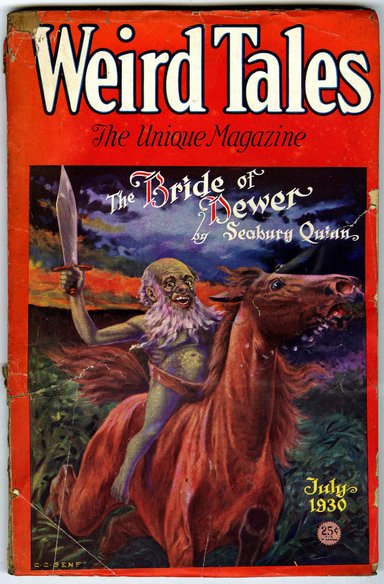
Cover by C. C. Senf, illustrating this story.
“I WALTER take thee Rosemary to be my wedded wife, to have and to hold from this day forward, for better, for worse——”
Dr. Bentley’s measured, evenly modulated words, echoed by the bridegroom’s somewhat tremulous repetitions, sounded through St. Philip’s.
“Eh bien,” irrepressible at church as elsewhere, Jules de Grandin whispered in my ear, “I feel myself about to weep in concert with the attenuated lady in lavender yonder, Friend Trowbridge. We may hold back the tears at a funeral, for the poor defunct one’s troubles are over and done, but at a wedding—pardieu, who can prophesy the outcome?”
“S-s-sh!” I commanded, reinforcing my scandalized frown with a sharp dig of my elbow in his ribs. “Can’t you be quiet anywhere?”
“Under compulsion, yes,” he responded, grinning elfishly at my embarrassment, but——”
“——and have declared the same by giving and receiving a ring, and by joining hands, I now pronounce that they are man and wife”—Dr. Bentley’s announcement concluded the ceremony, and the majestic strains of Mendelssohn’s Wedding March drowned out the Frenchman’s chatter.
Somewhat later, at the bride’s home, de Grandin, pleasantly warmed by several glasses of champagne punch, lifted Rosemary Whitney’s white-gloved hand to his lips. “Madame Whitney,” he assured her, and his little blue eyes swam with sudden tears, “may the happiness of this night be the smallest part of the happiness which lies in store for you; may you and Monsieur Whitney be always happy as I should have been, had not le bon Dieu willed otherwise!”
He was strangely silent on the way home. The propensity to chatter which kept his nimble tongue wagging most of his waking hours seemed to have deserted him entirely. Once or twice he heaved a deep, sentimental sigh; as we prepared for bed he forebore to make his usual complimentary remark about the excellence of my brandy, and even omitted to damn the instigators of the Eighteenth Amendment.
IT MIGHT have been three o’clock, perhaps a bit later, when the shrewish, insistent scolding of my telephone bell woke me.
“Doctor—Dr. Trowbridge”—the voice across the wire was low and muted, as though smothered beneath a weight of sobs—“can you come over right away? Please! This is Mrs. Winnicott, and—it—it’s Rosemary. Doctor, she’s home, and—yes, yes,” evidently she turned to someone at her elbow, “right away.” Once more, to me: “Oh, Doctor, please hurry!”
I was out of bed and beginning to dress almost before the sharp click in my ear told me Mrs. Winnicott had hung up, but swift as I was, Jules de Grandin was quicker. The chatter of the bell had roused him, and from the doorway of my room he had heard enough to realize an urgent call had come. While I still fumbled, cursing, at the fastenings of my collar, he passed down the upper hall, fully dressed. With my medicine and instrument kits in readiness he was waiting in the lower passage as I clattered down the stairs.
“It’s Rosemary Winnicott—Whitney, I mean,” I corrected myself. “Her mother just ’phoned, and though she wasn’t specific I gathered something dreadful has happened.”
“Mordieu, la petite Madame la Mariée?” he exclaimed. “Ohé, this is monstrous, my friend! Hurry; make haste!”
A round, red sun, precursor of a broiling June day, was slowly creeping over the horizon as we reached the Winnicott house and dashed through the front door without the formality of knocking.
In her pretty pink-and-ivory chamber Rosemary Whitney lay, pale as an image graven out of marble beneath the damask counterpane of the virginal bed she had risen from the previous morning with such sweet day-dreams as young girls know upon their wedding morns. Her eyes were quiet, though not closed, and her lips, blenched as though bereft of every drop of blood, were slightly parted. Once or twice she turned her head upon the pillow, weakly, like a fever patient, and emitted a little, frightened moan. That was all.
Impotent as a mother bird which sees its fledgling helpless before a coiling serpent—and as twitteringly nervous—Mrs. Winnicott stood beside her daughter’s bed, holding the little white hands that lay so listlessly on the bedspread, reaching mechanically for the phial of sal volatile which stood upon the night-table, then putting it back unopened.
“What is it? What has happened, if you please?” de Grandin cried, placing the medicine cases on a chair and fairly bounding to the bedside.
“I—I don’t know—oh, I don’t know!” Mrs. Winnicott wailed, wringing her hands helplessly together. “An hour ago—less, maybe—Walter and Rosemary drove up. Walter seemed stunned—almost as though he had been drugged—when he helped her from the car, and said nothing, just half led, half dragged her to the porch, beat upon the front door a moment, then turned and left her. I couldn’t sleep, and had been sitting by the window, watching the sky lighten in the east, so I saw them come. When I reached the front door Walter had gone and my poor baby lay there, like this. She’s been the same ever since. I’ve begged her to tell me—to answer me; but—you can see how she is for yourselves!”
“And Walter made no explanation; didn’t even stay to help her up to bed?” I asked incredulously.
“No!”
“The young whelp—the scoundrel!” I gritted through my teeth. “If I could get my hands on him, I’d——
“Tiens, my friend, our hands are excellently well filled right here,” de Grandin reminded sharply. “Come, attend Mademoiselle—Madame, I mean; chastisement of the truant bridegroom may come later, when we are more at leisure.”
Quick examination disclosed no physical injury of any kind. Rosemary suffered only from profound shock of some sort, though what the cause might be she was no more able to tell us than had she been a newborn babe. The Frenchman’s diagnosis paralleled mine, and before I could do more than indicate my opinion he had flown to the medicine case, extracted a hypodermic syringe and a phial of tincture digitalis, then prepared an alcohol swab for the patient’s arm. With an ease and quickness that bespoke his experience in the field dressing-stations of the war, he drove the needle through the girl’s white skin, and the powerful heart-regulant shot home. In a few moments her quick, light breathing became more steady, her piteous moaning less frequent, and the deathly pallor which had disfigured her features gave place to the faint suspicion of a normal color.
“Bien—très bon!” He regarded his handiwork complacently. “In a few moments we shall administer a sedative, Madame, and your daughter will sleep. From that time forth it is a matter of nursing. We shall procure a skilled attendant at once.”
“HULLO, Trowbridge,” greeted a familiar voice on the telephone shortly after our return from Mrs. Winnicott’s, “d’ye know a fellow named Whitney—Walter Whitney? Seems to me you were his family’s physician—this is Donovan talking, over at City Hospital, you know.”
“Yes, I know him,” I answered grimly. “What——”
“All right, you’d better come over and get him, then. A policeman picked him up a little while ago, nutty as a store full o’ cuckoo clocks. Shortly before sunrise this mornin’ he was drivin’ his car round and round City Hall—seemed to think the Public Square was some sort o’ bloomin’ merry-go-round, and if the officer hadn’t had more sense than most, he’d be decoratin’ a cell at some station house now, with a drunk an’ disorderly charge against him, instead of bein’ here an’ keepin’ more urgent cases out of a bed in H-3. Come on over and get him like a good fellow, won’t you?”
“You mean——”
“I sure do, son. It’s not dope an’ it isn’t booze—the boy’s as clean as a ribbon and sound as a hound’s tooth, but it’s something, all right, and I don’t mean maybe. I wish you’d come and take him off our hands. This isn’t any sanatorium for the idle rich, this is a bums’ roost, man.”
“All right,” I promised, turning wearily away. To de Grandin, I announced:
“It seems we’ll have to revise our opinion of Walter Whitney. Evidently whatever struck poor little Rosemary hit him, too; he’s over in the psychopathic ward of City Hospital, suffering from shock of some sort.”
“Morbleu, this is tragic, no less!” the little Frenchman exclaimed as we set out to get the stricken bridegroom.
THERE was no doubt Walter Whitney had suffered an ordeal of some kind. His face was serious, preoccupied, as though he sought to catch the lilt of faint, far-away music, or was trying desperately to recall the rime of a snatch of half-remembered verse. When we addressed him he gave back a non-comprehending, vacant-eyed stare, and if we spoke sharply he repeated our words with slow hesitancy, like a child learning to talk or an adult struggling with the intricacies of some foreign language. Once or twice his eyes brimmed with tears, as tears come sometimes at memory of some long-forgotten sorrow, and once he spoke spontaneously.
“What?” I asked, bending down to catch his mumbled answer.
“The—old tale? It’s—true—after—all,” he muttered slowly, unbelievingly. And when I asked him what he meant he murmured thickly: “God have mercy on us!”
FOR ten long days we labored with the stricken bride and bridegroom. Several times a day de Grandin or I called on them, but it was the little Frenchman’s indomitable will which dragged them back from the lethargy which succeeded the first onset of their strange malady to something near the normal. It was on the eleventh day, while we were visiting Rosemary, that she broke her semi-trance and spoke connectedly.
“Walter and I stole out the back door to where he’d parked his car in the alley while the guests were making merry in the front part of the house,” she began with a sad, reminiscent smile, like an old woman recalling the joys of her vanished youth. “We drove to Bladenstown, where Walter had engaged a suite at the Carteret Inn by wire, and he waited in the garden while I fussed about the rooms.
“I’d slipped out of my going-away dress and put on pajamas and kimono, and had finished creaming my face and brushing my hair when——”
She paused, catching her lower lip between her milk-white teeth, like a little girl afraid of what she may say next.
“Yes, Madame,” de Grandin prompted softly, his little blue eyes shining, “and then?”
“I heard a footstep on the stairs,” she answered, a faint flush mantling her pale cheeks. “I thought it was Walter, and——” Again a little pause, then:
“I switched the lights off quickly and dropped my kimono and slippers as I ran across the room and leaped into the bed. I didn’t want him to find me up, you see.”
Evidently we were expected to understand, and, though neither of us did, we nodded slowly in concert.
“The steps came up the little hall leading from the stairs to our suite,” she went on, “and paused before the door, then went down the hall, a little uncertainly, finally came back, and I could hear someone trying the latch tentatively.
“My heart was beating so it almost shut my breath off, and there was goose-flesh all over me; I felt a sort of feverish-chill inside, but I couldn’t help but giggle. Walter was as scared as I. Somehow, one doesn’t expect a man to be all cold and trembly in such circumstances, but I knew he was and—and it made me feel happier—more as if we were starting out even, you know.
“Just then the door opened a little, tiny crack, and as it did so, the moon, which had been behind the poplars growing at the lower end of the garden, sailed up into the sky and flooded the room with light. I held my breath, and put out my arms toward Walter, then—it came in!”
Her face went white as chalk as she pronounced the words, and we could see the tiny nodules of horripilation form on her forearms.
“It?” De Grandin wrinkled his brows in puzzlement. “What is it you say, Madame?”
“It came in—into the parlor of our suite. There was a little, tittering laugh, like the affected snicker of a wicked, senile man—an old roué listening to a nasty, scandalous story, and then I saw it. Oh!” she put her thin, pale hands to her face as though to shut away a sight too terrible for memory, and her narrow, silk-sheathed shoulders shook with sobs of revulsion.
“It wasn’t like a man, and yet it was. Not more than four feet tall, very stooped and bandy-legged, with no covering except a thick, horny hide the color of toadskin, and absolutely no hair of any kind upon its body anywhere. About the great, wide grinning mouth there hung a fringe of drooping, wart-like tentacles, and another fringe of similar protuberances dangled from its chin, if it could be said to have a chin, for the head and face were more like those of a horned toad or lizard than anything I can think of. There seemed to be some sort of belt or sash about the creature’s waist, and from it hung a wide-bladed shortsword without a scabbard.
“It stopped just inside the room, and looked around with dreadful, shining eyes that never changed expression, then came slip-slopping on its wide, splayed feet toward the bed where I lay petrified with horror.
“I wanted to scream, to jump up and run, to fling a pillow at the awful nightmare-thing which crept closer and closer, but all I could do was lie there and stare—I couldn’t even lower the arms I’d held out to my husband when I thought I heard him at the door.
“When it was almost up to me it spoke. ‘Don’t ’ee try and get away, my puss,’ it said, with a sort of horrible chuckle. ‘’Tis many and many a year since the old one had a man-child to take a bride to wife, and the bargain was only for their bride-night; nothing more. Lie quiet while I warm my chilled face in your bosom, my pretty, for it’s been more time than you can know since I’ve done as much——’
“Then”—she paused a moment, fighting for breath like a winded runner finishing a race—“then it came over to me and put its arms about me—ugh! they were cold as something fished up from the river!—and kissed me—kissed me on the mouth!”
Her voice rose to a shrill, thin scream as she finished, and for a moment she gasped weakly, then fell back against her pillows, her slender torso retching with physical sickness induced by the dreadful memory.
I hastened to administer aromatic ammonia, and in a few minutes she regained comparative calm.
“I don’t know what happened next,” she whispered. “I fainted, and the next I knew I was here in bed, with Mother and the nurse beside me.
“Tell me,” she added suddenly, “what’s become of Walter? I’ve been so weak and miserable all the while that I’ve scarcely noticed his absence; but I haven’t seen him once. Oh, Dr. Trowbridge, Dr. de Grandin, don’t tell me that awful creature—that horrible monster—hurt him—killed—oh, no! That would be too cruel! Don’t tell me, if it’s so!”
“It is not so, Madame,” de Grandin assured her gently. “Monsieur your husband has suffered severe shock, also, though as yet we do not know what induced it; but we believe he will soon be himself again; then we shall bring him to you.”
“Oh, thank you, thank you, sir,” she answered, the first smile showing on her pale, wasted face. “Oh, I’m so glad. My Walter, my beloved, is safe!” Clean, cleansing tears, over-wrought woman’s best restorative, coursed down her cheeks.
“Be of good courage, Madame,” de Grandin bade. “You have suffered much, but you have youth and love, you have each other; you also have Jules de Grandin for ally. The odds are all in your favor. But of course.”
“WELL, what d’ye make of it?” I demanded as we descended the Winnicott front steps. “Sounds to me as if she fell asleep and suffered such a nightmare that it carried over into her conscious mind, and——”
“And Monsieur her husband, who has been no less profoundly affected—did he also suffer a realistic cauchemar at the same time, perhaps?” broke in the Frenchman. “Non, my friend, your theory is untenable. I would it were not; the explanation would provide an easy exit from our difficulties.”
I set my lips grimly. “D’ye know what I think?” I answered.
“Parbleu, do you?” his elfin grin took the sting from the sarcasm.
“I believe the poor girl was temporarily unbalanced by some dreadfully vivid dream, and when that worthless scoundrel she married realized it, he took her home—returned her like an unprincipled woman throwing back a piece of merchandise on a shopkeeper’s hands!”
“But this so strange malady he suffered—still suffers?” de Grandin protested.
“Is malingering, pure and simple, or his guilty conscience preying on his mind,” I returned.
“Oh, là, là; le bon Dieu preserve the little patience with which heaven has endowed Jules de Grandin!” he prayed. “My good Trowbridge, my excellent, practical one, ever seeing but so much oil and pigment in a painting, but so many hundredweight of stone in a statue. Mort d’un coq, but you annoy me, you vex me, you anger and enrage me—me, I could twist your so stupid neck! What lies behind all this I know no more than you, but may Satan serve me fried with parsley if I traverse Monsieur Robin Hood’s barnyard seeking a conventional explanation for something which fairly reeks of the super-physical. No, a reason there is, there must be, but you are as far from seeing it as an Icelander is from hearing the blackbirds whistle in the horse-chestnuts of St. Cloud! Yes.”
“Well, where are you going to hunt this supernatural explanation?” I demanded.
“I did not say supernatural,” he answered acidly. “Everything is natural, though if we do not know, or if we misread nature’s laws, we falsely call it otherwise. Consider: Fifty years ago a man beholding the radio would have called it supernatural, yet the laws of physics governing the device were known as well then as now. But their application had not yet been learned. So in this case. Who—or what—it was Madame Whitney beheld upon her bridal night we do not know, nor do we in anywise know why she should have seen it; but that it was no figment of a dream Jules de Grandin is prepared to wager his far from empty head. Certainly.
“Now, first, we shall interrogate Monsieur Whitney; perhaps he can tell us that which will put us on the proper track. Failing that, we shall make discreet inquiries at the inn where the manifestation was seen. In that way we may acquire information. In any event, we shall not cease to seek until we have found. No, Jules de Grandin is not lightly to be thrown off the trail of ghost or human evil-doer, friend Trowbridge.”
“Humph!” I grunted. There seemed nothing else to say.
“DES bonnes nouvelles, mon ami!” de Grandin exclaimed. “But yes; certainly; assuredly we bring you great tidings of gladness. Madame your wife is most greatly improved, and if you show similar progress we shall take you to her within the week. Come, smile. Is it not wonderful?”
Walter Whitney raised a face which was like a death-mask of joy, and the smile he essayed was sadder than any tears. “I can’t see her; I shall never see her again,” he answered tonelessly.
“What is it you say? But this is infamous—monstrous!” the Frenchman exploded. “Madame your wife, who has but emerged from the valley of death’s shadow, desires to see you; la pauvre, belle créature, she expected, she deserved happiness and love and tenderness; she has had only sorrow and suffering, and you sit there, Monsieur, like a bullfrog upon the marsh-bank, and say you can not see her! It is damnable, no less, cordieu!” He fairly sputtered in his fury.
“I know,” Whitney answered wearily. “I’m the cause of it all; she’ll suffer worse, though, if I see her again.”
“What, cochon!—you would threaten her, the wife of your bosom?” De Grandin’s strong, deceptively slender fingers worked spasmodically.
For an instant faint animation showed in young Whitney’s somber, brooding face. “It isn’t anything I’d do to her—I’d give my heart’s blood to save her an instant’s suffering!—but it’s through me, though without my intention, that she’s suffered as she has, and any attempt on my part to join her would only renew it: I can’t see her, I mustn’t see her again—ever. That’s final.”
“May Jules de Grandin stew everlastingly in hell with Judas Iscariot on his left hand and he who first invented Prohibition on his right if it be so!” the Frenchman cried. “Làche, coward, wife-deserter, attend me: From her parent’s arms and from her loving home you took that pure, sweet girl. Before the holy altar of your God and before all men you vowed to love and cherish her for better, for worse, in sickness and in health. Together, beneath the golden beams of the honeymoon, you set forth upon life’s pathway. Ha, it was most pretty, was it not?” He smiled sarcastically. “Then what? This, mordieu: At the inn Madame your wife experienced a shock, she became hysterical, temporarily deranged, we will say; it is often so when young girls leave the bridal altar for their husbands’ arms. And you, what of you? Ha, you, the man on whose lips still clung the lying words you mouthed before the altar, you saw her so piteous condition, and like the poltroon you are, you did return her to her home; yes, to her parent’s house; pardieu, you took her back as an unprincipled woman returns a damaged gown to the shopman! Ha, you decorate your sex, Monsieur; I do remove my hat in your so distinguished presence!” Seizing his wide-brimmed Panama, he clapped it on his head, then swept it nearly to the floor in an elaborate parody of a ceremonious bow.
White lines showed in Walter Whitney’s face, deep wrinkles of distress cut vertically down his cheeks. “It’s not so!” he cried, struggling weakly to rise. “It’s a damned, infernal lie! You know it is! Damn you, you slanderous rascal, you wouldn’t dare talk so if I had my strength! I tell you, I’m responsible for Rosemary’s condition today, though it’s no fault of mine. I said I’d give my blood to spare her—good Lord, what do you think this renunciation is costing me? I—oh, you wouldn’t understand; you’d say I was crazy if I told you!”
“Your pardon, mon petit pauvre,” de Grandin answered quickly. “I did but hurt you to be kind, as the dentist tortures for a moment with his drill that the longer agony of toothache may be avoided. You have said what I wished; I shall not pronounce you crazy if you tell me all; on the contrary, I shall thank you greatly. Moreover, it is the only way that I can be rendered able to help you and Madame Whitney back to happiness. Come, begin at the beginning, and tell me what you can. I am all attention.”
Whitney looked at him speculatively a moment. “If you laugh at me I’ll wring your neck, when I get well,” he threatened.
“I suppose you and Rosemary and everybody else were justified in thinking all you did of me when I took her home the other morning,” he continued, “but I did it only because I knew nowhere else to go, and I knew my brain was going to snap ’most any minute, so I had to get her to a place of safety.
“I don’t know whether you know it or not, Dr. Trowbridge,” he added, turning to me, “but none of the men in my family that I can remember have ever married.”
“Your father—— I began with a smile, but he waved the objection aside.
“I don’t mean that. You’ve known us all; think of my uncles, my cousins, my elder brothers. See what I mean?”
I nodded. It was true. His mother’s three brothers had died unmarried; had never, as far as I knew, even had sweethearts, though they were fine, sociable fellows, well provided for financially, and prime favorites with the ladies. Two of his cousins had perished in the World War, both bachelors; another was as confirmed in celibacy as I; the fourth had recently taken his vows as an Episcopal monk. His brothers, both many years his senior, were still single. No, the score was perfect. Walter was the first male of his blood to take a wife within living memory. But:
“Both your sisters married,” I reminded him.
“That’s just it; it doesn’t affect the women.”
“What in the world——” I began, but he turned from me to de Grandin.
“My parents were both past forty when I was born, sir,” he explained. “My brothers and sisters were all old enough to have had me for a child, and both the girls were married, with families of their own before I came. I used to wonder why all our men were bachelors, but when I mentioned it, nobody seemed to care to answer. Finally, when I was just through prep school and ready to go to Amherst, my Aunt Deborah took me aside and tried to make it plain.
“Poor old girl, I can see her now, almost ninety years of age, with a chin and nose that almost met and the shrewdest, most knowing eyes I’ve ever seen in a human face. I used to think the man who illustrated the fairy-tale books got his idea of the witches from looking at her when I was a little tad, and later I regarded her as a harmless old nut who’d rather find the hole than the doughnut any day. Well, she’s got the laugh on me from the grave, all right.
“‘You must never think of marrying, Wally,’ she told me. ‘None of our men can, for it means only wo and calamity, usually death or madness for the wives, if they do. Look at your brothers, your uncles and your cousins; they’ll never marry; neither must you.’
“Naturally, I asked why. I’d had one or two heavy love affairs during prep days, and was already thinking seriously of settling down and raising a mustache and a family as soon as I graduated from college. Her statement rather seemed to cramp my style.
“‘Because it’s a curse put on our family,’ she answered. ‘’Way back, so far none of us know just how it happened, or why, one of our ancestors did something so utterly vile and wicked that his blood and his sons’ blood has been cursed forever. We’ve traced our genealogy through the female line for generations, for two generations of the family have never lived to bear the same surname.
“‘See here’—she took me out into the hall where the old Quimper coat of arms hung framed upon the wall—‘that’s the crest of the ancestor who brought the curse upon us. The family—at least his direct male descendants—died out in England centuries ago and the arms were struck from the rolls of the College of Heralds for want of one to bear them, but the blood’s poisoned, and you’ve got it in your veins. Wally, you must never, never think of marrying. It would be kinder to kill the girl outright, instead!’
“She was so earnest about it that she gave me the creeps, and laughing at her didn’t better things.
“‘Once, long ago, so long that I can only remember hearing my parents talk of it when I was a very little girl,’ she told me, ‘one of our men dared the curse and married. His wife went stark, raving mad on her bridal night, and he lived to be a broken, embittered old man. That’s the only instance I know of the rule being broken, but don’t you break it, Wally, or you’ll be sorry; you’ll never forgive yourself for what you did to the girl you loved when you married her!’
“Aunt Deborah was dead and in her grave at Shadow Lawns when I came back from college, and Mother had only the vaguest notions of the curse. Like me, she was inclined to regard it as one of the old lady’s crack-brained notions, and, though she never actually said so, I think she resented the influence the old girl had in keeping so many of our men single.
“Mother died two years ago, and I’ve lived here by myself since. Rosemary and I had known each other since the days when I used to scalp her every afternoon and hang her favorite doll in chains each morning, and while we’ve never really been swethearts in our younger days, we’d always been the best of friends and kept up the old intimacy. Last Decoration Day I was a little late getting out to Shadow Lawns, and when I reached the family plot I met Rosemary coming away. She’d been putting flowers on my parents’ graves.
“That really started it. We became engaged last fall, and, as you know, were married this month.
“Oh, Lord,” his face went pale and strained as though with bodily torture, “if I’d only known! If I’d only known!”
“Eh bien, Monsieur, we also desire to know,” de Grandin reminded.
“We’d planned everything,” Whitney continued. “The house was to be redecorated throughout, and Rosemary and I were going to spend our honeymoon away while the painters were at their work here.
“The night we married we drove to Carteret Inn and I waited in the garden while she unpacked and made her toilet for the night. The blood was pounding at my temples and my breath came so fast it almost smothered me while I strolled about that moonlit garden.
“D’ye remember how you felt sort o’ weak and trembly inside the first time you went up to ring a girl’s doorbell—the first time you called on your first sweetheart?” he asked, turning a wan smile in my direction.
I nodded.
“That’s how I felt that night. I’d been a clean-lived chap, Dr. Trowbridge. I’m not bragging; it just happened so; but that night I thanked God from the bottom of my heart that Rosemary could give me no more than I took to her—there’s consolation for all the ‘good times’ missed in that kind of thought, sir.”
Again I nodded, thoroughly ashamed of all the suspicions I’d voiced against the lad.
“I kept looking at my watch, and it seemed to me the thing must have stopped, but at last a half-hour crawled by—it seemed more like half a century. Then I went in.
“JUST as I began to mount the stairs I thought I saw a shadow in the upper hall, but when I looked a second time it was gone; so I assumed it had been one of the hotel servants passing on his duties, and paid no more attention. The latch of our door seemed stuck somehow, or perhaps my nervous fingers were clumsy; at any rate, I had some trouble getting in. Then——”
He stopped so long I thought he had repented his decision to take us into his confidence, but at length he finished:
“Then I went in. My God! What a sight! Something like a man, but green all over, like a body that has lain in the river till it’s ready to drop apart, was standing by the bed, holding Rosemary in its arms, and nuzzling at her bosom where her pajamas had been torn away with the most horrible, obscene mouth I’ve ever seen.
“I tried to rush the thing and beat it off, but my limbs were paralyzed; neither arm nor leg could I move. I couldn’t even cry out to curse the foul nightmare-goblin that held my wife against its nude, slimy breast and wheezed and snuffled at her as an old, asthmatic dog might sniff and slaver at a wounded bird.
“At last the horror seemed aware of my presence. Still holding Rosemary in its arms, it lifted its misshapen head and grinned hellishly at me. Its eyes were big as silver dollars, and bright as fox-fire glowing in the marsh at night.
“‘I’m come to claim my rights, Sir Guy,’ it told me, though why in God’s name it should address me so I’ve no idea. ‘’Tis many a year since last one of your gentle line gave in to me; they’ve cheated me right handsomely by staying womanless; but you’ve been good to me, and I thank ye right kindly for it.’
“I stood and stared, petrified with horror, weak with positive physical nausea at very sight of the fetid thing which held my wife, and the monster seemed suddenly to notice me again. “What, still here?’ it croaked. ‘Be off, ye churl! Have ye no more manners than to stand by staring while your liege lord wages his right? Be off, I say, or there ye’ll stand till all is done, nor will ye lift a hand to stay me.’
“But I did lift a hand. The terror which had held me spellbound seemed to melt as I caught a glimpse of Rosemary’s white face; and as the awful creature’s flat, frog’s-claw hands ripped another shred of her nightclothes away, I yelled and charged across the room to grapple with the thing.
“With a dreadful, tittering laugh it dropped Rosemary on the bed and turned to meet my onset, drawing a sort of short, wide-bladed sword from its girdle as it did so. I never had a chance. The slimy, naked monster was shorter by a foot than I, but for all its misshapen deformity it was quick as lightning and tremendously strong. Its arms, too, were half again as long as mine, and before I could land a single blow it hit me on the head with the flat of its sword and floored me. I tried to rise, but it was on me before I could struggle to my knees, beating at my head with its blade, and down I went like a beaten prize-fighter.
“How long I lay unconscious I do not know, but when I came to, the first faint streaks of morning were lighting the room, and I could see almost as plainly as by moonlight. The horrid apparition had vanished, but there was a strong, almost overpowering stench in the room—a stink like the smell of stagnant water that’s clogged with drowned and rotting things.
“Rosemary lay half in, half out of the bed, her lips crushed and bruised and a darkened spot upon her nose, as though she had been struck in the face. Her nightclothes were ripped to tatters, the jacket hanging to her shoulders by shreds, the trousers almost ripped away, and there were stains of blood on them.
“I got some water from the bathroom and washed her poor, bruised face and bathed her wrists and temples. Then I found some fresh pajamas in her bag. Presently she waked, but didn’t seem to know me. She didn’t speak, she didn’t move, just lay there in a sort of waking stupor, staring, staring and seeing nothing, and every now and then she’d moan so pitifully it wrung my heart to hear her.
“After trying vainly to revive her for a time I managed to get her clothes on somehow and lugged her downstairs to the car. Nobody was awake at that hour; nobody saw us leave, and I didn’t know which way to turn. Bladenstown is strange to me, I didn’t know where to look for a doctor, and there was no one to ask. If I had found one, what could I have told him? How could I explain Rosemary’s condition on her wedding night? You don’t suppose he’d have believed me if I’d told him the truth, do you?
“So I turned back toward Harrisonville and all the time, as I drove, something inside me seemed to say accusingly: ‘It’s your fault; it’s your fault; this is all your doing. You wouldn’t listen to Aunt Deborah; now see what you’ve brought on Rosemary!’
“‘Your fault—your fault—your fault!’ the humming of my motor seemed to chuckle at me as I drove.
“And it was. Too late I realized how terrible the curse on our family is, and what a dreadful ordeal I’d subjected Rosemary to. My heart was breaking when I reached her mother’s house, and I couldn’t find the words to tell her what had happened. I only knew I wanted to get away—to crawl off somewhere like a wounded dog and die.
“Then, as I left the Winnicott house and drove toward the center of the city, something seemed to go ‘snap’ inside my head, and the next I knew you gentlemen had me in hand.
“So now you know why I can never see Rosemary again,” he finished. “If I yield to my heart’s pleadings and go to her I know I shan’t be strong enough to give her up, and rather than bring that thing on her again, I’ll let her—and you, and all the world—think what you will of me, and when she sues me for divorce I’ll not contest the action.
“Now tell me I’m crazy!” he challenged. “Tell me this is all the result of some shock you can’t explain, and that I just imagined it. I don’t care what you say—I was there; I saw it, and I know.”
“Assuredly you do, mon vieux,” de Grandin conceded, “nor do I think that you are crazy, though the good God knows you have admirable excuse if you were. Non, I believe you firmly, but your case is not so hopeless as it seems. Remember, Jules de Grandin is with you, and it shall go hard but I shall make a monkey of this so foul thing which had no more discretion than to thrust itself into your bridal chamber. Yes, pardieu, I promise it!”
“I’M SORRY for what I said about that boy,” I confessed contritely as we left young Whitney’s house. “But appearances were certainly against him, and——”
“Zut, no apologies, my friend!” de Grandin admonished. “I am glad you lost your temper, for your suspicions, unworthy as they were, did furnish me with the very accusations I needed to sting him from his silence and force from him the explanation which shall aid us in our task.”
“Explanation?” I echoed. “I don’t see we’re much nearer an explanation than we were before. It’s true Walter’s story corroborates Rosemary’s, but——”
“But I damn think I see the glimmer of light ahead,” the Frenchman cut in with a smile. “Consider: Did not you catch the two small clues Monsieur Walter let drop?”
“No, I can’t say I did,” I returned. “As far as I was concerned the whole business was an unrelated hodge-podge of horror, meaningless as the vagaries of a nightmare.”
“What of the remarks made by the visitant concerning its having come to claim its rights?” he asked. “Or, by example, the odd manner in which it addressed the young Walter as Sir Guy? Does not that suggest something to you?”
“No, it doesn’t.”
“Eh bien, I should have known as much,” he returned resignedly. “Come, if you have time, accompany me to New York. I think our friend, Dr. Jacoby, may be able to enlighten us somewhat.”
“Who is he?”
“The curator of mediæval literature at the Musée Métropolitaine. Parbleu”—he gave a short chuckle—“that man he knows every bit of scandalous gossip in the world, provided it dates no later than the Fifteenth Century!”
THE long summer twilight was deepening into darkness as we entered the walnut-paneled, book-lined office of Dr. Armand Jacoby in the big graystone building facing Fifth Avenue.
The learned doctor appeared anything but the profound savant he was, for he was excessively fat, almost entirely bald, and extremely untidy. His silk shirt, striped with alternate bands of purple and lavender, was open at the throat, his vivid green cravat was unknotted but still encircling his neck, and a thick layer of pipe-ashes besprinkled his gray-flannel trousers. “Hullo, de Grandin,” he boomed in a voice as big and round as his own kettle-like abdomen, “glad to see you. What’s on your mind? You must be in some sort of trouble, or you’d never have made the trip over in this infernal heat.”
“Tiens, my friend,” the Frenchman answered with a grin, “your perception is as bounteous as your hair!” Then, sobering quickly, he added: “Do you, by any happy chance, know of a mediæval legend, well-authenticated or otherwise, wherein some knight, probably an Englishman, swore fealty to some demon of the underworld, or of the ancient heathen days, giving him le Droit du Seigneur?”
“What was that?” I interrupted before Jacoby could reply.
The doctor looked at me as a teacher might regard a singularly backward pupil, but his innate courtesy prompted his answer.
“It was the right enjoyed by feudal lords over the persons and property of their people,” he told me. “In mediæval times society was divided into three main classes, the nobility, with which the clergy might be classed, the freemen, and the serfs or villeins. The freemen were mostly inhabitants of towns, occasionally they were the yeomanry or small farmers, while the serfs or villeins were the laborers who cultivated the land. One of the peculiarities of these poor creatures’ condition was they were in no circumstances allowed to move from the estate where they lived, and when the land was sold they passed with it, just like any fixture. The lord of the manor had practically unlimited power over his serfs; he might take all they possessed and he might imprison them at his pleasure, for good reason or for no reason. When they died, whatever miserable property they had been able to accumulate became his instead of passing to their children. Even the burghers and yeomen were under certain duties to their lord or seigneur. They had to pay him certain moneys on stated occasions, such as defraying the expenses of knighting his eldest son, marrying his eldest daughter, of bailing him out when he was captured by the enemy. These rights were properly grouped under the term Droit du Seigneur, but in later times the expression came to have a specialized meaning, and referred to the absolute right enjoyed by many barons of spending the first night of marriage with the bride of any of his liegemen, occupying the hymeneal chamber with the bride while the bridegroom cooled his heels outside the door. Because of this it is probable that a third of the commoners’ children in mediæval Europe had gentle blood in their veins, although, of course, their social status was that of their mothers and putative fathers. The French and German peasants and burghers submitted, but the English yeomen and townsmen put one over on the nobles when they devised a law of inheritance whereby estates descended to the youngest, instead of the eldest son. You’ll find it all in Blackstone’s Commentaries, if you care to take the time.”
“But——”
Dr. Jacoby waved my question aside with a waggle of his fat hand and turned directly to de Grandin. “It’s an interesting question you raise,” he said. “There are a dozen or more legends to that effect, and in Scotland and northern England there are several castles where the progeny of those demons who exercised their Droit du Seigneur are said to dwell in secret dungeons in a kind of limited immortality. There’s one Scottish castle in particular where the head of the house is supposed to take the heir-apparent into his confidence upon his becoming of age, tell him the story of the family scandal and give him the key to the dungeon where his half-man, half-demon relative is cooped up. No one but the head of the family and his heir are supposed to have these keys, and only they are permitted to see the monstrosity. There’s a pleasant little story of the French wife of the Scottish laird who let her curiosity get the better of her, abstracted the dungeon key from her husband’s dispatch case and went down to see for herself. They found her wandering about the cellar next morning, her hair snow-white and her mind a blank. She ended her days in a lunatic asylum.”
“Very good,” de Grandin nodded. “But have you any memoranda of such a compact being made and carried out for several generations?”
“H’m,” Dr. Jacoby caressed his fat chin with the fat thumb and forefinger of his wide, white hand. “N-o, I can’t say I have. Usually these stories are buried so deep under additional legends that it’s practically impossible to get at the root-legend, but—hey, wait a minute!” His big eyes lighted with enthusiasm behind the pebbles of his thick-lensed spectacles. “There is an old tale of that kind; Queberon, or Quampaire, or some such name was the man’s, and the demon was called——” He paused, pondering a moment, then: “No, it’s no use, I can’t remember it; but if you’ll give me forty-eight hours I’ll dig it out for you.”
“Oh, my supreme, my superb, my so magnificent Jacoby!” de Grandin answered. “Always are you to be depended on. Your offer is more than satisfactory, my old one, and I am certain you are on the right track, for the modernized style of the name I have in mind is Quimper.”
“Humph, that’s not so modern,” Jacoby answered. “I shouldn’t be surprized if it’s the original patronymic.”
TWO days later a thick envelope arrived for de Grandin, and my excitement was almost equal to his as he slit the flap and unfolded several sheets of closely written foolscap.
“The legend you spoke of,” Jacoby wrote, “is undoubtedly that of Sir Guy de Quimper—probably pronounced ‘Kam-pay’ and differently spelled in the Eleventh Century, since there was no recognized system of orthography in those days—who was supposed to have made a bargain with a North England demon in return for his deliverance during the battle of Ascalon. I’ve tried to modernize a monkish account of the deal; perhaps you’ll learn what you wish from it, but I must remind you that those old monks were never the ones to spoil a good story for the truth’s sake, and when sufficient facts were not forthcoming, they never hesitated to call on their imaginations.”
“The warning was unnecessary,” de Grandin laughed, “but we shall see what Monsieur l’Historien has to say, none the less.”
“Pray ye for daughters, oh ye womenfolk of Quimper, and ask the Lord of His mercy and loving-kindness to grant ye bring no man-children into the world, for of a surety there rests upon the house of Quimper, entailed on the male line, a curse the like of which was never known before, and, priedieu, may not be known again till the heavens be rolled up like a scroll and all the world stand mute before our God His judgment seat.
“For behold, it was a filthy act wrought by Sir Guy of eld, and with his words of blasphemy he bound forever the men of all his line to suffer through their womenfolk a dole and drearihead most dreadful.
“It was upon the day when our good Lord Godfrey of Bouillon, most prowessed of our Christian knights, with good Sir Tancred and their little host of true believers smote the Paynim horde upon the plains of Ascalon and scattered them like straw before the winter blast that Guy of Quimper and his men-at-arms rode forth to battle for the Holy Sepulcher. Anon the battle waxed full fierce, and though our good knights rode down the infidel as oxen tread the grain upon the threshing-floor, nathless Sir Guy and his companions were separated from the main host and one by one the Christian soldiers watered the field of battle with their blood.
“And now cometh such a press of Paynim warlings that Sir Guy is fairly unseated from his charger and hurled upon the earth, whereat nigh upon a hundred of the infidel were fain to do him injury, and but that the stoutness of his armor held them off were like to have slaughtered him.
“Thrice did he struggle to arise, and thrice his weight of foemen bore him down, until at last, being sore beset and fearing that his time was come, he called aloud upon St. George, saying: ‘Ho, good Messire St. George, thou patron of true knights of Britain, come hitherward and save thy servant who is worsted by these pestilent believers in the Antichrist!’
“But our good St. George answered not his prayer, nor was there any sign from heaven.
“Then my Sir Guy called right lustily upon St. Bride, St. Denis and St. Cuthbert, but the sainted ones heard not his prayer, for there were one and twenty thousand men embattled in the cause that day, and one man’s plaint might soothly go unheard.
“Sir Guy of Quimper lifted up his voice no more, but resigned himself to Paradise, but an infidel’s steel pierced through his visor bars, and he bethought him of the pleasant land of England which he should never see again, and of the gentle lady whose tears and prayers were for his safety. Then did he swear a mighty oath and cry aloud: ‘If so be none will hear my prayer from heaven, then I renounce and cast them off as they have cast off me, and to the Saxon godlings of my forebears I turn. Ho, ye gods and goddesses of eld, who vanished from fair England at the coming of the Cross, hear one in whose veins courses Saxon blood, and deliver him from his plight. Name but your boon and ye shall have it, for I am most grievously afeared my hour draweth nigh, unless ye intervene!’
“And forthwith came a rustling o’er the plain, and from the welkin rode a shape which eye of man had not seen for many a hoary age. All nakedly it rode upon a naked horse, and at its heels came troops of hounds which ran like little pigs behind their dam, and in its hand it bore a short-sword of the ancient shape, the same the Saxon serfs brandished impotently against the chivalry of our good Duke of Normandy.
“‘Who calls?’ cried out the fearsome shape, ‘and what shall be the guerdon of my service?’
“‘’Tis Guy of Quimper calls,’ Sir Guy made answer, ‘and I am sore beset. Do but deliver me from out the heathen’s hand, and thy fee shall be whatsoe’er thou namest.’
“Then up there rose a monstrous wind, as cold as bleak November’s, and on the wintry blast rode Dewer, Old Dewer, the ghostly huntsman of the North, all followed by his troop of little dogs, and with his good sword he smote them right and left, so that heads and heads fell everywhere, and scarce a Paynim stayed to do him battle.
“And when the heathen host was fled Old Dewer unhorsed himself and leaned above Sir Guy and raised him up and set him on his feet. But so fearsome was his aspect and so ill-favored his face that my Guy of Quimper was like to have fallen down again in a swound at sight of it, but that he thought him of his oath, and making a brave face spake forth: ‘Name now thy boon, for by the eyes of Sainted Agnes, well and truly hast thou earned it.’
“Whereat Old Dewer laughed full frightfully and said: ‘Upon thy two knees now kneel, Sir Guy of Quimper, and claim me as thy overlord and name thyself my vassal liegeman, holding thy demesne as of fee from out my hand, upon condition that thy line shall give me seigneur’s rights upon their bridal night, and this accord shall bind thee and thy heirs male forever unless such time shall rise as a woman of thy house shall stare me in the face and bid me hence from out her bower, which time I trow shall not be soon.’ Thereat he laughed again, and the joints of Sir Guy’s limbs were loosed and scarcely could he kneel erect before Old Dewer and place his hands between the monster’s what time he spake the words of fealty.
“Thus came Sir Guy’s deliverance from the Turk, but at such cost of tears as might almost wash out that woful wight his guilt. For on returning to his home Sir Guy found there a son whose name was likewise called Guy, and when his marriage banns were published some one and twenty years hence, and with singing and dancing and all glad minstrelsy the bride was put to bed, lo, forth from out the empty air came Dewer, Old Dewer of the North, and claimed his right of seigneury. And forth from out her bower came the bride upon the morn, her cheeks all stained with tears and her hair unloosed, and in her eyes the light of madness. Nor did she ever speak sane word again.
“And when the time was come that young Sir Guy’s junior brother was to wed, Old Dewer rode forth from out the North to claim his fee, and thus for generation unto generation came he forth whenever and wherever the wedding bells did chime for one who had but one small drop of Quimper’s blood within his veins. But the women molested he not, for it was not according to the compact that the female line be cursed.
“But those of Sir Guy’s line who knew the curse forbore to wed, and some went into Holy Church, and by their prayers and ceaseless lamentations sought surcease of the curse, and others remained virgin all their days, according to the counsel of their elders, thus cheating that old fiend whose name is Dewer, surnamed the Huntsman.
“And some there were who taught their brides the words of power which should win freedom from the curse, but when the time was come they all cried craven, for where beneath the star-jeweled canopy of heaven dwells a woman with resolution to stare Old Dewer in the face and bid him hie himself away?
“And so throughout the length of years Old Dewer cometh ever, and when the womenfolk would drive him from their chambers their tongues cleave to the roofs of their mouths and they are speechless while he works his evil will, and never yet has there been found a bride who can retain her senses when from his foul mouth Old Dewer presses kisses on her lips.
“Pray ye for daughters, oh ye womenfolk of Quimper, and ask the Lord of His great mercy and loving-kindness to grant that ye bring no man-children into the world, for of a surety there rests upon the men of Quimper a curse the like of which was never known before.”
“I MAY add,” Jacoby’s letter ended, “that I consider the story entirely apocryphal. There seems no doubt that the Quimper family once existed in the north of England, and it is highly probable some representative of the house went to the Crusades, since practically every able-bodied man was drained from Europe during that prolonged period of hysteria. There are also semi-authentic data showing that one or more ladies of the house went mad, but whether their seizures dated from their wedding nights or not I can not say. The chances strongly favor the theory that the monkish chronicler seized upon the incidents of the brides’ insanity to point a moral and adorn a tale, and for lack of an authentic one, provided the story from his own imagination. There was at one time a decided movement among the English peasantry toward the worship, or at least a half-affectionate tolerance, of the old Saxon gods and goddesses, and it may well be the old monk invented the tale of Sir Guy’s compact with ‘Old Dewer’ in order to frighten off any who expressed an opinion that the old gods might not have been the demons the Christian priests were wont to paint them.
“I might also add the Quimper arms were formally struck from the rolls two centuries or more ago because of failure of heirs in the house. Whether, as the old monk intimates, this was due to most of the men taking holy orders or remaining single in secular life, there is no way of telling. I favor the theory that one or more of the numerous plagues which swept England and the Continent in the old days, coupled with the hazards of war and the sea, may have wiped the family out.”
“Eh bien, my friend, would you not open wide those great pop-eyes of yours, could you but know what we do?” de Grandin exclaimed as he finished the letter. “Parbleu, those old friars, they were great hands at dressing the truth in strange garments, but this one, I damn think, has recited no more than the barest of bare facts.”
“All right,” I agreed, “suppose he did. While I think Dr. Jacoby is unquestionably right in his surmises, suppose we grant your premises for the sake of argument, where are we? If this mysterious goblin called Dewer actually pursues all male members of old Sir Guy’s family, no matter how distantly they are related to him, and frightens them and their brides into fits, what are we to do about it? Is there any way we can prevent it?”
“You ask me?” he demanded sharply. “Pains of a rheumatic bullfrog, I shall say there is! Does not the never-enough-to-be-blessed old nameless monk make plain the formula in his chronicle? Does he not tell us the proviso Old Dewer himself made, that if a bride accosted by him should look him in the face and bid him be off, off he will go, and nevermore return? Name of a little blue man, can anything be simpler?”
“It certainly can,” I answered. “In the first place, Rosemary Whitney was frightened almost out of her mind by the specter, or whatever it was she saw on her wedding night. We’ve had a man-sized job pulling her through this illness, and a second shock like that—even the bare suggestion that she face the ordeal again—might do such serious injury to her nervous system that she’d never recover.
“In the second place, if there is such a thing as this old goblin, and if it’s as horrible to look at as Rosemary and Walter say, she’d faint dead away the moment she saw it, and never be able to say her little piece. No, old man, I’m afraid things aren’t as simple as you seem to think.”
“Ah bah,” he held his arm up for my inspection, “has Jules de Grandin nothing up his sleeve besides his elbow, my friend? I tell you in my bag I have a trick still left which shall make a sacré singe of this Monsieur Dewer and send him home a wiser and much sadder demon. Yes; I have said it.”
“What do you propose doing?”
“That, my friend, I shall show when the appointed time arrives. Meanwhile, let us labor with all our strength to restore Monsieur and Madame Whitney, that they may face their ordeal with calmness. Thus far their improvement has been most gratifying. Within a week we should be ready for the great experiment.”
“Suppose they fail and have another relapse?” I queried. “Remember, de Grandin, this is the health and sanity of two people with which you’re gambling.”
“Suppose you cease from croaking like a raven suffering with laryngitis,” he countered with a grin. “My throat is parched with answering your so pig-stupid objections. A glass of brandy—not too small—if you will be so kind.”
BEYOND the row of rustling poplars growing at the garden’s lower boundary the moon sailed serenely in the zenith, gilding hedge and path and formal flowerbed with argent. Still farther off, where the river ran between lush banks of woodland, a choir of little frogs—“peepers”—sang serenades to the green-skinned ladies of their choice, and in an ancient cherry tree, so old it bore no fruit, though still put out its blossoms in the spring, a night-bird twittered sleepily.
“Ah, you are brave, Madame,” de Grandin affirmed, “brave like the blessed Jeanne herself, and I do most solemnly declare that you shall conquer splendidly tonight.”
Rosemary lifted starry eyes to his. Preceding us to the suite in Carteret Inn—the same rooms where she and Walter had lodged so happily a month before—she had doffed her traveling-dress and put on a robe de nuit of pale green crepe, drawing a kimono of oyster-white embroidered with gold over it. Her face was pallid as the silk of her robe, but lines of determination such as only a woman casting dice for love and happiness can know showed about her mouth as she faced Jules de Grandin. “I’m terribly afraid,” she confessed in a voice that shook with nervousness, “but I’m going to do everything you tell me to, just as you tell me, for it’s not only me I’m fighting for, it’s Walter and his happiness, and, Dr. de Grandin, I love him so!”
“Précisément,” the little Frenchman took her hand in his and raised it to his lips, “exactly, Madame, quite so; and I believe that all I say is for the best. Now, if you please, compose yourself—so—that is excellent.” From underneath his jacket he slipped a small silver-framed photograph of Walter Whitney and set it upright on the bureau before the seated girl. “Regard it fixedly, Madame,” he bade; “gaze on the features of your beloved and think how much you love him—exclude all other thoughts from your mind.”
It was as if he had ordered a starving man to eat, or commanded one rescued from the burning desert to drain a cup of cool water. The soft, adoring look which only women wholly slaves of love can give crept into the girl’s eyes as she stared intently at the picture.
“Excellent,” he murmured, “très excellent!” For upward of a minute he stood there, smiling at her as though she had been his younger sister then, very softly, he commanded:
“Madame, you are tired, you are fatigued, you much desire sleep. Sleep—sleep, Madame Whitney; I, Jules de Grandin, order it!
“Sleep—sleep——” softly as a summer breeze, soothingly as a mother’s lullaby, his murmured admonition was repeated again and yet again.
Rosemary took no seeming notice of his words; her shining, sweet blue eyes stayed fixed upon her husband’s photograph, but slowly, almost before I realized it, her white, blue-veined lids lowered, and she leaned back in her chair.
For a minute or two de Grandin regarded her solicitously, then: “Madame Whitney!” he called softly.
No answer.
“Madame Whitney, can you hear me?”
Still no response.
“Très bon; she has passed into unconsciousness,” he said, and, turning to the sleeping girl:
“Anon, Madame, there will come one of fearful aspect, who will accost you—endeavor to do you violence. Be not afraid, ma chère; he can not harm you. I tell you this and you must believe. You do believe me, Madame?”
“I believe you,” she answered sleepily.
“Good; it is well. When this one comes you will know it, though you will not see him; nor will your conscious mind realize he is here. And when he comes you will open both your eyes and say—attend me carefully, for you must say these words—‘Dewer, enemy of my husband and of my husband’s blood, depart from hence, and come not near me any more; neither near me nor any woman whom my husband’s kinsmen take to wife. Dewer, go hence.’
“When first he does approach you, you shall say this, and ever you will keep your widely opened eyes upon his foul face, yet see him you will not, for I command it. And if he goes not quickly from you, you shall repeat the words of power, nor shall you show him any sign of fear. You understand?”
“I understand.”
“Très bien. Into your bed then, and sleep and rest all peacefully until he comes.”
Mechanically the girl arose, switched off the light and crossed to the bedstead, where she removed her slippers and kimono. In another moment her light even breathing sounded through the room.
I turned to descend the stairs to join Walter where he waited in the garden, but de Grandin’s light touch upon my arm stayed me. “Not yet, my friend,” he said; “come here, we should be near at hand in case our program goes awry.” He led me toward the bathroom adjoining the suite.
IT SEEMED an hour that we waited, though actually it must have been much less. The mournful music of the frogs, the distant hooting of a motor horn, the nearer chirping of some troubled bird were all the sounds we heard except the girl’s soft breathing. Then, far away, but drawing nearer by the second, came the drumming of a horse’s hoofs.
I looked out the bathroom’s single little window, then drew back with an involuntary cry. Across the moon’s pale face, like a drifting wisp of cloud, yet racing as no tempest-chased cloud could race, there rode the squat, sinister figure of a naked horseman upon a barebacked horse.
A moment I held my breath in acute terror, and the short hairs at the back of my neck rose stiffly and bristled against my collar. Then, more dreadful than the moon-obscuring vision, there came the sound of slipping, shuffling feet upon the floor outside the room, the door swung inward, and a light, tittering laugh which seemed all malice and no mirth sounded in the quiet room. Another instant and a fetid, nauseating stench assailed my nostrils, and I turned my head away to get a breath of pure air from the open window.
But Jules de Grandin seized my shoulder and fairly dragged me to the door. My heart stood still and all the breath in my body seemed concentrated in my throat as I looked into the moonlit chamber.
Something unspeakably obscene stood sharply outlined in a ray of silver moonlight, like an actor in some music hall of hell basking in the spotlight lit from the infernal fires. Like a toad it was, but such a toad as only lives in nightmares, for it was four or more feet high, entirely covered with gray-green skin which hung in wrinkles from its twisted form, save where it stretched drum-tight across a bulging, pot-like belly.
The head was more like a lizard’s than a toad’s, and covered with pendulous, snake-like tentacles. A row of similar excrescences decorated its upper lip, and a fringe of dangling, worm-like things hung down beneath its chin. The goggle eyes, round and protuberant, seemed to glow with an inward light, and turned their terrifying, lidless stare in all directions at once.
The monstrous thing paused tentatively in the moonlight a moment, and once again the wicked, lecherous titter came from it. “I’m here again, my sparrow,” it announced in a high, cracked voice. “Last time your booby husband—he, he!”—again that awful laugh!—“disturbed us at our tryst, but he’ll not hamper us tonight—the beaten god avoids his master!”
Again, seeming to struggle with some infirmity, the hideous thing lurched forward, but I had a feeling as I watched that those splayed, bandy legs could straighten instantly, and the whole flabby-looking body galvanize into frightful activity if need for action came.
Rosemary slept calmly, her head pillowed on one bent arm, and I heard de Grandin muttering mixed prayers and curses in mingled French and English as we waited her waking.
The visitant was almost at the bedside when Rosemary awakened. Rising as though in nowise terrified at the awful thing bending over her, she stared it boldly, calmly, in the face, no tremor of eyelid or twitch of lip betraying either fear or surprize.
“Dewer, enemy of my husband and of my husband’s blood, depart from hence and come not near me any more; neither near me nor any woman whom my husband’s kinsmen take to wife. Dewer, go hence!” she said.
The monster’s webbed, clawed hands, already stretched forth to seize her, stopped short as if they had encountered an invisible wall of steel, and if such a thing were possible, its hideous face turned still more hideous. When pleased anticipation lit up its fearsome features they were terrible as the horror of a grisly dream, but when rage and unbelieving fury set on them the sight was too awful to look on. I hid my eyes behind my upraised hands.
But I did not stop my ears, so I heard it cry in a raging, squawking voice:
“Nay, nay, ye’re feared o’ me; ye dare not bid me hence! Look, ye soft, pink thing, ’tis Dewer stands beside ye; Old Dewer o’ the North, at sight of whom men creep upon their bellies and women lose their senses. Ye dare not stare me in the face and bid me hence! Look ye, and be afraid!”
“Dewer,” the soft calm words might have been addressed to a servant dismissed for pilfering from the pantry, “Dewer, enemy of my husband and of my husband’s blood, depart from hence and come not near me any more!”
A skirling shriek like half a dozen bagpipes played out of tune at once came from the monster’s mouth, and with a stamp of its wide, webbed foot, it turned and left the room. A moment later I heard the muffled beating of a horse’s hoofs, and peering through the window saw a shade flit past the moon.
“And now, my friend, let us, too, depart,” de Grandin ordered as he tiptoed from the bathroom.
By Rosemary’s bed he paused a moment while he whispered: “One comes soon, ma chère, who brings you happiness; happiness and love. Awake and greet him, and may the mellow beams of the honeymoon forever light you on your path to blissfulness. Adieu!
“She waits above, mon vieux,” he called to Walter as we passed through the garden. “Be good to her, mon fils, her happiness is in your hands; guard well your trust.”
He was oddly silent on the homeward drive. Once or twice he heaved a sentimental sigh; as we approached my house he frankly wiped his eyes.
“What’s the matter, old chap?” I asked. “Aren’t you satisfied with your work?”
He seemed to waken from a revery. “Satisfied?” he murmured almost dreamily. “Ha—yes. I wonder if she sometimes thinks of me within the quiet of her cloister, and of the days we wandered hand in hand beside the River Loire?”
“Who—Rosemary?” I asked, amazed.
“Who?—what?—pardieu, I do wander in my thoughts!” he cried. “I am asleep with both eyes open, Friend Trowbridge. Come, a quarter-pint of brandy will restore me!”