WF Q56 .B73 1930
The Brain-Thief
First published in Weird Tales, May 1930 (vol. 15, no. 5). Novelette. Jules de Grandin. Text from the May 1930 Weird Tales appearance.
United States public domain. Held in the Reading Room of The Weird Library. Published by Weird Tales.
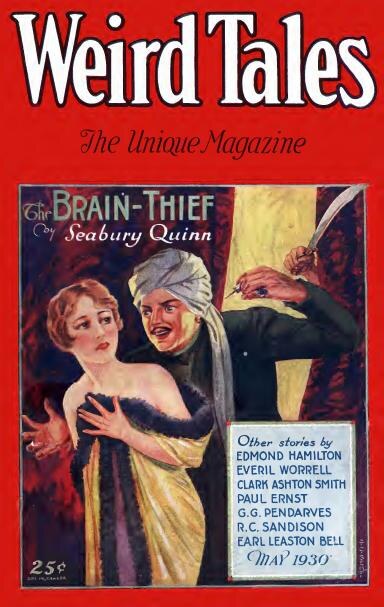
Cover by C. C. Senf, illustrating this story.
This text is printed as first published. It uses racial language from the period, including slurs.
“TIENS, Monsieur, you amaze me, you astound me; I am astonished, I assure you. Say on, if you please; I am entirely attentive.” Jules de Grandin’s voice, vibrant with interest, came to me as I closed the front door and walked down the hall toward my consulting-room.
“Holà, Friend Trowbridge,” he hailed as his quick ear caught my step outside, “come here, if you please; there is something I would have you hear, if you can spare the time.”
The tall young man, prematurely gray at the temples, seated opposite de Grandin rose as I entered the study and greeted me with an air of restraint.
“Oh, how d’ye do?” I growled grudgingly, then turned my back on the visitor as I looked inquiringly at de Grandin. If there was one person more than another whom I did not desire my roof to shelter, it was Christopher Norton. I’d known the cub since his first second of life, had tended him for measles, whooping-cough and chicken-pox, had seen him safely through adolescence, and was among the first to wish him luck when he married Isabel Littlewood. Now, like every decent man in the city, I had no desire to see any of him, except his back, and that at as great a distance as possible. “If you’ll excuse me——” I began, turning toward the door.
“Parbleu, that is exactly what I shall not!” de Grandin denied. “I know what you think, my friend; I know what everyone thinks, but I shall make you and all of them change your minds; yes, by damn, I swear it! Come, good friend, be reasonable. Sit and listen to the story I have heard, suspending your judgment meantime.
“Say it again, young Monsieur,” he ordered the visitor. “Relate your so pitiful tale from the beginning, that Dr. Trowbridge may know as much as I.”
There was such a look of distress on young Norton’s face as he looked half pleadingly, half fearfully at me that, had he been anything but the thoroughgoing scoundrel he was, I could have found it in my heart to be sorry for him. “It seems Isabel and I have been divorced,” he began, almost tentatively. “I—I suppose I wasn’t as good to her as I might have been——”
“You suppose, you confounded young whelp!” I burst out. “You know you treated that girl as no decent man would treat a dog! You know perfectly well you broke her heart and every promise you made her at the altar—you smashed her life and betrayed her confidence and the confidence of every misguided friend who trusted you——” I choked with anger, and wheeled furiously on de Grandin.
“Listen to me,” I ordered. “I don’t know what this good-for-nothing young reprobate has been telling you, but I tell you whatever he’s said is a pack of lies—lies from beginning to end. I’ve known him all his life—helped him begin breathing thirty years ago by slapping his two-seconds-old posterior with a wet towel—and I’ve known the girl he married all her life, too. He and she were born within a city block of each other, less than a month apart. Their parents were friends, they went to school together and played together, and were boy and girl sweethearts. When they finally married, all us old fools who’d watched them grow from childhood swarmed round and gave them our blessing. Then, by George, before they’d been married a year, this young jackanapes showed himself in his true colors. He abused her, beat her, finally deserted her and ran off with his best friend’s wife. If that’s the sort of story you’ve listened to, I’m surprized——”
“Cordieu, surprized you most assuredly shall be, my friend, but not as you think,” de Grandin interrupted. “Be good enough to seize your tongue-tip between thumb and forefinger while the young Monsieur concludes his story.”
“I don’t expect you to believe me, sir,” young Norton began again; “I don’t know I’d believe such a story if it were told me—but it’s true, all the same. As far as I can remember, the last time I saw Isabel was this morning when I left for the office. We’d had a little misunderstanding—nothing serious, but enough to put us both in a huff—and I stopped at Caminelli’s and bought some roses as a peace-offering on my way home tonight.
“I fairly ran the last half-block to the house, and didn’t wait for the maid to let me in. It was when I got in the hall I first noticed changes. Most of the old furniture was gone, and what remained was standing in different places. I thought, ‘She’s been doing a lot of house-cleaning since this morning,’ but that was all. I was too anxious to find her and make up, you see.
“I called, ‘Isabel, Isabel!’ once or twice, but no one answered. Then I ran upstairs.”
He paused, looking pleadingly at me, and the half-puzzled, half-frightened look which had been on his face throughout his recital deepened.
“There was a nurse—a nurse in hospital uniform—leaving the room as I ran down the upper hall,” he continued slowly. “She looked at me and smiled, and said, ‘Why, how nice of you to bring the flowers, Mr. Norton. I’m sure they’ll be delighted.’
“That ‘they’ didn’t mean anything to me then, but a moment later it did. On the bed, with a little, new baby cuddled in the curve of her elbow, lay Betty Baintree! Try and realize that. Dr. Trowbridge; Betty, Jack Baintree’s wife, whom I’d last seen at the Colony Country Club dance last Thursday night, was lying in bed in my house, a young baby in her arms!
“She greeted me familiarly. ‘Why, Kit, dear,’ she said, ‘I didn’t expect you so soon. Thanks for the flowers, honey.’ Then: ‘Come kiss baby; she’s been restless for her daddy the last half-hour.’
“It was then she seemed to notice the look of blank amazement on my face for the first time. ‘Kit, boy, whatever is the matter?’ she asked. ‘Don’t you——’
“‘Wha—what are you doing here, Betty?’ I managed to gasp. ‘Isabel—where is she?’
“‘Isabel?’ she echoed incredulously. ‘What’s got into you, dear—what makes you look so strangely? Haven’t you any greeting for your wife and baby?’
“‘My—wife—and—baby?’ I stammered. ‘But——’
“I don’t know just what happened next, sir. I’ve a confused recollection of staggering from that accursed room, stumbling down the stairs and meeting the nurse, who looked at me as though she’d seen a ghost, then tottering toward the door and running, hatless and coatless, to my mother’s house in Auburndale Avenue. I ran up the steps, tried the door and found it locked. Then I almost beat in the panels with my fists. A strange maid, not old Sadie, answered my frantic summons and looked at me as though she suspected my reason. The family occupying the house was named Bronson, she told me. They’d lived there for the past two years—‘since shortly after the widow Norton’s death.’
“‘Am I mad, or is this all some horrible nightmare?’ I asked myself as I turned once more toward my home, or rather toward the house which had been my home this morning.
“It wasn’t a dream, as I assured myself when I returned and found Betty crying hysterically in bed with the nurse trying to comfort her and looking poisoned daggers at me as I came in the door.
“I GOT my hat and coat and wandered about town looking for someone I knew—someone who might offer me a ray of comforting light to guide me through the terrible fog into which I seemed to have plunged. Half a block from home I met Dr. Raymond, of the Presbyterian Church, whom I’d known since I was a lad in his Sunday School’s infant class. I spoke to him, tried to stop him, but he passed me without a sign of recognition. Either he cut me dead or failed to see me, as though I’d been a disembodied spirit.
“Finally, I managed to locate Freddy Myers. He and I were in high school and college together, and had always been good friends. He let me in, but that was about all. Not a word of greeting, save a chilly ‘How do you do?’ Not a smile, not even a handshake did he offer me, and he remained standing after I’d come into the hall and made no move to take my hat and coat or invite me to be seated.
“I put the proposition squarely up to him; told him what I’d just been through, and asked him for God’s sake to tell me where Isabel was. The news of my mother’s death two years before was shock enough, but Isabel’s disappearance—Betty Baintree in my house, and the baby—I was like an earthman suddenly set down on the moon.
“For a while Fred listened to me as he’d have listened to the ravings of a drunken man; then he asked me if I were trying to kid him. When I assured him I was sincere in my questions, he grew angry and told me, just as you have. Dr. Trowbridge, how I’d abused Isabel, how my disgraceful amours with other women had finally forced her to divorce me, and how I was ostracized by every decent man who’d known me in the old days. Finally, he ordered me out and told me he’d punch my face if I ever spoke to him again.
“I don’t know what to think, sir. Freddy’s abuse was so genuine, his anger so manifestly sincere and his scorn so patently righteous that I knew it couldn’t all be some ghastly practical joke of which I was the victim. Besides, there was the strange maid in Mother’s house and the news of Mother’s death—that couldn’t have been arranged, even if Isabel and Betty and Freddy had joined in a conspiracy to punish me for the burst of nasty temper I showed this morning.
“For a little while I thought I’d gone crazy and all the astonishing things which seemed to have happened were only the vagaries of a lunatic. Indeed, sir, I’m not sure I’m sane, even yet—I hope to God I’m not! But what am I to do? Can’t anybody explain the situation to me? Suppose you found yourself in my place, sir.” He turned appealing, haunted eyes on me.
“Then I remembered hearing someone tell of the wonderful things Dr. de Grandin did,” he concluded. “I’d been told he’d corrected maladjusted destinies as though by magic, sometimes; so I’ve come here as a last resort.
“You’re my last hope, Dr. de Grandin,” he finished tragically. “I don’t know, except by inference and such reconstruction of events as I can make from the crazy, meaningless things I’ve seen and heard tonight, what’s happened, but one thing seems certain: For the last two years time has stood still for me. There’s been a slice of two years carved right out of my memory, and all the terrible things which have occurred during that period are a sealed book to me. Can’t you do something for me, sir? If you can’t, for God’s sake, send me to a lunatic asylum. I don’t know just what sins I’ve committed, but even though I’ve committed them unconsciously, the uncertainty of it all is driving me to madness, and an asylum seems the only refuge left.”
Jules de Grandin brushed the tightly waxed ends of his small blond mustache with the tip of a well-manicured forefinger. “I think we need not consider the padded cell as yet, my friend,” he encouraged. “At present I am inclined to prescribe a stiff dose of Dr. Trowbridge’s best brandy for you—and a like potion for myself.
“And now, Monsieur,” he continued as he drained the final drop of cognac from his goblet, “I would suggest that you take the medicine I shall prepare, then go to bed—Friend Trowbridge has a spare chamber for your accommodation.”
For a few moments he busied himself in the surgery, returning with a beaker of grayish, cloudy liquid, which young Norton tossed off at a gulp.
TEN minutes later, with my unwelcome guest soundly sleeping in my spare bedroom, de Grandin took up a pencil and pad of note-paper and turned to me. “Tell me, mon vieux,” he ordered, “all you can of this so unfortunate young man’s domestic tragedy.”
“Humph,” I retorted, still smarting at the generous use he had made of my hospitality, “there’s precious little to tell. Kit Norton is a rotter from the backbone out; there’s not an ounce of decency in his whole make-up. The girl he married was one of the finest young women in the city, absolutely above reproach in every way, and they seemed ideally happy for a little time; then, without a moment’s warning, his whole nature seemed to change. He became an utter sot, found fault with everything she did, and blamed her for his business reverses—he had plenty of’em, too, for he began to neglect his real estate office at the same time he began neglecting his wife—and it wasn’t long before his affairs with other women became the scandal of the town. The climax came when he and Betty Baintree eloped.
“Norton and Frank Baintree had been inseparable friends from boyhood. Frank married Betty a short time after Kit and Isabel were married, and the couples continued the friendship. When Kit and Betty ran off, of course, the lid blew off the whole rotten mess. It was then we all realized Kit’s contemptible conduct toward Isabel was all part of a deliberately planned scheme to force her to divorce him—and the proof of it was that Betty had acted toward Frank just as Kit had acted toward Isabel for about the same period. There’s no doubt of it, the brazen pair had conspired to force a divorce so they could be free to marry, and when their plans failed to work, they had the effrontery to elope, leaving identical notes with their deserted partners. It’s an unsavory business from start to finish, de Grandin, and I wish you hadn’t gotten mixed up in it, for——”
“Non, let us not be too hasty. Friend Trowbridge,” the little Frenchman interrupted. “See, you have already given me much of importance to think of. Had not Madame Betty’s conduct been identical with that of Monsieur Christopher, I might have seen a reason for it all; as it is—eh bien, I know not quite what to think. Such cases, however, are not altogether unknown. Once before I have seen something like this. A certain tradesman in Lyons—a draper, he was—left his home for the shop one morning, and was heard from no more. Five years passed, and he was thought dead by all who knew him, when pouf! where should he be found but living in Marseilles, happy and respectable as could be, with another wife and a family of fine, healthy children? In Lyons he had been a draper; in Marseilles he was a bricklayer—a trade, by the way, for which he had no apparent ability in his former life. Maurice Simon, his name was, but in Marseilles he knew himself only as Jean Dufour. Every test was made to prove him a malingerer, but it seemed established beyond all reasonable doubt that the unfortunate man was actually suffering a split consciousness—all memory of his former life in Lyons was completely obliterated from his mind, and his wife and children were utter strangers to him. Reproaches and argument alike left him unmoved. ‘I am Jean Dufour, bricklayer, of Marseilles,’ he repeated stubbornly. At last they managed to convince him of his identity. The realization of what he had done, how he had wrecked two women’s lives and the lives of his children, drove him mad. He died raving in a hospital for the insane.”
“But that can’t possibly be the case here,” I expostulated. “We know——”
“Pardonnez-moi, we know nothing; even less,” de Grandin denied. “Come, let us go.”
“Go?” I echoed. “Go where?”
“To interview Madame Betty, of course,” he returned coolly. “I may be wrong, but unless I am more mistaken than I think, we may find interesting developments at her home.”
Grumbling, but with my curiosity piqued, I rose to accompany him to the pretty little cottage where Kit Norton had taken his bride three years before.
“It is most strange,” he muttered as we passed through the quiet streets. “It seems hardly likely the poor Monsieur Christopher should have suffered the same fate. And yet——” He broke off musingly.
“What’s that?” I asked sharply, annoyed at his persistent sympathy for young Norton.
“I did but think aloud,” he returned. “The unfortunate gentleman of Lyons, of whom I spoke earlier in the evening—his aberration was an oddly tangled one. Investigations by the police showed that several days before he deserted his family and set out for Marseilles, he had an altercation with a certain fortune-telling man from the East; indeed, he had gone so far as to tweak his nose, and the Oriental had pronounced a curse of forgetfulness on him.”
AS WE paused before the cottage gate a long roadster, driven as though contending for a racing-trophy, dashed past us and stopped at the curb with a screeching of sharply applied brakes. A moment later its occupant leaped out and ran at breakneck speed up the brick path leading to Norton’s front stoop. “Lesterdale!” I exclaimed in surprize.
“Eh, what do you say?” de Grandin asked. “That’s Lesterdale, the best nerve man in the city,” I responded. “Wonder what brings him here?”
“Let us see,” the Frenchman returned matter-of-factly. “The house is open. Let us enter.”
Dr. Lesterdale had a case worthy of all his skill, we discovered almost as soon as we marched unbidden into Norton’s cottage.
Betty Norton crouched in her bed, her knees drawn up, her chin resting on them, and her arms flailing the unresisting air with the fury of the grand movement stage of hysteria. As we paused at the bedroom door we caught a glimpse of her tear-smeared face as she stared wildly about the room with wide, horror-numbed eyes. “Frank,” she shrieked, “oh, Frank my love, where are you?”
“Doctor,” she bent a terrified look on Lesterdale, “I dreamed—I thought I was Kit Norton’s wife, that I was the mother of—oh, say it isn’t true, Doctor.”
“Tiens, what is this?” de Grandin muttered. “Has she, too, emerged from a state of suspended memory?”
Lesterdale’s eyes were cool with professional unconcern. Like everyone else in the city he knew the scandal of Betty’s divorce and remarriage, and had he been there in any capacity other than that of physician, I could well imagine how his glance would have been blank with cold contempt as he looked at the pretty woman contorted on the bed. “Water!” he ordered shortly of the terrified nurse.
A moment later he dissolved a small white tablet in the half-filled tumbler she brought, plunged the nozzle of his hypodermic into the mixture and barked another order. “Alcohol—sponge—in the case yonder,” he snapped.
The nurse got the alcohol and a cotton sponge from his kit and swabbed Betty’s left arm.
The needle pierced the girl’s delicate skin and I saw a blister rise as the morphia went home before the syringe-plunger’s pressure.
“See the child has substitute feedings—dextri-maltose, milk and water, Wilson’s formula No. 2—can’t have it nurse with the mother full o’ morphine. Call me if she kicks up another row.” Lesterdale glanced appraisingly at Betty, noted the narcotic already stealing over her, and turned toward the door. “She ought to be quiet for the rest of the night,” he added over his shoulder.
“Oh, hullo, Trowbridge,” he called as he recognized me by the door. “What’s up, did they rout you out, too? Devil of a note, dragging a man from the bridge table to calm a conscience-stricken female. What?”
“But do you think it’s just an attack of conscience?” I countered. “Mightn’t it be a case of puerperal insan——”
“No,” he cut in. “Not even lactational neurosis; no symptom of it. It’s hysteria, pure and simple, or”—he smiled acidly—“more simple than pure, I’d say, considering who’s having it. Don’t see how it happened, but something’s awakened the little strumpet’s conscience, and it’s hurting her like the devil. Good-night,” he nodded shortly as he passed down the hall without a backward glance.
“Mordieu, he is hard, that one; hard like a nail,” de Grandin murmured. “A good neurologist he may be, Friend Trowbridge, but I think he is also a monumental fool. Let us interrogate the garde-malade.”
The nurse recognized me with a start of surprize as we edged into the room. “Mr. Norton called at my office, and——” I began, but she cut me short.
“Oh, he did, did he?” she returned sourly. “I should think he would, after what he’s done. He——”
“Slowly, Mademoiselle, if you please,” de Grandin urged. “Our perceptions are dull, and you go too fast. What, precisely, did Monsieur Norton do?”
The girl stared at him. “What?” she echoed. “Plenty. He came home from the office with a beautiful bouquet, then pretended he didn’t know his own wife and baby, and went flying out of the house like a crazy man. He drove the poor thing to this——” she glanced compassionately at Betty. “He hadn’t been gone half an hour when she went completely to pieces and started raving like a lunatic!”
“Ah?” de Grandin tweaked his mustache meditatively. “Now we begin to make progress. What, if you please, was the exact nature of her delusion?”
The nurse considered a moment. Years of hospital training had taught her accurate observation where symptoms were concerned, and professional habit was stronger than womanly anger. “She began crying as though her heart would break,” she replied slowly; “then, when he came back the second time and stared wildly in the room before rushing off again, she seemed to change completely. I’ve never seen anything like it. One moment she was crying and wringing her hands, begging Mr. Norton to recognize her, the next she was like a different woman. Just for a moment she stopped crying, and a sort of dazed, surprized look came into her eyes; then she looked round the room as though she’d never seen it before—like a casualty victim coming out of the ether in the emergency ward,” she finished with professional clarity.
“This dazed, bewildered condition lasted only a moment; then, like a woman recovering from a faint, she asked, ‘Where am I?’
“I soothed her as best I could; told her Mr. Norton had gone out for a moment, but would be back directly, and held the baby out to her. This seemed to excite her all the more. I had to explain where she was, who she was, and who the baby was—can you imagine? Instead of calming her, it seemed to make her worse. She stared unbelievingly at me, and when I showed her the baby again, she fell to screaming at the top of her voice and calling for somebody named Frank. Have you any idea who it could be. Dr. Trowbridge?”
“What else happened?” I returned, evading her question.
“That’s all, sir. I grew alarmed when she seemed to shrink from her own child, and called Dr. Lesterdale. He’s the best nerve man in town, don’t you think?”
“Quite,” I agreed. “If you——”
“Non, mon ami,” de Grandin interrupted. “Trouble the good mademoiselle no more. We have already heard enough—parbleu, I fear we have heard more than we can conveniently piece together. Come, let us go.
“Grand Dieu,” he murmured as we reached the street, “it is amazing, it is astonishing, it is bewildering! Has the clock of time turned back, and are we once more in the Seventeenth Century?”
“Eh?” I asked.
“Is witchcraft rampant in our midst?” he returned. “Barbe d’un bouc, my friend, I know not whether to say we have witnessed two most extraordinary cases of mental derangement or something wholly and entirely infernal.”
HOMER ABBOT, son of my old schoolmate, Judge Winslow Abbot, and one of the cleverest of the younger members of the local bar, was waiting nervously in my consulting-room next morning. “It’s about Marjorie,” he began, almost before we had exchanged greetings. “I’m dreadfully worried about her, Doctor!”
“What’s wrong?” I asked, noting the parentheses of wrinkles which worry had etched between his brows. “Do you want me to run over and look at her?”
“No, sir; I’m afraid this business is a little out of your line,” he confessed. “To tell you the truth, I’ve come to you more as a friend than as a physician.” He paused a moment, as though debating whether to continue; then: “She’s been acting queerly, recently. About a week ago she began coming down to breakfast all crocked up—circles under her eyes, no more life than a wet handkerchief, and all that sort of thing, you know. I was concerned at once, and begged her to come to you, but she just laughed at me.
“It’s gone from bad to worse, since. She’s irritable as the deuce—flies off the handle at nothing, scolds me like a shrew with or without reason; most of the time she seems actually trying to avoid me, makes every kind of excuse to keep from coming to the door with me in the morning, pleads a headache, or some other indisposition, to get away from me in the evening, even——”
“H’m,” I smiled knowingly to myself. A happy explanation of Marjorie’s sudden vagaries had occurred to me, but Homer’s next words killed it.
“Three nights ago I happened to wake up about one o’clock,” he hurried on. “You know that feeling of vague malaise we sometimes have for no reason at all? That’s what I felt when I sat up in bed and looked round. Everything was quiet—too quiet—in the room. I switched on the night light and looked across at Marjorie’s bed. It was empty.
“I waited and waited. When half an hour went by with no sign of her, I couldn’t stand it any more. I looked everywhere—went through the house from cellar to attic; she wasn’t anywhere. It wasn’t till I’d finished my search and returned almost frantic to the bedroom that I noticed her clothing was missing from the chair where she usually puts it; when I went to the closet I found her heavy sports coat gone, too.
“I sat up waiting for her till nearly five o’clock; finally, I couldn’t stick it any more, and dropped off to sleep.
“Marjorie was sleeping peacefully as a child when I woke two hours later, and when I tried to rouse her and ask where she’d been during the night, she turned from me like a fretful child, too, and mumbled something about wanting to be let alone.
“I tried my best to ask her about it that evening, but she had a couple of girl friends in to dinner and we played contract afterward, so I didn’t get a word alone with her till after eleven, when the company left. Then she fairly ran upstairs to bed, complaining of a splitting headache, and each time I tried to speak to her she begged me to let her alone to suffer in peace.
“I don’t think she went out that night, but I don’t know.”
“Eh?” I asked, impressed by the emphasis he laid on the last four words. “How d’ye mean?”
For answer he thrust his hand into his waistcoat pocket and extracted a tiny square of folded white paper. “What do you make of this?” he asked, handing me the packet.
I opened the paper, disclosing a dust of fine, white, crystalline powder, wet my forefinger, gathered a few grains of the substance on it, and touched it to my tongue. “Good heavens!” I ejaculated.
“Morphine, isn’t it?” he asked.
“No, it is codein,” I returned. “Where——”
“On her dresser, yesterday morning,” he cut in. “And there was another like it, with a few grains of the stuff still adhering to the paper, on the pantry shelf. We had coffee with our refreshments the night before, and I thought mine tasted bitter, but the others laughed at me, so I thought maybe the trouble was with me rather than the coffee. By the way, Marjorie brought the coffee in herself that night, and it wasn’t till I found these powders that I recalled she brought mine in separately, the only cup on the tray—no chance for me to take the wrong one that way, you see.
“I slept like a log that night, and woke with a queer, dizzy feeling yesterday morning. Marjorie was still asleep when I was dressed and ready for breakfast, and it was just by chance I discovered the powder. You see, I thought perhaps her headache was still troubling her, and went to her dresser for some cologne. That’s where I found the package I just showed you. I thought I recognized it; they gave me something of the kind in the hospital at St. Nazaire during the war.”
“But see here, boy,” I expostulated, “maybe we’re making a mountain of a molehill. This stuff’s codein, beyond doubt, and Marjorie shouldn’t be allowed to have it; but it’s possible some quack gave it her for those headaches she’s been complaining of—mere than one woman’s been made a dope fiend that way. That feeling of depression you had on waking——”
“Wasn’t present this morning,” he interrupted sharply. “I don’t know how I came to reason it all out, but the moment I found that infernal stuff I knew she’d drugged my coffee the previous night. So I took the paper and went downstairs and fixed a dummy pack with table salt, and left it where I’d found the codein on her dresser. It was while I was looking for salt to make the dummy I found the empty codein paper in the pantry.
“Dr. Trowbridge,” he leaned forward impressively, “last night, after dinner, my coffee was salty as brine!”
Young Homer Abbot and I faced each other a moment in solemn-eyed silence. I opened my lips to utter some banality, but he hurried on:
“I pretended to become sleepy almost immediately, and went to bed—but I didn’t undress. Marjorie didn’t trouble even to come upstairs to see if I had fallen asleep; I suppose she was so sure the dope had done its work. I heard the front door close before I’d been in bed half an hour, and jumped up, slipped on my shoes and jacket, and ran after her. I got down just in time to see her taxi round the corner, and though I chased it like a hound hunting a rabbit, it lost me in the fog, and I had to give up.
“Marjorie came in a few minutes after five this morning,” he concluded. Then, because he was still little more than a boy, and because his happy little world had tumbled to pieces before his eyes, Homer Abbot put his arm down on my desk, pillowed his face against it and cried like a heart-broken child.
“Poor chap,” I sympathized. “Poor boy, it’s a rotten shame, and——”
“And we had best be stirring ourselves to correct it, my friend,” Jules de Grandin supplemented as he stepped noiselessly into the room.
“I must ask forgiveness for eavesdropping,” he added as he paused beside me, “but I caught the beginning of the young monsieur’s so tragic tale, and could not forbear to linger till I heard its end.
“Do not despair, my friend,” he patted Homer’s bowed shoulder gently. “All looks hopeless, I know, but I think there is a reason behind it all, nor is it what you think.
“Trowbridge, my friend,” he added, his little eyes snapping with cold fury, “I damnation think this business of Monsieur Abbot’s and that of Monsieur Norton are bound up together somehow. Yes. Certainly there is someone, or some thing, in this city which stands in urgent need of eradication, and I shall supply that need—may Satan fry me in a pan with butter and parsnips if I do not so!”
Again he turned to Homer. “Think, Monsieur,” he urged, “what happened before your so charming wife began to show this remarkable change? Consider carefully: the smallest happening, the seemingly least important thing, may guide us to a solution of the case. What, by example, did you do for several days before she manifested the first symptom—even the very night before her indisposition became patent?”
Young Abbot took his chin in his hand as he bent his thoughts backward. “I can’t recall anything, especially, that happened about that time,” he answered slowly. “Let’s see, four of us went to the theater that Thursday night, and stopped at a night club afterward. U’m, yes; something rather queer did happen there. We had a little spat, but——”
“Excellent!” de Grandin interjected. “This petite querelle, it was about what, if you please?”
“Nothing of importance,” the other replied. “There was a queer, bilious-looking fellow sitting alone at a table across from us, and he kept looking at Marjorie. I didn’t notice him at first, but at last he got on my nerves, and I rose to speak to him. Marjorie begged me not to make a scene, and the fellow left a few minutes afterward—damn him, I’d have wrung his neck, if I’d caught him!” he ended savagely.
“Indeed, and for why?” de Grandin asked softly.
“Just before he left the room he turned and held up a little mirror, or some small, round, bright object, and flashed a ray from it directly into Marjorie’s eyes. I made a dash for him, but he’d gone before I could reach the door.”
“U’m,” de Grandin murmured to himself. “That is of importance, also.” He nodded once or twice thoughtfully; then: “And Madame, your wife, she said what?” he asked.
“She fussed at me!” Homer returned in an injured voice. “Declared I’d made a disgraceful scene and humiliated her, and all that kind of thing. Next morning she slept late, and was as exhausted as though she’d just risen from a sickbed when she finally got up.”
Jules de Grandin studied the end of his cigarette with slow, thoughtful care. At last, “It is fantastic,” he murmured, “but I damn fear it is so, none the less.
“Very good, Monsieur,” he turned again to Abbot, “you will oblige us by acting as though nothing untoward has occurred at your house. I especially desire that you do not let Madame suspect you have discovered her attempts to drug you. Anon, I think, we shall unravel this sorry tangle for you, but it may take time.”
NORA MCGINNIS, my genial household factotum, laid a sheaf of letters beside my plate when de Grandin and I repaired to the breakfast room half an hour later.
“Hullo,” I remarked, “here’s one for Kit Norton. Wonder how anyone knew he’s stopping here?”
“I mentioned it to the nurse before we left his house last night,” de Grandin replied. “Open the letter, if you please. Monsieur Norton sleeps late this morning, I made sure he should. Meantime, the note may contain something which will prove helpful to us.”
I slit the envelope and read:
“Kit:
“They tell me Frank divorced me because of you and Isabel divorced you on my account. They say we’ve been married two years and the baby’s ours. I can’t understand it all; and I shan’t try. I’m taking the baby with me. It’s best.
“Yours,
“BETTY.”
“Good heavens!” I exclaimed. “What can this mean?”
“Mean?” de Grandin was on his feet, his little eyes blazing like those of a suddenly incensed cat. “Mean? Mort d’un rat, it means murder; no less, my friend! Come, quick, when was that letter mailed?”
“It’s postmarked 12:40,” I returned. “Must have been dropped about midnight last night.”
“Hélas—too late!” he cried. “Come, prove that my fears are all too well grounded, Friend Trowbridge!”
Grasping my hand he fairly dragged me to the study, where he motioned me to take up the telephone. Next instant he rushed to the consulting-room extension and called Main 926.
“Allo?” he cried when the connection was put through.
“City Mortuary,” was the curt return. “Who’s speaking?”
“You have there the bodies of a young woman and an infant girl—Madame Norton and her child?” de Grandin affirmed, rather than asked.
“Gawd A’mighty, how’d you know? Who is this?” came the startled reply.
“Have the goodness to answer, if you please,” the Frenchman insisted.
“Yeah, we’ve got’em. Th’ police boat fished’em outa th’ river less’n half an hour ago. Who th’ hell is this?”
“One who can prove she destroyed herself while of unsound mind,” de Grandin returned as he hung up the receiver.
“You see?” he asked as he re-entered the study.
“No, I’m hanged if I do!” I shot back. All I understood was that Betty Norton had drowned herself and her baby.
“We shall avenge her; have no fear on that score, mon vieux,” de Grandin promised in a low, accentless voice. “The swine responsible for this shall die, and die most unpleasantly, or may Jules de Grandin never again taste roast gosling and burgundy. I swear it!”
JULES DE GRANDIN tossed aside the copy of l’Illustration he had been perusing since dinner and glanced at the diminutive watch strapped to his wrist. “It is time we were going, my friend,” he informed me. “Be sure to dress warmly; the March wind is sharp as a scolding woman’s tongue tonight.”
“Going?” I echoed. “Where——”
“To Monsieur Abbot’s, of course,” he returned. “I determined it this morning.”
“You what?” I demanded. “Well, of all the brass-bound nerve——” I began, but Kit Norton interrupted me.
“May I come, too, sir?” he asked.
“Assuredly,” the Frenchman nodded. “I think you may find interest in that which we shall undoubtlessly see tonight, young Monsieur.”
Grumbling, but curious, I hustled into a corduroy hunting-outfit, high laced boots and a leather wind-breaker. Similarly arrayed, de Grandin and Norton joined me in the hall, and, at the Frenchman’s suggestion, we hailed a taxicab and rode to within a block of Abbot’s house, then walked the remainder of our journey.
It was cold work, waiting in the shadow of the hedge skirting Homer’s front lawn, and I was in momentary dread of being seen by a passing policeman and arrested as a suspicious character, but our vigil was at last cut short by de Grandin’s soft exclamation. “Attendez-vous, mes amis, you recognize her?”
I peered through the wall of wind-shaken hedge in time to see a svelte figure, muffled from chin to heels in fur, glide swiftly down the steps and pause irresolutely at the curb. “Yes,” I nodded, “it’s Marjorie Abbot, but——”
“Très bien, it is enough,” de Grandin cut in, turning to flash the light of his pocket electric torch toward the corner where our taxi loitered.
The vehicle drove slowly toward us, passed by and slowed down at the curb where Marjorie stood. “Cab, lady?” hailed the chauffeur. The girl nodded, and a moment later we saw the red eye of the vehicle’s tail light blink mockingly at us as it rounded the corner.
“Well,” I exclaimed, “of all the treacherous tricks! That scoundrel deliberately passed us by after you’d signaled him, and——”
“And did precisely as he was instructed,” de Grandin supplied with a chuckle. “Trowbridge, my friend, you are a peerless pill-dispenser, but you are sadly lacking in subtlety. Consider: Do we wish to advertise our presence to Madame Marjorie? Decidedly not. What then? If our cab remained in plain sight, Madame Marjorie could not well fail to see it, and would unquestionably think it queer if it did not apply for her patronage. Had she been forced to seek another vehicle, she would have been on her guard, and looked constantly behind to see if she were followed. In such conditions, we should have had Satan’s own time to mark her destination without being discovered. As it is, our so excellent driver conveys her where she desires to go, returns for us, and makes the trip over again. Voilà, c’est très simple, n’est-ce-pas?”
“Umph,” I admitted grudgingly. “What’s next?”
“To warn Monsieur Abbot of our advent,” he returned. “He awaits us; I have told him to be prepared.”
We crossed the yard and rang Abbot’s bell, but no response came to our summons. Despairing of making the bell heard, de Grandin hammered on the door; still no answer.
“Eh bien, can he have fallen asleep in good earnest?” the Frenchman fumed. “Let us go in to him.”
The door was unlatched and we had no difficulty entering, but though we called repeatedly, no answer came to our hails. At length: “Upstairs, my friends,” the Frenchman ordered. “Our plans seem to have miscarried, but I will not have it so.”
Wrapped to the chin in blankets, but fully clothed save for shoes and jacket, Homer Abbot lay in his bed, his head tilted grotesquely to one side, his heavy respiration proclaiming the deepness of his slumber.
“Wake, my friend, rouse up, we are come!” de Grandin cried, seizing the sleeper’s shoulder and giving it a vigorous shake.
Young Abbot’s head rolled flaccidly from side to side, but no sign of consciousness did he give.
Once more de Grandin shook him, then, “By damn, you will wake, though I kill you in the process!” he declared, shoving the sleeper so fiercely that he tumbled from the bed, his limbs sprawling uncouthly, like the arms and legs of a rag-doll from which the sawdust had been drained.
“Grand Dieu, observe!” the little Frenchman ordered, pointing dramatically to a tiny spot of red upon the upper part of Homer’s shirt sleeve.
“Hypo!” I commented as I saw the telltale stain.
“Bien oui, drugs given by mouth failing, she has made use of injections,” de Grandin agreed excitedly. “Quick, Friend Trowbridge, time is priceless; to the nearest pharmacy for strychnia and a syringe, if you please. We shall rouse him to accompany us despite all their planning!”
I hurried on my errand till my breath came pantingly, returned with the stimulant in less time than I should have thought possible, and prepared an injection. The powerful medicine acted swiftly, and Homer’s lids fluttered upward almost before I could withdraw the needle.
“How now, my friend, were you caught napping?” de Grandin asked.
“Looks that way,” the other answered. “I turned in as you suggested, and pretended to be sound asleep, but she must have suspected something. Shortly after I went to bed she came in, bent over me and called softly. I didn’t answer, of course, but my lids must have quivered, the way they usually do when someone looks intently at you, for she bent still closer and kissed me. Just as her lips touched mine I felt a sting in my arm, and before I could let out a yell, I was dead to the world.”
“Exactly, precisely, quite so,” the Frenchman agreed. “Now, let us depart. Our taxicab has returned.”
“Sure, I can go there again,” the chauffeur answered de Grandin’s excited query. “Th’ place is out th’ Andover Road about five miles—deserted as hell on Sunday afternoon, too; you couldn’t miss it, once you’ve been there.”
“Très bien; allez-vous-en!”
“Huh?”
“Let us go, let us hasten, let us fly, my excellent one, my prince of chauffeurs; time presses and there is five dollars extra for you if you make speed.”
“Buddy, just you set back an’ hold onto your hair,” the driver cautioned. “Watch me earn that five-spot!”
He did. At a wholly unlawful speed we raced along the wide, smooth turnpike, passing an occasional interurban bus and one or two bootleggers’ cars, cityward bound with their loads of conviviality, but encountering no other traffic.
THE house was rather small, of frame construction, and badly in need of repainting. Surrounding it was a rickety paling fence, and a yard of considerable extent, densely overgrown with lilac trees, dwarf cedars and a few straggling rhododendrons. Apparently no light burned inside, but de Grandin motioned us forward while he stayed to pay the chauffeur.
“Discretion is essential, my friends,” he cautioned as he joined us. “Let us proceed with caution.” Thereupon we dropped behind each shadowing bush and advanced by a series of short, quick dashes, like infantrymen at skirmish practise.
Slowly we circled the house, at length descried a single feeble ray of light flickering from beneath a drawn blind and tight-barred shutters. The Frenchman glued his eye to the chink whence the light emanated, then drew back with a shrug of impatience. “I can see nothing,” he admitted dejectedly.
We looked at each other in helpless discomfiture, but in a moment the little man was grinning delightedly, “Messieurs Norton—Abbot,” he demanded in a whisper, “can you emulate a cat?—two cats?—several cats?”
“A cat?” the youngsters chorused in amazement.
“But certainly. A pussy-cat, a kitty,” de Grandin agreed. “Can you caterwaul and meaul like a duet of tom-cats enjoying a quarrel?”
“Certainly,” Abbot returned, “but——”
“There are no buts, my friend. Do you and Monsieur Norton repair to yonder lilac bush, and thereupon set up such a din as might make a dead man leave his coffin in search of peace elsewhere. Continue your concert a full two minutes, then fling a stone into a distant thicket, to simulate the crashing of departing felines through the undergrowth. Remain utterly quiet for two minutes more, then join me as soundlessly as may be. You understand? Very well; be off!”
Grinning broadly, Abbot and Norton departed to a screen of lilac bushes, and in a moment there rose such a racket of howls, caterwauls and vicious hisses as might have convinced anyone that two lusty tom-cats had staged a finish-fight on the lawn.
I rocked with laughter at the exhibition, but my mirth was swallowed in admiration of de Grandin’s strategy as I watched him. From under his leather jacket he drew a long, curve-bladed Senegalese knife and fell to cutting the shutter-slats away. As he worked he thrust a stick of chewing-gum between his teeth and began masticating furiously. The razor-sharp steel sheared through the rotten, worm-eaten wood almost as if it had been cheese, and in a moment an opening six inches wide by two high had been made. Cutting a slat from the other shutter barring the window, he laid the wooden cleats on the frosty lawn, then slipped the great pigeon’s-blood ruby from his finger and pressed it against the window-pane.
The stone cut through the glass almost as easily as the knife had hacked the wood, and in a moment a small circular opening was chopped from the pane. Just before the circle was complete, the Frenchman took the gum from his mouth, flattened it against the glass and thrust his finger-tip into it. Then, cutting the remainder of the circle with the ruby, he nonchalantly lifted out a disk of glass without a single betraying tinkle having sounded.
Shutters and window having been drilled through, he proceeded to make a small incision in the linen window-blind with the tip of his knife, thereby making it possible for us to see and hear all which went on inside the lighted room.
A final burst of feline profanity and a crashing in the bushes by the fence apprised the world that one of the struggling cats had quit the field of honor hotly pursued by his victorious rival, and in another moment Abbot and Norton joined us.
With upraised finger de Grandin enjoined silence, then waved us forward to the observation-slits he had cut.
WE VIEWED the scene within as though looking through the peep-hole of a camera obscura. An old-fashioned cannon stove, heaped almost to overflowing with glowing coal, stood in the center of the room, and from the ceiling swung an oil lamp by one of those complicated pulley arrangements once common to every rural dining-room. In a rather tattered easy-chair lounged a tall, spare man of indeterminate age, a long, cord-belted dressing-gown of paisley weave covering his dinner clothes. His skin was sallow with a sallowness that was more than mere pallor, there was a distinctly yellowish cast to it, like new country butter; close-cropped hair of raven blackness crowned his head as closely as a skull-cap, growing well down over his broad, low brow and seeming to lend an intensity to the burning, searching eyes which glowed like twin pools of black ink in the immobile yellow mask of his face. Slim black brows spanned his forehead and met, forming a sharp downward angle above the bridge of his thin, narrow-nostriled nose. There was neither amusement nor hate nor any other sign of emotion on his mask-like face, only intense, implacable concentration, as he bent his changeless stare on the woman standing rigid as though frozen against the wall opposite him.
“Take them off—all!” he was saying in a low, sibilant voice as we pressed our eyes to the peep-hole. Evidently we arrived in the midst of a conversation, or, rather, a monolog, for the woman was mute as she was motionless.
“Marjorie!” Homer Abbot exclaimed softly as he recognized his wife rigid against the wall. Then:
“That’s the man who tried to flirt with her at the supper club the——”
“And that’s the man Isabel and I saw at the theater the other night—I mean before I lost my memory,” Kit Norton cut in. “We were coming from the theater and I jostled him when he deliberately got in my way to peer into Isabel’s face. He looked at me as though he’d have liked to murder me, but all he did was raise his hand and flash a big, bright ring before my eyes. It dazzled me for a moment, and when I reached out to grab him by the collar, he was gone. He must have——”
“Silence!” de Grandin’s sharp whisper cut short his recital. The seated, yellow-faced man was speaking again.
“At once!” he commanded in the same level, toneless voice, and I noticed that his thin lips scarcely moved as he spoke.
The woman by the wall trembled as though with a sudden chill, but her hands rose flutteringly to her throat, undid the clasp of her long fur cloak and threw it back from her shoulders. “All!” the man repeated tonelessly, inexorably.
Quickly, mechanically, she unloosed the fastenings of her costume. In a moment she was done and stood facing him, still and straight as a statue carved in ivory, arrayed only in the beauty with which generations of New Jersey forebears had endowed her.
“You are slightly rebellious,” the seated man remarked. “We must cure that. Wake!”
Marjorie Abbot started as though a cup of chilled water had been dashed in her face, saw her crumpled garments on the floor at her feet, and made a wild, ineffectual clutch at the topmost wisp of silk on the pile of clothing.
“Still!” The girl straightened like a puppet stretched upright by a spring, but a tortured cry burst from her, even as she stiffened into immobility.
It was a pitiful, bleating cry which wrung my heart. Once, when I was a little boy, I spent a season on an uncle’s farm and was given a lamb for pet. All summer I loved and pampered the little, woolly thing till it became tame and friendly as a house-dog. At autumn came slaughtering-time, and with the unsentimental practicality of country folk they gave my pet to the itinerant butcher who came to do the killing. Never shall I forget the startled, reproachful cry of that lamb as, his confidence and gentle friendliness betrayed, he felt the gleaming knife cross his throat. It was such a cry of helpless terror and despair Marjorie Abbot gave. But it was not repeated.
“Quiet!” commanded the yellow-faced man. “Be motionless, be speechless, but retain full consciousness. At my unspoken command you have left your silly husband and come to me; you have exposed your body to my eyes when I ordered it, though your strongest instincts forbade it. Hereafter you obey my slightest thought; you have neither volition nor will of your own when I command otherwise. You will know what you do, and realize that you act against your desires, but you will be powerless to explain by word or act. You will apparently wilfully and wantonly drag your husband’s name and your own through scandal after scandal; you will use your charm to allure, but never will you make return for what you receive; you will be pitiless, heartless, passionless, a woman taking all, giving nothing, living only to create misery and heartbreak for all with whom you come in contact. You understand?”
Only the wide, terror-stricken stare of the motionless, nude girl’s eyes replied, but the answer was eloquent.
“Do not think I can not do this—that your love for your husband can withstand my power,” the man went on. “I caused the break between the fool Norton and his wife; it was I who made the Baintree girl desert her husband and create a scandal with Norton. But they knew nothing of what they did—I commanded their memories to sleep, and they slept. Last night I wakened Norton—how the fool must have squirmed when he saw a strange woman in his home, and learned all which had happened while I kept his memory locked in the secret chamber of my mind! Last night I released my hold upon his wife, too, so that both awakened in a strange world, separated from the mates they loved, despised by all who knew them; found themselves parents of a child whose very existence they had not suspected till I released them from my spell. I think we shall find amusement watching their efforts to adjust themselves.” For the first time his thin, pale lips curved in a snarling smile.
“You wonder why I did this to them—why I do it to you?” he demanded, “Because I hate them, hate you—hate every hypocritical member of your two-faced race! In my country white men talk morality and honor, then take our women when they feel inclined; abandon them when they wish. In India I could do nothing; the English pigs prevented it. But in France I found a welcome—they drew no color line there, but received me as a great artist. Ha—the Frenchmen proved almost as stupid as your Americans, but not quite; no nation in the world is composed of such utter fools as you! You welcomed me as a refugee from British oppression; I am free to work my will here. Your dull Western minds are malleable as wax to my superior will! I who can make multitudes believe they see me cast my rope into the sky, then climb it to the clouds, find the subjection of your wills to mine less than child’s play.
“Who am I?” he broke off with sudden sharpness, staring intently at her. “Answer!”
“My lord and my master,” she faltered.
“And who are you?”
“Your thing and creature, your less than slave, your chattel, to do with as you will, my lord.”
“What is your wish?”
“I have no wish, no will, no desire, no mind, save to do as you command, O lord and ruler of my existence,” she answered, slipping to her knees, laying her hands palm-upward on the floor, then bending forward and beating her smooth forehead softly on the rug between them.
“It is well. Resume your clothing and your duties, O monstrous uncouthness. Remember, from this time forward you know neither truth nor honor nor virtue nor fair dealing, save to make mock of them. It is understood?”
“It is understood, master.” Again she struck her brow against the floor between her supplicatingly outstretched hands.
“Like hell it is!” With a maddened roar Homer Abbot smashed through the rotting shutters, crashed the window-panes to a hundred fragments and hurled himself into the superheated room. “You damned ape-faced swine,” he shouted, “you might have broken Kit Norton’s home and made his name a byword all over town, but you don’t do it to me!”
He lunged frantically at the slender form reclining in the shabby armchair. Unconcerned as though there had been no interruption, his wife proceeded with the process of donning her flimsy silk undergarments.
“Ah? We have a caller, it seems,” the seated man remarked pleasantly. He made no move to defend himself, but his sable, deep-set eyes narrowed to mere specks of shining black flame as he focused them on the intruder.
Homer Abbot stopped stone-still in mid-stride as though he had run into an invisible wall of steel. A dazed, half-puzzled, half-frightened look came to his face as he bent every ounce of energy toward advancing, yet remained fixed as a thing carved of stone.
“You are right, my dear sir,” the yellow-faced one pursued; “I shall not make your name a scandal in the town—not in the sense you mean, at any rate. But concerning your wife’s name—ah, that is something different. I shall kill you and command her to remain here with your body till the police arrive. She will know how you died, but she will not tell. Oh, no; she will not tell, for I shall forbid her, and you yourself have heard her acknowledge my authority.”
He laughed soundlessly as he drew an automatic pistol from the pocket of his dressing-gown. It was one of those German monstrosities of murderousness, built like a miniature machine-gun, which sprays ten bullets from its muzzle at a single pressure of the trigger.
Slowly, seeming to delight in the delay, he raised the weapon till it covered Abbot’s heart, then:
“Have you prayed; are you prepared to meet the White Man’s God, all-conquering white man, who is so weak before the commands of my will?” he asked. “If so, I shall——”
“Chapeau d’un cochon, you shall do nothing, and damnably little of it!” Jules de Grandin shouted as he launched himself through the broken window.
The distance between them was quite eight feet, but the Frenchman cleared it with the lightning speed of a famished cat leaping on an unwary bird. Before the seated man could deflect his aim from Homer Abbot, de Grandin was beside him and the lamplight glittered on the wide, curved blade of his great knife as he swung it downward saberwise.
Through coat sleeve and shirt sleeve, through flesh and bone and sinew, the keen steel cut, severing the man’s arm midway between carpus and elbow as neatly as a surgical operation might have done.
The hand fell to the carpeted floor with a thud, the fingers clenching in muscular spasm, and the pistol, clutched in the severed fist, sputtered a fusillade of futile shots like a bunch of firecrackers set off together.
As a spilth of ruby blood spurted from his severed radial and brachial arteries, a look of stupefaction, of incredulous wonderment, replaced the grimace of tigerish fury which had been on the yellow-skinned one’s face. For a moment he regarded the bleeding stump and the small, almost femininely dainty hand lying on the floor with confounded astonishment; then his surprize seemed swallowed up in mad, unreasoning terror. In the twinkling of an eye he was changed from the calm, sinister personification of the inscrutable East to a groveling thing—a member of an inferior, dominated race trembling and defenseless before the resistless purpose of the all-conquering West. Frenziedly he clutched at his maimed arm, shrinking from de Grandin’s blazing eyes and menacing steel as a beaten dog might flinch from an angry master.
He was a pitiable object as he crouched and cowered in his chair, and despite the heartless cruelties he had confessed, I felt a wave of compassion for him.
“Mercy!” he implored, shrinking still further from the Frenchman. “Have pity, sahib, you have conquered; be merciful!”
Jules de Grandin’s little blue eyes, hot as molten lava from a volcanic crater, cold and hard as polar ice, never changed expression as he glared down upon the cringing man. “Make no mistake, Monsieur le Serpent,” he answered in a voice one tone above a whisper. “I am come not as foeman unto foeman, but as executioner to criminal. Vile, stinking swine, your boastings to Madame Abbot were your confession, and your confession was your doom. Such mercy as you showed to the draper of Lyons, and to Madame Betty, now dead by her own hand, and to her innocent babe, slain by your devilishness as surely as though your accursed hands had done the deed—such mercy as that you may expect from Jules de Grandin.
“Trowbridge, my good one,” he called over his shoulder, “take them out. Lead Messieurs Norton and Abbot, and Madame Marjorie, to the front gate and await me. I have one damnably pleasant duty to perform here, and can not be annoyed by your mistakenly merciful expostulations. Allez-vous-en—tout vite!”
We turned and left him, for there was a look of command in his face which would not be denied; but as we left I cast a single backward look, then hurried on, for in that fleeting glance I saw de Grandin seize the Hindoo’s neck between his slim, strong hands and force his writhing face toward the glowing barrel of the red-hot stove.
A scream of unsupportable anguish echoed through the night as we reached the gate, but I pushed my companions before me. “Don’t go back,” I urged. “He’s getting only what he deserves, but we couldn’t bear to watch it, even so.”
IT WAS some ten minutes later as we trudged along the turnpike toward the nearest interurban bus station that Marjorie Abbot, who walked stiffly as a robot beside her husband, suddenly threw her hand to her brow and burst into a fit of wild, uncontrollable weeping. “Homer—oh, Homer!” she cried. “My dear, I can tell you, now. I love you, dear; I love you—I didn’t mean to do it, Homer, truly, I didn’t, but he made me! Oh, my dear, dear love, I don’t understand it; but I’m free; I’m free! My lips aren’t sealed any longer!”
Jules de Grandin chuckled delightedly. “Mais oui; mais certainement, Madame,” he laughed. “And never again shall that butter-faced son of a most unsavory and entirely immoral pig hold you, or any woman, in his thrall. No, by damn it, Jules de Grandin has made entirely certain of that. Yes. To be sure!”
A few minutes more we walked, Homer and Marjorie holding hands as frankly as country sweethearts, while they murmured soft, foolish little endearments in each other’s ears. Then:
“Tiens, Monsieur, look not so down-hearted!” de Grandin ordered Kit Norton. “Tomorrow morning you and I—yes, and the good, slow-witted Trowbridge, too—shall seek out Madame Isabel and tell her the true state of affairs. She loves you, mon vieux. I’ll swear to it, and when she learns that what you did was not of your doing, but because of the black magic of that most damnable time-thief whom I have just sent to his proper place, I bet me your life she will understand and forgive, and you and she shall once more be happy in each other’s company.
“Not here,” he added after a moment’s thought. “The townsfolk would never understand, and your remarriage to Madame Isabel so soonly after poor Madame Betty’s tragic death—it would make fresh scandal for gossiping tongues to fondle. But there are other places, and I damn think one place is good as another, or better, when love is your companion. N’est-ce-pas, Friend Trowbridge?” he dug a sharp elbow into my ribs.
“SEE here, de Grandin,” I remarked next morning at breakfast as I scanned the headlines of my paper, “that house we visited last night burned down. Here’s the story:
Man Dies in Mystery Blaze
Fire of undetermined origin completely destroyed the old Spencer homestead, five miles from Harrisonville, late last night. The house, a frame structure, has been occupied by an East Indian gentleman, Mr. Chunda Lal, for the past several years. It contained no modern improvements, and it is thought the flames started from an overheated coal stove or an overturned oil lamp.
The blaze was first noticed by neighbors who lived a mile or more away, about one o’clock this morning, but the place was practically demolished before they could arrive on the scene. Search of the still smoking ruins today revealed a human body, charred past possibility of recognition, among the debris. It is feared the unfortunate tenant perished in the fire. The loss, amounting to $4,600, was covered by insurance.
“U’m,” murmured Jules de Grandin as he returned the paper, “the account is graphic, though a trifle inaccurate. However, I fear I shall not point out the errors to the excellent journalist who wrote the story. No; it would be better not.”
“But it’s strange the house should have burned last night,” I returned. “I suppose it’s one of those fortunate accidents which——”
“Non, not at all; by no means!” he cut in. “It would have been strange had it been otherwise, my friend, for I took greatest pains that things should be exactly as they were. After I had impressed on this Monsieur Chunda that it is extremely poor policy to trifle with other people’s wives and husbands—that hot stove proved of greatest help in the process, I assure you—I carefully bound him in his chair, then arranged an alarm clock in such a way that it would spring the stove door open when one o’clock arrived. The door once open, a flood of glowing coals fell outward on the floor, which I had previously drenched with kerosene—and the inevitable process of combustion took place. However, the ‘East Indian gentleman’ of whom the paper speaks suffered no inconvenience thereby, since his soul had gone to the sub-cellar of hell some hours earlier.
“You remember how poor Madame Marjorie suddenly regained mastery of herself as we proceeded down the road last night?” he asked.
“Yes, of course.”
“Very good. It was at that moment the rascally one departed this world for a place of everlasting torment. I had been at particular pains not to bind his wound, and—one can not bleed for long and remain alive, you know, my friend. The entirely unlamented Chunda Lal and his power over Madame Marjorie expired at the same happy instant. Yes.”
“But do you mean he actually did all those things he boasted of?” I demanded. “Is it possible a man, no matter how clever he might be as a hypnotist, could so entirely change people’s natures as he claimed to have done? Why, it seems incredible!”
“I agree,” the Frenchman nodded, “but nevertheless, it are true. Consider: In India, where he came from, the fakirs perform certain tricks which are explicable only by hypnotism. The rope trick, by example. He declared he could perform it, and it is one of the few unexplained Eastern illusions. They apparently throw a cord into the air, make it fast to nothing at all, then climb it until they are lost to sight. No one has ever explained that. Your own Monsieur Herman, the magician, tells in his memoirs how he offered much money to anyone who would show him the technique of the illusion, but no one came forward to claim the reward. Why? Because it is a mere illusion of the eye—a piece of superhypnotism.
“Consider the evidence here: Monsieur Norton tells how, just before he apparently became a knave of the first water, he encountered this evil time-thief in a theater lobby and how the despicable one waved a bright-set ring before his eyes. That single flash was enough to center the victim’s attention. Just what the relationship between the optic nerves and the brain centers of ratiocination is we do not certainly know, but all psychologists are agreed that shining objects, or swiftly whirling objects which confuse or blind the eyes, put the subject in ideal condition for quick and easy hypnosis. In any event, while Monsieur Norton’s thought-guards were overwhelmed by the flashing of that ring, the brain-thief leaped in and took complete possession of his consciousness, captured his will and made him break the heart of the wife he loved.
“How the villain captured poor Madame Betty’s mind we do not know; but we have the young Abbot’s story of how his wife was overcome by the quick flash of a bright object in the night club, and we have the evidence of the complete control the miscreant established over Madame Marjorie. Certainly. It is all most unusual, and instances of such hypnotism are fortunately rare, but we have seen what we have seen in this case; two lives were destroyed and the happiness of Madame Betty’s first husband demolished completely. Had it not been for Jules de Grandin, both Monsieur Norton and Madame Isabel, as well as Monsieur and Madame Abbot, might also have been made helpless victims of the vile one’s plottings.
“Parbleu, when I recall the evil that one wrought it makes me entirely ill. Quick, Trowbridge, my friend, assist me. My mouth is filled with a most unpleasant taste at the very thought of that never-enough-to-be-accursed man with the yellow face. Nothing but a drink—a nobly large drink—of brandy will remove it!”