WF Q56 .C67 1929
The Corpse-Master
First published in Weird Tales, July 1929 (vol. 14, no. 1). Novelette. Jules de Grandin. Text from the July 1929 Weird Tales appearance.
United States public domain. Held in the Reading Room of The Weird Library. Published by Weird Tales.
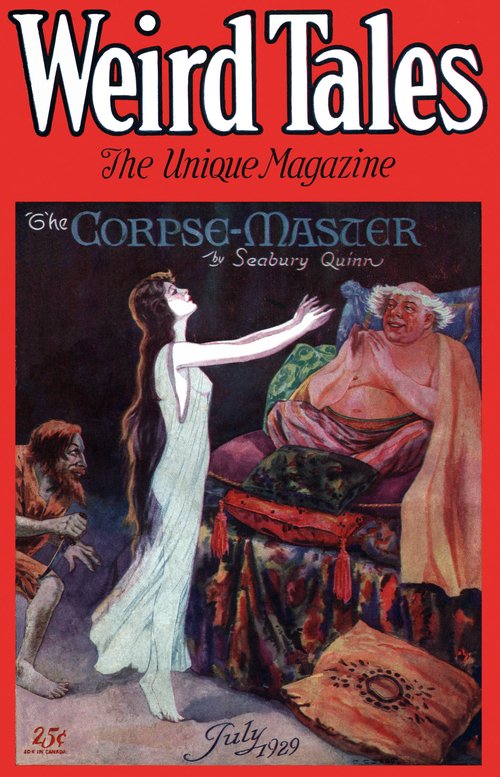
Issue cover by C. C. Senf.
This text is printed as first published. It uses racial language from the period, including slurs.
The ambulance-gong insistence of my night bell brought me up standing from a stuporlike sleep. For something like the millionth time I cursed the poor judgment which had led me to study medicine, as I shoved my toes into a pair of slippers and draped a bathrobe about my rather matronly figure, then, still half blinded by lingering sleep, began feeling my way down the stairs, one groping foot tentatively preceding the other in the mechanics of descent.
“Are you the doctor?” a breathless voice demanded as I switched on the vestibule light and opened the door. A hatless youth, jacket and trousers drawn over his pajamas, half stumbled, half fell through the doorway and clawed desperately at my sleeve. “Quick, quick, Doctor,” he hurried on, not waiting for my affirmative, “it’s my uncle—Colonel Evans. He’s—he’s dying, sir. I think he attempted suicide, and—”
“All right,” I agreed, turning to sprint upstairs. “What sort of wound has he?—or was it poison?”
“It’s in his throat,” the youth replied. “I found him in the bathroom, lying on the floor, and—oh, Doctor, please hurry!”
I took the last four steps at a bound, snatched some garments from the bedside chair and charged down again, pulling on my clothes like a fireman responding to a night alarm as I ran. “Now, which way—” I began, but:
“Tiens, why do we stand here like statues on the Arc de Triomphe?” a querulous voice demanded from the stairs. “Trowbridge, mon vieux, it is to hasten. Come, the young man can relate what he found as we rush to the relief of Monsieur his uncle.”
Both our caller and I stared with open-mouthed amazement as Jules de Grandin, meticulously garbed as though he had spent an hour on his toilet, ran lightly down the stairs, snatched my first-aid kit from its place in the hall closet and motioned us toward the door.
Swallowing my astonishment, I turned to the visitor. “This is Dr. de Grandin,” I introduced. “He’s stopping with me, and will be of great assistance—”
“Yes, parbleu, and the Trump of Judgment will serve excellently well as an alarm clock if we delay long enough!” the little Frenchman interrupted, literally forcing the caller and me through the front door. “En avant, mes amis; let us go.”
As I shot the self-starter of my car I wondered anew at Jules de Grandin. That he slept like a cat I already knew, but how he could have been wakened by the conversation in the hall, arrayed himself like Solomon in all his glory and been ready to respond to the urgent call in so short a time was beyond me.
“Down two blocks and over one—376 Albion Road,” the young man’s direction broke through my wondering revery. “My uncle went to bed about 10 o’clock, according to the servants, and none of them heard him moving about since. I’d been downtown to a fraternity meeting, and didn’t get home till half an hour ago. When I went to the bathroom to wash my teeth I found him there. He was lying on the floor beside the tub with a razor in his hand, and blood was all over the place. It was awful!”
“Undoubtlessly,” de Grandin murmured from his place on the rear seat. “What did you next, young Monsieur?”
“I snatched a roll of gauze from the medicine cabinet and staunched the wound as well as I could, then called Soames, the butler, and had him hold the pack in place while I raced round here for you. I remembered seeing your sign sometime before.”
We drew up before the Evans mansion as he concluded his recital, and rushed through the door and up the stairs together.
“In there,” our companion directed, pointing to a doorway through which a column of bright light streamed out to the darkened hall. A portly man in bathrobe and slippers knelt above a recumbent form stretched at full length on the white tiles of the bathroom floor. One glance at the supine figure and both de Grandin and I turned away, I with a deprecating shake of my head, the Frenchman with a fatalistic shrug of his narrow shoulders.
“He has no need of our services, that poor one,” de Grandin informed the nephew. “Ten minutes ago, perhaps yes; now”—another shrug—“the undertaker, the clergyman, perhaps the police, are the only attendants he requires.”
“The police?” the young man echoed in a shocked voice. “Surely, Doctor, this is a case of suicide, and—”
“Do you say so?” the Frenchman interrupted sharply. “Trowbridge, my friend, consider this, if you please.” Delicately, so that not so much as a hair of the dead man’s thin, white beard was disturbed, he indicated the deeply incised slash across the cut throat. “Does that mean nothing?” he demanded.
“Why—er—”
“Perfectly. If you will wipe your pince-nez before you look a second time, you will observe the cut runs diagonally from right to left.”
“Of course, but—”
“But Monsieur the deceased was right-handed—look how the razor lies beneath his right hand. Now, if you will raise your hand to your own throat and draw the index finger across it, as though it were a knife, you will note the course described is slightly out of the horizontal—somewhat diagonal—and slanting downward from left to right. Is it not so?”
I nodded as I completed the gesture.
“Very good. Now, when one is bent on suicide he screws his courage to the sticking-point; then, if he has chosen the cut throat as his means of exit, he usually stands before a mirror, cuts deeply and quickly with his knife, and makes a downward-slanting slash. But as the red blood lays a ribbon across his neck, as the severed nerves shriek out their message of pain, and he realizes the enormity of his deed, the gash becomes more and more shallow. At the end it trails away to little more than a superficial skin-scratch. It is not so here; at its end it is deeper than at the beginning.
“Again, this poor one would almost inevitably have stood before the mirror to do away with himself. Had he done so, he would have fallen crosswise of the room, perhaps; more likely not. One with a severed throat does not die quickly. He suffers, he strangles, he chokes. And as he does so, he thrashes about like the decapitated fowl, and the signs of his struggle are written plainly on his surroundings. What have we here? Cordieu, is it likely a man would slit his gullet, then lie down peacefully to bleed his life away, as this one appears to have done? It is not en caractère, my friend.
“Further”—he bent down again, pointing with dramatic suddenness to the dead man’s hairless pate—“if we desire further proof, look at this!”
Plainly enough, there was the welt of bruised flesh, the mark of some blunt instrument which had stunned without breaking the skin.
“Maybe he struck his head as he fell,” I hazarded, realizing how weak the supposition was, even as I voiced it.
“Ah bah! Friend Trowbridge, this unfortunate one was struck unconscious by some miscreant, dragged or carried to this room, then slaughtered like a poleaxed beef. Without the telltale mark of the butcher’s bludgeon there is ground enough for suspicion in the quietude of his position, in the neat manner the razor lies beneath his hand instead of being firmly grasped in cadaveric spasm or flung away in the death contortions—but with this bruise-mark before us there is but one answer. He has been done to death; he has been butchered; he was murdered.”
“Would ye be afther seein’ Sergeant Costello, sor?” Nora McGinnis, my household factotum, appeared like a phantom at the dining-room door while de Grandin and I finished our after-dinner coffee.
“But of course, bring him in, ma petite,” the little Frenchman returned. “Always I am glad to talk with your so distinguished countryman.”
“Good evenin’, sors,” the big Irish policeman greeted as he followed Nora through the doorway. “’Tis th’ devil’s own business I’m up against, an’ if ye would be afther givin’ me th’ bit of a lift, ’tis meself that’ll be grateful to yez.”
“Say on, mon vieux,” de Grandin invited, lighting a cigar, “I listen.”
“Well, sor, right on top o’ this Evans killin’ comes another one tonight, not half an hour ago, an’ while we’re certain sure it wuz no suicide, for all it’s dressed up to look like one, I’m hanged if we’ve so much as a thread o’ suspicion to lead us to th’ murderer. We’re sure Colonel Evans was murdered, too, though we’re layin’ low about accusin’ anybody o’ th’ crime, right now; but wid two cases o’ th’ same kind starin’ us in th’ face—” He made a world-encircling gesture with his arms, then sat back in his chair, an expression of deepest depression on his broad face. “’Twas this way,” he continued as de Grandin refrained from comment.
“It hadn’t got decently dark tonight when Mulligan, who pounds a beat up in th’ Eighth Ward, was hailed by a felly from th’ Rangers’ Club hollerin’ an’ yellin’ an’ raisin’ th’ devil about Mr. Wolkof havin’ shot hisself. Mulligan goes in an’ finds th’ pore felly layin’ on his back wid a little hole in his forehead an’ th’ back blowed outa his skull; an’ bein’ th’ wise lad, he does nawthin’ a-tall but ’phone headquarters.
“I’m detailed on th’ case, d’ye see, an’ hotfoots it up to th’ club, expectin’ to find th’ common or garden variety o ’ suicide—them swells messes ’emselves up for reasons you an’ I’d never give a second thought to, ye know, sor—but I’ll be broke if it don’t look more to me like murder than anny suicide I ever saw. Lissen, sor:
“Mister Wolkof wuz one o’ them rich fellies wid more money an’ time than brains, an’ when he wuzn’t foolin’ round wid society stunts he wuz off to Africky or Asia or God knows where explorin’ some heathen land. That’s what all th’ members o’ th’ Rangers’ Club does, more or less, ye know; ’tis a organization entirely made up o’ active or retired explorers, I understand, so—”
“Ah?” de Grandin’s exclamation came with a sharp rising inflection as he struck his forehead with his knuckles.
“Sor?” Costello started at the interruption, but the Frenchman signaled him to proceed. “It is nothing, mon ami,” he assured the detective. “The so thick skull of Jules de Grandin has found a thought within it, and the pain is most excruciating. Say on, I am all attention.”
“Well, sor, as I wuz after tellin’ ye, I found this here now Wolkof felly layin’ flat on his back across th’ floor o’ his room, a .45 Colt revolver kind o’ half-way held in his hand—restin’ on his half-closed fingers, like, sor. D’ye see?”
“Perfectly,” de Grandin nodded.
“Now, I don’t set up to be no expert, sor; but I served clean through th’ Spanish War an seen plenty o’ men die wid their boots on, an’ I’ve been on th’ force ever since I wuz mustered out, an’ I’ve seen a few things there, too. To begin, th’ whole layout o’ th’ case looked fishy to me. Here wuz an old-fashioned, black-powder revolver, what they call a low-velocity gun, sor, an’ if it had been fired close again, th’ dead man’s forehead, it had ought to left a good-sized smudge o’ powder-stain; but th’ devil a bit o’ smoke-stain wuz there. Also, sor, ’tis most unusual, I’ve noticed, for a guy contemplatin’ suicide to shoot hisself in th’ forehead. Usually, if they’re right-handed, they bring th’ muzzle o’ th’ gun up to their right temples before they lets fly. Besides that, sor—ye’ve noticed it yerself, I dare say—when a man’s shot through th’ head he usually tightens up all o’ a sudden. You doctors have some fancy sort o’ hi-falutin’ name for it—”
“Cadaveric spasm,” de Grandin prompted.
“Yes, sor, that’s it! Well, if a man has this cad—what you said, sor—he grasps whatever he’s got in his hand like a Wop waiter holdin’ onto a tip. ’Tis meself that’s seen many a pore felly shot through th’ head wid a Spanish Mauser hold so tight to his rifle that ’twas all we could do to git it away from him when th’ buryin’ party came round.”
“Précisément,” de Grandin agreed, his eyes shining with appreciation of Costello’s close reasoning as he reconstructed the scene. “You did find this Monsieur Wolkof lying full length upon his back with a hole drilled through his head, no powder-brand upon his brow where the projectile entered, and the presumably suicidal weapon lying loosely in his hand. One thing more, though it may not be conclusive: was there any powder-stain upon the dead man’s pistol-hand?”
“There wuz not, sor,” the Irishman declared emphatically, “but ye’re yet to hear th’ cream o’ th’ whole business. ’Twas in Mr. Wolkof’s open right hand th’ pistol rested so easy-like; but all th’ club attendants I questioned tells me he were a left-handed man—writin’, feedin’ hisself an’ shavin’ wid his left hand entirely. Now, sor, I axes ye, would a man all steamed up to blow his brains out be after goin’ out o’ his way to hold th’ pistol in his right hand when he’s so much more important matters to consider, an’——”
“Nom de mille sales chameaux, non!” the Frenchman shouted gleefully. “Sergeant, mon brave, you are a man after my own heart. Never do you overlook the smallest matter of importance. Never do they draw the woolen across your eyes. How easy it would be for you to report a plain case of suicide and thus save your official face, but the great conscience of you will not permit—”
“Sure, sor, that’s why I’m here now,” Costello interrupted. “’Tis th’ great conscience o’ th’ newspapers I’m thinkin’ of. They’ll be takin’ th’ hide off me back an’ tackin’ it to th’ barn door if I don’t make good on this here case, d’ye see, sor?”
“Pardieu, but I say they shall not!” de Grandin promised. “Jules de Grandin, he is in this case with you, mon vieux, in it up to both elbows. Never fear, we shall apprehend the miscreant who has done this; we shall—”
“Sergeant Costello’s wanted on th’ tellyphone from headquarters,” Nora McGinnis interrupted. “Will ye be takin’ th’ message from th’ study, Sergeant?”
The detective rose heavily and strode across the polished bare floor of the dining-room, treading silently as a cat despite his great bulk.
“Hullo! Costello speakin’,” we heard him call through the ’phone. A series of grunted replies, one or two short, monosyllabic queries, then: “Glory be to God! Th’ murtherin’ blackguard! Oi will thot, immejiately!
“Gentlemen,” his Irish brogue had completely supplanted his carefully mastered American accent as he re-entered the dining-room, “there’s all hell broke loose. ’Tis a gur-rul this time—a tiny, wee baby gur-rl that’s been kilt entirely while we sat here talkin’ like three damned fools. They’ve got her pore little body down to th’ morgue now; an’ if Jerry Costello can git his hands on th’ bloody scoundrel ’at done it, there’ll be no nade for th’ public executioner to tur-rn on th’ juice for th’ electric chair, so there won’t!” His great, freckle-flecked fists doubled into twin balls half as large as hams, capable, almost, of felling a wild bull in full charge.
“Wait, wait, my friend!” de Grandin cried as the Irishman turned to hasten away. “We come with you. Mordieu, are we men or are we apes, that we should sit about like decorations on a cocked hat while perverted degenerates assail little helpless children?”
With my horn tooting almost continuously and Sergeant Costello waving crossing policemen aside as though no such things as traffic regulations existed, we rushed to the city mortuary like a fire engine responding to an alarm. Parnell, the coroner’s physician, was fussing over a tray of instruments; Martin, the coroner, bustled about in a perfect fever of anxiety to begin his official duties; and two plain-clothes men conferred in muted whispers beside the autopsy table as we shouldered our way past the uniformed patrolman at the morgue entrance and approached the pitiful little relic lying on the white-enameled slab under the hydrogen light’s merciless glare.
Death in the raw is never pretty, as doctors, soldiers and undertakers know only too well. When it is accompanied by violence it wears a still less lovely aspect, and when the victim is a little child the sight is almost heart-breaking. Bruised and battered almost beyond human resemblance, her short, fair hair matted with blood and cerebral matter, little Hazel Clark lay before us, the queer, unnatural angle at which her right hand thrust out denoting a Colles’ fracture of the wrist; a subclavicular dislocation of the left shoulder was apparent by the projection of the bone beneath the clavicle; and the vault of her little skull had been literally beaten in by some blunt, heavy instrument wielded with tremendous force. The child had been as completely “broken” as ever mediæval malefactor was when bound to the wheel of torture for the ministrations of the executioner.
For a moment de Grandin bent over the battered little corpse, viewing it intently with the skilled, knowing eye of a surgeon; then, so lightly that they scarcely displaced a single blood-stained hair of the child’s head, his quick, practised fingers passed quickly over her body, pausing now and again to prod gently, then sweeping onward, in their investigative course. At length: “He was a gorilla for strength, this one,” he announced, turning from the autopsy table and regarding the detectives shrewdly, “and a veritable gorilla for savagery, as well. What is there to tell me of the case, mes amis?”
Such meager data as they had they gave him quickly. She was three and a half years old, the idol of her lately widowed father’s heart, and had neither brothers nor sisters. That afternoon her father had given her a quarter as reward for having gone an entire week without having merited a scolding, and shortly after dinner she had set out for the corner drug store to purchase an ice cream cone with part of her righteously acquired wealth. Attendants at the drug store testified she left the place immediately and set out toward home; a neighbor had seen her proceeding up the street, the cone grasped tightly in her baby fingers, her tongue protruding as she sampled the confection with ecstatic little licks. Two minutes later, from a spot where the heavy privet hedge of a residence vacated for the summer cast a shadow over the sidewalk, residents of the block were startled by a child’s shrill, terrified scream. The cry was not repeated, and no one had been sufficiently alarmed to investigate till Mortimer Clark, rendered uneasy by his daughter’s prolonged absence, set out in search of her.
From the drug store he traced her course homeward, and was passing the deserted house without thought when his attention was arrested by a patch of discoloration on the granolithic sidewalk. Stooping to investigate the unwonted moisture, he struck a match and was shocked to discover a little pool of fresh blood. With senses sharpened by a sort of panic premonition, he entered the shadowed grounds of the empty house and struck match after match to aid him in his search as he called his little daughter repeatedly. About to continue homeward, he was arrested by the gleam of white cloth beneath a spreading rhododendron bush. Hazel’s broken little body lay where it had been callously tossed by her murderer half an hour before, her scant, little-girl clothing torn almost to ribbons, her head caved in, one wrist broken and a shoulder dislocated. The father’s agonized cries roused the neighborhood, and the police were notified.
House-to-house inquiry by the detectives finally elicited the information that a “short, stoop-shouldered man” had been seen walking hurriedly away a moment after the child’s single despairing cry was heard. Further description of the suspect was unavailable.
“Pardieu,” de Grandin stroked his small, blond mustache musingly as the plain-clothes men concluded, “it would seem we have to search the hayfield for an exceedingly small needle, n’est-ce-pas, my friends? The number of diminutive men with stooping shoulders is very great, and our task will be proportionately hard, I fear.”
“Hard the devil,” a detective returned disgustedly. “It’s impossible. We ain’t got no more chance o’ findin’ that bird than a pig has o’ wearin’ vest pockets!”
“Ha, do you say it?” de Grandin demanded, fixing his fierce, uncompromising stare on the speaker. “Alors, my friend, prepare to encounter a fully tailored porker before you are greatly older. You have forgotten, in the excitement, that I am in this case.”
The policeman regarded him in mingled wonder and disgust. Finally: “Okeh, Frenchy, go as far as you like—you won’t get far,” he replied as he turned away.
“Death of a dyspeptic bullfrog—” de Grandin began furiously, but the sudden entrance of a uniformed policeman cut him short.
“Sergeant, sir,” the newcomer saluted Costello as he advanced, “they found the weapon used on th’ little girl. It’s a winder-sash weight, an’ they’ve got it up t’ headquarters now, testin’ it for fingerprints.”
“Humph,” Costello grunted. “Anything on it?”
“Yes, sir; th’ killer must’a’ handled it after he dragged her body into th’ bushes, for there’s th’ marks o’ bloody fingers on it, plain as day.”
“Ha, parbleu, have I not said so?” de Grandin exclaimed. “Is not every criminal a fool at heart? What have you to say now concerning the pig and his so odious vest-pocket, Monsieur—” he turned to taunt the skeptical detective, but the man had left, following close on the heels of the messenger from headquarters.
“Costello, mon ami, do you see to recording the fingerprints,” de Grandin ordered, addressing the big Irishman over his shoulder. “Tomorrow, if you will be so good as to tell me what you find, I shall take keenest delight in helping you discover the perpetrator of this outrage. Meantime, I think there is much I can learn from the autopsy. With Dr. Parnell’s permission, I shall remain until his work is done.”
I knew Parnell of old. His qualifications as a surgeon were almost negligible, and his post-mortems were invariably performed in the sloppiest possible manner. With no stomach for the sight I knew awaited those who watched him work, I excused myself and hastened home, the memory of the murdered child’s battered head and broken limbs haunting me like a nightmare as I drove slowly through the warm summer evening.
What time de Grandin returned I do not know. I did not see him again until next morning, and he was in a villainous temper, wolfing his breakfast in surly silence, making only abrupt, monosyllabic replies to my tentative questions. Only once did he flare up from his taciturnity. That was when I mentioned Parnell’s name. “Ah bah,” he cried, regarding me with blazing eyes, “do not speak of him, my friend. He is an old woman, that man; his talents would better be exercised in the abattoir. He is a fool, he is a butcher, he is a clumsy lout!”
That evening, as we concluded dinner, he announced abruptly: “I should greatly like to interview Monsieur Clark, Friend Trowbridge. Will you accompany and introduce me?”
I assented, wonderingly, and we drove to the darkened house where Mortimer Clark sat with his dead.
“He’s in the drawing-room, sir,” the elderly housekeeper told us. “He’s been there ever since they brought Hazel’s body home, just sitting beside her and—” She broke off as her throat filled with sobs. “If you could take his mind off his trouble for a minute or two, it would be a Godsend to him, and the rest of us, too. It’s positively spooky, the way he sits and sits and stares and stares and—”
“Mordieu, yes, Madame,” de Grandin assented testily, “but we can aid neither him nor you if we stand and talk and talk. If you will be so good as to direct us, we shall announce ourselves without your aid.” The sting of his words was softened by one of his quick, disarming smiles as he waved her to precede us down the hall.
Coroner Martin had done his work as a mortician with consummate artistry. Under his deft hands all signs of the brutality which had struck little Hazel down had been completely effaced. Clothed in a short, light pink dress, the child lay peacefully in an open silver-gray casket, one soft, pink cheek resting against the tufted silken pillow sewn with artificial forget-me-nots, a little bisque doll, dressed in a frock the exact replica of the child’s, resting in the crook of her left elbow. Beside the casket, a smile sadder than any grimace of wo on his thin, ascetic features, sat Mortimer Clark.
As we tiptoed into the darkened drawing-room we heard him murmur: “Eight o’clock, little daughter, time for shut-eye town. Daddy’ll tell you a story.” For a moment he paused, looking expectantly into the still, childish face on the pillow before him, as though awaiting an answer. The little gilt mantel-clock ticked the quick seconds away; far down the block a neighbor’s dog howled dismally; a light, vagrant breeze bustled softly through the opened French windows, fluttering the white-scrim curtains and setting the orange flames of the tall white tapers at the casket’s head and foot to waving back and forth till elusive, elongated shadows wavered and danced against the gray walls of the room.
It was spooky, this stricken man’s vigil beside his dead; it was ghastly to hear him talking to her as though her tiny ears could understand his words and her pink lips part in smiles and her blue eyes open and look childish laughter into his. But as the story of the old woman and her pig progressed, I felt a sort of terrified tension about my heart. “. . . the cat began to kill the rat, the rat began to gnaw the rope, the rope began to hang the butcher—” the recital went on to the silly, inconsequential end of the nursery tale, and as he spoke, the father bent lower and lower above the casket, as though he would project his softly spoken words across the silences of death by the very intensity of his utterance.
“Grand Dieu,” de Grandin whispered as he plucked me by the elbow, drawing me toward the door. “Let us not look at it, Friend Trowbridge. It is a profanation that other eyes should witness that, and other ears hear what the poor one says. Oh, it is abominable, it is monstrous, it is detestable, my friend. Sang de Saint Pierre, I, Jules de Grandin, shall find the one who has caused this thing to be, and, though he take refuge beneath the very throne of God, I shall drag him forth and cast him screaming into lowermost hell. God do so to me, and more also, if I do not!” Tears were coursing down his cheeks, and he let them flow unabashed, but the eyes which streamed with compassion shone with a sort of demoniacal hatred. Actually, they seemed to gleam with an unreflected, inward light, like the furious eyes of a savage tom-cat at sight of a prowling cur.
“Do you want to speak with him?” I asked falteringly, nodding backward toward the room where Clark held his eery converse with the dead.
“Non,” he responded furiously. “Neither do I wish to stop and tell indecent stories to the priest as he elevates the host. The one would be no greater sacrilege than the other, but—ah?” He cut himself short, staring fascinated at a small, framed parchment which adorned the wall. “Tell me, Friend Trowbridge,” he commanded, “what is it that you see there?”
“Why,” I answered, “it’s a certificate of membership in the Rangers’ Club. Can’t you see? Clark was with the Army Air Service, and—”
“Très bien,” he broke in. “Thank you, my friend. Ideas ofttimes lead us to see that which we wish, when in reality it is not there; that is why I sought the testimony of your disinterested eyes.”
“But what in the world has Clark’s membership in the Rangers to do with—”
“Zut,” he shut me off. “I think, I cogitate, I concentrate, my friend. Do you please withhold your idle talk. Monsieur Evans—Monsieur Wolkof, now Monsieur Clark—all are members. C’est très étrange. But yes, I shall interview the steward of that club, Friend Trowbridge. It is perhaps possible his words may throw more light on these so despicable affairs than all the clumsy, well-meaning investigations of our friend Costello. Come, let us go. Tomorrow will do as well as today, for the miscreant who fancies himself secure is in no hurry to run away despite all the nonsense talked of the guilty who flee when no man pursueth.”
Sergeant Costello was waiting for us when we reached home. A very worried-looking Costello he was, something like fear shining in his usually fearless Irish eyes, and a set to his grim chin which was more like desperation than courage. “We’ve checked up th’ fingerprints on th’ sash-weight, Dr. de Grandin, sor,” he announced almost truculently.
“Bon,” the Frenchman replied carelessly. “They are, perhapsly, of someone you can identify?”
“I’ll say they are,” the sergeant replied shortly. “They’re Gyp Carson’s—th’ meanest killer th’ force ever had to deal wid.”
“Ah,” de Grandin shook off his air of preoccupation with visible effort as he turned directly to the detective. “It is for us to locate this Monsieur Gyp, then, my friend. Have you credible information concerning his present whereabouts?”
The Irishman’s answering laugh was almost an hysterical cackle. “That we have, sor,” he replied with emphasis. “He wuz burned—electrocuted, you know—at th’ penitentiary at Trenton last month for rubbin’ out a milk-wagon driver durin’ a hold-up. Be rights he oughter be out in Mount Olivet Cemetery this minute—an’, be th’ same token, he oughter been there when th’ little Clark gur-rl wuz kilt last night!”
“A-a-ah?” de Grandin twisted the ends of his little, waxed mustache furiously. “Parbleu, it would seem this case contains the possibilities, my friend. Tomorrow morning, as early as you please, let us meet at the cemetery and investigate the grave of this Monsieur Gyp. Perhaps we shall find something there. If we find nothing at all, we shall have found the most valuable information we can have.”
“If we find nothin’—” The Irishman looked at him in bewilderment, then raised his big hands in a gesture of futility. “All right, Dr. de Grandin, sor,” he admitted finally. “I’ve seen some queer things since I begun runnin’ round wid you, but if ye’re after tellin’ me th’ dead can return from th’ grave an’ do such things—”
“Eh bien, my friend, I tell you nothing at all. I, too, seek information,” de Grandin cut in. “Let us await the morning, and rely on the testimony of pick and shovel, if you please.”
A superintendent and two overalled workmen were waiting beside the grave when de Grandin, Costello and I arrived at the cemetery the following morning. The Carson grave lay in the newer, less expensive portion of the burying-ground, where perpetual care was not so conscientiously applied as in the more fashionable sections. Scrub grass, almost blistered away by the midsummer sun, fought for a foothold in the clayey soil and the mound had already begun to fall in. Incongruously, a monument bearing the effigy of a weeping angel with a line of pious quotation from Scripture leaned over the grave-head, while a footstone with the inscription, “Our Darling,” guarded its lower end.
The superintendent glanced over Costello’s papers, stowed them away in the inner pocket of his tattered work coat and nodded to the Polish laborers. “Git goin’,” he ordered tersely, “an’ make it snappy.”
It was dismal work watching the sweating men fling shovelful after shovelful of earth from the desecrated sepulcher. The oppressive warmth of the day was unrelieved by any breath of breeze and the air seemed to hang dead-still. The veil of mist which completely overhung the sky was too thin to cut off the boiling heat of the morning sun, the scant foliage of the graveyard was dusty, and the entire landscape was a sick, yellowing green in the tepid sunlight.
The laborers’ picks and spades bored deeper and deeper into the hard, heat-baked earth. At length the hollow, reverberating sound of steel in contact with wood warned us their work was drawing to a close. A pair of strong, web straps were lowered, made fast to the rough chestnut box enclosing the coffin, and at a word from the superintendent the men strained at the thongs, bringing their weird freight to the surface. A pair of pick-handles were laid across the open grave and the grave box rested on them. With a wrench the superintendent undid the screws holding the clay-stained lid and laid it aside. Within lay the casket, a cheap, square-ended affair covered with shoddy gray broadcloth, the tinny, imitation-silver name-plate and crucifix on its lid already showing a dull, brown-blue discoloration.
“Maintenant!” murmured de Grandin breathlessly as the superintendent began unlatching the fastenings which held the upper half of the casket lid in place. Then, as the last catch snapped back and the cover came away:
“Sang du diable!”
“Good heavens!” I exclaimed.
“For th’ love o’ God!” Costello’s amazed antiphon sounded at my elbow.
The cheap sateen pillow of the casket showed a depression like the pillow of a bed recently vacated, and the poorly made upholstery of its bottom displayed a wide furrow, as though flattened out by some weight imposed on it for a considerable time, but sign or trace of human body there was none. The case was as empty as on the day it left the factory.
“Glory be to God!” Costello muttered hoarsely, staring and staring again into the empty coffin, as though loth to believe the evidence of his eyes. “An’ this is broad daylight!” he added in a kind of wondering afterthought.”
“Précisément,” de Grandin’s acid answer came back with whiplike sharpness. “That is diagnostic, my friends. Had we found something within, it might have meant one thing or another. Here we find nothing; nothing at all. What does it mean?”
“I know what it means!” the look of superstitious fear on Costello’s broad, red face had given way to one of furious anger. “It means there’s been some shinnanigans goin’ on. Th’ dir-rty killer wuzn’t burned a-tall, an’—who had this buryin’?” he turned savagely to the superintendent.
“Donally,” the other replied, falling back a pace before Costello’s rising fury.
“Ah, he did, did he? Well, be gob, we’ll see what Mr. Donally has to say about this, an’ he’d better have plenty to say, too, if he don’t want to collect himself from th’ corners of a four-acre lot!”
Donally’s Funeral Parlors were new, but by no means prosperous-looking. Situated in a small side street in the poorer section of town, the only pretension they made to elegance was the brightly-gleaming gold of the letters in which the legend:
JOSEPH DONALLY
Funeral Director & Embalmer
Sexton St. Rose’s R. C. Church
appeared on their plate-glass windows.
“See here, young felly, me lad,” Costello began without preliminary as he stamped unceremoniously into the dark little room which constituted Mr. Donally’s office, “come clean, and come clean in a hurry. Wuz Gyp Carson dead when you had his funeral?”
“I’ll say he was—if he wasn’t we sure played one awful low-down trick on him,” the mortician replied. “Say, feller, if they set you in that piece o’ furniture down to Trenton an’ turned God knows how many volts o’ juice into you, d’ye think you’d be dead? What d’ye mean, ‘was he dead’?”
“I mean just what I say,” Costello responded. “We’ve just come from th’ cemetery, an’ if there’s hide or hair of a corpse in his coffin, I’ll eat it, so I will.”
“What’s that?” the other demanded. “Y’ say th’ casket was empty?”
“Empty as your head.”
“Well, I’ll be—” Donally began, but Costello cut in:
“You sure will, an’ you’ll be all beat up, too, if you don’t spill me th’ low-down. Come clean, now, or must I sock ye in th’ jaw an’ lock ye up in th’ bargain?”
“Whatcher tryin’ to put over?” Mr. Donally wanted to know. “Think I faked up a stall funeral? Lookit here, if you don’t believe me.” From a pigeon-hole of his desk he produced a packet of papers, thumbed rapidly through them, finally handing Costello a thin sheaf fastened together with an elastic band.
Everything was in order. The death certificate, signed by the prison physician, showed the cause of death as “cardiac arrest by fibrillary contraction induced by three shocks of an alternating current of electricity of 7½ amperes at a pressure of 2,000 volts.”
“There wasn’t much time,” Donally volunteered. “I hadda work fast on that case, for th’ prison doctors had made a full ‘post’ an’ his old woman was one o’ them old-fashioned folks that don’t believe in embalmin’, so there was nothin’ to do but rush him out to the graveyard an’ plant him. Not so bad for me, though, at that. I sold ’em a casket an’ burial suit an’ twenty-five limousines for th’ funeral, an’ later got my commission on th’ monument.”
De Grandin looked speculatively at the young undertaker. “Have you any reason to believe attempts at resuscitation were made, my friend?” he asked.
“Huh? Resuscitate that?” Donally returned disgustedly. “Say, feller, didn’t I just tell you they’d made a full autopsy at the prison? You might as well try to resuscitate a hunk o’ Hamburger steak as bring back a feller which had had that done to him.”
“Quite so,” the Frenchman agreed. “I did but ask. Now—”
“Now we don’t know anny more where we’re at than we did a hour ago,” the sergeant supplied. “I might’a’ thought this guy wuz in cahoots wid th’ felly’s folks, but th’ prison records show he wuz dead, an’ them doctors down to Trenton don’t certify nobody’s dead if there’s so much as th’ flicker of an eyelash left in ’im. It looks like we’d have to hunt around for some gink wid a fad for grave-robbin’, don’t it, Dr. de Grandin?
“But say”—a sudden gleam of inspiration overspread his face—“this may sound wild as a mountain goat to you, sor, but I was just after thinkin’: Suppose someone had dug his body up an’ taken an impression o’ his fingerprints, then had rubber gloves made wid th’ prints on th’ outside o’ th’ fingers? Wouldn’t it’a’ been a horse on th’ force for him to go round murderin’ pore, innocent little gur-rls, then leave his weapons layin’ round permiscuous-like, so’s we’d be sure to find what we thought wuz his prints, only to discover they wuz made by a gunman ’at had been burned a month or more ago? Boy, howdy, that’s th’ answer, sure’s a gun’s made o’ iron! Suppose you say it’s all a lotta horse-feathers, an’ no one but a crazy man would think up such a hare-brained scheme? Well, sors”—he regarded us triumphantly—“who but a crazy felly would go about murderin’ pore little three-year-old gur-rls ’at never done him anny harm a-tall?”
“Tiens, my friend, your idea has at least the foundation of reason beneath it,” de Grandin commented. “Do you search for one who might have stolen this body before perpetrating his so dastardly crime. Me? I shall make certain investigations of my own. Anon we shall confer, and together we shall surely lay this so vile miscreant by the heels. When we do—”
“Be gorry, there’ll be no wor-rk for th’ public executioner if I ketch him!” the Irishman promised grimly.
“Mais non, my friend,” de Grandin protested. “Promise me as a descendant of the Irish kings that you will not entirely kill him.”
“What th’ hell for?”
“Cordieu, am I to have no pleasure? Shall I not have even one small little part in taking vengeance on this slayer of little children?”
Costello burst into a roar of laughter, but there was little merriment in it. Rather, it was such a bull-bellow of amusement as some ancient sea-roving flatha might have given as he led his savage seamen against the Scotch or British. “Shake, Doc,” he ordered as his huge hand went out to grasp the Frenchman’s slim, white fingers. “Ye’re th’ bye I’m after doin’ business wid in this case!”
De Grandin was absent most of the day, attending to some mysterious affairs of his own, but a few minutes before dinner was announced he ran lightly up the front steps, made a hasty toilet and proceeded to attack the fried chicken, corn fritters and other delicacies Nora McGinnis had provided with an appetite which would have shamed a half-starved wolf.
“Ah, but it has been a lovely day,” he assured me with twinkling eyes as he contemplated the glowing end of his after-dinner cigar. “Yes, pardieu, an exceedingly lovely day! This morning, when I went from that Monsieur Donally’s shop, my head whirled like that of an unaccustomed voyager stricken by sea-sickness. I knew not which way to turn, and only miserable uncertainty confronted me on all sides. Now”—he blew a great cloud of fragrant smoke from his nostrils and watched it spiral slowly toward the veranda roof—“now I know much, and that which I do not actually know I damn surmise, I think I see the end of this tortuous trail, Friend Trowbridge.”
“How’s that?” I encouraged, watching him from the corners of my eyes.
“How? Cordieu, I shall tell you!” he replied explosively. “When the good Costello came to the house, telling us of the murder of that Monsieur Wolkof—that murder which was made to appear like a suicide—and mentioned that he was killed in the house of the Rangers’ Club, I suddenly recalled that Colonel Evans, whose death we had but lately deplored, was also a member of that organization. It struck me at the time that there might be something more than mere coincidence in it; but when that so pitiful Monsieur Clark proved also to be a member, nom d’un asperge, coincidence ceased to be coincidence and became a moral certainty.
“‘Now,’ I ask me, ‘what lies behind all this business of the monkey? Is it not more than ordinarily strange that two members of the Rangers’ Club should have been slain so near together, and in such similar circumstances, and a third should have been visited with a calamity worse than ten thousand deaths?’
“‘You have said it, mon garçon,’ I tell me. ‘It are indubitably as you say. Come, let us interview the steward of the Rangers’ Club. Perhaps he will have something to tell us.’
“Nom d’un pipe, what did he not tell? From him I learn much, much more than he thought. I learn, by example, that Messieurs Evans, Wolkof and Clark have long been friends; that they have all been members of the club’s grievance committee; that they were called on some five years ago to consider the case and finally to recommend the expulsion of a Monsieur Wallagin—mon Dieu, what a name!
“‘So far, so fine,’ I tell me. ‘But what of this Monsieur-with-the-Funny-Name? Who and what are he, and what have he done that he merited expulsion from the Rangers’ Club?’
“I make the careful inquiry and find out much. He has been an explorer of considerable note, and have written some monographs which showed he knew how to use his eyes. Hélas, he knew also how to use his wits, as many club members who lent him money later discovered to their sorrow. From Thomas, Richard and Henry he borrowed, but never did he repay. Furthermore, he had a most unpleasant lot of stories which he gloried to tell—stories of his doings in the far places which did not recommend him to the company of self-respecting gentlemen. And so he was—what do you say?—booted out of the club. When he went he swore horrid vengeance on all who voted his expulsion.
“Five years have passed since then, and Monsieur Wallagin seems to have prospered exceedingly. He has a marvelous house in the suburbs where no one but himself and a single servant—always a Chinese—lives, but the neighbors tell queer stories of strange parties he holds, parties where pretty ladies in strange attire appear, and once or twice strange-looking gentlemen, as well.
“Eh bien, why should this make me suspicious? I do not know, unless it be that my nose scents the odor of the rodent farther than the average. In any event, out to that strange, lonesome house of Monsieur Wallagin I go and at its portals I wait like a hungry tramp in hope of charity.
“My vigil is not unrewarded. Non, by no means. Before I have stood an hour I behold a small Chinaman forcibly ejected from the house by a large, gross man who looks to me like a hog in human form. I meet the estimable Chinois as he trudges down the road, and sympathize with him on the misfortune he has suffered. He tells me much, though he thinks he tell but little.
“My friend, I learn he have been discharged because he salted the food which was prepared for the guests!”
The impressiveness of his manner as he imparted this bit of trivial information struck me queerly. I was about to express my surprize, when he hurried on with his story:
“Consider, my friend: This so execrable Wallagin have several house guests there, and what does he feed them? I demand to know.”
“Haven’t the faintest idea,” I confessed, smiling at his vehemence.
“Pardieu, I shall tell you. Barley, my friend; barley and wheat, and damned, detestable turnips, with never the soupçon of meat or salt in them. What think you of that?”
“Queer sort of hospitality,” I hazarded.
“Hospitality?” he echoed. “It is damnable, my friend—believe me, I use the term advisedly—damnable, no less. This poor one from far-off China has been hurled from his kitchen for no greater fault than that he did salt the wretched soup wherewith Wallagin regaled his visitors. He, this villainous Wallagin, always personally tastes all food before it is served to those who enjoy his so strange hospitality, and this day he discovered the savor of salt in it, whereupon he kicks out his cook without more ado.”
“But see here, de Grandin,” I returned. “Why make so much ado over an eccentricity? Perhaps Wallagin’s guests are on some queer diet, and demand that sort of food. Here you are abusing the man like a pick-pocket for no earthly reason I can see save the rations he serves his callers. I admit I don’t think I’d relish such fare, but they must—they’re not obliged to remain there if they don’t like it, are they?”
Something so deadly serious shone in his eyes as he faced me that I felt a little shiver of apprehension. “I do not know,” he replied simply. “Me, I think they are; but we shall soon ascertain. If I am right in what I suspect, we shall see devilment beside which the worst of ancient Rome was mild. If I am wrong—alors, I am wrong. Come, I think I hear the good Costello’s feet outside; he is ready to accompany us.”
Costello ascended the front steps as the Frenchman ceased speaking. The two exchanged brief nods, and de Grandin motioned me to rise. In a moment we were in my car, speeding over the smooth turnpike leading to Morrisdale, the fashionable new suburb at the western end of town.
Evening had brought little surcease from the day’s steaming heat, and though the moon shone in the eastern sky, a thin veil of haze lay across her face like gauze before an odalisk’s features, and the landscape was rather obscured than revealed by the strained light filtering through the damp, superheated night air. Perspiration ran in streams down Costello’s face and mine, but de Grandin seemed rather in a chill of suppressed excitement, his little round blue eyes alight with dancing elf-fires, his small white teeth fairly chattering with nervous excitation as he leaned across the back of the seat, urging me to more and more speed as we whirled down the wide highway.
Wallagin’s house was a massive stone affair, standing well back from the road in a jungle of overgrown greenery, and seemed to me principally remarkable for the fact that it had neither front nor rear porches, but rose sheer-walled as a prison from its foundations.
At a signal from de Grandin I parked the car beside the driveway’s entrance and, led by the little Frenchman, we made our cautious way to the house, creeping to the only window showing a gleam of light and fastening our eyes to the narrow crack beneath its not-quite-drawn blind.
“Monsieur Wallagin acquired a new cook this afternoon,” de Grandin whispered as we took our stations. “I made it my business to see him and bribe him heavily to smuggle a tiny bit of meat into the soup he prepared for tonight. If he has been faithful to his trust we may see something; if not—pah, my friends, what is it we see here?”
Inside the house was a room which must have been several degrees hotter than the stoke-hole of a steamer, for the window was tightly shut and a great log fire blazed on the wide hearth of the open fireplace almost directly opposite our point of vantage. The walls of the room were smooth-dressed stone, the floor was paved with cement. Lolling on a sort of ottoman composed of heaped-up cushions sat the master of the house, a great, overfed bulk of a man with enormous paunch, great, fat-upholstered shoulders between which his massive head was sunk like an owl’s in its feathers, large, white hands with wrists wrinkled by pendulous layers of fat, and eyes as cold and gray as twin inlays of burnished agate. What hair the man possessed lay round the lower part of his cranium like a white wreath, for it was long and curling and white with a whiteness which was more due to total absence of color than to any silvery shading, and the broad, flabby face beneath the bulging, gleaming dome of his brow was pasty-pale with a sort of bleached, yellowish pallor like the belly of a toad, or one of those burrowing worms which live their lives away from any ray of sunlight. It was a massive face, an intellectual face, but a weak, vicious face as well, the countenances of Caligula and Nero in one, with something of the bestial brutality of a sensual Eastern seraglio-master in addition.
About his great shoulders was draped a robe of heavy Paisley weave, belted at the loins but open to the waist, displaying his obese torso and abdomen, so that as he squatted there he resembled a grimly grotesque travesty of Mi-lei-Fo, the laughing Buddha of China.
As we fixed our eyes to the gap beneath the curtain the man smiled in wide-mouthed anticipation and beat his fat hands together sharply.
A door at the farther end of the room swung open in response to his signal, and into the apartment trooped a file of women. Young they all were, and comely, with a diversity of beauty which would have done credit to the casting director of any metropolitan revue. The leader was tall, statuesque, with sweeping black hair, sharp-hewn, patrician features, and a majesty of carriage like a youthful queen’s. Two others—one blond, petite and fairylike in her beauty, the other ruddy-haired and plumply rounded—followed in the wake of the first, and last of all came slouching, with stoop-shouldered, hang-dog mien, an undersized man.
“Jasus!” Costello breathed in a terrified whisper. “Will ye be lookin’ at that felly, Dr. de Grandin, sor. ’Tis Gip Carson hisself! An’—blessed be God!—th’ woman ladin’ th’ parade is none other than pore dead Missis Clark, mother o’ th’ little gur-rl that wuz kilt th’ other night!”
“S-s-s-st!” de Grandin’s sharp, low hiss cut him off. “Observe, my friends; did I not say we should see something? Regardez-vous!”
At a signal from the seated man the women ranged themselves before him, arms uplifted, heads submissively bent; then, with a slow, gliding motion, first one, then the others, began to dance a sort of fantastic rigadoon. Each was clothed in a clinging shift of some netlike, silky material, falling in undulating lines from shoulder to instep like a boudoir negligée, and through the meshes of the filmy cloth their white bodies showed pale and wraithlike.
The dance was not a thing of art—at least, not such art as is exemplified upon the stage—for the dancers’ movements were stilted and slow, each seeming to feel her way through the measures of her performance as though she danced blindfolded; yet there was a sort of eery, blood-freezing fascination about it, too, for though I set Costello’s utterances down to Irish superstition and mistaken identity, there was something so unreal about the spectacle that, though I could not frame the words to describe it, I felt I looked on something so obscene, so utterly vile, that my eyes would be long polluted by what they saw that night.
“Oi tell ye, sor,” Costello began again in a frightened whisper, his native brogue asserting itself, “there’s Missis Clark, an’—”
“Be still, great fool, or I must silence you!” de Grandin hissed. “Behold what is to come.”
The dance concluded, the fleshy master of the revels waved the slouching man to a seat on the floor and motioned to the dancers to approach. It seemed to me as I watched that each woman hesitated with a show of visible reluctance before obeying the silent order, but each stepped forward, nevertheless, and sank crouching at the bloated creature’s feet.
All we saw was pantomime, for the heavy window shut in all sounds beyond its thick pane. Perhaps that added to the horror of the vision. At any rate, I felt myself go sick as the bloated man dropped a monstrous arm caressingly about the shoulders of the women seated to his right and left, then, with a throaty, cynical laugh, motioned some command to the stoop-shouldered fellow squatting cross-legged on the bare floor beside the red-haired woman. Slowly, mechanically, the undersized man leaned toward the girl, put the palms of his hands on her cheeks and drew her face to his, then kissed her long upon the mouth. It was as though two automatons caressed. Though lip folded over lip in the counterfeit of love, the osculation was as devoid of sentiment as though the man and woman were two dolls carelessly tumbled face to face against each other, and I caught myself trying vainly to recall a half-forgotten verse from Oscar Wilde:
For within the grave there is no pleasure,
. . . and desire shudders into ashes . . .
My wandering attention was recalled as the gross creature motioned to the dark-haired woman to perform what was evidently a nightly rite. A shudder passed through her lissome frame as she complied, but despite her evident revulsion, she seated herself before him, leaned back until her head was pillowed on his crossed bare feet, and twined her lovely arms up and backward about his almost shapeless fat ankles.
Sudden recognition, sharp and painful as the stab of a dentist’s drill, pierced my consciousness as I looked. With the raising of her arms to embrace her master’s legs, the woman had exposed her axillæ, and sunken deep in her left armpit was a short wound, patently quite fresh, but bloodless despite its evident depth, its lips drawn puckeringly together with the familiar “baseball stitch.”
No surgeon leaves a wound like that. It was the mark the embalmer’s scalpel made in cutting through the superficial tissue to raise the axillary artery for his injection. The woman before me, the woman who had danced like a houri from some sultan’s zenana not five minutes before, was dead; dead as any tenant of the graveyard!
About to shriek out my discovery, I was arrested by the sudden clutch of de Grandin’s hand upon my arm. “Observe, my friend,” he whispered. “We shall see whether or not my plan has carried.”
Shuffling into the room, apparently no more concerned with the scene before him than if he had been serving coffee at a formal dinner, a little Chinaman entered, a tray containing four small soup bowls held high before him. He set the food upon the floor and turned unconcernedly to leave, giving not so much as the tribute of a single backward glance at the gross, squatting man and his bond-woman, and the queer, lifeless-looking pair who kissed and clung in gruesome similitude of passion beside their master’s cushioned throne.
An indolent motion of the master’s hand and the slaves fell on their provender like hungry beasts at feeding-time, lifting the coarse china bowls to their mouths and drinking greedily.
Such a look of dawning recognition as spread over the four expressionless faces as they drained the broth I have seen sometimes when half-unconscious patients have received powerful restoratives. The man was first to show it, surging up from his crouching posture on the floor and gazing about him wildly through half-closed, desperate eyes, like a caged thing seeking escape from its prison. But before he could do more than wheel drunkenly in his tracks, realization seemed to burst upon the women, too, and scream after agonized scream burst from their lips. There was a flutter of transparent draperies, the soft thudding of soft bare feet on the cement flooring of the room, and they rushed pellmell to the door, brushing the hunch-shouldered man from their way as though he were a child.
Utterly transfixed with horror, I stood as if rooted to the earth till the sudden sharp clutch of the little Frenchman’s hand brought me out of my stupor. “Quick, Friend Trowbridge,” he ordered. “To the cemetery; to the cemetery, with all haste! Nom d’un sale chameau, we have yet to see the end of this!”
“Which cemetery?” I asked stupidly, my wits still benumbed by the horrid sight I had witnessed.
“N’importe,” he returned, fairly dragging me toward the waiting motor. “At Shadow Lawn or Mount Olivet we shall see that which will make us all three call ourselves liars.”
Mount Olivet was the nearest of the three municipalities of the dead adjacent to Harrisonville, and toward it we made at top speed. Parking the car beside the main entranceway, we dashed through the narrow grilled gate for foot-passengers—the driveway was closed at sundown—and raced across the grave-hummocks toward the humble tomb of the executed murderer which had proved untenanted that morning.
“Say, Dr. de Grandin, sor,” Costello demanded, panting as he strove to keep abreast of the agile little Frenchman, “just what’s th’ idea of all this business? I know ye’ve some good reason, but—”
“S-s-st!” de Grandin hissed between clenched teeth. “Crouch here, my friends; in the shadow of this monument, and keep your gaze fixed upon that grave; keep it—ah!”
Shuffling queerly, stumbling now and again over the mounded tops of the sodded graves, a slouching figure came careening crazily toward us, veered off as it neared the Carson grave and sank to its knees beside the loosened earth so recently replaced by the cemetery laborers. An instant later it was scrabbling with frenzied hands at the clay and gravel of the mound, as though seeking to burrow its way into the sepulcher.
“Me God!” Costello breathed unbelievingly. “’Tis Gip Carson hisself!” He shuddered as he rose, and I could see the tiny globules of fear-sweat standing on his forehead in the pallid moonlight as he stepped forward, but the inbred sense of duty was stronger in his Irish heart than was the pull of generations of Irish superstition. “Gyp Carson, I arrest ye in th’ name o’ th’ law for th’ murder o’ William Hamiline,” he thundered as he laid a heavy hand on the burrowing creature’s shoulder.
It was as if he had touched a soap bubble. With an odd little squeak, like that of a mouse caught in the jaws of a trap, the creature beneath his hand collapsed in a crumpled heap on the mound of fresh earth. When de Grandin and I reached them the pale, drawn face of a corpse grinned sardonically up at us in the beam of Costello’s flashlight.
“Dr.—de—Grandin, sor—Dr.—Trowbridge, for th’ love o’ heaven, gimme a drink o’ sumpin’,” the big Irishman pleaded pitifully, catching at the diminutive Frenchman’s shoulder as a terrified child might clutch its mother’s skirts.
“Courage, mon brave,” de Grandin soothed, patting the detective’s big hand, “there is yet work for us to do. Tomorrow they will bury this poor one. The law has had its will of him; now let his body rest in peace. Tonight—sacré nom, the dead must attend the dead; it is with the living we have business. En avant; to Wallagin’s house, Friend Trowbridge!”
“It is as I suspected,” he told us as I turned the car carefully in the narrow roadway and set out for the accursed dwelling we had just left. “Your solution of the case was sane, Friend Costello, but there are times when very sanity proves the falseness of a conclusion. That someone had resurrected the remains of this poor Gyp Carson to copy his fingerprints seemed most reasonable, but today I obtained certain information which led me up another road. Already I have explained the mystery of this Wallagin person; how he was thrown out from the Rangers’ Club for various reasons and how he vowed horrid vengeance on those who voted his expulsion. That was of interest. I sought still further. I found that he was long in the Island of Haiti and that he there mingled with the Culte des Morts. Ah, my friends, we who sit here in this clean northern air can laugh at such things, but in Haiti, that dark step-daughter of mysterious Africa’s dark mysteries, they are no jest. No. In Port-au-Prince and in the backlands of the jungle the native Haitians will tell you of the zombie—he is well known wherever black magic is practised. Now, a zombie is neither a ghost nor yet a living person resurrected, but only a spiritless corpse ravished from the quiet of the grave, endowed with a pseudo-life by black sorcery and made to serve the whim and pleasure of the magician who has animated it. Sometimes these wicked ones steal a corpse to make it commit a crime while they stay far from the scene, thus furnishing themselves unbreakable alibis. More often they rob the grave for the purpose of securing slaves who labor ceaselessly for them at no wage at all. Yes, it is so; with my own two eyes I have seen it before the American Marines occupied the island.
“But there are certain limits which even the strongest sorcery can not transcend. The poor, dead zombie must be fed, for if it were not so, he could not continue to serve the purpose of his execrable master. But he must be fed only certain things. If he taste salt or meat, though but the tiniest bit of either be concealed in a great quantity of food, he comes to a realization of his own deadness and goes back to his grave, nor can all the magic of his owner stay him from returning for one little second. Furthermore, when once he goes back, he is forever after dead—truly dead—and not to be again raised by any magic incantation, for Death which has so long been cheated at once reasserts his mastery, and putrefaction, which was stayed during the zombie’s period of servitude, takes place quickly, so that the zombie dead six months, if it returns to its grave and touches its hand to the earth, becomes at once like any other six-months-dead corpse—a mass of corruption, not pretty to the sight or pleasant to the nose, but preferable to the horrid dead-alive thing it was a moment before.
“Consider, then: The steward of the Rangers’ Club told me of the awful tales this Monsieur Wallagin was wont to tell so boastfully—tales, said he, which made the hair to rise and the flesh to creep—and when I pressed him for an explanation, he told me that Wallagin had bragged that he had been a zombie-maker, a corpse-master in black Haiti, and that the mysteries of Papa Nebo, Gouédé Mazacca and Gouédé Oussou, those dread oracles of the dead, were an open book to him.
“‘So, Monsieur Wallagin,’ I say, ‘I damn suspect you have been up to the business of the monkey here in this so pleasant State of New Jersey. You have, it would seem, brought here the black mysteries of Haiti, and with them you wreak vengeance on those you hate, n’est-ce-pas?’
“Thereupon I take my way to his house and wait beyond his gate in hope something will transpire. It does. It is a little, so small Chinaman who has been discharged from this Wallagin’s employ.
“For why? Because he had put salt in the soup this Wallagin serves to his four guests!
“‘Four guests?’ I say. ‘I had not thought there were so many.’
“‘Nom d’un nom, yes,’ the Chinois tell me. ‘There are one man and three so lovely women in that house, and all seem sleeping most of the time, save in the dark of night, when he has the women dance for his delight, and calls the men to witness the performance. Sometimes, too, he sends the men abroad at evening. It is at night he feeds them the soup without salt or meat which are not fit for a mangy dog to lap.’
“‘Oh, excellent young man of China, oh, paragon of all Celestials,’ I tell him, ‘you are truly of much assistance to me. Behold, I give you much money; come with me and we shall hire another cook for this Monsieur Wallagin the damned, and we shall bribe him well to smuggle a so small piece of meat into the soup which he shall prepare for those four “guests.” Salt the monster might easily detect when he tastes the soup before it are served, but a little, tiny bit of meat would pass unnoticed by his palate. Nevertheless, it will do sufficiently for my purposes.’
“Voilà, my friends, there is the explanation of this night’s so dreadful scenes.”
“But what are we going to do?” I demanded. “You can’t arrest this Wallagin. No court on earth would believe your story long enough to try him.”
“Do you believe it, my friend?” de Grandin addressed Costello.
“Sure, an’ I do,” the other returned. “Ain’t I seen it wid me own eyes?”
“Perfectly. And what would you say this so monstrous Wallagin’s punishment should be?”
“Ouch, Dr. de Grandin, sor, is it kiddin’ me ye are? Sure, what would I do if I seen a poison snake runnin’ across th’ road as I was walkin’ down th’ street wid a jolly bit o’ black-thorne in me hand?”
“Précisément,” de Grandin agreed. “Are you willing?” His fierce, uncompromising glance caught and held the Irishman’s eyes a moment; then, as a light of understanding dawned in Costello’s face, he thrust out his slender, womanishly small hand and lost it in the depths of the detective’s great fist.
“Très bon, we are arrived; let us do what is to be done quickly,” de Grandin announced as I drew up before the Wallagin gate.
Without ceremony we marched up the garden path, turned the handle of the front door and hurried down the wide central hall of the big house.
Wallagin sat, or rather squatted, at ease on the pile of cushions in the superheated room in which we had witnessed the dance of the dead a half-hour or so before. As we entered he raised supercilious, faintly amused eyebrows.
“Ah, Dr. de Grandin,” he greeted affably, “I’ve been rather expecting a visit from you—and Sergeant Costello. I’ve heard you gentlemen had paid me the compliment of prying into my poor affairs. Pray be seated—if you can so far debase yourselves as to repose on the floor. Unfortunately, I possess no chairs.”
“Monsieur”—there was more pity in the eyes of a hungry cat regarding a mouse than in the gaze de Grandin bent on the sneering toad-man—“we are come to settle a reckoning with you—parbleu, a reckoning which is exceedingly long overdue!”
“So-o?” the other drawled. “Just how do you propose going about it, if I may be pardoned the curiosity? Let us suppose I admit everything you charge—assume I agree that I raised Gyp Carson from his grave to—er—eliminate the Clark brat and that sniveling old fool of an Evans and that pious hypocrite, Wolkof? What of it? Let us go a step further; suppose I admit bringing Clark’s slut of a wife from the grave, together with Evans’ niece and Wolkof’s sister, and confess I made them my—er—let us say playthings? What can you do? No grand jury would give your story a moment’s credence; they’d never bring in a true bill against me. If they did, no petit jury would convict me on such a fantastic story. This is the Twentieth Century, and we are in practical, hard-headed America, my dear sir. They stopped hanging witches here in 1692, you know. If I confess everything in open court it will simply be taken as sure proof of my mental derangement. I might be confined in an asylum for a time, but I’d have small difficulty in persuading the doctors I’d regained my reason within a few months, and in less than a year I should again be free. No, no, my clever friend; I’m just a bit too sharp to be taken in your trap. You’re stalemated before you begin to play, I fear.”
He turned his fat, voluptuous, unspeakably evil grin on each of us in turn, then continued tauntingly: “Suppose I surrender myself to you, Sergeant Costello. You’re an officer of the law and can’t very well use violence on a prisoner who expresses his willingness to accompany you. Come, take me to the station house and tell the story of my confession to the lieutenant—you’ll be kicked off the force for drunkenness on duty tomorrow morning, if you do. You might ask your clever French friend how he managed to smuggle the meat into my pets’ soup before we go, however. I assume that, with his Latin freedom from scruples, he resorted to bribery and corruption of my cook? They do such things in Paris, I understand.”
Again he faced de Grandin, smiling contemptuously. “This scheme of things would seem to require the preachers’ fiery hell for adjustment, cher docteur,” he remarked pleasantly. “Earthly justice seems pitifully inadequate to the occasion, n’est-ce-pas?”
“Monsieur,” de Grandin assured him, speaking in a low, even monotone, “this business will be adjusted here and now; make no mistake.
“Trowbridge, my friend,” he turned to me, “I regret that I must request you to leave us for a little time. Your Saxon stomach could not stand that which is about to be enacted here. Await us with the car, if you will, good friend. Meantime, Sergeant Costello and I have that to do which will admit of small delay. Are you ready, Sergent?”
From inside his jacket he drew a bundle of slender sticks, no thicker than match stems, but about six inches in length. “You have undoubtlessly traveled in China, Monsieur?” he asked pleasantly, regarding Wallagin with a smile. “You recognize these and know the excellent use to which we propose putting them, hein?”
Something like terror showed in the livid, unhealthy face of the seated man. “Surely,” he began, “surely you won’t resort to—Sergeant Costello, I appeal to you as an officer of the law—I’m under your protection as an arrested prisoner. Mercy, man, save me!—save me from—”
“Dr. Trowbridge, sor,” the Sergeant turned to me, “would ye be so kind as to keep this bit o’ joolery for me till I join yez at th’ gate? ’Tis a favor I’d be grateful for.” From the underside of his coat lapel he detached the blue-enamel-and-gold shield of his office and handed it to me. “Now, my bye,” he turned to face Wallagin once more, “I’m right wid ye!”
I have seen more pity depicted on the faces of torturers of the Inquisition in mediæval paintings than appeared in de Grandin’s and Costello’s features as they wheeled with one accord and advanced on their cringing, whimpering prisoner. Without a second look I turned and hastened from the room, nor did I slacken my hurried walk till I reached the car and clambered into my seat behind the steering-wheel.
Once I heard a horrid, thick-voiced scream from the house behind me, but it died almost as quickly as it came. After that, for what seemed eternity, there was ominous silence.
At last de Grandin and Costello emerged from the big dwelling, both serious-faced, but with an expression of grim satisfaction on their countenances.
“Well, Dr. de Grandin, sor,” the sergeant remarked as he retrieved his shield from my custody and pinned it to his coat once more, “I shouldn’t much wonder if that’s another mysterious suicide th’ force’ll be raked over th’ coals for not explainin’. Eh?”
“Tiens, it was a most unpleasant task, but I can vouch that it was well done,” the little Frenchman answered. “Ah bah, I have the vilely unpleasant taste in my mouth, cher Sergent. Come, we shall both be the better for a pint of brandy apiece.”