WF L345 .S85 1927
A Suitor from the Shades
First published in Weird Tales, June 1927 (vol. 9, no. 6). Novelette.
United States public domain. Held in the Reading Room of The Weird Library. Published by Weird Tales.
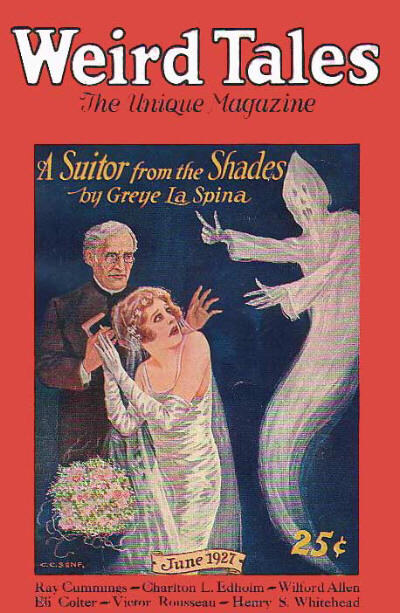
"Check!" Father Rooney chuckled deep in his throat, and lifted his hand from the knight that had just made an unexpected foray among his opponent’s pieces.
The old doctor leaned over the board to study the situation carefully. “It does look as though you had me,” he admitted unwillingly. “Well, next time you may not have such good luck.”
“Luck?” queried the priest softly, a whimsical smile curving his lips.
‘ ‘ Poor papa! You are always beating him, Father,” reproached a soft voice from the other end of the room.
The floor lamp illuminated a narrow circle about the chess players and but dimly disclosed a little figure that pressed against the curtain at the open window as though to escape observation from without as well as
“No—no—no!” she screamed, and sank back unconscious into the arms of her father.
from within. Against the wall behind her the polished surface of a pair of crutches caught the light in long lines. It was characteristic of Clare that she should put unpleasant things behind her.
The face she turned occasionally toward the chess players disclosed singular beauty, even in the softly diffused light of the big lamp. One saw dark, sensitive eyes and felt the tenderness of the habitual gentle smile that made her expression so attractive. Her low forehead was shaded by light brown hair that fell over her small ears and was knotted loosely at the nape of a slender neck. But Clare’s real beauty lay in the spirituality that beamed from her eyes.
There was a brilliant moon. Clare, gazing out into the garden, thought she had never seen it as strange as it seemed that night. It was a mysterious dreamland, not the garden she knew. It was full of unexpected patches of light that changed shape imperceptibly as the moon swam upA SUITOR FROM THE SHADES
ward across the sky, and against these light spots, outlining them abruptly, were massively upreared structures of ebony-black shadow. The garden she thought she knew so well was like an unknown, entirely new country and one that, oddly enough, seemed to hold a dark threat in those ominous shadows that crept upon and engulfed the moonlit spots that relieved its blackness.
A slow shudder crept over the slight figure of the lame girl, who leaned back instinctively against the curtain and toward the soft and homely light of the tall lamp beneath which sat her father and his old friend at their game of chess. Still her gaze was held by the garden in its new aspect.
Out of the black shadows a figure advanced into a moonlit space, and like some goddess of the night lifted slim arms to her sister queen floating in her cloud chariot overhead.. Out upon the hush of the night floated the rich notes Clare so adored. “Ah,” she murmured with a kind of relief in her voice, “Margaret is going to sing.”
The song was Ned Wentworth’s Ode to the Queen of Night. It was the favorite lyric in Ned’s last musical comedy, then crowding one of New York’s best theaters night after night, incidentally filling Ned’s pockets with gold. Clare closed her eyes that the velvet tones might have their full effect upon her entranced senses.
At the other end of the room, the chess players stopped their game to listen, the chess board carefully balanced across their old knees. Father Rooney characteristically lifted his kindly eyes heavenward, although his physical gaze was limited by the low ceiling; the old doctor’s eyes went straight to the great portrait that hung over the divan, the portrait of his dead wife.
For Clare the evil spell lying upon the garden was broken. The strange
enchantment with its vague threat passed away at the thrill of that dear voice. As the tones died away on a lingering high note, she turned her face upon her sister and opened her eyes. Margaret was apparently all alone in the still night and the lonely garden. The chess players had resumed their game; the lame girl could hear their occasional low murmurs.
“Where can Ned be?” she questioned as she gazed.
Ned Wentworth had been standing in the black shadow of a great walnut tree, watching the throbbing of Margaret’s full throat as her rich notes poured out their benediction upon the still night air. His heart expanded so painfully that it seemed it must burst; her beauty actually hurt him. He looked hungrily at the great coils of heavy auburn hair, gleaming with gold under the magical light of the autumn moon; he saw as if for the first time the healthy pallor of her clear skin thrown into relief as she lifted her face upward in her invocation to the Queen of Night; he followed the line of the fine throat that swept into and was absorbed by the noble curve of her bust; and he clenched his fists with his effort to control himself—he felt that he could no longer refrain from telling her how madly he loved her.
He stepped impulsively toward her as the last gorgeous notes quivered upon the cool silence and died softly away. She paused, hands still outstretched as she had stood while singing, lost in the maze of emotion that had suddenly swept over her at Ned’s impulsive movement. Rich scarlet began to mount in her cheeks until they blazed hotly under the tranquil light of the cold Lady of Night. Into the broad sweep of moonlight beside her stepped her lover, his gray eyes almost black with the intensity of his feeling; he did not speak, nor did she. It appeared to them that they had
;728
both been waiting for this very moment all their lives.
Margaret was quite motionless, her head very high, dark eyes on his face steadily, gravely, as if the wonder and richness of her emotion were too great to be carried off lightly. Ned took another step forward, a ntovement that brought her still outstretched arms to his shoulders, upon which her light palms dropped tenderly.
“Margie! Then it is true? You love me?”
He swept her into his embrace; her arms met about his neck and he felt her hands caressing his hair. Sudden self-consciousness fell upon them and they drew back into the shade of the walnut lest they be observed from the house.
\X7'ith such careless haste that the ’ ’ chessmen were tossed hither and thither, Father Rooney sprang from his chair and across the room.
. “What ails our little girl?” cried the old priest, deeply disturbed.
Dr. Sloane got out of his chair with more difficulty; sciatica had made a semi-invalid of him for months. He joined the other man who leaned over Clare. The blond head lay on outstretched arms across the window-sill.
So motionless was she that for a terrible moment her father felt the clutching fear which his love for the daughter so like his dead wife made more terrible.
The priest held a listening ear against the girl’s side. “She lives, old friend. Her^heart is beating—but sluggishly. Let me carry her to the divan, where she will be more comfortable. It is only a fainting spell. ’ ’
Father Rooney knew well the name of the fear that was lifting a grisly head in his friend’s breast, and his heart ached for the old doctor, who followed him haltingly and painfully as he carried the limp little form
across the room and disposed it on the broad divan. Sitting beside her, the priest began to stroke Clare’s hands softly, whiie her father held a bottle of salts under her nose.
The lame girl stirred feebly. Then suddenly she broke out into hysterical sobbing, so heart-racking and so pitiful that tears rose to the eyes of the old priest who had seen so much, heard so much, of human suffering, that one felt he must have grown hardened by it. Now, however, he sat stroking a limp, cold hand, and hot tears slowly formed in his eyes and dropped upon it.
He loved Clare as though she had been his own child. Hers was a rare soul that knew and appreciated the lofty truths in his church just as she recognized and loved the.same unchangeable truths that, formed the foundation of the faith of her fathers. For so young a girl (she was only nineteen) Clare possessed a lucidity of thought and a fairness of judgment that made her especially interesting to the good priest, who secretly believed her one of God’s favored souls.
“She has never been like this before,” worried Dr. Sloane, wrinkled brow troubled. “Clare, dear! Clare! It’s Dad calling you, dear. Clare!”
The girl’s sobbing increased in intensity. Her body began to writhe on the divan as if in sharp agony. The priest in Father Rooney lifted an attentive ear to the undertones of this sobbing that somehow fell strangely upon that clerical ear; he felt intuitively that here was a matter of soul trouble, not a mere hysterical weakness on Clare’s part, and he was deeply disturbed.
Suddenly he looked up sharply and threw a searching glance about the room. His eye met that of Dr. Sloane, who had also looked about quickly.
“I would have sworn that there was someone else in. the room just now,” said the doctor in a puzzled
tone, as he met his friend’s gaze. “Didn’t you feel it, yourself?”
The expression of the priest’s face was troubled. “A very unpleasant someone, if you care for my opinion,” he declared dryly. ‘ ‘ I presume it was the effect on us of our poor little Clare’s hysterics,” he offered, but without conclusiveness.
Clare had become quiet and lay very still. At last her dark eyes opened heavily and she searched the solicitous faces of the two men contritely. “Sorry I made such a fuss,” she murmured. “It wasn’t- like me, was it? I—I don’t know what happened to me. It—it wasn’t like a heart attack. It was as if something from outside had robbed me of all my strength, in an unguarded moment.” She paused, her lips parted as if to say more, then closed firmly.
Father Rooney’s brow wrinkled ever so slightly; a half-puzzled expression, that had rested on his face a moment past,, returned. He looked gravely at the delicate beauty of the face on the divan cushion. Her last words—and her silence—had disturbed him far more than he cared to admit to himself; for some strange reason they seemed ominous. It was with an effort that he threw off his depression to meet the two radiant faces that now looked in at the door.
“Father, Ned and I- What’s
the matter? Is anything the matter with Clare? ’ ’ Margaret sprang from the encircling arm of her lover to kneel at the side of the divan. The shadow that always lay, though ever so lightly, upon her younger sister, was a dread shadow and its gloom now drew fringes of trailing darkness across the bliss of her new happiness.
“It’s quite nothing, Margie darling. Don’t be frightened. Anyway, I’m all right now,” Clare hastened to reassure her.
Then with characteristic self-forgetfulness—and none but the wise old priest knew how generous was her
spirit at that moment—Clare put out her hand to Ned.
“You and Margie—love each other? How beautiful! Forgive me if I cry. I’m just glad you’re both so happy.”
She turned her face against the pillow and began to cry softly. So different was it from her previous hysterical weeping that the priest drew a small, half-smothered sigh of relief.
He rose, touching with kindly benediction the soft hair.
“Good night, Clare. Good night, all. I must be on my way.”
“But you haven’t congratulated us yet,” interrupted Margaret, springing to her feet and turning a beaming face upon him.
“May heaven send you its richest blessings, my daughter,” lie told her gravely. “And you, too, Mr. Wentworth.” His hand went out to Ned in a hearty handshake.
Dr. Sloane had sunk into a near-by armchair, reminded painfully of his sciatica by twinges that doubled him up after his recent exertions. He waved one hand at the departing cleric.
“I really need a hankie,” apologized Clare comically from the depths of her cushion. Ned whipped out one and tried to dry her eyes in bigbrotherly fashion. “I can do it better,” she said.
Ned suddenly threw a quick glance at the door. “Did someone come in?” he asked the doctor.
“No one.”
“That’s strange. I felt someone looking at me from the doorway.”
“Ned, you’re dreaming tonight,” Margaret rallied him, laughing. “He felt eyes on him while we were in the garden. ’ ’
“Then they must have been mine,”
Clare said, sitting up. “I was watching Margaret while she sang.”
Ned and Margaret exchanged glances; both colored and laughed, but Clare’s pale face remained impassive. They exchanged glances again;
Clare could not have seen that first rapture of their love, after all.
I t was nearly midnight when the sisters finally retired to the room they shared together. There had been a bottle of old port opened that the healths of the young pair might be toasted. And it seemed that the hours had only been minutes, to Margaret.
“Clare darling, I’ve kept you up awfully late tonight,” she apologized with compunction, turning a flushed, happy face to her sister. “You should have been in bed ages ago/’
“This is a special night, Margie.”
“Wasn’t it magnificent?” Margaret’s voice dropped into an almost solemn key as she stopped brushing out her wonderful auburn hair. ‘ * It
seemed to — us — that there had never been such a night before.”
“I thought much the same. But, Margie, did it seem to you—don’t tell me I’m imagining things, please— did it seem to you that there was something strange, something almost awful, about the beauty of the garden tonight? I was really afraid of it, and I have never felt that way before. But tonight it actually seemed that there was a presence abroad, a presence that boded no good to someone.”
Margaret, her smooth forehead wrinkled, whirled about suddenly to face her sister.
“That’s odd,” she commented bruskly. ‘ ‘ Ned complained of the very same feeling. He declared that he felt jealous, envious eyes upon him.”
Clare tumbled over into bed and turned her face from her sister. She slipped something under her pillow as she did so—it was Ned’s handkerchief. In a smothered voice she said.
“Margie! That' was not a heart attack I had this evening. ’ ’
“Clare dear, you are dreaming. If
it wasn’t a heart attack, what was it?”
“That is just what I would give worlds to know,” answered the other girl earnestly. “Margie, there was something strange in our garden tonight, something no one could see— but it was there, nevertheless. And —I know what it was! Oh, don’t turn out the light, Margie! I just can’t sleep in the dark tonight.”
Such unusual timidity on Clare’s part made Margaret look at her sister searchingly. Then she sat on the edge of the bed and began to smooth the brown hair gently.
“And what was it you saw in the garden?” she inquired, with a touch of light humor in her tone.
“I didn’t see. I just felt. But something took all my strength out of me suddenly. It was as if something else had clothed itself with my body, only my body didn’t go with it into the garden; it stayed inside. But I knew — I know — all that that Other saw and did.”
‘ ‘ Dearest, you are overwrought and tired. This glorious night has thrown a spell over you and it has been too much for your tired little head.”
“Margie!” Clare drew herself up, to a sitting posture. “Do you remember Clifford Bentley?” There was so much significance in her tone that the older girl gave her an amazed look as she replied affirmatively.
“Margie, Clifford Bentley was in the garden tonight, spying on you and Ned.”
For a moment Margaret regarded her sister with a kind of terror; then she broke into a soft laugh.
“Oh, come now, Clare, that is too much to ask me to believe. Clifford Bentley has been dead many years, quite too dead, poor boy, to come wandering about our garden.”
“But he was there,” persisted Clare stubbornly. “I tell you, Margie, I felt him there. Please don’t
laugh. I am quite serious.. Oh, why can’t you understand? Don’t you remember his last words to you?”
Margaret’s face paled under the warm color and she stared wide-eyed at her sister.
* ‘ I remembei'—I was to remain true to him until death joined us; and if 1 did not—but Clare! How absurd! He a mere boy of fifteen and I an infant of eleven! It is so ridiculous that I can’t help laughing, dearest. ’ ’
“It isn’t ridiculous,” protested Clare unhappily but positively. ‘ ‘ Because he may be able to cause trouble between you and Ned yet. You know, Margie, you owe your life to Clifford—and if it had not been for you, he would he alive and well now.”
.“Clare, you are positively idiotie tonight! I must insist that you go to sleep and get rid of your morbid thoughts. Why should you try to spoil my wonderful night, the most beautiful of my life?”
A/Targaret withdrew pettishly, and a few minutes afterward Clare heard her tucking herself into her own bed, that stood on the other side of their common reading stand. Slowly the lame girl slipped down into her bed again, but her eyes did not close. Still, she was not looking at the picture which she stared at; she was looking back across the years to the time when Margaret was eleven and she was nine—and Clifford Bentley fifteen.
It was a boy-and-girl. love affair —precocious, to be sure. Clifford adored the little tomboy with her mop of brilliant hair and her impulsiveness and her enchanting ways. She had let him put his seal ring upon her “engagement” finger, in return for his promise to give her a ride on his iceboat. That had been a wonderful sport! Then the tragic moment came when the thin ice broke
under a too-sudden turn of the skeleton craft, and both children had been thrown into the icy water by the shock. It was Clifford who first came to the surface; it was he who dived and groped under the ice for Margaret, who brought her unconscious to the surface.
When rescue came, the boy’s coat was wrapped about the girl’s shivering form. Both children had had pneumonia from the exposure, but it was Clifford who had not survived it. His last words to his mother had been for Margaret: ‘ ‘ Tell her I expect her to be true to me until death joins us. If she is not true, I shall come back to remind her of her promise.”
Clare, reviewing the pathetic and tragic little story, felt deep sympathy for Clifford, Clifford who had given his life for Margaret and was now forgotten. She, too, would gladly have done the same. She lay very quiet, although she did not sleep..
As she heard the library clock chime the hours once, twice, she suddenly moved the handkerchief and pressed it against her lips. As she did it she breathed out a prayer for Ned Wentworth and his happiness. Then with a little sigh, she slipped softly off to sleep.
N ed wentworth could not sleep.
He filled his pipe and settled down before the hearth where glowed the urbanite’s humble apology for a wood-fire, a gas log. He had felt it impossible to write while he was fresh from the sweet influence of Margaret’s presence; he wanted to think over his happiness. Also, he wanted to think over another thing—an intuition he had had of a something sinister hovering near while he had been in the garden with Margaret.
Exactly as he had told his sweetheart, he had felt burning, envious, malignant eyes fixed upon him from
the black shadows of the garden. Even when he had taken Margaret into the lighted room, he had felt this entity near at hand. Who could it be that was trying to penetrate his objective consciousness so strangely? Who could be so bitter against the man who had won Margaret’s love, except some rival? He entertained not the slightest doubt that it was an unsuccessful rival whose bitter envy he had felt. But who?
He remembered distinctly that in the moment Margaret had finished her song, turning to him with all her soul in her eyes, he had felt as though someone stood between them, someone about whose person he must pass to reach her. Who could this individual be who was interested in separating two young people so eminently suited to each other? Ned simply could not understand the situation, yet felt that it was a tangible situation. The fact that this unknown person was strong enough to make his unseen presence strongly felt was sufficient to give thought to the young lover. But an invisible rival could not long occupy Ned’s thoughts to the exclusion of pleasanter things. He mused and smoked while the hours fled.
The clock struck one. Simultaneously, Ned Wentworth sprang, as if catapulted, out of his chair, and whirled around to face the door, in full expectancy of seeing a stranger there. The doorway was vacant; it framed nothing but empty air.. The young man’s eye roved the apartment with keen scrutiny. There was nothing more suspicious than a tall screen that served to hide his writing desk from the rest of the room. Upon this screen Ned’s glance finally rested with curious intentness. Then he shook himself impatiently and again sat down before the hearth. The impression of a strange presence was so strong, however, that he was induced
to move his chair so that he faced the screen.
For fully five minutes he sat motionless, smoking. Then he rose, went directly to the screen, whirled it aside and looked behind it. Nobody there. Furious at himself for entertaining the thought of a discarnate personality, he yet found himself considering it; he was actually angry because he had given the unknown the satisfaction of seeing him look behind the screen. When he returned to his place before the hearth, he deliberately turned his chair so that the screen was behind him. '
He refilled his pipe and touched a match to it nonchalantly. Stealing insidiously into his mind came thoughts of the girl who sang his Ode to the Queen of Night at the performances in the Bedford Theater. She was slight and graceful, lacking Margaret’s robust, fearless poise; dainty and petite, while Margaret was almost too heavy to be graceful; she was charmingly pretty and knew just how to make herself fascinating, while Margaret made not the slightest pretext at using beauty aids, such as rouge, which with her deadwhite skin would be so attractive. Beatrice Randall knew how to charm and fascinate a man, Ned reflected with a slow smile; Margaret, unfortunately, was entirely without that subtle mystery, that feminine art and guile, that attracts the male so positively. Beatrice would go any length to enchant an admirer; Margaret would have considered such efforts beneath her. On the whole, thought Ned, when Margaret sang his Ode she appeared a proud and unapproachable goddess; when Beatrice sang it, she was a most approachable, enticing, and desirable woman.
Instinctively Wentworth glanced up at the mantel shelf where a framed portrait of Margaret stood. As he looked, his brow contracted; a puzzled, almost startled expression
flitted over his face. He put down his pipe. Incredulous, indignant, remorseful, he reached for the photograph and carried it to his lips.
“Three hours engaged,” he said, and whistled. ‘ ‘ Three hours engaged —and beginning to criticize Margaret! Comparing her with another woman who isn’t fit to tie her shoes. What on earth has got into me?”
Then he remembered the entrance of that sinister presence a few minutes ago. Furious indignation swept over him as he began to realize what had taken place; the thing was intolerable. A gust of futile anger shook him.... Someone with a deep interest in Margaret Sloane was attempting telepathically to turn his mind from her, and toward some other woman. He put Margaret’s portrait on the table beside him and clenched his fists as he faced about toward the empty room.
Aloud he exclaimed: “Whoever you are that is trying to separate Margaret and me, you can not prevail. We love each other! You may as well be off, my invisible rival, for I am on my guard now.” He laughed grimly but shamefacedly at his spoken words.. They seemed absurd, addressed to thin air, but he had the feeling that whatever or whoever it was that had entered his room and had actually succeeded for a few minutes in swaying his thoughts, this personality would understand—if not his words, his intentions.
He looked long at Margaret’s portrait, his lips parting in a tender smile. Who could compare with her? Ah, there was never such a glorious girl; how could he have thought otherwise, even for a passing moment? To be sure, she was a bit over-independent, and a man enjoys the clinging-vine type of woman for a sweetheart. Beatrice Randall was just such a helpless little thing; with all her guile and her feminine arts, a man felt he must look
after the child. How appealingly feminine she was when she sang his Ode in that entrancing “little girl” way of hers; no wonder it always brought down the house. Now Margaret had a way of surrounding herself with such an atmosphere of independence, of proud confidence in herself, that a man almost felt he would be entirely superfluous in her life. Now that she was engaged to be married, it would not be such a bad idea for her to cultivate a little more of the womanly attitude of helpless dependence that was so pretty in Beatrice.
Ned had been pacing back and forth. He stopped and stood stockstill; the sickening realization swept over him that once more the unknown rival had entered into his secret thoughts and swung them away from Margaret. It was too much! He caught up a hat and stick, and went out of the house to walk about under the stars; perhaps the presence would tire of following him about in the open. It may have been so; it may also have been that the unknown had done all he cared to do for one night. After a brisk hour’s walk, Ned found his mind cleared of its cobwebs, and he went home, to -sleep soundly.
\T7ith daylight, Ned’s recollections ’ ’ of his uncanny experience faded as dreams in one’s first waking moments; he remembered only that he had unaccountably given more thought to the prima donna in his musical comedy than he had ever given that damsel before, or ever would again, he told himself.
Ostensibly to inquire about Clare, but in reality to assure himself of his happiness, he telephoned Margaret early.
“Clare’s all right. But she’s worrying herself sick over an utterly ri734
diculous fancy, an absurd thing she declares took place last night.”
“What was tharr Ned’s voice was vaguely troubled.
“Some kind of ghostly visitor who she insists visited us last night. Dad is encouraging her; yes, he is. He declares that he and Father Rooney felt the presence of an outsider in the room last night when Clare had that fainting spell. For my own part, I felt nothing. I consider the whole subject too utterly absurd for discussion. ’ ’
“Not as ridiculous as it may seem at first glance, dear,” Ned replied hesitantly, a sudden flood of memory rushing upon him, carrying conviction with it. “I had a rather strange experience last night, myself.” Even as he said it, he hoped Margaret would not insist upon details; how would it sound in her ears that he had spent hours thinking about some other woman when he had just engaged himself to her?
“What happened, Ned?”
“Really, the thing w*as so intangible that it would be extremely difficult to put it into words,” hedged Wentworth desperately. ‘ ‘ Perhaps when I see you I can explain better than I can over the telephone now.”
This excuse appearing reasonable, Margaret did not insist further, much to Ned’s relief. But the girl w r as far moi’e troubled after this conversation than she cared to admit to herself. She fidgeted about the house, wishing it. were evening; in the evening Father Rooney would surely be over to inquire about her sister, and she wanted to hear from his own lips if he had felt any supernatural experience the night before.
Margaret scoffed at the ridiculous idea that a boy of fifteen should come back from the dead to keep her fi’om marrying another man, even granted that the boy had attained manhood in another world in the meantime. Her keen sense of humor and her
abounding good health combined to restrain her thoughts from wild surmises; she merely wondered if some contagion of diseased thought had fastened upon the others of her immediate circle, leaving her untouched. This seemed far more probable to hex*, than that the veil separating the visible and invisible worlds could have been lifted to permit the entrance into her life of a long-dead boy sweetheart.
She did not have to wait until evening to see the old priest. About 3 o’clock she saw* him entering the garden. He stopped to speak with Clare, w*ho was basking in the sunshine.
“Cobwebs brushed away?” he asked the lame girl, pointedly..
She colored but met his eyes bi'avely. “Oh, yes, Father.”
He looked keenly at her slightly clouded face. “Perhaps there is something I can do for you, my child?”
“I’m afraid you would be the last one to help me,” she laughed ruefully. “I want to find out the name and address of a good psychic. 1 must talk with someone v*ho understands—supernatural things. There is an influence abroad that bodes evil to Ned—and to my sister,” she added hastily, lowering her eyes before the kindly serutiixy of the priest.
“I wish I could help you, Clare.” He paused a moment, considering. “If you were only a Catholic, my child,” he added regi’etfully.
“But it isn’t religious help that I want, Father. What I need is something that I don’t believe you could give me. If I only knew what to do!”
“Can’t you leave it in higher hands than those of a mere mortal, my daughter? If you can do that with your whole heart, the problem will be solved for you. You believe that, do you not?”
She nodded slowly and thoughtA SUITOR FROM THE SHADES
fully. The old man passed a caressing hand over her brown locks, sighed, and went up the path with knit; brow.
Margaret, impatiently waiting for him, was standing at the top of the 'porch steps.
“Ned called up this morning, Father,” she said abruptly. He persists in saying that he had an uncanny experience last night. My sister says the same, and Dad. Father Rooney, do you believe that a man can come back from the dead, in these days?”
“Why ‘in these days’?” he inquired whimsically. “These days differ in no way from other days, Margaret; they are all a part of eternity.’”
“But do you?”
“What difference would it make, Margaret, what I believe? In the olden days, did not someone ask that same question? It is in Holy Writ, Margaret.”
“You are evading my question, Father,” the girl cried with an impatient shake of her head.
“What do you think, Margaret?” asked the old priest mildly.
“I don’t know what to think. Clare says it is true. Ned—why, I actually believe he would agree with her; Dad, too. Tell me, did you feel someone in the room with us last night, someone we couldn’t see?”
Her question was sufficiently pointed this time for Father Rooney to get the drift of her inquiry; he smiled.
“My child, a priest becomes very intuitive, and senses presences good and evil that other people do not ordinarily feel. It is his study, his ardent prayers, his meditations alone, that make him more sensitive.. And a man who employs his brain in creative work, as does Mr. Wentworth, is also liable to psychic impressions.
Your dear father—why, he is a physician, and a good physician must be intuitive. While as for our little Clare—ah, her physical disability has kept her very near the Unseen; you can trust her intuitions, Margaret.”
“How about me?” scornfully.
“You are far less liable to such delicate impressions, because you are in robust health; your employments are active physical employments; your outlook upon life is—well, my child; largely material. There, ’ ’ and he raised a hand to still her quick protest, “you have not yet had a sorrow, my child. When you have suffered disillusion, disappointment, grief—then perhaps you will find yourself closer than now, to the veil that hides the Unseen.”
“In other words, Father, the rest of you felt that there was a spook in the room, but for me that spook didn’t exist?”
“Something like that, Margaret; something like that. I don’t know but that you are better off than we are, in that respect. It is not always a pleasant thing to have these other entities thrust themselves upon one’s notice without invitation.”
“Well,” with a slightly scornful laugh, “when I see a spirit, I shall believe that they exist and return to earth, but I fear I shall never be convinced by my own good eyes.”
Little did Margaret dream as she spoke so skeptically under what circumstances her own good eyes were to teach her the frailness of the veil that separates the material and the spiritual worlds!
Father Rooney shook one finger at the young girl in half-playful admonition.
“I wish there were some way to help my little Clare,” he murmured to himself as he went on into the house. “She is too susceptible to psychic influences. May our Lady watch over her,” he finished softly and earnestly.
‘ ‘ VX/hy, there comes Mrs. Campbell
» » across the road. I wonder what she wants?” Margaret went slowly down the path to meet the visitor, stopping at Clare’s side to drop her gentle hands on the lame girl’s drooping shoulders.
The woman who came briskly up the bricked path was short and rather heavily built without being actually stout. Her graying hair was pulled back tightly from her round face and drawn into a “figure eight” at the nape of the neck. Although her face had not the slightest trace of actual beauty, her features were prepossessing; there was about her that atmosphere of homely and agreeable motherliness that warms the heart. She wore a starched white linen shirtwaist and a pepper-and-salt tailored skirt, to the black belt of which was hooked a chatelaine bag of black leather. Stout black shoes completed her utilitarian, rather than handsome, clothes.
As she approached the sisters, Clare leaned forward with a kind of breathless interest, her eyes fixed upon the newcomer. A mixture of anxiety and expectation appeared on the lame girl’s face.
Mrs. Campbell did not speak until she was directly up to the girls; it would have been most unlike her to have wasted her energy upon the balmy afternoon air by speaking when there was a possibility of not being heard perfectly.
“Well, Margaret and Clare, good afternoon, both of you. Clare, I came over especially to see you,” she said abruptly.
Margaret laughed musically.
“Well, that is unkind of you, Mrs. Campbell,” she said. “Am I to take that as a summary dismissal?”
“You can stay if you like, Margaret, but I’m thinking that you would not believe a word I’m going
to say, and I don’t choose to give you the chance to laugh at me, Margaret Sloane.”
Clare gasped audibly. Margaret, although accustomed to her Scotch neighbor’s frankness, pretended to be offended.
“Really, Mrs. Campbell, if you think me incapable of appreciating your pearls of wisdom-”
She moved off with her swinging, easy walk, leaving Clare gazing after her with troubled eyes. The lame girl was deeply disturbed, and it was not until Margaret turned to throw her half-mocking smile that she realized her sister’s pique was more apparent than real.
The Scotchwoman went directly to the heart of her message.
“My dear, do you know that there was a stranger in your garden last night?”
“Then you saw him?” gasped the girl, starting involuntarily at the other’s words.
“Ah, you know, then?”
“I—I felt his presence,” admitted Clare.
“Well, I saw him, and I hope I don’t see him again. He isn’t a pleasant individual,” dryly. “Do you know who he is, Clare? Spirits like that don’t usually trouble human beings unless there is some powerful tie between them. Be frank with me, my dear. I may be able to help you, and I foresee that you may need help, you and Margaret, too.”
Clare drew a long breath. “His name, if I’m not mistaken, is Clifford Bentley,” she began. And she plunged into the forlorn little story of the childhood romance with its tragic ending. Her listener nodded understanding^.
“Do you think he intends to make any trouble for my sister?” asked the lame girl anxiously.
“I’m afraid he does, Clare. I’ll tell you what I saw. He was looking
over your shoulder into the garden at Margaret. Suddenly he leaned over you, and you disappeared in a cloud of luminous vapor. But the luminosity, Clare, was not that light shed from the aura of an entity that is trying to uplift itself or others; it was the murky, red-shot vapor that betrayed the presence of evil.
‘'Whether it is evil for you or for Margaret, matters little, for that entity has taken advantage of your physical weakness, your psychic susceptibility, your unselfish nature, and unless you can beat off his influence, you will end by becoming little better than the instrument by which that evil thing will eventually seek to make its actual physical appearance among us.”
‘'Mrs. Campbell! You terrify me!”
“I terrify myself,” said the lady, dryly. "If you only could have seen that evil atmosphere that, enveloped
you-„” The pause was eloquent;
Clare met it with understanding eyes.
"It was that I felt, then. It was that which robbed me of consciousness. Oh, dear Mrs. Campbell, you have the wonderful gift of secondsight. Can’t you tell me what this all means? Why has he come back? ’ ’
The Scotchwoman nodded with the half-proud, half-mortified air of one who admits something to one’s detriment, which yet one can not help but consider a merit.
“Yes, Clare, I have the secondsight. My mother had it, and my grandmother before her. It’s a wonderful thing, as you say—but not such a pleasant thing, sometimes. ’ ’
"Tell me what to do, won’t you? I know Mr. Campbell hates to have you exercise your power—but—isn’t this an exceptional occasion?” begged the lame girl.
"Clare, I’ll try.” She glanced cautiously at the house as she spoke, to ascertain if Margaret were in sight.
"You know, I can not promise success. It is for this that I can not discuss the thing with your sister; Margaret is so skeptical that I would be quite uneasy in her presence, and unable to let myself go, as I must if I wish to go into a trance.”
She moved closer to the girl. ‘ ‘ Give me your two hands, my dear,” she commanded gently, her voice seeming already to come from a distance.
She stood perfectly stiff for a moment, while the lame girl’s whole soul was watching in her eyes.
There was not the slightest suspicion in Clare’s mind as to the seeress’ honesty. The Sloanes had known the Campbells for more than seven years, and no one in the suburb had anything but admiration and respect for the little Scotchwoman. Doiiglas Campbell, while admitting his wife’s gift of second-sight, was stubbornly set against her use of it; he believed it a weakening and unhealthy practise even when exercised by an effort of the will. In this Laura Campbell differed from her husband, but was too docile a wife to question his well-meant authority —at least, in public. It is a fact that when she felt herself justified, she had no hesitation in yielding to her intuitions, and in the case of the Sloane girls her friendliness for them drove her to seek them out for the purpose, for she had seen plainly that the uninvited guest of the previous night was an undesirable, and might prove a troublesome, visitor.
A fter a long moment, during which Clare felt her heart beating loudly and painfully, the Scotchwoman began to speak. Her intonation was stiff and harsh, the very opposite of her customary rapid, easy speech. The words dropped off her lips slowly, one by one, with monotonous regularity. Meantime her hands gripped those of the lame girl with a grip that made Clare wince.
“You — seek — to — learn — the reason — for — my — presence. You
— shall — know — soon — enough. Tell — Margaret — that — she — must — never — marry — Ned — Wentworth. While — you — live — I — have — the — means — to — prevent — it — but — I — will — not — trouble — her — if — she — will — keep — her — vow — to — me.”
“Oh!” Clare Sloane cried out suddenly as if in acute pain.
The seeress gave a deep sigh, shuddered from head to foot, and closed her eyes tightly. Then she released the hands she had been holding so tightly, and opened her eyes, to see the lame girl laboring for breath, her head thrown back on the cushions.
“Margaret! Margaret! Bring your sister’s tablets!”
Mrs. Campbell began to stroke and beat at one of the delicate hands, while she looked anxiously toward the house. Margaret came running down the path, a glass of water in one hand and Clare’s medicine in the other. She threw a reproachful look at their neighbor, as she hastily began to minister to her sister.
‘ ‘ What on earth did you tell Clare, to upset her like this?” asked the older girl, indignantly.
“I'm sorry, Margaret, but I can’t tell you what upset her.”
“You mean, you won’t tell me,” flashed the girl.
“No, I mean just what I said. She’s reviving—look, the color is coming into her cheeks again.”
“What did you do? Did you try any of that trance business?”
“Clare asked me to try it for her,” replied the other woman quickly. * ‘ It was to help her out about something, ’ ’ she hesitated.
“And you mean to tell me,” scornfully, “that you don’t know what you told her?”
- “You’re going a little too far, Margaret,” rebuked the Scotchwoman, indignant in her turn. “I’m not accustomed to having my word disputed. If you knew anything at all about the nature of a trance, you would know that the medium is never aware of what is said.”
“Oh, I believe you,” hastily.
“Clare, darling, are you feeling better now?”
Clare was breathing more naturally, and her cheeks were not as pallid as they had been a moment since.
Her hands were still cold to the solicitous Margaret’s touch, and the girl began chafing them. Clare, as soon as she could speak, began to beg brokenly, “Oh, can you tell me what he meant? Was it you talking? Or was it he speaking with your lips?”
“He?” Mrs. Campbell’s lips parted; she looked strangely at the lame girl. “What did I say? Tell* me everything, Clare. Don’t forget a single word.”
Clare repeated it, to the best of her ability.
“I don’t like that,” said the Scotchwoman anxiously. “He means, that while you live, he can control you psychically, gathering from you the force to make himself felt unpleasantly on this plane. The alternative is, ’ ’ and she directed her gaze sharply and narrowly at Margaret, who colored under it resentfully, “the alternative is, that Margaret keeps her vow to him, her vow never to marry.”
“In other words, Mrs. Campbell, my sister must pay for my happiness with her life, or I must pay for her life with my happiness? Excuse me, ’ ’ coldly, “but I think you go too far with this mysterious jargon. Come, Clare dear, the sun is sinking. Let me help you into the house.”
The Scotchwoman silently assisted in drawing Clare to her feet and adjusted the crutches, while Margaret picked up the cushions upon which the lame girl had been reclining. As
the sisters went slowly up the path to the house, she stood watching them with perturbed countenance.
“It’s bad. It’s very, very bad. And Margaret won’t believe the peril she is in. Poor Clare! I must tell Douglas of this. If it comes to the worst, he’ll have to permit me to make up a circle, and Dr. Sloane will have to override Margaret’s objections—for object she surely will, unless she falls into the sphere of influence of that unwelcome guest, herself. I can only watch—and pray,” she whispered to herself.
' 7
N ed wentwoeth was an impulsive lover. Moreover, his uncanny obsession on the, night of his engagement to Margaret had weighed on his mind; he felt that the sooner they were married, the sooner the unseen rival for the girl’s affections would be induced to leave the field to him. He lost no time, therefore, in urging an early marriage upon Margaret.
His plans met with Dr. Sloane’s approval. The old man was relieved to see at least one of his girls happily married and provided for. In secret he grieved much for his younger daughter, whose lameness might prove a serious obstacle to her satisfactory settlement in life. He agreed that Ned and Margaret should be married very quietly early in the coming month, and that after the wedding the young pair should make an extended trip through the Southwest.
Margaret’s days became an orgy of shopping expeditions. Her nights were occupied with dreams of the happy future she was going to spend with her lover. The ominous and mysterious words of Mrs. Campbell had apparently been erased from her mind. Not so with Clare; the lame girl remembered with terrible distinctness the dilemma that her sister
had so tersely and indignantly stated; one of the two must pay for the other’s life or happiness by sacrificing her own.
To do Margaret full justice, she would not knowingly have accepted happiness at the expense of her younger sister, but she had dismissed the words of the seeress as fantastic vaporings unworthy of consideration.
Clare, however, had been deeply impressed; she spent hours pondering on them. If her death would purchase Margaret’s happiness, the lame girl was ready to surrender it. She did not put into words her secret thought, that Margaret’s happiness was also the happiness of Ned Wentworth.
Time flew. Margaret’s wedding was so near at hand that when Clare looked at the calendar on the wall <?f their room, she found but a single day remaining before the older sister would leave her home for the new life that spread with so much rich promise before her. Day by day Clare had prayed fervently for strength to resist any fresh' attacks upon her psychic forces by the entity which she knew as Clifford Bentley. Once or twice Clare, now watchful and alert, had felt the certain indications of Clifford’s presence; the failing of her vital powers that preceded the entrance of the spirit-lover so convincingly, if invisibly, into the material world. As yet she had been able to fight him off, and this gave her confidence in her ability to save her sister from the annoyance, if nothing more, that Clifford’s influence might bring to bear upon either Margaret or Ned.
The night before the wedding Ned did not drop in as he had expected; he telephoned to Margaret that he was not feeling quite himself but would undoubtedly be all right in the morning. His words were mild in comparison to what he was experiencing. For several days he had
been fighting off an obsession even worse than the mild one that had overcome him on the night of his engagement to Margaret. He had not dared be off his guard for a moment. As surely as he permitted his thoughts to wander ever so slightly, he felt them getting beyond his control, until his head would be awhirl with incoherencies and strange conjectures that tormented him cruelly.
He began to “remember” incidents that concerned Margaret, but in which he figured as a principal; incidents in which he knew at the same time that he had never taken part. One time he found himself saying aloud with persistence, “I am Clifford Bentley! I am Clifford Bentley!” until he caught himself up with what was almost terror clutching at his heart.
Intuition told him that Clifford Bentley must be the rival now making such desperate efforts to cause trouble between Margaret and himself. Ned swore that he would not give her up, no matter what the cost of keeping her might be. As his determination on this point increased, so did the insidious attacks upon his mental stronghold by the invisible rival.
The night before his wedding Ned had come to the point where he was half dead for want of sleep. His apprehensions had grown so strong that he had been keeping himself awake night after night with strong coffee, fearing to relax his guard for a single moment. That night he could hold out no longer; he was obliged to give way to sleep for a few hours; flesh and blood could stand no more.
When he waked the next day, he found to his consternation that he had overslept. It was already noon, and as the wedding was set for 3 o’clock, he had no more time than was absolutely necessary to dress and motor out to Dr. Sloane’s. He
paid little or no attention to a dull ache in his head, and a tingling, pricking sensation that occasionally shot through his body; if he thought of it at all, it was as the natural result of his sleeplessness for several nights, and the consequent nervous strain. Certain it is that he did not think of it as having any connection with Clifford Bentley.
The wedding was to be a very quiet one, the only outside person present being Father Rooney. Margaret was to be unattended. Had she chosen a bridesmaid, it would have been Clare, but the lame girl insisted that her crutches would have made a distressingly inharmonious appearance. The bride came into the room on her father’s arm, the old doctor having managed to brace up sufficiently to go through the short ceremony of giving his daughter away.
Near the officiating clergyman, who had been placed near the window opening on the garden, stood the bridegroom. Ned also was unattended; lie had' decided that he was fully able to take care of Margaret’s wedding ring without any outside assistance. As his bride approached, the young man turned his head toward her. A sudden horror and dismay seized upon him. As he looked, he became aware that, strangely enough, his emotions were so complex as to convince him, without a struggle, that he was at once himself and that other! In vain he fought against that terrible obsession; he could do nothing to drive out the triumphant rival who had entered his mind, his body. In despair he cast down his eyes, dreading lest others might read in them the strange and awful thing that had befallen him.
Margaret approached, her head bent, her eyes on the flowers she carried. The clergyman began to read from his prayer-book. Ned could feel the gentle presence of the girl he loved, as she paused beside him. When
741'
the clergyman addressed the question to Ned that would bind him to her, it seemed to him that the intruding personality was laughing at him as it whipped the replies out of his very mouth, responding with a decisive abruptness that caused the minister to send a quick glance at the brush bridegroom. Ned was praying for the ceremony to close.
The minister addressed the bride: “Wilt thou take this man to be thy wedded husband...?”
Wentworth’s heart pumped madly.
In a moment it would be over. A silence succeeded to the clergyman’s question, a silence that endured—that weighed down every heart. Ned lifted his head and sought Margaret’s eyes in astonishment.
She was looking at him, horror on her amazed face. The flowers she was carrying fell tumbling at her feet from relaxed fingers. She took an instinctive step backward and put one hand behind her gropingly, as though seeking support. Still she stared at him incredulously. The clergyman, not understanding, prompted her in an undertone. With a sharp anguish that cut the young lover’s heart, her voice rang out wildly.
“No—no—no!” she screamed, and sank back unconscious into the arms of her father.
C onsternation on every face. Clare had dropped hers into both hands, and was sobbing and praying behind that frail shield. Dr. Sloane stood, holding his fainting daughter as if he had been turned into stone and unable to move. The clergyman had closed his prayer-book and gazed in bewilderment at the fainting bride and the agonized, astounded groom.
Only Father Rooney grasped the situation even faintly. He it was who relieved the old doctor of his burden and carried Margaret to the divan. It was he who motioned everyone but
the young lover from the room. He held salts to the girl’s nostrils, while lie questioned Ned with a single look of sympathetic inquiry.
“I don’t know! That’s the worst of it, I don’t know,” Ned groaned miserably. “Father, I haven’t been quite myself since the night we became engaged. Do you suppose—she could have—felt the difference? I can imagine nothing else that would have turned her against me so suddenly and incomprehensibly.”
“Do you mean, my poor boy, that you have felt that invisible presence again? That—that it has become an obsession?”
“Exactly. I have fought it for days. But last night—I had lost so much sleep,” apologetically, “I could not keep awake. That was its chance, I suppose. This morning I have been feeling strange, when I come to think of it.” Hurriedly Ned recounted his experiences with the invisible rival who had taken possession of his very self that afternoon, replying to the minister’s questions through the lips of the obsessed.
The old priest nodded his head wisely. “I think I understand, my son. It is a strange condition, and a difficult one. I hardly know what to advise you.”
Ned stood looking down at the unconscious girl, his eyes melancholy. “I can only fight until I can go on with it no longer,” he said despairingly. “But how am I to continue fighting with an invisible entity that takes advantage of me in my unguarded moments of sleep?”
“Do you feel the presence at this moment?” demanded Father Rooney.
‘ ‘ N-no, I think not. That is, ’ ’ correcting himself, “I feel that it is somewhere near, but not controlling me for the time being.”
Father Rooney hastily crossed himself. “For the time being, Ned, there is nothing for you to do but to keep away from Margaret. Whatever
this unknown entity is, its interest seems to be in keeping you two apart.
Until you feel yourself complete master of the situation, it will be best for you to leave Margaret alone.”
“I feel that strongly, but—it will be very hard, Father.”
“Would you bring worse upon the woman you love?” said the priest gravely. “Believe me, my son, this matter will have to be solved by other power than yours or mine. I am persuaded, however, that your wisest course now will be to leave Margaret.”
The young man bent, pressed a tender kiss upon the forehead of the girl who was to. have been his wife, and went sadly from the room. Dr. Sloane and Clare were waiting for him in the hall; their anxious eyes questioned him.
“The marriage must be postponed. And Father Rooney feels that it will be wiser for me not to be here when Margaret comes out of her faint. I’ll telephone later to learn how our dear girl is getting along.”
Dr. Sloane patted his shoulder. “Cheer up, Ned. I think it’s nothing more than the result of nervous strain. Wedding preparations have been too much for Margie. But I certainly never would have thought she’d keel over like that; she’s so athletic and in such fine condition. Well, she’ll be all right in a couple of days, and then we’ll have you two tied up in a jiffy and off on your honeymoon. ’ ’
Clare, who knew only too well what must be the root of the trouble, although she could not know the exact circumstances, dared not meet Ned’s eyes, so disturbed was she. “I shall be praying for you, Ned,” she whispered timidly, as she slipped away to assist the good priest in his ministrations.
Margaret revived presently and sat up, controlling herself with a strong effort. “I want to be alone, please,” she said. “Clare, I don’t mind you, of course.” Her eyes dropped down
upon her traveling gown. “I must take off these things,” she said sadly.
As she rose to leave the room, her self-control gave way; tears gushed from her eyes, blinding her until she had to lean against the lame girl for guidance.
“Oh, it is cruel!” she sobbed. “What have we done to deserve this persecution? Tell Ned, Dad, that it isn’t his fault, but I can’t explain just now. I hope—I hope he will forgive me.”
T he girls went to their room, their tears mingling.
The day wore away. Ned telephoned in and received Margaret’s message, to which she had added that it was her conviction their marriage could never take place, but that she would always love him—a message that half, maddened the unhappy young man.
The sisters retired early, although there was no sleep for either of them for hours. Clare won her sister’s confidence at last; Margaret confided to her the reason for the “no” that should have been “yes.” Ned’s obsession by the determined spirit of Clifford Bentley had been so plainly discernible by the girl that she had refused to marry him, because she felt it would not have been Ned she was marrying, but the intruding personality of that long-dead childhood sweetheart. The horror of the situation had been too much for her selfcontrol. The bizarre idea of becoming the wife of two men in one body had forced from her that decisive, agonized negative.
Clare calmed her as best she might, both girls prayed together, and about half past 11 they fell asleep, exhausted by their emotions.
It was, as the girls ascertained afterward, shortly after midnight that Margaret awoke from troubled dreams. The room was in partial darkness. As she shook off her drowA SUITOR FROM THE SHADES
einess, she became aware of arms about her, and a face that pressed dose against her own. The thought flashed through her gratefully that her sister had been watching and praying over her; she turned her lips to meet those others that sought hers.
The kiss undeceived her; that was no sister’s kiss!
With convulsive nei'vous force Margaret drew herself away from the arms that had been holding her and sat up in bed, half dazed. For an instant she imagined that the events of the afternoon had been a dream, and that it was the kiss of her young husband that had just been pressed upon her lips. And then she knew that it was no dream.
The soft light of the night lamp fell upon the face of a young man, a complete stranger, who in his turn rose from the kneeling posture he had been maintaining by the side of her bed. Although she had never seen that face as an adult face, the terrified girl knew intuitively that she was looking upon the features of Clifford Bentley, who had succeeded at last in making himself visible and tangible.
She felt her senses slipping weakly from her control. She was convinced that this would be fatal, as she had not the slightest confidence in the kindly intentions of that dread lover from the unknown world. With all her might she gripped at courage, and stared that dead-alive entity squarely in the deep’ eyes that burned passionately upon her with a significance that froze the coursing blood in her veins; Margaret Sloane was no coward, but she had never shaken and trembled as she did that night, in the throes of an unearthly fear.
“What do you want?” she managed to whisper through dry lips.
“You!”
4 ‘ Why do you come back to torment me? That was a child’s silly promise —you can not hold me to it. ’ ’
“I can—and will!” The apparition, doubly terrible because of its tangibility, moved toward her.
‘ ‘ No—no! ’ ’ She thrust out protesting hands wildly. “Don’t come nearer! If you do, I shall scream! I can not bear it! ”
Clifford Bentley leaned toward her, smiling with white teeth showing between red lips, and regarding the shrinking, horrified girl meaningly. “You fear me—yet you have tasted my warm kisses,” he whispered. “Do you think my rival will want you now, silly Margie?”
Margaret’s brain began to whirl. Surmises too dreadful to shape into words prodded her mind sharply. She threw herself desperately from the bed, anywhere, away from that triumphantly smiling face, and began to scream.
Shriek after shriek rang through the startled house.
The figure of Clifford Bentley retired around the foot of Margaret’s bed and approached that of Clare.
Before the older sister’s staring, incredulous eyes he leaned over the sleeping girl—and the next instant he had disappeared, like a dissipating vapor, from her sight.
T he screams of his older daughter brought the doctor stumbling from his room across the hall. He entered abruptly to find Margaret on the floor in a dead faint, and Clare sitting up in bed rubbing her eyes, apparently half dazed. Inquiry failed to elicit anything further than that Margaret had had a nightmare which had so terrified her that she had sprung from bed to fall unconscious on the floor.
After she had been revived and tucked into bed again, and her father had left the girls alone, Clare made her sister tell the whole unbelievable story, while both glanced fearfully over their shoulders into the dim shadows of the room. As Margaret
finished, her voice broken with sobs, her eyes wide with her unspoken fears, the lame girl exclaimed with indignation, “He is cruel, Margie, and a coward, to behave like this.”
“I can’t help being terribly afraid. Who can tell how far his power will carry him?” confessed the half-hysterical Margaret.
Clare was silent. She, too, was afraid. More, she was remembering with poignant emotion the last words the seeress had spoken to her. The lame girl pressed both hands tightly against her laboring heart, that beat so painfully in her bosom. Gladly she would have stilled its beating, could she have known surely that the act would purchase immunity for Margaret and happiness for Ned.
“Margie, the first thing we must do in the morning is to see Mrs. Campbell, ’ ’ she said at last.. ‘ ‘ She can help us if anyone can. Don’t try to dissuade me, dear; you must admit that even a forlorn hope is worth snatching at, now. ’ ’
Margaret had so far lost her former high spirits and self-confidence that she would have assented willingly to whatever plans Clare might have proposed. Still, she could not help questioning Mrs. Campbell’s ability to find a way out of the terrible and tortuous maze in which she and Ned seemed lost.
“Do you really believe there is anything extraordinary about Laura Campbell’s trances, Clare?” she asked earnestly. “I’ve always wondered at the loss of dignity such feigning costs her. ’ ’
“She really has what they call second-sight, Margie. I’ve seen her myself, in trances. Not often, because Mr. Campbell hates to have her give way to them. But the day we were in the garden and I had that heart attack—you remember?—she spoke with the voice of a man, and—I knew, somehow, that it was he.” Her own
tones were modified as she-spoke, and she glanced timorously about her.
“Well,” conceded Margaret unhappily, “I suppose we ought to do everything we can—and if she is able to help us, I know Mr. Campbell will let her. But I can’t help being skeptical; it all seems so foolish and childish to me. Of course, if you want me to I’ll run over and ask her if she can help us out.”
“Oh, Margie, if you only would!” urged Clare earnestly.
Margaret accordingly went across the road to their Scotch neighbor’s home, and related to Laura Campbell the story of the “nightmare” she had had the previous night. The quietfaced woman listened in grim silence, a non-committal expression on her round, motherly countenance. Only the continuous snapping of the catch of the chatelaine betrayed her nervousness.
“You’ll have to make up a circle and hold a seance and call him,” she said with finality.
“I don’t see why,” shrank the girl.
“You don’t see why? You foolish girl, you make me lose all patience with you! ”
“But-”
“ ‘But’ nothing!” snapped the Scotchwoman with asperity. “You are an ungrateful girl, Margaret Sloane. And a blindly selfish one, too, if you want my frank opinion. Your sister Clare is being slowly killed, all her vital forces arc being drawn out of her by that — that male vampire — that satellite of your attractions. And you — you draw back at the only chance to make terms with him! I’m sure I don’t know what you can be thinking of.”
Margaret’s color was running high. “I had no idea that my sister was in danger of any kind,” she retorted spiritedly. “But the mere suggestion of such a thing is sufficient to make me agree to any plan, no matter how idiotic it may appear. Will you unA SUITOR FROM THE SHADES
dertake to conduct a seance for us?” abruptly.
“Have someone telephone your fiance to be at your home this evening at 8 o’clock. See that arrangements are made so that we can have the entire evening undisturbed by visitors.
I will be over as soon as Mr. Campbell has gone to his lodge; it’s fortunate tonight is lodge night, or you’d have to wait. My husband would not give me his permission to act as medium at your seance, so I’ve got to do it behind his back.. And I can assure you, Margaret Sloane, that isn’t a pleasant thing for me to do.”
Margaret, confronted with the possibility that her neighbor might repent her offer, was transformed from scomer to suppliant. Her eyes pleaded eloquently.
“Get along with you, Margaret,” snorted the Scotchwoman with feigned indignation. ‘ * Asking me to deceive my good Douglas, are you? There, there, don’t worry, my dear. Laura Campbell has never yet turned her back on anyone who really needed her help. I’ll be over at 8 o’clock.”
Margaret did not feel up to talking directly with Ned, and begged Clare to telephone for her. Ned was in his rooms, happily, and almost out of his head with joy at' hearing that a possible solution of the weird problem might be reached so soon. He promised to be at Dr. Sloane’s at the appointed hour.
/'"'lake was sitting on the porch that ^evening at about half past 7, when she saw the bowed figure of Father Rooney approaching through the dusk. He came up slowly, and seated himself on the top step, fanning himself with his broad-brimmed hat, for the day had been a hot one.
“I don’t know that you’ll want to stay this evening, Father,” the lame girl said to him timidly. “Father won’t be free to play chess with you tonight. You see, we’re going to do
something of which you won’t approve — we ’re going to hold a seance, to see if we can’t learn how to get out of the strange situation in which we seem to have been thrown.”
Father Rooney stopped fanning himself.. His hat half hid his face from the girl, as he looked sharply at her over its wide brim. There was an anxious note in his voice.
“A seance, my daughter? Is your father permitting it? Does he consider it a wise thing for — well, Clare, for you, my child? I’m speaking not only as a priest, but from the physician’s standpoint. ’ ’
Clare returned his grave query with a serene smile. “Oh, I don’t believe it can do me any harm,” she said thoughtfully. “Do you suppose anything could hurt me more than to believe that some malicious spirit is robbing me daily of strength in order to torment my poor sister? Besides, I’d rather risk a—a heart attack, Father, than continue to go through what I’ve been suffering for weeks.”
Father Rooney sighed. Too well he knew the self-sacrifice that was the dominant note in Clare’s nature.
“I can not attend such a meeting, my child, as you know. But. — I think I shall remain. I can pray for you and yours — it may well be that God sent me here for just that tonight — when you may need spiritual help more than ever in your lives before.”
He rose to greet the doctor and Ned, who had been walking in the grounds.
Ned had not entered the house as yet, fearing a repetition of the terrible scene that had taken place on the ill-fated day of the wedding. For although he had been feeling himself almost entirely free from his obsession since he had kept away from Margaret, how could he know when it might return in force?
“Coming in?” he asked the priest.
“I will sit out here, 1 ’ observed Father Rooney. “Here I can watch the stars.’ 7
Mrs. Campbell came up the bricked path at this juncture, and the whole party, with the exception of the good priest, went indoors.
Margaret was sitting on the divan in the front room. As Ned entered, she rose to her feet and put out both hands, while tears sprang to her eyes and rolled piteously down her cheeks.
“My poor Ned, can you ever forgive me?” she murmured brokenly.
“There is nothing to forgive,” he whispered. “Oh, Margie, let us hope that tonight may open a way for us out of the tangle that seems to have been made of our happiness.”
Mrs. Campbell interposed, with her usual bruskness.
“Better for you to keep your exchanges of affection for a later moment,” she said decidedly. “I sympathize with you, but every moment you are enraging yet more the entity who has proved powerful enough to have made a fine tangle of your affairs. Dr. Sloane, will you and Mr. Wentworth arrange the chairs so that we can sit in a circle?”
She busied herself with the preliminary arrangements for the seance, her every movement followed closely by the lame girl.
Clare sat apart from the rest, hands folded tightly in her lap, eyes dark with melancholy. When everything had been arranged to her satisfaction, the Scotchwoman indicated to each their places in the circle. She seated Ned at her left, Clare at her right; Dr. Sloane sat on the other side of the lame girl, and Margaret—half glad, half afraid — between lover and father.
The lights were turned out. Only a small night lamp, its tiny wick floating on the oil, stood upon the table at the other end of the room.
In that flickering and barely discernible light, the faces of the sitters
flashed into and out of sight at every draft of air that floated in at the garden window.
The seeress, tense and watchful, maintained her hold on Clare’s hand with gentle force. She felt the lame girl sink back in her chair limply, with a kind of half-sob, half-sigh. The doctor spoke in hushed tones.
“I’m afraid Clare is fainting,” he worried.
“I guarantee that she is all right for the time being,” replied the psychic quickly. “She has slipped off into a trance. Do not try to waken her. It is better so. I shall direct, instead of becoming the medium myself, for Clare is to be our medium tonight. Now we shall be able to see and talk with Mr. Clifford Bentley.”
Hardly had the words left her lips before Margaret, holding tightly to the hands of father and lover, gave a sharp exclamation.
Standing directly behind Clare’s chair was the figure of Clifford Bentley, his white face and burning eyes fixed upon the unhappy bride with passionate intensity.
N ed spoke impulsively, half rising as he cried out, “You miserable scoundrel!” His eyes flashed angrily.
Mrs. Campbell maintained her grip on his hand and drew him down firmly. “Sit down, Mr. Wentworth. This is no time to call names.” She addressed the newcomer with cold courtesy. “I see that you have anticipated our wishes. We are here tonight especially to talk with you.”. “I know — I know,” muttered the newcomer fiercely. “I understood that you intended to meddle, and I came before I was called, of my own accord. Otherwise you would have had the mortification of not seeing ( me in spite of all your calling.” He laughed shortly. “I want to save all my strength, however, to appear to Margie, my false, lovely Margie,” he added insinuatingly.
“This is really too much,” exclaimed Ned, trying in vain to extricate his hand from the iron hold of the psychic. “I intend to see if that fellow is solid enough to feel the weight of my fist. Let me go, please!”
The Scotchwoman’s strong hand maintained its immovable grip, and she turned to shake her head warningly at him. Then she spoke again to the intruder.
“You have been taking the psychic energy from this poor little lame girl, so that you could appear materially. For shame, Clifford Bentley! No matter what your motive, do you consider that a manly thing to do? What has Clare ever done to you, that you should subject her to such treatment? Look at the poor child now, helpless, her disturbed spirit torn with agony as she sees you clothed in the psychic vitality you have stolen from her in order to destroy her sister’s happiness! Does not that stir your heart with remorse and pity?”
“It is entirely up to Margaret,” replied the materialized Clifford. “I loved Margie. She promised to be my wife. She let me put my ring on her finger. She is morally bound to me. Now she is betraying me, for that other — that weak fellow whose Billy brain I can sway as I choose,” scornfully.
“That is a lie!”
This time Ned would have torn his hand from Mrs. Campbell’s had she not cried hastily, “Mr. Wentworth, beware of \Vhat you are doing! If
LUCK
Get Your Share. The "LUCKY SEVEN” Secret Rules are free to f all who wear this Rare and beauti- ' 1 Talisman Ring. On each side
-iis Odd and Charming Ring ia
1 moulded the figure of Fortuna — J The "Goddess of Luck”8ymbolic t of Success Triumphant. Ancient J belief, that her emblem brings success to wearer in Love, Games Business. Health and everything. Genuine 14-K Antique Gold 8. Ring mounted with 32 facet, one carat Radio-Flash Mexican Dia_ mond type gem. Wonderful reproducion of a $500 Genuine Diamond in brilliancy^ Cut and Flashing Rainbow Fire. Guaranteed 20 years.
Send strip of paper to show finger size and we will send this wonderful ring. On arrival pay the postman only $3.68, plus postage. Nothing more to pay.
Yours to keep, wear and enjoy forever. Wear 7 days and 7 nights—follow the 7 rules that we send you.-Il not satisfied your money quickly returned. Address Radio-Flash Bern Importing Co.. St. Paul, Winn, Oept. 37-UL
HEALING THE ENSEEN ffAY
Give symptoms or desires. Name, address and Free Will Offering for Demonstration and Instruction and Be Convinced.
Aquarian Circle, Elkhart, Indiana
PIMPLES
cleared up—often in 24 hours. To prove you can be rid of pimples, blackheads, acne eruptions on the face or body, barbers’ itch, eczema, enlarged pores, oily or shiny skin,
simplyj send me ^ you r ^name and address^ today — no coatjj i—used like toilet watei—is simply magical in prompt jfer Tweja ^te^TODAy’ ** teU, “ f trl0ad§! U DOt
E.s'.°GnrENS, 4W T Chemk»l Bldg., Kansas City, Mo.
ONLY $1.97
Banjo Uke
only SI.87. Regular $
pay postman $1.97 plus posta
WINEHOLT STUDIOS, Box 30, WOOOBII
I WANT SONG FORMS. CASPER NATHAN,
E-3544 North Racine. Chicago.
8G2
you so much as injure a hair of his head, the harm done him will rebound—it will result in serious suffering to this little lame girl, entranced in our circle.”
“It seems I find friends wherever I go, ” observed Clifford Bentley, with a mocking intonation that infuriated Wentworth. “Even Margie,” he went on with pointed and deliberate malice, “lay in my arms last night, and returned my warm kisses with her own! She can not deny it, can you, Margie?”
Ned, his tanned skin pallid with unutterable horror and loathing, turned wide eyes upon the face of the girl whose hand he held; her lids dropped before his accusing gaze.
“Margie!” he groaned. “It isn’t true, dear?”
“It might be well, Mr. Wentworth, to refrain from questions and accusations for the time being,” observed Mrs. Campbell dryly. “You should be ashamed to think evil of the woman you love. Mr. Clifford Bentley, you have been telling a lie that is half truth, and that is the basest of lies. I must ask you now to tell the exact truth, or I shall waken Clare— you know I can do it — and after you have returned to your etheric form I shall take certain steps that will result in your being bound down for many years as you may not care to be bound. Oh, you may smile!— I assure you I can do this, much as I dislike it, and much as it may cost me. Are you going to speak?”
Somewhat sulkily, the unwelcome Clifford turned from her. “Oh, I suppose I must not refuse a lady’s request, especially since it is put so persuasively,” and he smiled sourly. “Very well, then — I lied about Margie. / kissed her. To be sure, she kissed me, too — but she didn’t know it was I. But what does it matter, my dear lady?” he went on to Mrs. Campbell sarcastically. “If Margie won’t remain true to her
STATEMENT OF THE OWNERSHIP, MANAGEMENT. CIRCULATION, ETC., REQUIRED BY THE ACT OF CONGRESS OF AUGUST 24, 1912,
Of Weird Tales, published monthly at Indianapolis. Indiana, for April 1, 1927.
State of Illinois 1 County of Cook / BS '
Before me, a notary public in and for the State and county aforesaid, personally appeared Wm.
R. Sprenger, who, having been duly sworn according to law, deposes and says that he is the Business Manager of the Weird Tales and that the following is, to the best of his knowledge and belief, a true statement of the ownership, management (and if a daily paper, the circulation), etc., of the aforesaid publication for the date shown in the above caption required by the Act of August 24, 1912, embodied in section 443, Postal Laws and Regulations, printed on the reverse of this form, to wit:
1. That the names and addresses of the publisher, editor, managing editor, and business managers are:
Publisher—Popular Fiction Publishing Company, 2457 E. Washington St., Indianapolis, Ind.
Editor—Farnsworth Wright, 450 E. Ohio St., Chicago, Ill.
Managing Editor—None.
Business Manager—William R. Sprenger. 450 E. Ohio St.. Chicago, Ill.
2. That the owner is: (If owned by a corporation, its name and address must bo stated and also immediately thereunder the names and addresses of stockholders owning or holding one per cent or more of total amount of stock. If not owned by a corporation, the names and addresses of the individual owners must be given. If owned by a firm, company, or other unincorporated concern, its name and address, as well as those of each individual member must be given.)
Popular Fiction Publishing Company, 2457 E. Washington St., Indianapolis, Ind.
Wm. R. Sprenger, 450 E. Ohio St., Chicago, Illinois.
Farnsworth Wright, 450 E. Ohio St., Chicago, Illinois.
George M. Cornelius, 2457 E. Washington St., Indianapolis, Indiana.
George H. Cornelius, 2467 E. Washington St., Indianapolis, Indiana.
P. Cornelius, 2457 E. Washington St., Indianapolis, Indiana.
3. That the known bondholders, mortgagees, and other security holders owning or holding 1 per cent or more of total amount of bonds, mortgages, or other securities are: (If there are none, so state). None.
4. That the two paragraphs next above, giving the names of the owners, stockholders, and security holders, if any, contain not only the list of stockholders and security holders as they appear upon the books of the company, but also, in cases where the stockholder or security holder appears upon the books of the company as trustee or in any other fiduciary relation, the name of the person or corporation for whom such trustee is acting, is given; also that the said two paragraphs contain statements embracing affiant’s full knowledge and belief as to the circumstances and conditions under which stockholders and security holders who do not appear upon the books of the company as trustees, hold stock and securities in a capacity other than that of a bona fide owner: and this affiant has no reason to believe that any other person, association, or corporation has any interest, direct or indirect, in the said stock, ’ ds, or other securities than as so stated by him.
.. That the average number of copies of each issue of this publication sold or distributed, through the mails or otherwise, to paid subscribers during the six months preceding the date shown above is- (This information is required from daily publications only.)
WM. R. SPRENGER,
" ‘ s_ Manager. _
Sworn to and subscribed before me this 30th iy of March, 1927. JAMES H. COREY, [SEAL] Notary Public.
My commission expires July 12, 1927.
promise of her own free will, I shall have to see to it that she keeps her word and remains unwed. As long as Clare lives, I shall be able to get what I need to make myself not only visible, but tangible. Perhaps Margie won’t like the idea of that,” he finished, turning his terrible, burning eyes upon Margaret.
“As long as Clare lives?” said the seeress, very slowly and gravely. “And—when she shall have passed over-?”
“When she joins me here, I shall have a companion whom I can love. When I can not come back any more, I shall remain with her. She has a tender heart; she would be kind to me. I have been so lonesome here— no one knows how lonesome!”
Another voice fell clearly upon the ears of those present. All recognized it as Clare’s, although it sounded far away. The words issued slowly but distinctly from the entranced girl’s lips.
“Margie—Dad—Ned—I can see you and hear you, although I am not in my poor sick body. All is well with me. Don’t forget that. All is well with me here. I am very happy. Here all is life and light. I am not lame here. I can run as Margie runs in our garden. Don’t call me back! I am so happy here! I can be near you all when I please —and I feel no pain — only such a happiness as I never felt before. You won’t call me back to limp on my crutches again, will you, dear ones?”
Clifford Bentley began wringing his hands with a kind of tense anguish that was terrible to behold. Now his voice rang out clearly.
“Oh, I have done wrong. I see it now. Poor little Clare! It is my fault that you will not return. I have made your earth life wretched, poor child. Forgive me, little Clare. I promise never to trouble Margie again, for your sake!”
“Poor Clifford!” How heavenly
BIG 25c BARGAIN
BUST DEVROPED
DEVELOPMENT without bathing, exercises, pumps or other dangerguaranteed'two DOLLAR *
,4DAY FREE
Large Aluminum Box of my Wonfr*w o r TH d ‘J of 1 x n o w y 8ui
lot. your dime back by first mail.
AGENTS IF YOU WANT TO GIVE YOUR customers the best house dress values in the country and make real money. Write B & G Mfg. Co., Dept 1"' ~“- v -’ ~~
‘GOOD
LUCK!’
RABBIT FOOT, proBArhinl Krino-nr <.4
What Do You Want?
Whatever it is we can help you get it. Just give us the chance by writing for
“Clouds Dispelled"
Absolutely Free. You will be delighted. Aet today! Write NOW!!
THE BROTHERHOOD OF L
Dept. O. Box 1585,Log An;
LearnHowtoB
M S« E 4 ARDS
LUCK
.,ove, Happized in this ring. Atlystifles. Be
BINE, PENNA.
sweet were the tones of Clare’s faraway voice! “Yon were lonely. Now I understand. And I can not blame you, poor lonely Clifford. After all, you must not reproach yourself — I shall be happier here — I can be with my dear ones as I choose — and I shall suffer no more with a weak heart and useless feet.”
The figure of the entranced girl sank lower in the chair. The psychic cried out suddenly as she felt that cold hand pulling on her own warm one.
“Turn on the lights!” she commanded, her voice agitated and alarmed. “Oh, why did I consent to this! I know what Douglas will say to me, now.”
Margaret, almost holding her breath, heard a soft whisper in her ear. “Good-bye, my Margie. I shall always be near you. God bless you, dear.”
Ned, still holding his sweetheart’s hand tightly in his own, felt a soft cheek brush his, and he trembled on the verge of tears. Something told him it was Clare’s farewell to him.
Sloane fumbled for the elec- -“-^tric switch. As he put out his hand to turn it on, the figure of Clifford Bentley dissolved into thin nothingness before the eyes of the dazed members of the circle.
The door opened softly.
Father Rooney, his old face pale and drawn, tiptoed into the room. Without a word he went to Clare’s side, passing the Scotchwoman, who stood looking sadly down upon the lame girl’s slight figure. Upon the white brow he made the sign of a cross reverently. Then he faced the others, a sob rising chokingly in his throat as he spoke, his eyes meeting those of the doctor pityingly.
“Her spirit passed me as I waited without. Our little Clare is with the angels.”